|
Astronomy Picture of the Day |
| |
Astronomy Picture of the Day |
 APOD: 2026 April 5 – NGC 3310: A Starburst Spiral Galaxy
Explanation:
The party is still going on in spiral galaxy NGC 3310.
Roughly 100 million years ago,
NGC 3310 likely
collided with a smaller galaxy
causing the large
spiral galaxy
to light up with a tremendous burst of
star formation.
The changing gravity during the collision created
density waves that compressed existing
clouds of gas and triggered the
star-forming party.
The featured image from the
Gemini North Telescope shows the galaxy in great detail,
color-coded so that pink highlights gas
while white and blue highlight stars.
Some of the
star clusters
in the galaxy are quite young, indicating that
starburst galaxies may remain in
star-burst mode for quite some time.
NGC 3310 spans about 50,000 light years, lies about 50 million light years away,
and is visible with a small telescope towards the constellation of Great Bear
Ursa Major.
 APOD: 2026 February 13 - NGC 147 and NGC 185
Explanation:
Dwarf galaxies
NGC 147
(left) and
NGC 185
stand side by side in this deep telescopic portrait.
The two are not-often-imaged satellite galaxies of M31, the
great spiral Andromeda Galaxy,
some 2.5 million light-years away.
Their separation on the sky, less than one degree across a pretty
field of view toward the constellation Cassiopeia,
translates to only about 35 thousand light-years at
Andromeda's distance, but Andromeda itself is found well outside this frame.
Brighter and more famous satellite galaxies of Andromeda,
M32 and M110, are
seen much closer to the great spiral.
NGC
147 and NGC 185
have been identified as binary galaxies, forming
a gravitationally stable binary system.
But recently discovered faint
dwarf galaxy Cassiopeia II
also seems to
be part of their system, forming a gravitationally bound group
within Andromeda's intriguing population of small
satellite galaxies.
 APOD: 2026 January 10 - Jupiter with the Great Red Spot
Explanation:
Jupiter reaches
its 2026 opposition today, January 10.
That puts our Solar System's
most massive planet
opposite the
Sun and near its closest and brightest for viewing from planet Earth.
In fact, captured only 3 days ago this sharp
telescopic snapshot
reveals excellent details of the ruling gas giant's
swirling cloudtops,
in light zones and dark belts girdling the
rapidly rotating outer planet.
Jupiter's famous, persistent anticyclonic vortex, known as the
Great Red Spot,
is south of the equator at the lower right.
But two smaller red spots are also visible, one near the top in the
northernmost zone, and one close to Jupiter's south pole.
And while Jupiter's Great Red Spot is
known to be shrinking,
it's still about the size of the Earth itself.
 APOD: 2025 September 10 – The Great Lacerta Nebula
Explanation:
It is one of the largest nebulas on the sky -- why isn't it better known?
Roughly the same angular size as the
Andromeda Galaxy, the Great Lacerta Nebula can be found toward the
constellation of the Lizard (Lacerta).
The emission nebula is difficult to see with
wide-field binoculars because
it is so faint, but also usually
difficult to see with a
large telescope because it is so great in angle -- spanning about three
degrees.
The depth, breadth,
waves, and beauty of the nebula -- cataloged as
Sharpless 126 (Sh2-126) --
can best be seen and appreciated with a
long duration camera exposure.
The featured image is one such combined exposure -- in this case
taken over three nights in August through dark skies in
Moses Lake,
Washington,
USA.
The hydrogen gas in the Great Lacerta Nebula
glows red because it is excited by light from the bright star
10 Lacertae, one of the bright blue stars
just to the left of the red-glowing nebula's center.
Most of the stars and nebula are about 1,200
light years distant.
 APOD: 2025 August 14 – M13: The Great Globular Cluster in Hercules
Explanation:
In 1716,
English astronomer
Edmond Halley
noted, "This is but a little Patch, but it shews itself to the
naked Eye, when the Sky is serene and the Moon absent."
Of course, M13
is now less modestly recognized as the Great Globular Cluster in
Hercules, one of the brightest
globular
star clusters in the northern sky.
Sharp telescopic views like this one
reveal the spectacular cluster's
hundreds of thousands of stars.
At a distance of 25,000 light-years, the
cluster stars crowd
into a region 150 light-years in diameter.
Approaching the cluster core,
upwards of 100 stars could be contained in a cube just 3 light-years on a side.
For comparison with our neighborhood of the Milky Way, the
closest star to the Sun is over
4 light-years away.
Early telescopic observers of the great globular cluster also
noted a curious convergence of three dark lanes with a spacing
of about 120 degrees, seen here just below the cluster center.
Known as the propeller in M13, the shape is likely a
chance optical effect of the
distribution of stars viewed from our perspective
against the dense cluster core.
 APOD: 2024 December 10 – The Great Meteor Storm of 1833
Explanation:
It was a night of 100,000 meteors.
The
Great Meteor Storm of 1833 was perhaps the most
impressive meteor event in recent history.
Best visible over eastern
North America during the pre-dawn hours of November 13,
many people -- including a young
Abraham Lincoln --
were woken up to see the
sky erupt in
streaks and
flashes.
Hundreds of thousands of
meteors blazed across the sky,
seemingly pouring out of the constellation of the Lion
(Leo).
The
featured image is a digitization of a
wood engraving which itself was based on a
painting from a first-person account.
We know today that the
Great Meteor Storm of
1833
was caused by the Earth moving through a dense part of the
dust trail expelled from
Comet Tempel-Tuttle.
The Earth moves through
this dust stream
every November during the
Leonid meteor shower.
Later this week you might get a slight taste of the
intensity of that 1833 meteor storm by
witnessing the annual
Geminid meteor shower.
 APOD: 2024 November 4 – M42: The Great Nebula in Orion
Explanation:
The Great Nebula in Orion,
an immense, nearby
starbirth region,
is probably the most famous of all
astronomical nebulas.
Here, glowing gas
surrounds hot young stars at the edge of an
immense interstellar
molecular cloud only 1500
light-years away.
In the featured deep image in
assigned colors
highlighted by emission in
oxygen and
hydrogen,
wisps and sheets of dust
and gas are particularly evident.
The Great Nebula in Orion
can be found with the
unaided eye near the
easily identifiable
belt of three stars in the popular constellation
Orion.
In addition to housing a bright
open cluster of stars known as the
Trapezium, the
Orion Nebula contains many stellar nurseries.
These nurseries contain much
hydrogen gas,
hot young stars,
proplyds, and
stellar jets
spewing material at high speeds.
Also known as
M42, the
Orion Nebula spans about 40 light years and is located in the same
spiral arm of
our Galaxy as the
Sun.
 APOD: 2024 October 6 – The Magnificent Tail of Comet McNaught
Explanation:
Comet McNaught, the Great Comet of 2007,
grew a spectacularly long and filamentary tail.
The magnificent
tail spread across the sky and was visible for several days to
Southern Hemisphere observers just after sunset.
The amazing ion tail showed its greatest extent on long-duration, wide-angle camera exposures.
During some times,
just the tail itself
was visible just above the horizon for many northern observers as well.
Comet C/2006 P1 (McNaught),
estimated to have attained a peak brightness of
magnitude -5 (minus five),
was caught by the
comet's discoverer in the featured image just after sunset in January 2007 from
Siding Spring Observatory in
Australia.
Comet McNaught, the brightest
comet in decades, then
faded as it moved further into southern skies and away from the
Sun and
Earth.
Over the next month,
Comet Tsuchinshan–ATLAS, a candidate for the Great Comet of 2024, should display its most
spectacular tails
visible from the
Earth.
 APOD: 2024 September 26 - The Great Globular Cluster in Hercules
Explanation:
In 1716,
English astronomer
Edmond Halley
noted, "This is but a little Patch, but it shows itself to the
naked Eye, when the Sky is serene and the Moon absent."
Of course, M13
is now less modestly recognized as the Great Globular Cluster in
Hercules, one of the brightest
globular
star clusters in the northern sky.
Sharp telescopic views like this one
reveal the spectacular cluster's
hundreds of thousands of stars.
At a distance of 25,000 light-years, the
cluster stars crowd
into a region 150 light-years in diameter.
Approaching the cluster core,
upwards of 100 stars could be contained
in a cube just 3 light-years on a side.
For comparison, the
closest star to the Sun is over
4 light-years away.
The deep, wide-field image also reveals distant background galaxies
including NGC 6207 at the upper left, and faint, foreground
Milky Way dust clouds known
to some as integrated flux nebulae.
 APOD: 2024 September 25 – Comet A3 Through an Australian Sunrise
Explanation:
Comet Tsuchinshan-ATLAS is now visible in the early morning sky.
Diving into the inner
Solar System at an
odd angle, this large dirty iceberg will pass its closest to the
Sun -- between the orbits of
Mercury and
Venus -- in just two days.
Long camera exposures are now capturing
C/2023 A3 (Tsuchinshan–ATLAS),
sometimes abbreviated as just
A3, and its dust tail before and during sunrise.
The featured image composite was taken four days ago
and captured the comet as it rose above
Lake George,
NSW,
Australia.
Vertical bands further left are
images of the comet as the rising Sun made the predawn sky increasingly bright and colorful.
Just how bright the comet will become over the next month is
currently unknown as it involves how much gas and dust the
comet's nucleus will expel.
Optimistic
skywatchers are
hoping
for a great show where Tsuchinshan–ATLAS creates
dust and ion tails visible across
Earth's sky and becomes known as the
Great
Comet of 2024.
 APOD: 2024 August 7 – Milky Way Behind Three Merlons
Explanation:
To some, they look like battlements,
here protecting us against the center of the
Milky Way.
The Three
Merlons,
also called the
Three Peaks of Lavaredo, stand tall today because they are made of dense dolomite rock which has better resisted
erosion
than surrounding softer rock.
They formed about
250 million years ago and so are comparable in age with one of the
great extinctions of life on
Earth.
A leading hypothesis is that this great
extinction
was triggered by an
asteroid about 10-km across, larger in size than
Mount Everest, impacting the Earth.
Humans have gazed up at the stars in the
Milky Way and beyond for centuries,
making these battlefield-like formations, based in the
Sexten Dolomites, a popular place for
current and
ancient astronomers.
 APOD: 2024 May 19 – Jupiter Diving
Explanation:
Take this simulated plunge
and dive into the upper atmosphere of Jupiter, the
Solar System's ruling gas giant.
The awesome
animation is based on image data from
JunoCam, and the microwave radiometer on board the
Jupiter-orbiting
Juno spacecraft.
Your view will start about 3,000 kilometers above
the southern Jovian cloud tops, and you can track your progress
on the display at the left.
As altitude decreases, temperature increases while you
dive deeper at the location of Jupiter's famous
Great Red Spot.
In fact, Juno
data indicates the Great Red Spot,
the Solar System's largest storm system,
penetrates some 300 kilometers into the giant planet's atmosphere.
For comparison, the
deepest point for planet Earth's oceans
is just under 11 kilometers down.
Don't worry though, you'll
fly
back out again.
 APOD: 2024 April 19 - The Great Carina Nebula
Explanation:
A jewel of the southern sky,
the Great
Carina Nebula is more modestly known as NGC 3372.
One of our
Galaxy's
largest star forming regions, it spans over 300 light-years.
Like the smaller, more northerly
Great Orion Nebula, the
Carina Nebula is easily visible to the
unaided eye.
But at a distance of 7,500 light-years
it lies some 5 times farther away.
This stunning telescopic view reveals
remarkable details of the region's glowing filaments of
interstellar gas
and
obscuring cosmic dust clouds.
The
Carina Nebula
is home to young, extremely massive stars, including
the still enigmatic variable Eta Carinae, a
star with well over 100 times the mass of the Sun.
Eta Carinae
is the bright star above the central dark notch in
this field and left of the
dusty Keyhole Nebula (NGC 3324).
 APOD: 2023 October 10 – Hidden Orion from Webb
Explanation:
The Great Nebula in Orion has hidden stars.
To the unaided eye in visible light, it appears as a small
fuzzy patch in the
constellation of Orion.
But this image was taken by the
Webb Space Telescope
in a representative-color composite of red and very near
infrared light.
It confirms with impressive detail that the
Orion Nebula is a busy neighborhood of
young stars, hot gas, and dark dust.
The rollover image
shows the same image in representative colors further into the
near infrared.
The power behind much of the
Orion Nebula (M42) is the
Trapezium -
a cluster of bright stars near the nebula's center.
The diffuse and
filamentary glow
surrounding the bright stars is mostly heated interstellar
dust.
Detailed inspection of these images shows an
unexpectedly large number of Jupiter-Mass Binary Objects
(JuMBOs), pairs of Jupiter-mass
objects which might give a clue to how stars are forming.
The whole
Orion Nebula cloud complex, which
includes the
Horsehead Nebula,
will slowly disperse over the next few million years.
 APOD: 2023 October 6 - Edwin Hubble Discovers the Universe
Explanation:
How big is our universe?
This question,
among others,
was debated by two leading astronomers in 1920 in what has since
become known as
astronomy's
Great Debate.
Many astronomers then believed that our
Milky Way Galaxy was the entire universe.
Many others, though, believed that our galaxy was just
one of many.
In the
Great Debate,
each argument was detailed, but no consensus was reached.
The answer came over three years later with the detected variation
of single spot in the
Andromeda Nebula, as shown on the
original glass discovery plate digitally reproduced here.
When Edwin
Hubble compared images, he noticed that this
spot varied, and on October 6, 1923
wrote "VAR!" on the plate.
The best explanation, Hubble knew, was that this spot was the
image of a variable star that was very far away.
So M31 was really the
Andromeda Galaxy --
a galaxy possibly similar to our own.
Annotated 100 years ago, the
featured image
may not be pretty, but the variable spot on it opened a window
through which humanity gazed knowingly, for the first time, into a
surprisingly vast cosmos.
 APOD: 2023 September 1 - The Great Globular Cluster in Hercules
Explanation:
In 1716,
English astronomer
Edmond Halley
noted, "This is but a little Patch, but it shows itself to the naked Eye, when
the Sky is serene and the Moon absent."
Of course, M13
is now less modestly recognized as the Great Globular Cluster in
Hercules, one of the brightest
globular
star clusters in the northern sky.
Sharp telescopic views like
this one
reveal the spectacular cluster's
hundreds of thousands of stars.
At a distance of 25,000 light-years, the
cluster stars crowd
into a region 150 light-years in diameter.
Approaching the cluster core,
upwards of 100 stars could be contained
in a cube just 3 light-years on a side.
For comparison, the
closest star to the Sun is over
4 light-years away.
The remarkable range of brightness
recorded in this image follows stars into the dense cluster core.
 APOD: 2023 May 1 – Carina Nebula North
Explanation:
The Great Carina Nebula
is home to strange stars and iconic nebulas.
Named for its
home constellation, the huge star-forming region is larger and brighter than the
Great Orion Nebula
but less well known because it is so far south -- and because so
much of humanity lives so far north.
The featured image
shows in great detail the northernmost part of the
Carina Nebula.
On the bottom left is the
Gabriela Mistral
Nebula consisting of an
emission nebula
of glowing gas (IC 2599) surrounding the small open cluster of stars
(NGC 3324).
Above the image center is the larger star cluster
NGC 3293,
while to its right is the emission nebula Loden 153.
The most famous occupant of the
Carina Nebula,
however, is not shown.
Off the image to the lower right is the bright, erratic, and doomed star known as
Eta Carinae --
a star once
one of the brightest stars in the sky and now predicted to explode in a
supernova sometime in the next few million years.
 APOD: 2023 March 22 – M31: The Andromeda Galaxy
Explanation:
How far can you see?
The most distant object easily visible to the unaided eye is M31, the great
Andromeda Galaxy, over two million
light-years away.
Without a telescope, even this immense
spiral galaxy
appears as an unremarkable, faint,
nebulous cloud in the
constellation Andromeda.
But a bright white nucleus, dark winding dust lanes, luminous blue spiral arms,
and bright red emission nebulas are recorded in
this stunning fifteen-hour telescopic digital mosaic of our
closest major galactic neighbor.
But how do we know
this spiral nebula is really so far away?
This question was central to the famous
Shapley-Curtis
debate
of 1920.
M31's great distance was determined in the 1920s by
observations that resolved individual stars
that
changed their brightness
in a way that gave up their true distance.
The result proved that
Andromeda is just like our
Milky Way Galaxy -- a conclusion making
the rest of the universe
much
more vast
than had ever been
previously imagined.
 APOD: 2022 September 14 - Waves of the Great Lacerta Nebula
Explanation:
It is one of the largest nebulas on the sky -- why isn't it better known?
Roughly the same angular size as the
Andromeda Galaxy, the Great Lacerta Nebula can be found toward the
constellation of the Lizard (Lacerta).
The emission nebula is difficult to see with wide-field binoculars because
it is so faint, but also usually
difficult to see with a
large telescope because it is so great in angle -- spanning about three
degrees.
The depth, breadth, waves, and beauty of the nebula -- cataloged as
Sharpless 126 (Sh2-126) --
can best be seen and appreciated with a
long duration camera exposure.
The featured image is one such combined exposure -- in this case
10 hours over five different colors and over six nights during
this past June and July at the
IC Astronomy Observatory in
Spain.
The hydrogen gas in the Great Lacerta Nebula
glows red because it is excited by light from the bright star
10 Lacertae, one of the bright blue stars just above the red-glowing nebula's center.
The stars and nebula are about 1,200
light years distant.
 APOD: 2022 August 4 - M13: The Great Globular Cluster in Hercules
Explanation:
In
1716, English astronomer
Edmond Halley noted,
"This is but a little Patch, but it shows itself to the naked Eye, when
the Sky is serene and the Moon absent."
Of course, M13
is now less modestly recognized as the Great Globular Cluster in
Hercules, one of the brightest
globular
star clusters in the northern sky.
Sharp telescopic views like this one
reveal the spectacular cluster's
hundreds of thousands of stars.
At a distance of 25,000 light-years, the
cluster stars crowd
into a region 150 light-years in diameter.
Approaching the cluster core
upwards of 100 stars could be contained
in a cube just 3 light-years on a side.
For comparison, the
closest star to the Sun is over
4 light-years away.
The remarkable range of brightness
recorded in this image
follows stars into the dense cluster core.
Distant background galaxies in the medium-wide field of view
include NGC 6207 at the upper left.
 APOD: 2022 July 17 - Europa and Jupiter from Voyager 1
Explanation:
What are those spots on Jupiter?
Largest and furthest, just right of center, is the
Great Red Spot --
a huge
storm system that has been raging on
Jupiter
possibly since
Giovanni Cassini's likely notation of it
357 years ago.
It is not yet known why this
Great Spot is red.
The spot toward the lower left is one of Jupiter's largest moons:
Europa.
Images from Voyager
in 1979 bolster the modern hypothesis that
Europa has an underground ocean and is therefore a good place to
look for extraterrestrial life.
But what about the dark spot on the upper right?
That is a shadow of another of Jupiter's large moons:
Io.
Voyager 1 discovered
Io to be so volcanic that no
impact craters could be found.
Sixteen frames from
Voyager 1's flyby of
Jupiter in 1979 were recently reprocessed and merged to create the
featured image.
Forty-five years ago this September,
Voyager
1 launched from Earth and started one of the
greatest explorations of the
Solar System ever.
 APOD: 2022 April 25 - The Great Nebula in Carina
Explanation:
In one of the brightest parts of
Milky Way lies a nebula where some of the
oddest things occur.
NGC 3372, known as the
Great Nebula in Carina,
is home to massive stars and changing nebulas.
The Keyhole Nebula (NGC 3324),
the bright structure just below
the image
center, houses several of these massive stars.
The entire Carina Nebula, captured here, spans over 300 light years and lies about 7,500 light-years away in the
constellation of Carina.
Eta Carinae, the
most energetic star
in the nebula,
was one of the brightest stars in the sky in the 1830s, but
then faded dramatically.
While Eta Carinae itself maybe on the verge of a supernova explosion,
X-ray
images indicate that much of the
Great Nebula in Carina has been a veritable
supernova
factory.
 APOD: 2022 April 8 - Hale-Bopp: The Great Comet of 1997
Explanation:
Only twenty-five years ago,
Comet Hale-Bopp
rounded the Sun and offered a dazzling spectacle in
planet Earth's night skies.
Digitized from
the original astrophoto on 35mm color slide film,
this classic image of the Great Comet of 1997
was recorded a few days after its perihelion passage on
April 1, 1997.
Made with a camera and telephoto lens piggy-backed on a small telescope,
the 10 minute long,
hand-guided exposure features the memorable
tails of
Hale-Bopp, a whitish dust tail and blue ion tail.
Here, the ion tail extends well over ten degrees across
the northern sky.
In all, Hale-Bopp was reported as visible
to the naked eye from late May 1996 through September 1997.
Also known as C/1995 O1, Hale-Bopp is recognized as
one of the most compositionally
pristine comets
to pass through the inner Solar System.
A visitor from the distant
Oort cloud,
the comet's next perihelion passage
should be around the year 4380 AD.
Do you
remember Hale-Bopp?
 APOD: 2022 January 31 - Carina Nebula North
Explanation:
The Great Carina Nebula
is home to strange stars and iconic nebulas.
Named for its
home constellation, the huge star-forming region is larger and brighter than the
Great Orion Nebula
but less well known because it is so far south -- and because so
much of humanity lives so far north.
The featured image
shows in great detail the northern-most part of the
Carina Nebula.
Visible nebulas include the semi-circular filaments surrounding the active
star Wolf-Rayet 23 (WR23) on the far left.
Just left of center is the
Gabriela Mistral
Nebula consisting of an
emission nebula
of glowing gas (IC 2599) surrounding the small open cluster of stars
(NGC 3324).
Above the image center is the larger star cluster
NGC 3293,
while to its right is the relatively faint emission nebula designated Loden 153.
The most famous occupant of the
Carina Nebula,
however, is not shown.
Off the image to the lower right is the bright, erratic, and doomed star star known as
Eta Carinae --
a star once
one of the brightest stars in the sky and now predicted to explode in a
supernova sometime in the next few million years.
 APOD: 2022 January 9 - Hubbles Jupiter and the Shrinking Great Red Spot
Explanation:
What will become of Jupiter's Great Red Spot?
Gas giant
Jupiter is the solar system's
largest world with about 320 times the mass
of planet Earth.
Jupiter is home to one of the largest and longest lasting storm systems known,
the Great Red Spot (GRS), visible to the left.
The GRS is so large it could swallow Earth, although it has been shrinking.
Comparison with historical notes indicate that
the storm
spans only about one third of the exposed surface area it had 150 years ago.
NASA's
Outer Planets Atmospheres Legacy (OPAL) program has been monitoring the storm more recently using the
Hubble Space Telescope.
The featured Hubble OPAL image shows
Jupiter as it appeared in 2016,
processed in a way that makes red hues appear quite vibrant.
Modern GRS data indicate that the storm continues to constrict its surface area,
but is also becoming
slightly taller, vertically.
No one knows the future of the
GRS, including the possibility that if the shrinking trend continues, the GRS might one day even do what
smaller spots on Jupiter have done --
disappear completely.
 APOD: 2021 November 26 - Great Refractor and Lunar Eclipse
Explanation:
Rain clouds passed
and the dome of the Lick Observatory's 36 inch Great Refractor
opened on November 19.
The historic telescope
was pointed toward a partially eclipsed Moon.
Illuminated by dim red lighting to preserve an astronomer's
night vision,
telescope controls, coordinate dials, and
the refractor's 57 foot long barrel were
captured in this high dynamic range image.
Visible beyond the foreshortened barrel and dome slit,
growing brighter after its
almost total eclipse phase,
the lunar disk created a colorful corona through lingering clouds.
From the open dome, the view of the
clearing sky above includes the Pleiades star cluster
about 5 degrees from
Moon and Earth's shadow.
 APOD: 2021 November 4 - NGC 147 and NGC 185
Explanation:
Dwarf galaxies
NGC 147
(left) and
NGC 185
stand side by side in this sharp telescopic portrait.
The two are not-often-imaged satellites of M31, the
great spiral Andromeda Galaxy,
some 2.5 million light-years away.
Their separation on the sky, less than one degree across a pretty
field of view, translates to only about 35 thousand light-years at Andromeda's
distance, but Andromeda itself is found well outside this frame.
Brighter and more famous satellite galaxies of Andromeda,
M32 and M110, are
seen closer to the great spiral.
NGC 147 and NGC 185
have been identified as binary galaxies, forming
a gravitationally stable binary system.
But recently discovered faint
dwarf galaxy Cassiopeia II
also seems to
be part of their system, forming a gravitationally bound group
within Andromeda's intriguing population of small
satellite galaxies.
 APOD: 2021 October 26 - Jupiter Rotates
Explanation:
Observe the graceful twirl of our Solar System's largest planet.
Many interesting features of
Jupiter's enigmatic atmosphere, including
dark belts and light zones, can be followed in detail.
A careful inspection will reveal that different cloud layers rotate
at slightly different speeds.
The famous Great Red Spot is not visible at first
-- but soon rotates into view.
Other smaller storm systems occasionally appear.
As large as Jupiter is, it rotates in only 10 hours.
Our small Earth, by comparison, takes 24 hours to complete a
spin cycle.
The featured high-resolution time-lapse video was
captured over five nights earlier this month by a
mid-sized telescope on an apartment balcony in
Paris,
France.
Since
hydrogen and
helium gas are colorless, and those elements compose most of Jupiter's expansive
atmosphere, what trace elements create the observed
colors of Jupiter's clouds remains a topic of research.
 APOD: 2021 May 20 - M13: The Great Globular Cluster in Hercules
Explanation:
In
1716, English astronomer
Edmond Halley noted,
"This is but a little Patch, but it shews itself to the naked Eye, when
the Sky is serene and the Moon absent."
Of course, M13
is now less modestly recognized as the Great Globular Cluster in
Hercules, one of the brightest
globular
star clusters in the northern sky.
Sharp telescopic views like this one reveal the spectacular cluster's
hundreds of thousands of stars.
At a distance of 25,000 light-years, the
cluster stars crowd
into a region 150 light-years in diameter.
Approaching the cluster core
upwards of 100 stars could be contained
in a cube just 3 light-years on a side.
For comparison, the
closest star to the Sun is over
4 light-years away.
The remarkable range of brightness
recorded in this image
follows stars into the dense cluster core.
Distant background galaxies in the medium-wide field of view
include NGC 6207 at the lower right.
 APOD: 2021 February 11 - Cygnus Mosaic 2010 2020
Explanation:
In brush strokes
of interstellar dust and glowing gas,
this beautiful skyscape is painted across the plane of our
Milky Way Galaxy
near the northern end of the Great Rift and
the constellation Cygnus the Swan.
Composed over a decade
with 400 hours of image data, the broad mosaic spans an impressive
28x18 degrees across the sky.
Alpha star of Cygnus, bright, hot, supergiant
Deneb
lies at the left.
Crowded with stars and luminous gas clouds Cygnus is also home
to the dark, obscuring Northern Coal Sack Nebula and the
star forming emission regions NGC 7000,
the North America Nebula and
IC 5070, the Pelican Nebula, just left and a little below Deneb.
Many other
nebulae and star clusters are identifiable
throughout the cosmic scene.
Of course, Deneb itself is
also known to northern hemisphere skygazers for its place in two
asterisms,
marking a vertex of the
Summer Triangle,
the top of the
Northern Cross.
 APOD: 2020 December 30 - Jupiter and Saturn Great Conjunction: The Movie
Explanation:
Yes, but have you seen a movie of Jupiter and Saturn's Great Conjunction?
The featured time-lapse video was composed from a series of images taken from Thailand and shows the two giant planets as they angularly passed about a tenth of a degree from each other.
The first Great Conjunction sequence shows a relative close up over five days with moons and cloud bands easily visible, followed by a second video sequence, zoomed out, over 9 days.
Even though Jupiter and Saturn appeared to pass unusually close together on the sky on December 21, 2020, in actuality they were still nearly a billion kilometers apart.
The two gas giants are destined for similar meet ups every 19.86 years.
However, they had not come this close, angularly, for the past 397 years, and will not again for another 60 years.
If you're willing to wait until the year
7541,
though, you can see Jupiter
pass directly in front of Saturn.
 APOD: 2020 December 23 - Jupiter Meets Saturn: A Red Spotted Great Conjunction
Explanation:
It was time for their
close-up.
Two days ago
Jupiter and
Saturn
passed a tenth of
a degree
from each other in what is known a
Great Conjunction.
Although the
two planets pass each other on the sky every 20 years,
this was the closest pass in nearly four centuries.
Taken early in day of the
Great Conjunction, the
featured multiple-exposure combination
captures not only both giant planets in a single frame,
but also Jupiter's four largest moons (left to right)
Callisto,
Ganymede,
Io, and
Europa --
and Saturn's largest moon
Titan.
If you look very closely, the clear
Chilescope image even captures Jupiter's
Great Red Spot.
The now-separating planets can still be seen
remarkably close -- within about a degree -- as they set just after the
Sun,
toward the west,
each night for the remainder of the year.
 APOD: 2020 December 20 - A Volcanic Great Conjunction
Explanation:
Where can I see the
Great Conjunction?
Near where the Sun just set.
Directionally, this close passing of
Jupiter and
Saturn will be toward the southwest. Since the planetary pair, the Sun,
and the Earth are nearly in a geometric
straight line, the planets will be seen to set just where the Sun had set --
from every location on Earth.
When can I see the
Great Conjunction?
Just after sunset.
Since the two planets are so near the Sun directionally, they always appear in the sky near the Sun, but can best be seen when the
Earth blocks the Sun but not the planets: sunset.
Soon thereafter,
Jupiter and Saturn will also set, so don't be late!
Is tomorrow night the only night that I can see the
Great Conjunction?
Tomorrow night the jovian giants will
appear the closest, but on
any night over the next few days they will appear unusually close. Technically, the closest pass happens on 21 December at 18:20
UTC.
Will there be an
erupting volcano on the horizon near the
Great Conjunction?
Yes, for
example
if you live in Guatemala
where the featured image was taken.
Otherwise, generally, no.
In the featured image captured last week,
Jupiter and Saturn are visible toward the right,
just above a tree, and bathed in the diffuse glow of
zodiacal light.
 APOD: 2020 December 19 - Conjunction after Sunset
Explanation:
How close will Jupiter and Saturn be at their
Great Conjunction?
Consider this beautiful triple conjunction of Moon, Jupiter and
Saturn captured through clouds in the wintry twilight.
The telephoto view
looks toward the western horizon
and the Alborz Mountains in Iran after sunset on December 17.
The celestial gathering
makes it easy to see Jupiter and fainter Saturn are separated on that date by
roughly the diameter of the waxing crescent Moon.
On the day of their
Great Conjunction, solstice day December 21,
Jupiter and Saturn may seem to nearly merge though.
In their closest conjunction
in 400 years they will be
separated on the sky by only about 1/5 the apparent diameter of the Moon.
By then the two largest worlds in the Solar System and
their moons will be sharing the same field of view in
telescopes around planet Earth.
 APOD: 2020 December 15 - Great Conjunction: Saturn and Jupiter Converge
Explanation:
It's happening.
Saturn and
Jupiter
are moving closer and will soon appear in almost exactly the same direction.
Coincidentally, on the night of the
December solstice
-- the longest night of the year in the north and the longest day in the south -- the long-awaited
Great Conjunction will occur.
Then, about six days from now,
Saturn and Jupiter will be right next to each other --
as they are every 20 years.
But this juxtaposition is not just any
Great Conjunction -- it will be the closest since
1623
because the two planetary giants will pass only 1/10th of a
degree from each other --
well less than the apparent diameter of a full moon.
In the next few days a
crescent moon will also pass a few degrees away from the
converging planets
and give a preliminary
opportunity for iconic photos.
The featured illustration shows the approach of
Saturn and Jupiter
during November and December over the French
Alps.
 APOD: 2020 December 8 - Great Conjunction over Sicilian Lighthouse
Explanation:
Don’t miss the coming
great conjunction.
In just under two weeks, the two largest planets in
our Solar System
will angularly pass so close together in
Earth's
sky that the
Moon would easily
be able to cover them both simultaneously.
This
pending planetary passage -- on December 21 -- will be the closest since
1623.
Jupiter and
Saturn will remain
noticeably bright and can already be
seen together toward the southwest just after sunset.
Soon after dusk is the best time to see them --
because they set below the horizon soon after.
In mid-November, the Jovian giants were
imaged together here about three degrees apart -- and slowly closing.
The featured image, including a crescent moon, captured the dynamic duo
beyond the
Cape Murro di Porco Lighthouse in
Syracuse,
Sicily,
Italy.
 APOD: 2020 November 26 - The Great Turkey Nebula
Explanation:
Surprisingly reminiscent of The Great Nebula in Orion,
The Great Turkey Nebula spans this creative field of view.
Of course
if it were the Orion Nebula it would be our closest
large stellar nursery, found at the edge of a large molecular cloud
a mere 1,500 light-years away.
Also known as M42,
the Orion Nebula is visible to the eye as the middle
"star" in the sword of Orion the Hunter, a constellation
now rising in planet Earth's
evening skies.
Stellar winds from clusters of newborn stars scattered throughout
the Orion Nebula sculpt its ridges and cavities seen in
familiar in telescopic images.
Much larger than any bird you might be cooking,
this Great Turkey Nebula was imagined to be
similar in size to the Orion Nebula,
about 13 light-years across.
Stay safe and well.
 APOD: 2020 October 20 - Saturn and Jupiter over Italian Peaks
Explanation:
Saturn and Jupiter are getting closer.
Every night that you go out and check for the next two months,
these two bright planets will be even closer together on the sky.
Finally, in mid-December, a
Great Conjunction
will occur -- when the two planets will appear only 0.1
degrees apart -- just one fifth the
angular diameter of the
full Moon.
And this isn't just any
Great Conjunction --
Saturn (left) and
Jupiter (right)
haven't been
this close since
1623,
and won't be nearly this close again until 2080.
This celestial event is quite easy to see -- already the two
planets are easily visible
toward the southwest just after sunset -- and already they are remarkably close.
Pictured, the astrophotographer and partner eyed the planetary duo above the
Tre Cime di Lavaredo
(Three Peaks of
Lavaredo) in the
Italian
Alps about two weeks ago.
 APOD: 2020 October 19 - A Flight over Jupiter Near the Great Red Spot
Explanation:
Are you willing to wait to see the largest and oldest known storm system in the Solar System?
In the
featured video, Jupiter's
Great Red Spot finally makes
its appearance 2 minutes and 12 seconds into the 5-minute video.
Before it arrives, you may find it pleasing to enjoy the
continually changing view of the
seemingly serene clouds of
Jupiter,
possibly with your lights low and sound up.
The 41 frames that compose
the video
were captured in June as the robotic
Juno spacecraft
was making a close pass over
our Solar System's largest planet.
The time-lapse sequence actually occurred over four hours.
Since arriving at Jupiter in 2016,
Juno's numerous
discoveries
have included unexpectedly
deep atmospheric jet streams, the
most powerful auroras ever recorded, and
water-bearing clouds bunched near Jupiter's equator.
 APOD: 2020 July 29 - The Giants of Summer
Explanation:
As Comet NEOWISE
sweeps through northern summer skies,
Jupiter and Saturn are shining brightly,
near opposition.
With
Jupiter
opposite the Sun on July 14 and
Saturn
on July 21, the giant planets are still near their closest to planet Earth
in 2020.
Sharing the constellation Sagittarius they are up all night,
and offer their best and brightest views at the telescope.
Both captured on July 22 from a balcony in Paris these two sharp
telescopic images
don't disappoint, showing off what the giant planets are famous for,
Saturn's bright rings and Jupiter's Great Red Spot.
These giants of the Solar System are worth following during 2020.
On December 21, skygazers can watch the once-in-20-year
great conjunction of Jupiter and Saturn.
 APOD: 2020 July 6 - M43: Dust, Gas, and Stars in the Orion Nebula
Explanation:
Unspeakable beauty and unimaginable bedlam can be found together in the Orion Nebula
Arguably the most famous of all astronomy nebulas, the
Great Nebula in Orion is an
immense interstellar
molecular cloud only 1500
light-years away.
In the featured deep image shown in assigned colors, the
part of the nebula's center known as M43 is shown as taken by the
Hubble Space Telescope.
The Great Nebula in Orion can be found with the
unaided eye near the
easily identifiable
belt of three stars in the popular constellation
Orion.
The entire Orion Nebula, including both
M42 and
M43 spans about 40
light years and is located in the same
spiral arm of
our Galaxy as the
Sun.
 APOD: 2020 June 28 - Europa and Jupiter from Voyager 1
Explanation:
What are those spots on Jupiter?
Largest and furthest, just right of center, is the
Great Red Spot --
a huge
storm system that has been raging on
Jupiter
possibly since
Giovanni Cassini's likely notation of it
355 years ago.
It is not yet known why this
Great Spot is red.
The spot toward the lower left is one of Jupiter's largest moons:
Europa.
Images from Voyager
in 1979 bolster the modern hypothesis that
Europa has an underground ocean and is therefore a good place to
look for extraterrestrial life.
But what about the dark spot on the upper right?
That is a shadow of another of Jupiter's large moons:
Io.
Voyager 1 discovered
Io to be so volcanic that no
impact craters could be found.
Sixteen frames from
Voyager
1's flyby of Jupiter in 1979 were recently reprocessed and merged to create the
featured image.
About 43 years ago,
Voyager
1 launched from Earth and started one of the
greatest explorations of the
Solar System ever.
 APOD: 2020 May 1 - A View Toward M106
Explanation:
Big, bright, beautiful
spiral, Messier 106 dominates this cosmic
vista.
The nearly two degree wide
telescopic
field of view looks toward the well-trained constellation
Canes Venatici, near the handle of the Big Dipper.
Also known as NGC 4258, M106 is about 80,000 light-years across and
23.5 million light-years away, the largest member of the
Canes
II galaxy group.
For a far far away galaxy, the distance to M106 is well-known
in part because it can be
directly measured
by tracking this galaxy's remarkable maser, or microwave laser emission.
Very rare but naturally occurring, the
maser
emission is produced
by water molecules in molecular clouds orbiting its
active
galactic nucleus.
Another prominent spiral galaxy on the scene, viewed nearly
edge-on,
is NGC 4217 below and right of M106.
The distance to NGC 4217 is much less well-known, estimated
to be about 60 million light-years, but the bright
spiky
stars are in the foreground, well inside our own Milky Way galaxy.
Even the existence of galaxies beyond the Milky Way
was questioned 100 years ago in
astronomy's
Great Debate.
 APOD: 2020 April 30 - Andromeda Island Universe
Explanation:
The most distant object easily visible to the unaided eye is
M31,
the great
Andromeda Galaxy
some two and a half million light-years away.
But without a telescope, even this
immense spiral galaxy - spanning over
200,000 light years - appears as a faint, nebulous cloud in the
constellation
Andromeda.
In contrast, a bright yellow nucleus, dark winding dust lanes,
expansive blue spiral arms and star clusters are recorded in this
stunning telescopic image.
While even casual skygazers
are now inspired by the knowledge that there are
many distant galaxies like M31, astronomers
debated
this fundamental concept 100 years ago.
Were these "spiral nebulae" simply outlying components of our own
Milky Way Galaxy or were they instead "island universes",
distant systems of stars comparable to the Milky Way itself?
This question was central to the famous
Shapley-Curtis debate of 1920,
which was later
resolved by observations
of M31 in favor of Andromeda,
island universe.
 APOD: 2020 April 26 - Edwin Hubble Discovers the Universe
Explanation:
How big is our universe?
This very question,
among others,
was debated by two leading astronomers 100 years ago today in what has become known as
astronomy's Great Debate.
Many astronomers then believed that our
Milky Way Galaxy was the entire universe.
Many others, though, believed that our galaxy was just
one of many.
In the
Great Debate,
each argument was detailed, but no consensus was reached.
The answer came over three years later with the detected variation
of single spot in the
Andromeda Nebula, as shown on the
original glass discovery plate digitally reproduced here.
When Edwin Hubble
compared images, he noticed that this
spot varied, and so wrote "VAR!" on the plate.
The best explanation, Hubble knew, was that this spot was the
image of a variable star that was very far away.
So M31 was really the
Andromeda Galaxy --
a galaxy possibly similar to our own.
The
featured image
may not be pretty, but the variable spot on it
opened a door
through which humanity gazed knowingly, for the first time, into a
surprisingly vast cosmos.
 APOD: 2020 March 19 - M13: The Great Globular Cluster in Hercules
Explanation:
In
1716, English astronomer
Edmond Halley noted,
"This is but a little Patch, but it shews itself to the naked Eye, when
the Sky is serene and the Moon absent."
Of course, M13
is now less modestly recognized as the Great Globular Cluster in
Hercules, one of the brightest
globular
star clusters in the northern sky.
Sharp telescopic views like this one
reveal
the spectacular cluster's hundreds of thousands of stars.
At a distance of 25,000 light-years, the
cluster stars
crowd into a region 150 light-years in diameter.
Approaching the cluster core
upwards of 100 stars could be contained
in a cube just 3 light-years on a side.
For comparison, the
closest star to the Sun is over
4 light-years away.
The remarkable range of brightness recorded in this image
follows stars into the dense cluster core and reveals three
subtle dark lanes forming the apparent shape of a propeller
just below and slightly left of center.
Distant background galaxies in the medium-wide field of view
include NGC 6207 at the upper left.
 APOD: 2020 February 15 - Carina Nebula Close Up
Explanation:
A jewel of the southern sky, the
Great
Carina Nebula, also known as NGC 3372, spans over 300 light-years,
one of our galaxy's largest star forming regions.
Like the smaller, more northerly
Great Orion Nebula, the
Carina Nebula is easily visible to the
unaided eye, though at a distance of 7,500
light-years it is some 5 times farther away.
This
gorgeous telescopic close-up
reveals remarkable details of the region's central glowing filaments of
interstellar gas
and obscuring cosmic dust clouds in
a field of view nearly 20 light-years across.
The Carina Nebula is home to young, extremely massive stars, including
the still enigmatic and violently variable
Eta Carinae, a
star system with well over 100 times the mass of the Sun.
In the processed composite of space and ground-based image data
a dusty, two-lobed Homunculus Nebula
appears to surround Eta Carinae itself just
below and left of center.
While Eta Carinae is likely on the verge of a supernova explosion,
X-ray images indicate that the Great Carina Nebula
has been a veritable
supernova
factory.
 APOD: 2020 January 3 - Quadrantids over the Great Wall
Explanation:
Named for a
forgotten
constellation, the
Quadrantid Meteor Shower
is an annual event for planet Earth's northern hemisphere skygazers
The shower's radiant on the sky
lies within the old, astronomically obsolete constellation
Quadrans
Muralis.
That location is not far from the Big Dipper,
at the boundaries of the modern constellations Bootes and Draco.
With the radiant out of the frame at the upper right,
Quadrantid meteors streak through this night
skyscape composed of digital frames recorded in the hours
around the shower's peak on January 4, 2013.
The last quarter moon illuminates rugged terrain and a section of the
Great Wall in Hebei Province, China.
A likely source of the dust stream that produces
Quadrantid meteors was identified
in 2003
as an asteroid.
As usual, in 2020 the shower is expected to peak briefly
on the night of January 3/4.
Meteor
fans in North America can anticipate a good show to celebrate the new year
in moonless skies before tomorrow's dawn.
 APOD: 2019 October 30 - M42: Inside the Orion Nebula
Explanation:
The Great Nebula in Orion,
an immense, nearby
starbirth region,
is probably the most famous of all
astronomical nebulas.
Here, glowing gas
surrounds hot young stars at the edge of an
immense interstellar
molecular cloud only 1500
light-years away.
In the featured deep image in
assigned colors highlighted by
emission in
oxygen and
hydrogen,
wisps and sheets of dust and gas are particularly evident.
The Great Nebula in Orion
can be found with the unaided eye near the
easily identifiable
belt of three stars in the popular constellation
Orion.
In addition to housing a bright
open cluster of stars known as the
Trapezium, the
Orion Nebula contains many stellar nurseries.
These nurseries contain much
hydrogen gas,
hot young stars,
proplyds, and
stellar jets
spewing material at high speeds.
Also known as
M42, the
Orion Nebula spans about 40 light years and is located in the same
spiral arm of
our Galaxy as the
Sun.
 APOD: 2019 July 17 - Apollo 11: Descent to the Moon
Explanation:
It had never been done before.
But with the words "You're Go for landing",
50 years ago
this Saturday, Apollo 11 astronauts
Aldrin and
Armstrong were cleared to make the
first try.
The next few minutes would contain more than a
bit of drama, as an unexpected boulder field and an unacceptably sloping crater loomed below.
With fuel dwindling,
Armstrong
coolly rocketed the lander above the lunar surface as
he looked for a clear and flat place to land.
With only seconds of fuel remaining, and with the help of
Aldrin and
mission control calling out data,
Armstrong finally found a safe spot -- and put
the Eagle down.
Many people on Earth listening to the live audio felt great relief on hearing "The Eagle has landed", and
great pride knowing that for the first time ever,
human beings were on
the Moon.
Combined in the
featured descent video are two audio feeds, a video feed similar to
what the astronauts saw, captions of the dialog,
and data including the tilt of the Eagle lander.
The video concludes with the
panorama of the lunar landscape visible
outside the Eagle.
A few hours later,
hundreds of millions of people across planet
Earth, drawn
together as a single species,
watched fellow humans walk on the Moon.
 APOD: 2019 May 8 - Jupiter Marble from Juno
Explanation:
What does Jupiter look like up close?
Most images of
Jupiter are taken
from far away, either from
Earth or from a great enough distance that nearly
half the planet is visible.
This shot, though, was composed from images taken relatively close in, where less than half of the planet was visible.
From here,
Jupiter still appears
spherical but
perspective distortion now makes it look more like a
marble.
Visible on
Jupiter's cloud tops
are a prominent dark horizontal belt containing a
white oval cloud,
and a white zone cloud, both of which circle the planet.
The Great Red Spot looms on the upper right.
The
featured image was taken by the robotic Juno spacecraft in February during its 17th close pass of our Solar System's largest planet.
Juno's mission, now extended into 2021, is to study Jupiter in new ways.
Juno's data has already
enabled discoveries that include
Jupiter's magnetic field being surprisingly lumpy, and that some of
Jupiter's cloud systems
run about 3,000 kilometers into the planet.
 APOD: 2019 May 7 - The Great Nebula in Carina
Explanation:
What's happening in the center of the Carina Nebula?
Stars are forming, dying, and leaving an
impressive tapestry of dark dusty filaments.
The entire
Carina Nebula, cataloged as NGC 3372, spans over 300
light years
and lies about 8,500 light-years away in the
constellation of Carina.
The nebula is composed predominantly of
hydrogen gas, which
emits the pervasive red glow seen in this
highly detailed featured image.
The blue glow in the center is created by a trace amount of glowing
oxygen.
Young and massive stars located in the nebula's center
expel dust when they explode in supernovae.
Eta Carinae, the most energetic star in the nebula's center,
was one of the brightest stars in the sky in the 1830s, but then
faded dramatically.
 APOD: 2019 April 21 - Spiral Aurora over Icelandic Divide
Explanation:
Admire the beauty but fear the beast.
The beauty is the
aurora overhead,
here taking the form of great green
spiral, seen between picturesque clouds with
the bright Moon to the side and stars in the background.
The beast is the wave of charged particles that creates the
aurora but might, one day, impair civilization.
In 1859, following notable auroras seen all across the globe,
a pulse of charged particles from a
coronal mass ejection (CME) associated with a
solar flare
impacted Earth's
magnetosphere
so forcefully that they created the
Carrington Event.
A relatively direct path between
the Sun and the Earth might have been cleared by a preceding
CME.
What is sure is that the Carrington Event compressed the
Earth's magnetic field so violently that
currents were created in telegraph wires so great that many wires sparked and gave
telegraph operators shocks.
Were a
Carrington-class event to impact the Earth today, speculation holds that
damage might occur
to global power grids and electronics on a scale never yet experienced.
The featured aurora was imaged in 2016 over
Thingvallavatn Lake in
Iceland,
a lake that partly fills a fault that
divides
Earth's large Eurasian and North American
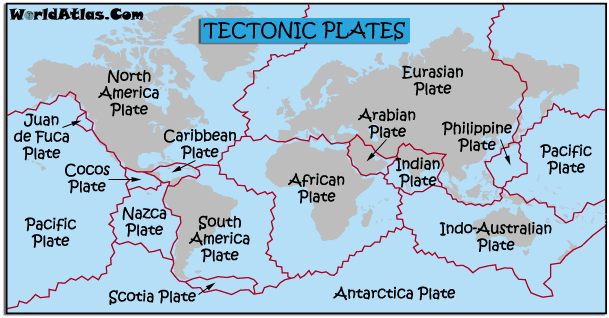
tectonic plates.
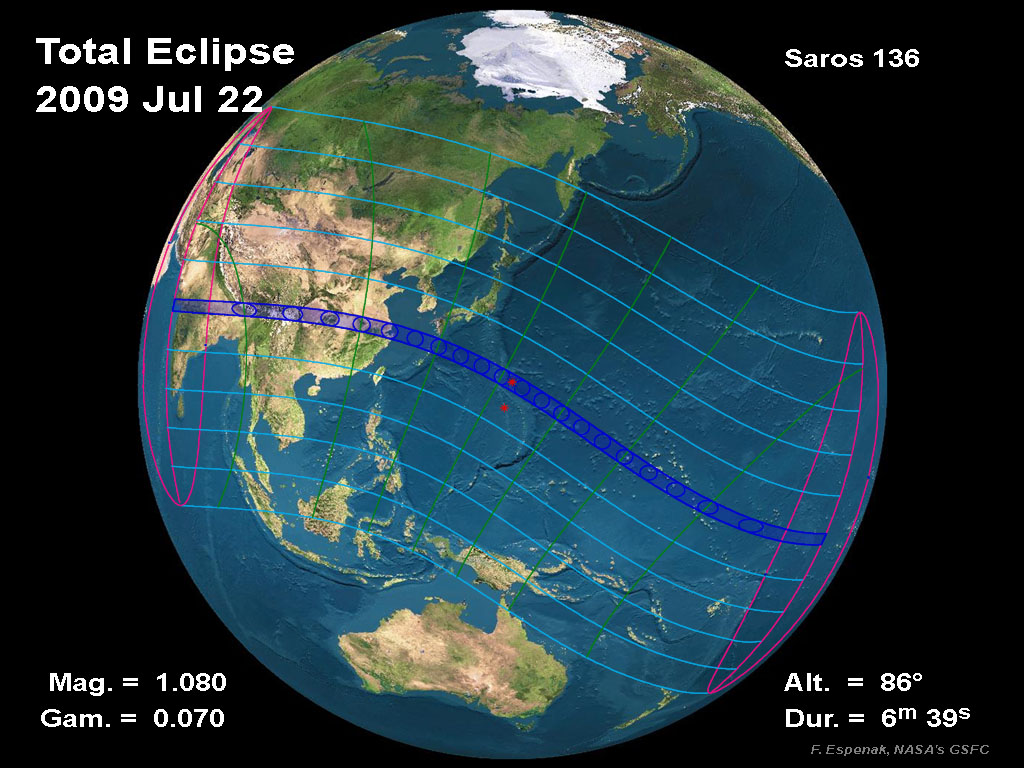
 APOD: 2019 January 30 - Wide Field View of Great American Eclipse
Explanation:
Only in the fleeting darkness of a total solar eclipse is the
light of the solar corona easily visible.
Normally overwhelmed by the bright solar disk, the
expansive corona, the
sun's outer atmosphere,
is an alluring sight.
But the subtle details and
extreme ranges in the corona's brightness, although discernible to the eye, are notoriously difficult to photograph.
Pictured here,
however, using over 120 images and meticulous digital processing,
is a detailed wide-angle image of the Sun's corona taken during the
Great American Eclipse in 2017 August.
Clearly visible are
intricate layers and glowing caustics of an ever
changing mixture of hot gas and
magnetic fields.
Hundreds of stars as faint as 11th
magnitude are visible behind the Moon and Sun, with
Mars appearing in red on the far right.
The
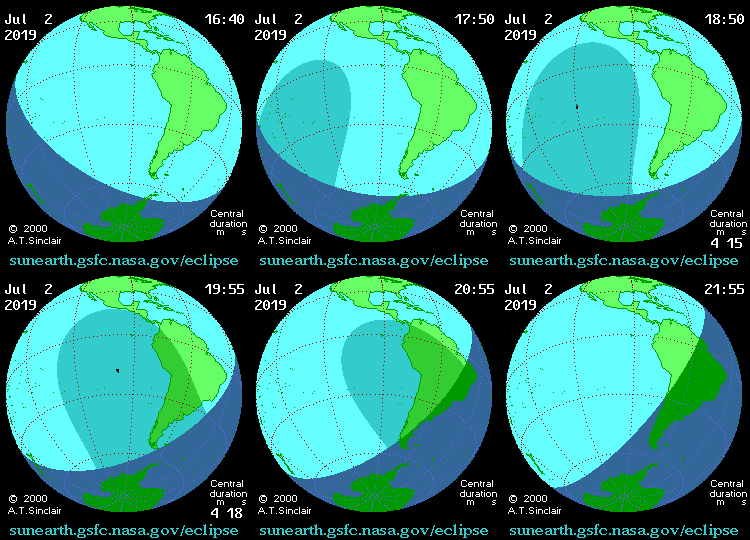
next total eclipse of the Sun will occur on July 2 and
be visible during sunset from a thin swath across
Chile and
Argentina.
 APOD: 2018 December 27 - The Great Carina Nebula
Explanation:
A jewel of the southern sky, the
Great
Carina Nebula, also known as NGC 3372, spans over 300 light-years,
one of our galaxy's largest star forming
regions.
Like the smaller, more northerly
Great Orion Nebula, the
Carina Nebula is easily visible to the
unaided eye, though at a distance of 7,500
light-years it is some 5 times farther away.
This
gorgeous telescopic close-up
reveals remarkable details of the region's central glowing filaments of
interstellar gas
and obscuring cosmic dust clouds.
The field of view is over 50 light-years across.
The Carina Nebula is home to young, extremely massive stars, including
the stars of open cluster
Trumpler 14
(above and left of center) and the still enigmatic variable
Eta Carinae, a
star with well over 100 times the mass of the Sun.
Eta Carinae
is the brightest star, centered here just below
the dusty Keyhole Nebula (NGC 3324).
While Eta Carinae itself maybe on the verge of a supernova explosion,
X-ray images indicate that the Great Carina Nebula
has been a veritable
supernova
factory.
 APOD: 2018 May 20 - In the Heart of the Tarantula Nebula
Explanation:
In the heart of monstrous
Tarantula Nebula lies huge bubbles of energetic gas,
long filaments of dark dust, and unusually massive stars.
In the center of this heart, is a
knot of stars so dense that it was once thought to be a single star.
This star cluster, labeled as
R136 or NGC 2070,
is visible just above the center of the
featured image and home to a great number of hot young stars.
The energetic light from these stars continually ionizes nebula gas,
while their energetic particle wind blows
bubbles and defines intricate filaments.
The
representative-color picture, a digital synthesis of images from the
NASA/ESA orbiting
Hubble Space Telescope and
ESO's ground-based
New Technology Telescope, shows great details of the
LMC nebula's tumultuous center.
The Tarantula Nebula, also known as the
30 Doradus nebula, is one of the
largest
star-formation regions known, and has been creating
unusually strong episodes of
star formation every few million years.
 APOD: 2018 April 30 - Total Solar Eclipse Corona in HDR
Explanation:
How great was the
Great American Eclipse?
The featured HDR image shows it to be perhaps greater than we knew.
On August 21 of last year, the
Moon
blocked the
Sun
for a few minutes along a
narrow path across the USA.
Although one of the most photographed
events in human history,
this image -- only recently completed after an
extraordinary amount of digital processing -- shows one of the most
detailed depictions of a solar corona ever taken.
Composed of
extremely hot gas,
the solar corona is only visible to the unaided eye during a total solar eclipse.
The featured image combined over 70 images of different time exposures.
The series of complementary
HDR images recovered enough detail to see
motion of the solar corona.
The images were taken in Unity,
Oregon in the morning to get steady atmospheric seeing conditions.
The next total solar eclipse visible on Earth will be in 2019 July, while the next one visible across North America and the USA will occur in
2024 April.
 APOD: 2018 April 25 - Hubble's Jupiter and the Shrinking Great Red Spot
Explanation:
What will become of Jupiter's Great Red Spot?
Gas giant
Jupiter is the solar system's
largest world with about 320 times the mass
of planet Earth.
Jupiter is home to one of the largest and longest lasting storm systems known,
the Great
Red Spot (GRS), visible to the left.
The GRS is so large it could swallow Earth, although it has been shrinking.
Comparison with historical notes indicate that
the storm
spans only about one third of the surface area it had 150 years ago.
NASA's
Outer Planets Atmospheres Legacy (OPAL) program has been monitoring the storm more recently using the
Hubble Space Telescope.
The featured Hubble OPAL image shows
Jupiter as it appeared in 2016,
processed in a way that makes red hues appear quite vibrant.
Modern GRS data indicate that the storm continues to constrict its surface area, but is also becoming
slightly taller, vertically.
No one knows the future of the
GRS, including the possibility that if the shrinking trend continues, the GRS might one day even do what
smaller spots on Jupiter have done --
disappear completely.
 APOD: 2018 February 21 - Jupiter in Infrared from Hubble
Explanation:
Jupiter looks a bit different in infrared light.
To better understand
Jupiter's cloud motions and to help NASA's robotic
Juno spacecraft understand the
planetary context of the small fields that it sees, the
Hubble Space Telescope is being directed to
regularly image the entire Jovian giant.
The colors of Jupiter
being monitored go beyond the normal human visual range to include both
ultraviolet and
infrared light.
Featured here in 2016, three bands of near-infrared light have been digitally reassigned into a mapped color image.
Jupiter appears
different in infrared
partly because the amount of sunlight reflected back is distinct,
giving differing cloud heights and latitudes discrepant brightnesses.
Nevertheless, many familiar features on
Jupiter remain, including the
light zones and dark belts that circle the planet near the equator, the
Great Red Spot on the lower left, and the
string-of-pearls storm systems south of the Great Red Spot.
The poles glow because high altitude haze there is energized by charged
particles from Jupiter's
magnetosphere.
Juno has now completed
10 of 12 planned science orbits of Jupiter and continues to record data that are helping humanity to
understand not only Jupiter's weather but
what lies beneath Jupiter's thick clouds.
 APOD: 2018 February 9 - Total Solar Lunar Eclipse
Explanation:
This digitally processed and composited picture
creatively compares two famous eclipses in one;
the total lunar eclipse (left)
of January 31,
and the total solar eclipse
of August 21,
2017.
The Moon appears near mid-totality in both the back-to-back total eclipses.
In
the lunar eclipse, its surface remains faintly illuminated in Earth's
dark reddened shadow.
But in the solar eclipse the Moon is in silhouette
against the Sun's bright disk, where
the otherwise dark lunar surface is just visible due to
earthshine.
Also seen in the lunar-aligned image pair
are faint stars in the night sky surrounding the eclipsed Moon.
Stunning details of prominences and coronal streamers surround
the eclipsed Sun.
The total phase of the Great American Eclipse of August 21 lasted
about 2 minutes
or less for locations along the Moon's shadow path.
From planet Earth's night side, totality for the Super Blue Blood Moon
of January 31 lasted
well over an hour.
 APOD: 2017 December 14 - Jupiter Diving
Explanation:
Take this simulated plunge
and dive into the upper atmosphere of Jupiter, the
Solar System's ruling gas giant.
The awesome
animation is based on image data from
JunoCam, and the microwave radiometer on board the
Jupiter-orbiting Juno spacecraft.
Your view will start about 3,000 kilometers above
the southern Jovian cloud tops, but you can track your progress
on the display at the left.
As altitude decreases, temperature increases while you
dive deeper at the location of Jupiter's famous Great Red Spot.
In fact, Juno
data indicates the Great Red Spot, the Solar System's
largest storm system,
penetrates some 300 kilometers into the giant planet's atmosphere.
For comparison, the deepest point for planet Earth's oceans
is just under 11 kilometers down.
Don't panic though, you'll
fly
back out again.
 APOD: 2017 November 29 - M42: The Great Orion Nebula
Explanation:
Few astronomical sights excite the imagination like the
nearby stellar nursery known as the Orion Nebula.
The Nebula's glowing gas
surrounds hot young stars at the edge of an immense interstellar
molecular cloud.
Many of the filamentary structures visible in the
featured image are actually
shock waves -
fronts where fast moving material encounters slow moving gas.
The Orion Nebula spans about 40
light years
and is located about 1500 light years away in the
same spiral arm
of our Galaxy as the
Sun.
The Great Nebula in
Orion can be found with the
unaided eye just below and to the left of the easily identifiable
belt of three stars in the popular
constellation Orion.
The featured image,
taken last month, shows a two-hour exposure of the nebula in three colors.
The whole Orion Nebula cloud complex,
which includes the
Horsehead Nebula,
will slowly disperse over the next 100,000 years.
 APOD: 2017 September 8 - The Great Gig in the Sky
Explanation:
There were
no crowds on the beach
at Phillips Lake, Oregon on August 21.
But a few had come there to stand, for a moment, in the
dark shadow of the Moon.
From the beach, this unscripted mosaic photo records their much anticipated
solar eclipse.
In two vertical panels it catches
the last few seconds of totality and the first instant of 3rd contact,
just as the eclipse ends and sunlight faintly returns.
Across the US those gathered
along the path of totality also took pictures
and shared their moment.
And like those at Phillips Lake they may
treasure the experience more
than any planned or unplanned photograph of the total eclipse of the Sun.
 APOD: 2017 September 5 - Europa and Jupiter from Voyager 1
Explanation:
What are those spots on Jupiter?
Largest and furthest, just right of center, is the
Great Red Spot --
a huge
storm system that has been raging on
Jupiter
possibly since
Giovanni Cassini's likely notation of it
352 years ago.
It is not yet known why this
Great Spot is red.
The spot toward the lower left is one of Jupiter's largest moons:
Europa.
Images from Voyager
in 1979 bolster the modern hypothesis that
Europa has an underground ocean and is therefore a
good place to look for extraterrestrial life.
But what about the dark spot on the upper right?
That is a shadow of another of Jupiter's large moons:
Io.
Voyager 1 discovered
Io to be so volcanic that no
impact craters could be found.
Sixteen frames from
Voyager
1's flyby of Jupiter in 1979 were recently reprocessed and merged to create the
featured image.
Forty years ago today,
Voyager
1 launched from Earth and started one of the
greatest explorations of the
Solar System ever.
 APOD: 2017 September 1 - A First Glimpse of the Great American Eclipse
Explanation:
Making landfall in Oregon, the
Moon's
dark umbral shadow toured the United States on August 21.
Those gathered along its coast to coast path were
witness
to a total eclipse of the Sun, possibly the most
widely shared celestial
event in history.
But first, the Moon's shadow touched the northern Pacific and
raced eastward toward land.
This dramatic snapshot was
taken
while crossing the shadow path 250 miles off the Oregon
coast, 45,000 feet above the cloudy northern Pacific.
Though from a shorter totality, it captures the eclipse
before it could be seen from the US mainland.
With the eclipsed Sun not far above, beautiful colors appear along the
eastern horizon giving way to a clear, pitch-black, stratospheric sky
in the shadow of the Moon.
 APOD: 2017 July 15 - Close up of the Great Red Spot
Explanation:
On July 11,
the Juno spacecraft once again swung near to
Jupiter's turbulent cloud tops in its looping 53 day orbit around
the Solar System's ruling gas giant.
About 11 minutes after perijove 7,
its closest approach on this orbit,
it passed directly
above Jupiter's Great Red Spot.
During the much anticipated fly over, it captured
this
close-up image data from a distance of less than 10,000 kilometers.
The
raw JunoCam data was subsequently processed by
citizen scientists.
Very
long-lived but found to be shrinking, the Solar System's
largest
storm system was measure to be 16,350 kilometers wide on
April 15.
That's about 1.3 times the diameter of planet Earth.
 APOD: 2017 July 3 - The Summer Triangle over the Great Wall
Explanation:
Have you ever seen the
Summer Triangle?
The bright stars
Vega,
Deneb, and
Altair form a large triangle on the sky
that can be seen rising in the northern spring during the morning, and
rising in the northern fall during the evening.
During summer months, the
triangle can be found nearly overhead near midnight as three of
the brightest stars on the sky.
Featured here, along with the arch of the central band of our
Milky Way Galaxy, the
Summer Triangle
asterism was captured this spring
over the Great Wall of China.
This part of the Great Wall,
a World Culture Heritage Site,
was built during the
6th century on the
Yan Mountains.
At the summit is
Wangjinglou Tower
from which, on a clear night, the lights of
Beijing
are visible in the distance.
 APOD: 2017 June 13 - The Great Nebula in Carina
Explanation:
In one of the brightest parts of
Milky Way lies a nebula where some of the oddest things occur.
NGC 3372, known as the
Great Nebula in Carina,
is home to massive stars and changing nebulas.
The Keyhole Nebula (NGC 3324),
the bright structure just to the right of the image center,
houses several of these massive stars and has itself
changed its appearance.
The entire Carina Nebula,
captured here, spans over 300 light years and lies about 7,500 light-years away in the
constellation of Carina.
Eta Carinae, the
most energetic star
in the nebula,
was one of the brightest stars in the sky in the 1830s, but
then faded dramatically.
While Eta Carinae itself maybe on the verge of a supernova explosion,
X-ray
images indicate that much of the
Great Nebula in Carina has been a veritable
supernova
factory.
 APOD: 2017 May 23 - Approaching Jupiter
Explanation:
What would it look like to approach Jupiter?
To help answer this, a team of 91 amateur
astrophotographers took over 1,000 pictures
of Jupiter from the Earth with the resulting images aligned and digitally merged into the featured time-lapse video.
Image taking began in 2014 December and lasted just over three months.
The resulting fictitious approach sequence has similarities to what was seen by NASA's robotic
Juno spacecraft as it
first approached the
Jovian world last July.
The video
begins with Jupiter appearing as a small orb near the image center.
As Jupiter nears from below, the planet looms ever larger while the
rotation of its cloud bands
becomes apparent.
Jupiter's
shrinking Great Red Spot rotates into view twice, at times showing
unusual
activity.
Many white ovals are visible moving around the giant planet.
The video ends as the imaginary spacecraft passes over Jupiter's North Pole.
 APOD: 2017 May 12 - M13: The Great Globular Cluster in Hercules
Explanation:
In
1716, English astronomer
Edmond Halley noted,
"This is but a little Patch, but it shews itself to the naked Eye, when
the Sky is serene and the Moon absent."
Of course, M13
is now less modestly recognized as the Great Globular Cluster in Hercules,
one of the brightest
globular
star clusters in the northern sky.
Telescopic views reveal the
spectacular cluster's hundreds of thousands
of stars.
At a distance of 25,000 light-years, the
cluster stars
crowd into a region 150 light-years in diameter.
Approaching the cluster core
upwards of 100 stars could be contained
in a cube just 3 light-years on a side.
For comparison, the
closest star to the Sun is over
4 light-years away.
Along with the cluster's dense core, the outer reaches of M13
are highlighted in this
sharp color image.
The cluster's evolved red and blue
giant stars show up in yellowish and blue tints.
 APOD: 2017 March 8 - Dust, Gas, and Stars in the Orion Nebula
Explanation:
The Great Nebula in Orion,
an immense, nearby
starbirth region,
is probably the most famous of all
astronomical nebulas.
Here, filaments of dark dust and glowing gas
surround hot young stars at the edge of an
immense interstellar
molecular cloud only 1500
light-years away.
In the featured deep image shown in assigned colors,
part of the nebula's center is shown as taken by the
Hubble Space Telescope.
The Great Nebula in Orion can be found with the
unaided eye near the
easily identifiable
belt of three stars in the popular constellation
Orion.
In addition to housing a bright
open cluster of stars known as the
Trapezium, the
Orion Nebula contains many
stellar nurseries.
These nurseries contain much
hydrogen gas, hot young stars,
proplyds, and
stellar jets
spewing material at high speeds.
Also known as
M42 and
M43, the
Orion Nebula spans about 40
light years and is located in the same
spiral arm of
our Galaxy as the
Sun.
 APOD: 2017 February 28 - A White Oval Cloud on Jupiter from Juno
Explanation:
This storm cloud on Jupiter is almost as large as the Earth.
Known as a
white oval,
the swirling cloud is a high pressure system equivalent to an
Earthly anticyclone.
The cloud is one of a
"string of pearls" ovals south of
Jupiter's famous
Great Red Spot.
Possibly, the Great Red Spot is just a really large
white oval that
turned red.
Surrounding clouds show interesting
turbulence as they
flow
around and
past the oval.
The featured image
was captured on February 2 as NASA's robotic
spacecraft Juno made a new pass just above the cloud tops of the
Jovian world.
Over the next few years, Juno will continue to orbit and
probe Jupiter,
determine atmospheric water abundance, and attempt to determine if
Jupiter has a solid surface beneath its thick clouds.
 APOD: 2017 February 5 - Odysseus Crater on Tethys
Explanation:
Some moons wouldn't survive the collision.
Tethys, one of
Saturn's larger moons
at about 1000 kilometers in diameter, survived the collision,
but today exhibits the resulting expansive impact crater Odysseus.
Sometimes called the Great Basin,
Odysseus
occurs on the leading hemisphere of
Tethys
and shows its great age by the relative amount of smaller craters that occur inside its
towering walls.
The density of Tethys is similar to
water-ice.
The featured image was captured in November by the
robotic Cassini spacecraft
in orbit around Saturn as it swooped past the giant ice ball.
Cassini has now started on its
Grand Finale Tour
which will take it inside Saturn's rings and
culminate in September with a dive into Saturn's thick atmosphere.
 APOD: 2016 November 10 - Great Rift Near the Center of the Milky Way
Explanation:
Over 100 telescopic image
panels in this stunning vertical mosaic span
about 50 degrees
across
the night sky.
They follow part of the
Great Rift, the
dark river
of dust and molecular gas that stretches
along the plane of our Milky Way Galaxy.
Start at top center and you can follow the
galactic
equator down through brighter stars in constellations Aquila,
Serpens Cauda, and Scutum.
At the bottom is Sagittarius near the center of the Milky Way.
Along the way you'll encounter many obscuring
dark
nebulae hundreds of light-years distant flanked by bands of
Milky Way starlight, and the telltale reddish glow of starforming regions.
Notable Messier objects
include The Eagle (M16) and Omega (M17)
nebulae, the Sagittarius Star Cloud (M24), the beautiful Trifid (M20)
and the deep Lagoon (M8).
 APOD: 2016 August 30 - Aurora over Icelandic Fault
Explanation:
Admire the beauty but fear the beast.
The beauty is the
aurora overhead,
here taking the form of great green
spiral, seen between picturesque clouds with
the bright Moon to the side and stars in the background.
The beast is the wave of charged particles that creates the
aurora but might, one day, impair civilization.
Exactly this week in 1859,
following notable auroras seen all across the globe,
a pulse of charged particles from a
coronal mass ejection (CME) associated with a
solar flare
impacted Earth's
magnetosphere
so forcefully that they created the
Carrington Event.
A relatively direct path between
the Sun and the Earth might have been cleared by a preceding
CME.
What is sure is that the Carrington Event compressed the
Earth's magnetic field so violently that
currents were created in telegraph wires so great that many wires sparked and gave
telegraph operators shocks.
Were a
Carrington-class event to impact the Earth today, speculation holds that
damage might occur
to global power grids and electronics on a scale never yet experienced.
The featured aurora was imaged last week over
Thingvallavatn Lake in
Iceland,
a lake that partly fills a fault that
divides
Earth's large Eurasian and North American
tectonic plates.
 APOD: 2016 July 27 - M13: A Great Globular Cluster of Stars
Explanation:
M13
is one of the most prominent and best known
globular clusters.
Visible with binoculars in the constellation of Hercules, M13 is frequently one of the first objects found by
curious sky gazers seeking
celestials wonders
beyond
normal human vision.
M13 is a colossal home to over 100,000 stars, spans over 150
light years across,
lies over 20,000 light years distant, and is over 12 billion years old.
At the 1974 dedication of
Arecibo Observatory, a
radio message
about Earth was sent in the direction of
M13.
The featured image
in HDR,
taken through a small telescope, spans an angular size just larger than a full Moon,
whereas the
inset image,
taken by
Hubble Space Telescope, zooms in on the central 0.04 degrees.
 APOD: 2016 May 27 - The Great Carina Nebula
Explanation:
A jewel of the southern sky, the
Great
Carina Nebula, also known as NGC 3372, spans over 300 light-years,
one of our galaxy's largest star forming
regions.
Like the smaller, more northerly
Great Orion Nebula, the
Carina Nebula is easily visible to the
unaided eye, though at a distance of 7,500
light-years it is some 5 times farther away.
This
gorgeous telescopic close-up
reveals remarkable details of the region's central glowing filaments of
interstellar gas
and obscuring cosmic dust clouds.
The field of view is over 50 light-years across.
The Carina Nebula is home to young, extremely massive stars, including
the stars of open cluster
Trumpler 14
(below and right of center) and the still enigmatic variable
Eta Carinae, a
star with well over 100 times the mass of the Sun.
Eta Carinae is the brightest star, seen here
just above
the dusty Keyhole Nebula (NGC 3324).
While Eta Carinae itself maybe on the verge of a supernova explosion,
X-ray images indicate that the Great Carina Nebula
has been a veritable
supernova
factory.
 APOD: 2016 May 22 - LL Orionis: When Cosmic Winds Collide
Explanation:
What created this great arc in space?
This arcing, graceful structure is actually a
bow shock
about half a light-year across, created as the wind from young star LL Orionis
collides with the
Orion Nebula flow.
Adrift in Orion's
stellar nursery
and still in its formative years, variable star
LL Orionis produces a wind more energetic than
the wind from our own
middle-aged sun.
As the fast stellar wind runs into slow moving gas a shock front is
formed, analogous to the
bow
wave of a
boat moving through water or a plane traveling at
supersonic speed.
The slower gas is flowing away from the
Orion Nebula's hot central star cluster, the
Trapezium, located off the lower right hand edge
of the picture.
In three dimensions,
LL Ori's wrap-around shock front is shaped like a
bowl that appears brightest when viewed along the "bottom" edge.
The complex stellar nursery in Orion shows a myriad of similar
fluid
shapes associated with
star formation, including
the bow shock surrounding a faint star at the upper right.
Part of
a mosaic
covering the Great Nebula in Orion,
this composite color image was recorded
in 1995 by the Hubble Space Telescope.
 APOD: 2016 April 17 - Asperatus Clouds Over New Zealand
Explanation:
What kind of clouds are these?
Although their cause is presently unknown, such unusual atmospheric structures,
as menacing as they might seem, do not appear to be harbingers of
meteorological doom.
Known informally as
Undulatus asperatus clouds,
they can be stunning in appearance, unusual in occurrence, are relatively unstudied,
and have even been suggested as a new
type of cloud.
Whereas most low cloud decks are
flat bottomed,
asperatus clouds appear to have significant vertical structure underneath.
Speculation therefore holds that
asperatus clouds might be related to
lenticular clouds that form near mountains,
or mammatus clouds associated with thunderstorms,
or perhaps a foehn wind --
a type of dry downward wind that flows off mountains.
Such a wind
called the
Canterbury arch
streams toward the east coast of New Zealand's
South Island.
The featured image,
taken above
Hanmer Springs in
Canterbury,
New Zealand, in 2005,
shows great detail partly because sunlight illuminates the undulating clouds from the side.
 APOD: 2016 March 23 - The Great Nebula in Carina
Explanation:
In one of the brightest parts of
Milky Way lies a nebula where some of the oddest things occur.
NGC 3372, known as the
Great Nebula in Carina,
is home to massive stars and changing nebulas.
The Keyhole Nebula (NGC 3324),
the bright structure just above the image center,
houses several of these massive stars and has itself
changed its appearance.
The entire Carina Nebula
spans over 300 light years and lies about 7,500 light-years away in the
constellation of Carina.
Eta Carinae, the
most energetic star
in the nebula,
was one of the brightest stars in the sky in the 1830s, but
then faded dramatically.
Eta
Carinae is the brightest star
near the
image center,
just left of the Keyhole Nebula.
While Eta Carinae itself maybe on the verge of a supernova explosion,
X-ray
images indicate that much of the Great Carina Nebula has been a veritable
supernova
factory.
 APOD: 2015 November 8 - A Quadruple Sky Over Great Salt Lake
Explanation:
This was a sky to show the kids.
All in all, three children, three planets, the Moon, a star, an airplane and a mom were all captured in one image near
Great Salt Lake in
Utah,
USA in early September of 2005.
Minus the airplane and the quadruple on the ground, this busy
quadruple coincidence sky was visible last week all over the world.
The easiest object to spot is the crescent
Moon, which is easily the brightest sky orb in the
featured image.
Venus is the highest planet in the sky, with
Jupiter to its right.
The bright star
Spica
completes the quadruple just below
Venus.
The streak on the far right is an
airplane.
Mom is seated.
Grandpa, appreciating the beauty of the moment, took the picture.
This week, the
pre-dawn sky shows a
similar conjunction of planets.
 APOD: 2015 November 4 - The Great Orion Nebula M42
Explanation:
The Great Nebula
in Orion, also known as M42, is one of the
most famous nebulae in the sky.
The star forming region's glowing gas clouds and hot young stars
are on the right in this sharp and colorful image that includes the bluish reflection nebulae
NGC 1977 and friends on the left.
Located at the edge of an otherwise invisible
giant molecular
cloud complex,
these eye-catching nebulas represent only a small
fraction of this galactic neighborhood's wealth of
interstellar material.
Within the
well-studied
stellar nursery, astronomers have also
identified
what appear to be numerous infant planetary systems.
The gorgeous skyscape spans nearly two degrees or about 45
light-years
at the Orion Nebula's estimated distance of 1,500 light-years.
 APOD: 2015 October 24 - Jupiter in 2015
Explanation:
Two
remarkable global maps
of Jupiter's banded cloud tops
can be compared by just sliding your cursor
over this sharp projection
(or follow this link) of image data from the Hubble Space Telescope.
Both captured on January 19, during
back-to-back 10 hour rotations of the ruling gas giant, the
all-planet projections represent the first in
a series of planned annual portraits by the
Outer
Planet Atmospheres Legacy program.
Comparing the two highlights cloud movements and
measures wind speeds in the planet's
dynamic atmosphere.
In fact,
the Great Red Spot,
the famous long-lived
swirling storm boasting
300 mile per hour winds, is seen sporting a rotating, twisting filament.
The images confirm that Great Red Spot is
still
shrinking, though still larger than planet Earth.
Posing next to it (lower right)
is Oval BA, also known as
Red Spot Junior.
 APOD: 2015 July 10 - Messier 43
Explanation:
Often imaged
but rarely mentioned,
Messier 43
is a large star forming region in its own right.
It's just part of the star forming complex of gas and dust that
includes the larger, more famous neighboring Messier 42,
the Great Orion Nebula.
In fact,
the Great Orion Nebula itself lies off the lower edge of
this scene.
The close-up of Messier 43 was made while testing the
capabilities of a near-infrared instrument with one of the twin
6.5 meter Magellan telescopes
at Las Campanas Observatory in the Chilean Andes.
The composite image shifts the otherwise invisible infrared wavelengths
to blue, green, and red colors.
Peering into
caverns of interstellar dust hidden from
visible light, the near-infrared view can also be used
to study cool, brown dwarf stars in the complex region.
Along with its
celebrity neighbor, Messier 43 lies about
1,500 light-years away, at the edge of Orion's giant molecular cloud.
At that distance, this field of view spans about 5 light-years.
 APOD: 2015 May 15 - Jupiter, Ganymede, Great Red Spot
Explanation:
In this sharp snapshot,
the Solar System's
largest moon Ganymede poses next to Jupiter,
the largest planet.
Captured on March 10 with a small telescope from
our fair planet Earth, the scene also includes Jupiter's
Great Red Spot, the Solar System's largest storm.
In fact,
Ganymede is about 5,260 kilometers in diameter.
That beats out
all three of its other fellow Galilean
satellites,
along with
Saturn's Moon Titan at 5,150 kilometers and Earth's own Moon at
3,480 kilometers.
Though its been
shrinking
lately, the Great Red Spot's diameter is
still around 16,500 kilometers.
Jupiter, the Solar System's ruling gas giant, is about
143,000 kilometers in
diameter
at its equator.
That's nearly 10 percent the diameter of the Sun.
 APOD: 2015 April 18 - The Great Crater Hokusai
Explanation:
One of the largest young craters on Mercury,
114 kilometer (71 mile) diameter Hokusai crater's bright
rays are known to extend across
much of the planet.
But this mosaic of oblique views focuses on Hokusai close up,
its sunlit
central peaks, terraced
crater walls, and
frozen sea of impact melt on the
crater's floor.
The images were captured by the MESSENGER spacecraft.
The first to orbit Mercury,
since 2011 MESSENGER has conducted
scientific explorations, including
extensive imaging of the
Solar System's innermost planet.
Now running out of propellant and unable to counter orbital
perturbations caused by the Sun's gravity,
MESSENGER is predicted to
impact
the surface of Mercury on April 30.
 APOD: 2015 March 13 - The Great Wall by Moonlight
Explanation:
Last Friday, an almost
Full Moon rose as the Sun set,
over this mountainous landscape north of Beijing, China.
Also near apogee,
the farthest point in its elliptical orbit around
planet Earth, it was this year's smallest and faintest Full Moon.
The Jiankou section of the
Great Wall
of China meanders through the
scene, the ancient Great Wall itself the subject of an
older-than-the-space-age myth
that it would be visible to the eye when
standing on the lunar surface.
But
even from low Earth orbit,
the large scale artifact of human
civilization is very difficult to identify.
At its farthest from our fair planet, the Moon shines brightly
in the twilight sky though, posing in the faint, pinkish band known as
the antitwilight arch or the belt of Venus.
 APOD: 2014 May 18 - Jupiters Great Red Spot from Voyager 1
Explanation:
What will become of Jupiter's Great Red Spot?
Recorded as shrinking since the 1930s, the rate of the
Great Red Spot's size appears to have accelerated just in the past few years.
A hurricane larger than Earth, the
Great Red Spot has been
raging
at least as long as telescopes could see it.
Like most astronomical phenomena, the
Great Red Spot was neither predicted nor immediately understood after its discovery.
Although small eddies that feed into the
storm system seem to play a role, a more full understanding of the
gigantic storm cloud
remains a topic of continued research, and may result in a
better understanding of weather here on Earth.
The above image
is a digital enhancement of an image of Jupiter taken in 1979 by the
Voyager 1 spacecraft as it zoomed by the Solar System's largest planet.
NASA's
Juno spacecraft
is currently heading
toward Jupiter
and will arrive in 2016.
 APOD: 2014 May 17 - Hubble's Jupiter and Shrinking Great Red Spot
Explanation:
Gas
giant Jupiter is the solar system's
largest world with about 320 times the mass
of planet Earth.
It's also known for a giant swirling storm system,
the Great
Red Spot, featured in this
sharp Hubble image from April 21.
Nestled between Jupiter-girdling cloud bands, the Great Red Spot
itself could still easily swallow Earth, but lately it has
been shrinking.
The
most recent Hubble observations measure the spot to be
about 10,250 miles (16,500 kilometers) across.
That's the smallest ever measured by Hubble
and particularly dramatic when compared to 14,500 miles measured by
the Voyager 1
and 2 flybys in 1979, and historic telescopic observations
from the 1800s indicating a width of about 25,500 miles on its long
axis.
Current indications are that the rate of shrinking is increasing for the
long-lived Great Red Spot.
 APOD: 2014 April 8 - M42: Inside the Orion Nebula
Explanation:
The Great Nebula in Orion,
an immense, nearby
starbirth region,
is probably the most famous of all
astronomical nebulas.
Here, glowing gas surrounds hot young stars at the edge of an
immense interstellar
molecular cloud only 1500
light-years away.
In the above deep image composite in assigned colors taken by the
Hubble Space Telescope
wisps and sheets of dust and gas are particularly evident.
The Great Nebula in Orion can be found with the
unaided eye near the
easily identifiable
belt of three stars in the popular constellation
Orion.
In addition to housing a bright
open cluster of stars known as the
Trapezium, the
Orion Nebula contains many
stellar nurseries.
These nurseries contain much
hydrogen gas, hot young stars,
proplyds, and
stellar jets
spewing material at high speeds.
Also known as
M42, the
Orion Nebula spans about 40 light years and is located in the same
spiral arm of
our Galaxy as the
Sun.
 APOD: 2014 March 26 - M78 and Reflecting Dust Clouds
Explanation:
An eerie blue glow and ominous columns of
dark dust highlight M78 and other bright
reflection nebula
in the constellation of Orion.
The dark filamentary
dust not only absorbs light, but also reflects the
light of several bright blue stars that
formed recently in the nebula.
Of the two reflection nebulas
pictured above, the more famous nebula is
M78, in the image center, while
NGC 2071 can be seen to its lower left.
The same type of scattering that colors the
daytime sky further enhances the blue color.
M78 is about five
light-years across and visible through a small telescope.
M78 appears above only as it was
1600 years ago,
however, because that is how long it takes light to go from
there to here.
M78
belongs to the larger
Orion
Molecular
Cloud
Complex
that contains the
Great Nebula in Orion and the
Horsehead Nebula.
 APOD: 2014 February 20 - Comet Lovejoy over The Great Wall
Explanation:
Fading now as it returns to the outer solar system
Comet Lovejoy
(C/2013 R1) still graces planet Earth's sky,
a delicate apparition in
binoculars
or small telescopes.
The comet, a relic
of the solar system's
formative years, is seen here rising in the morning twilight on January 12
among the stars of
Ophiuchus,
the Serpent Bearer.
Posing near the comet is bright star Alpha Ophiuchi, also
known
as Rasalhague, from Arabic "the head of the serpent collector".
Of course, the serpentine shape below is the ancient
Great Wall of China,
along the
Panlongshan
section northeast of Beijing.
Panlongshan is translated as "a coiled dragon".
A moving and fortuitous scene, it was captured with a digital camera and
telephoto lens in two consecutive exposures.
The exposures were merged to show a natural looking foreground
and twilight sky.
 APOD: 2013 October 28 - The Great Comet of 1680 Over Rotterdam
Explanation:
Was there ever another comet like ISON?
Although no two comets are exactly alike,
one that appears to have had notable similarities was Comet Kirch, the
Great Comet of 1680.
Like approaching
Comet ISON,
Comet Kirch was a bright
sungrazer,
making a very
close approach
to the surface of the Sun.
Neither comet, coincidently, is a member of the most common group of
sungrazers -- the
Kreutz group --
populated by remnants of a comet that
disintegrated near the Sun hundreds of years ago.
The long tail of Comet Kirch is depicted in the above painting by
Lieve Versheier.
As pictured, some members of the foreground crowd of
Rotterdam in
the Netherlands are holding
cross-staffs,
an angle measuring device that predated the
sextant.
No one knows how
Comet ISON
will develop, but like Comet Kirch, it is expected to be
brightest when very near the Sun, in
ISON's case
during last few days of November.
 APOD: 2013 October 20 - Three Galaxies and a Comet
Explanation:
Diffuse starlight and dark nebulae
along the southern
Milky Way
arc over the
horizon and sprawl diagonally through this
gorgeous nightscape.
The breath-taking mosaic spans a wide
100 degrees, with the rugged
terrain
of the Patagonia, Argentina region in the foreground.
Along with the insider's view of our own galaxy, the image
features our outside perspective on two irregular satellite galaxies -
the Large and
Small Magellanic Clouds.
The scene also captures the
broad tail
and bright coma of Comet McNaught, the
Great Comet of 2007.
Currently, many
sky
enthusiasts are following the development of
Comet ISON, a comet which might become the
Great Comet of 2013.
 APOD: 2013 October 15 - The Great Carina Nebula
Explanation:
A jewel of the southern sky,
the Great
Carina Nebula, also known as NGC 3372, spans over 300 light-years,
one of our galaxy's largest star forming
regions.
Like the smaller, more northerly
Great Orion Nebula, the
Carina Nebula is easily visible to the
unaided eye, though at a distance of 7,500
light-years it is some 5 times farther away.
This
gorgeous telescopic portrait
reveals remarkable details of the region's glowing filaments of
interstellar gas
and obscuring cosmic dust clouds.
Wider than the Full Moon in
angular size,
the field of view stretches over 300 light-years across the nebula.
The Carina Nebula is home to young, extremely massive stars, including
the still enigmatic variable
Eta Carinae, a
star with well over 100 times the mass of the Sun.
Eta
Carinae is the brightest star
near the
image center,
just left of the dusty
Keyhole Nebula (NGC 3324).
While Eta Carinae itself maybe on the verge of a supernova explosion,
X-ray images indicate that the Great Carina Nebula
has been a veritable
supernova
factory.
 APOD: 2013 October 13 - Hale Bopp: The Great Comet of 1997
Explanation:
Sixteen years ago,
Comet
Hale-Bopp rounded the Sun and offered a dazzling spectacle in planet
Earth's night.
This
stunning view, recorded shortly after the comet's
1997 perihelion passage, features the memorable
tails
of Hale-Bopp -- a whitish dust tail and blue ion tail.
Here, the ion tail extends well over ten degrees across
the northern sky, fading near the double
star clusters
in Perseus, while the head of the comet lies near
Almach,
a bright star in the constellation Andromeda.
Do you remember Hale-Bopp?
The photographer's sons do, pictured in the foreground at
ages 12 and 15.
In all, Hale-Bopp was reported as visible
to the naked eye from roughly late May 1996 through September 1997.
Currently, sky enthusiasts await
Comet ISON's
continued brightening in the coming weeks, unsure how interesting its
first journey to the inner Solar System will be.
 APOD: 2013 March 20 - M42: Inside the Orion Nebula
Explanation:
The Great Nebula in Orion,
an immense, nearby
starbirth region,
is probably the most famous of all
astronomical nebulas.
Here, glowing gas surrounds hot young stars at the edge of an
immense interstellar
molecular cloud only 1500
light-years away.
In the above deep image in
assigned colors highlighted by
emission in
oxygen and
hydrogen,
wisps and sheets of dust and gas are particularly evident.
The Great Nebula in Orion can be found with the
unaided eye near the
easily identifiable
belt of three stars in the popular constellation
Orion.
In addition to housing a bright
open cluster of stars known as the
Trapezium, the
Orion Nebula contains many
stellar nurseries.
These nurseries contain much
hydrogen gas, hot young stars,
proplyds, and
stellar jets
spewing material at high speeds.
Also known as
M42, the
Orion Nebula spans about 40 light years and is located in the same
spiral arm of
our Galaxy as the
Sun.
 APOD: 2013 February 18 - The Great Russian Meteor of 2013
Explanation:
What in heaven's blazes is that?
Thousands of people living near the
Ural Mountains in
Russia saw last Friday morning one of the
more spectacular meteors of modern times streak across the sky.
Forceful sound waves
arrived at the ground minutes later, knocking people over and breaking windows for hundreds of kilometers.
The above video is a compilation of several
car dashcams and includes real time footage of the meteor rampaging,
smoke trails drifting,
shadows quickly shifting, and even the meteor's light reflecting off the back of a bus.
The fireball is thought to have been caused by a
car-sized chunk
of ice and
rock crashing into the Earth's atmosphere.
Since the event was captured from so many angles, the
meteor's trajectory has become determined well enough to indicate from where it came
and to where any resultant pieces might have landed.
It is already certain that this meteor had nothing to do with the several-times larger
asteroid 2012 DA14 which passed the
Earth from a different direction later the same day.
If pieces of the meteor are found,
they might tell
humanity more about the
early Solar System,
when the meteor was likely formed.
 APOD: 2013 February 9 - The Great Meteor Procession of 1913
Explanation:
One hundred years ago today the
Great Meteor Procession of 1913 occurred, a sky event
described by some
as "magnificent" and "entrancing" and which left people feeling "spellbound" and "privileged".
Because one had to be in a right location, outside, and under clear skies, only about 1,000 people noted seeing the
procession.
Lucky sky gazers -- particularly those near
Toronto,
Canada -- had their eyes
drawn to an amazing train of
bright meteors
streaming across the sky,
in groups, over the course of a few minutes.
A current leading progenitor hypothesis is that a single
large meteor once grazed the Earth's atmosphere
and broke up.
When the resulting pieces next encountered the Earth, they came in over
south-central Canada, traveled thousands of kilometers as they crossed over the northeastern USA,
and eventually fell into the central
Atlantic ocean.
Pictured above is a digital scan of a
halftone
hand-tinted image by the artist
Gustav Hahn
who was fortunate enough to witness
the event first hand.
Although nothing quite like the
Great Meteor Procession of 1913
has been reported since, numerous bright fireballs -- themselves
pretty spectacular -- have since been
recorded, some even
on
video.
 APOD: 2012 November 28 - Jupiter and Io
Explanation:
On December 3 (UT), Jupiter,
the
solar system's largest planet, will be at opposition,
opposite the Sun in planet Earth's sky,
shining brightly and rising as the Sun sets.
That
configuration results in Jupiter's almost annual
closest approach to planet Earth.
So, near opposition the gas giant offers earthbound telescopes
stunning views of its stormy, banded atmosphere and large
Galilean moons.
For example, this sharp series was recorded on the night of November
16/17 from the island of Sardinia near Dolianova, Italy.
North is up in the images that show off Jupiter's
famous Great Red Spot, and planet girdling
dark belts and light zones.
Also seen in transit is Jupiter's
volcanic moon Io, its
round, dark shadow tracking across the
Jovian cloud tops
as the sequence progresses left to right.
 APOD: 2012 June 14 - M13: The Great Globular Cluster in Hercules
Explanation:
In
1716, English astronomer
Edmond Halley noted,
"This is but a little Patch, but it shews itself to the naked Eye, when
the Sky is serene and the Moon absent."
Of course, M13
is now modestly recognized as the Great Globular Cluster in Hercules,
one of the brightest
globular
star clusters in the northern sky.
Telescopic views reveal the
spectacular cluster's hundreds of thousands
of stars.
At a distance of 25,000 light-years, the cluster stars
crowd
into a region 150 light-years in diameter, but
approaching the cluster core
upwards of 100 stars could be contained
in a cube just 3 light-years on a side.
For comparison, the
closest star to the Sun is over
4 light-years away.
Along with the cluster's dense core, the outer reaches of M13
are highlighted in this
sharp color image.
The cluster's evolved red and blue
giant stars show up in yellowish and
blue tints.
 APOD: 2012 April 23 - Evaporating Blobs of the Carina Nebula
Explanation:
No, they are not alive -- but they are dying.
The unusual blobs found in the
Carina nebula, some of which are seen floating on the upper right, might best be described as
evaporating.
Energetic light and winds from nearby stars are breaking apart the dark
dust grains that make the iconic forms opaque.
Ironically the blobs, otherwise known as dark
molecular clouds,
frequently create in their midst the very stars that later
destroy them.
The floating space mountains
pictured above by the orbiting
Hubble Space Telescope span a few light months.
The Great Nebula in Carina itself spans about 30 light years, lies about 7,500 light years
away, and can be seen with a small telescope toward the constellation of Keel
(Carina).
 APOD: 2011 September 13 - Great Orion Nebulae
Explanation:
The Great Nebula
in Orion, also known as M42, is one of the
most famous nebulas in the sky.
The star forming region's glowing gas clouds and hot young stars
are on the right in this sharp and colorful image that includes the smaller
nebula M43
near center and dusty, bluish reflection nebulae
NGC 1977 and friends on the left.
Located at the edge of an otherwise invisible
giant molecular
cloud complex,
these eye-catching nebulae represent only a small
fraction of this galactic neighborhood's wealth of
interstellar material.
Within the well-studied stellar nursery, astronomers have also
identified what appear to be numerous
infant planetary systems.
The gorgeous skyscape spans nearly two degrees or about 45
light-years
at the Orion Nebula's estimated distance of 1,500 light-years.
 APOD: 2011 June 9 - The Great Carina Nebula
Explanation:
A jewel of the southern sky,
the Great
Carina Nebula, also known as NGC 3372, spans over 300 light-years,
one of our galaxy's largest star forming regions.
Like the smaller, more northerly
Great Orion Nebula, the
Carina Nebula is easily visible to the
unaided eye, though at a distance of 7,500
light-years it is some 5 times farther away.
This
gorgeous telescopic portrait
reveals remarkable details of the region's glowing filaments of
interstellar gas
and obscuring cosmic dust clouds.
Wider than the Full Moon in
angular size,
the field of view
stretches nearly 100 light-years across the nebula.
The Carina Nebula is home to young, extremely massive stars, including
the still enigmatic variable
Eta Carinae, a
star with well over 100 times the mass of the Sun.
Eta
Carinae is the brightest star
at
the left, near the dusty
Keyhole Nebula (NGC 3324).
While Eta Carinae itself maybe on the verge of a supernova explosion,
X-ray images indicate that the Great Carina Nebula
has been a veritable
supernova factory.
 APOD: 2011 May 2 - Jupiter's Great Red Spot from Voyager 1
Explanation:
It is a hurricane twice the size of the Earth.
It has been
raging at least as long as telescopes could see it, and shows no signs of slowing.
It is
Jupiter's Great Red Spot, the largest swirling storm system in the Solar System.
Like most astronomical phenomena, the
Great Red Spot was neither predicted nor immediately understood after its discovery.
Still today, details of how and why the
Great Red Spot changes its shape, size, and color
remain mysterious.
A better understanding of the weather on Jupiter may help contribute to the better understanding of weather here on Earth.
The above image
is a recently completed digital enhancement of an image of Jupiter taken in 1979 by the
Voyager 1 spacecraft as it zoomed by the Solar System's largest planet.
At about 117 AU from Earth,
Voyager 1
is currently the most distant human made object in the universe and
expected to leave the entire
solar heliosheath any time now.
 APOD: 2010 December 4 - Sunset at the Spiral Jetty
Explanation:
In dwindling twilight
at an August day's end,
these broad dark bands appeared in the sky for a moment, seen from
Robert
Smithson's Spiral Jetty on
the eastern shore of Utah's
Great Salt Lake.
Outlined by rays of sunlight known as
crepuscular
rays, they are actually shadows cast by
clouds near the distant western horizon, the setting Sun having
disappeared from direct view behind them.
The cloud shadows are parallel, but seem to converge in the distance
because
of perspective.
Coiled in the salt-encrusted lake surface,
Smithson's most famous earthwork
provides a dramatic contrast to the converging lines.
The Spiral Jetty was constructed in 1970, when the water level was
unusually low and was completely submerged in a few years
as the level rose.
Now just above water again, it has spent much
of its existence submerged in
the briny lake.
 APOD: 2010 August 17 - NGC 4755: A Jewel Box of Stars
Explanation:
The great variety of star colors in this
open cluster underlies its name:
The Jewel Box.
One of the bright central stars is a
red supergiant,
in contrast to the many blue stars that surround it.
The cluster, also known as
Kappa Crucis contains just over 100 stars,
and is about 10 million years old.
Open clusters are younger,
contain few stars, and contain a much higher fraction of
blue stars than do
globular
clusters.
This
Jewel Box lies about 6,400 light-years away, so the light that we see
today was emitted from the cluster before even the
Great Pyramids in
Egypt were built.
The Jewel Box,
pictured above, spans about 20 light-years,
and can be seen with binoculars towards the southern constellation of the cross
(Crux).
 APOD: 2010 May 27 - M13: The Great Globular Cluster in Hercules
Explanation:
In 1716,
English astronomer
Edmond Halley noted,
"This is but a little Patch, but it shews itself to the naked Eye, when
the Sky is serene and the Moon absent."
Of course, M13
is now modestly recognized as
the Great Globular Cluster in Hercules,
one of the brightest
globular
star clusters in the northern sky.
Telescopic views reveal the
spectacular cluster's hundreds of thousands
of stars.
At a distance of 25,000 light-years, the cluster stars
crowd
into a region 150 light-years in diameter, but
approaching the cluster core
upwards of 100 stars could be contained
in a cube just 3 light-years on a side.
For comparison, the
closest star to the Sun is over
4 light-years away.
Along with the cluster's dense core, the outer reaches of M13
are highlighted in this sharp
color
image.
The cluster's evolved red and blue
giant stars show up in yellowish and
blue tints.
 APOD: 2010 January 12 - The Flame Nebula in Infrared
Explanation:
What lights up the Flame Nebula? Fifteen hundred
light years away towards the constellation of Orion lies a nebula which, from its glow and dark
dust lanes,
appears, on the left, like a billowing fire.
But
fire,
the rapid acquisition of
oxygen,
is not what makes this
Flame glow.
Rather the bright star Alnitak, the easternmost star in the
Belt of Orion
visible just above the nebula, shines energetic light into the
Flame that knocks electrons away from the
great clouds of hydrogen
gas that reside there.
Much of the glow results when the electrons and
ionized hydrogen recombine. The above false-color picture of the Flame Nebula (NGC 2024)
was taken in
infrared
light, where a young star cluster
becomes visible.
The Flame Nebula is part of the
Orion Molecular Cloud Complex,
a star-forming region that includes the famous
Horsehead Nebula,
visible above on the far right.
 APOD: 2010 January 9 - Andromeda Island Universe
Explanation:
The most distant object easily visible to the eye is
M31,
the great
Andromeda Galaxy
some two and a half million light-years away.
But without a telescope, even this
immense spiral galaxy - spanning over
200,000 light years - appears as a faint, nebulous cloud in the
constellation
Andromeda.
In contrast, details of a bright yellow nucleus and dark winding dust lanes,
are revealed in this
digital telescopic image.
Narrow band image data recording emission from hydrogen atoms, shows off
the reddish star-forming regions dotting
gorgeous blue spiral arms and young star clusters.
While even casual
skygazers
are now inspired by the knowledge that there are
many distant galaxies like M31, astronomers
seriously debated
this fundamental concept in the 20th century.
Were these "spiral nebulae" simply outlying components of our own
Milky Way Galaxy or were they instead "island universes" -- distant
systems of stars comparable to the Milky Way itself?
This question was central to the famous
Shapley-Curtis
debate
of 1920, which was later resolved by
observations of M31
in favor of Andromeda,
island universe.
 APOD: 2009 December 8 - Ice Moon Tethys from Saturn Orbiting Cassini
Explanation:
What processes formed the unusual surface of Saturn's moon Tethys?
To help find out,
NASA
sent the
robotic Cassini spacecraft right past the enigmatic ice moon in 2005.
Pictured above is one of the highest resolution images of an entire face of Tethys yet created.
The pervasive white color of
Tethys is thought to be created by
fresh ice particles continually falling onto the moon from Saturn's diffuse
E-ring -- particles expelled by Saturn's moon
Enceladus.
Some of the unusual cratering patterns on
Tethys
remain less well understood, however.
Close inspection of the
above image
of Tethys' south pole will reveal a
great rift running diagonally down from the middle:
Ithaca Chasma.
A leading theory for the creation of this
great canyon is anchored in the tremendous moon-wide surface cracking that
likely occurred when
Tethys' internal oceans froze.
If so, Tethys may once have
harbored
internal oceans, possibly similar to the underground oceans some hypothesize to exist under the
surface of Enceladus today.
Might ancient life be frozen down there?
 APOD: 2009 November 11 - Great Observatories Explore Galactic Center
Explanation:
Where can a telescope take you?
Four hundred years ago, a telescope took
Galileo to the
Moon to discover craters, to
Saturn to discover rings, to
Jupiter to discover moons, to
Venus to discover phases, and to the
Sun to discover spots.
Today, in celebration of Galileo's telescopic achievements and as part of the
International Year of Astronomy, NASA has used its entire fleet of
Great Observatories, and the
Internet, to bring the center of our Galaxy to you.
Pictured above, in greater detail and in more colors than ever seen before, are the combined images of the
Hubble Space Telescope in near-infrared light, the
Spitzer Space Telescope in infrared light, and the
Chandra X-ray Observatory in X-ray light.
A menagerie of vast star
fields is visible, along with dense star clusters, long filaments of gas and dust, expanding supernova remnants, and the
energetic surroundings of what likely is our
Galaxy's central black hole.
Many of these features are labeled on a
complementary annotated image.
Of course, a
telescope's magnification and light-gathering ability create only an image of what a human could see if visiting these places.
To actually go requires
rockets.
 APOD: 2009 July 18 - Planets, Great Wall, and Solar Eclipse
Explanation:
This dramatic skyscape was recorded during the
August 2008 total solar eclipse.
The Moon's silhouette surrounded by a glistening solar corona hangs
above the Jiayuguan Fort along
the western edge of
the Great Wall of China.
Lined-up along the
ecliptic plane, all the planets of
the inner solar
system, Mercury, Venus, Mars, (and Earth!) can also be seen
along with Saturn and bright star Regulus,
as the
Moon's shadow tracks across the landscape.
Beyond the Moon's shadow, outside the total eclipse track,
sunlight still brightens the sky over mountains on the horizon
30 - 50 kilometers away.
Much anticipated, the
2009
July 22nd total solar eclipse will again
be visible from China.
Planets and bright stars will briefly appear in
darkened daytime skies,
though a total eclipse won't be seen from the Great Wall.
Still, major cities and populated areas lie along the
2009 total eclipse track
that begins in India and
sweeps eastward across Asia and into the Pacific Ocean.
 APOD: 2009 June 17 - M13: A Great Globular Cluster of Stars
Explanation:
M13
is one of the most prominent and best known
globular clusters.
Visible with binoculars in the constellation of Hercules, M13 is frequently one of the first objects found by
curious sky gazers seeking
celestials wonders
beyond
normal human vision.
M13 is a colossal home to over 100,000 stars, spans over 150
light years across,
lies over 20,000 light years distant,
and is over 12 billion years old.
At the 1974 dedication of
Arecibo Observatory, a
radio message
about Earth was sent in the direction of
M13.
The reason for the low abundance of unusual
blue straggler stars
in M13 remains unknown.
 APOD: 2009 March 31 - In the Heart of the Tarantula Nebula
Explanation:
In the heart of monstrous
Tarantula Nebula lies huge bubbles of energetic gas,
long filaments of dark dust, and unusually massive stars.
In the center of this heart, is a
knot of stars so dense that it was once thought to be a single star.
This star cluster, labeled as
R136 or NGC 2070,
is visible just above the center of the
above image and home to a great number of hot young stars.
The energetic light from these stars continually ionizes nebula gas,
while their energetic particle wind blows
bubbles and defines intricate filaments.
The
above representative-color picture of this great
LMC nebula details its tumultuous center.
The Tarantula Nebula, also known as the
30 Doradus nebula, is one of the
largest
star-formation regions known, and has been creating
unusually strong episodes of star formation every few million years.
 APOD: 2009 March 2 - Earthgrazer: The Great Daylight Fireball of 1972
Explanation:
What is that streaking across the sky?
A bright earthgrazing meteor.
In 1972, an
unusually bright meteor
from space was
witnessed bouncing off Earth's atmosphere, much like a
skipping stone
can bounce off of a calm lake.
The impressive event lasted several seconds, was visible in daylight, and reportedly visible all the way from
Utah,
USA to
Alberta,
Canada.
Pictured above, the fireball was
photographed streaking above
Teton mountains behind
Jackson Lake,
Wyoming,
USA.
The Great Daylight Fireball of 1972 was possibly the size of a small truck, and would likely have created an
impressive airburst were it to have
struck Earth more directly.
Earthgrazing meteors are rare but are more commonly
seen when the
radiant
of a meteor shower is just rising or setting.
At that time, meteors closer to the Earth than
earthgrazers would more usually strike the Earth near the horizon, while meteors further than
earthgrazers would miss the Earth entirely.
 APOD: 2009 February 16 - The Great Carina Nebula
Explanation:
A jewel of the southern sky,
the Great
Carina Nebula, aka NGC 3372, spans over 300 light-years,
one of our Galaxy's largest star
forming regions.
Like the smaller, more northerly
Great Orion Nebula, the
Carina Nebula is easily visible to the
unaided eye, though at a distance of 7,500
light-years
it is some 5 times farther away.
This
stunning telescopic view from the
2.2-meter ESO/MPG telescope La Silla Observatory
in Chile reveals remarkable details of the region's glowing filaments of
interstellar gas and
dark cosmic dust clouds.
The Carina Nebula is home to young, extremely massive stars, including
the still enigmatic variable Eta Carinae, a star with well over 100 times the mass of the Sun.
Eta Carinae
is the bright star left of the central dark notch in
this field and near the dusty Keyhole
Nebula (NGC 3324).
 APOD: 2009 January 6 - Jupiter Eclipsing Ganymede
Explanation:
How hazy is Jupiter's upper atmosphere?
To help find out, astronomers deployed the
Hubble Space Telescope to watch Jupiter eclipse its moon
Ganymede.
Although
Ganymede circles Jupiter
once a week, a particularly useful occultation occurs more rarely.
Such an occultation
was captured in great visual detail in April 2007.
When near Jupiter's limb,
Ganymede reflects sunlight though Jupiter's upper atmosphere, allowing astronomers to search for haze by
noting
a slight dimming at different colors.
One result of this investigation was the
above spectacular image, where bands of clouds that circle Jupiter are clearly visible, as well as magnificent swirling storm systems such as the
Great Red Spot.
Ganymede, at the image bottom, also shows noticeable detail on its
dark icy surface.
Since Jupiter and Ganymede are so bright, many eclipses can be
seen right here on Earth with a small telescope.
 APOD: 2008 October 23 - Great Orion Nebulae
Explanation:
The Great Nebula
in Orion, also known as M42, is one of the
most famous nebulae in the sky.
The star forming region's glowing gas clouds and hot young stars
are on the right in this sharp and colorful
two frame mosaic
that includes the smaller
nebula M43
near center and dusty, bluish reflection nebulae
NGC 1977 and friends on the left.
Located at the edge of an otherwise invisible giant molecular
cloud complex,
these eye-catching nebulae represent only a small
fraction of this galactic neighborhood's wealth of
interstellar material.
Within the well-studied stellar nursery, astronomers have also
identified what appear to be numerous
infant solar systems.
The gorgeous skyscape spans nearly two degrees or about 45 light-years
at the Orion Nebula's estimated distance of 1,500 light-years.
 APOD: 2008 August 31 - Eclipse over the Great Wall
Explanation:
Contrary to the
famous myth, you can't see the
Great Wall of China
from
the Moon ... even during a total
solar eclipse.
But on August 1 you could see the
Moon eclipsing the Sun
from the Great Wall.
In fact, from this location near the Great Wall's western end,
the Moon completely blocked the Sun's
overwhelming disk revealing a shimmering
solar corona and bright
planets in the briefly darkened sky.
A main pass, The Great Wall's
Jiayuguan Fort,
is also silhouetted in the foreground.
The pass is the western-most of the wall's passes and the best
preserved, initially built around 1372 during the Ming dynasty.
The nearby city of Jiayuguan in Gansu
Province was an important stop on
the Silk Road.
 APOD: 2008 August 26 - 47 Tuc: A Great Globular Cluster of Stars
Explanation:
Stars come in bunches.
Of the over 200
globular star clusters that orbit the
center of our Milky Way Galaxy,
47 Tucanae is the second brightest globular cluster
(behind Omega Centauri).
Light takes about 13,000 years to reach us from
47 Tuc
which can be seen on the sky near the
Small Magellanic Cloud
in the southern constellation of
Tucana.
Also known as NGC 104, the dense cluster is made up
of several million stars in a volume only about 120 light-years across.
The cluster's
red giant stars
are particularly easy to see
in this picture.
The globular cluster is also home to exotic
x-ray binary star systems.
 APOD: 2008 July 24 - When Storms Collide
Explanation:
These detailed Hubble Space Telescope close-ups
feature Jupiter's
ancient swirling storm system
known as the
Great Red Spot.
They also
follow the progress of two newer storm
systems that have grown to take on a similar reddish hue:
the smaller "Red Spot Jr." (bottom), and smaller still,
a "baby red spot".
Red Spot Jr. was seen to form
in
2006, while the smaller spot was just identified
earlier this year.
For scale,
the Great Red Spot has almost twice the diameter
of planet Earth.
Moving
horizontally from left to right past the Great Red Spot,
Red Spot Jr. clearly went below the larger storm,
but the smaller spot was pulled in.
Emerging on the right, the baby spot's stretched and now paler
shape is indicated by the arrow in the frame from July 8.
It is expected that the baby red spot will be pulled back and
merge, becoming part of the giant storm system.
 APOD: 2008 June 24 - Ithaca Chasma: The Great Rift on Saturn's Tethys
Explanation:
What created the Great Rift on Saturn's moon Tethys?
No one is sure.
More formally named
Ithaca Chasma,
the long canyon running across the right of the
above image
extends about 2,000 kilometers long and spreads as much as 100 kilometers wide.
The above image
was captured by the Saturn-orbiting robotic
Cassini spacecraft
as it zoomed by the icy moon last month.
Hypotheses for the
formation of Ithaca Chasma include cracking of
Tethy's outer crust
as the moon cooled long ago, and that somehow the rift is related to the huge
Great Basin
impact crater named
Odysseus,
visible elsewhere on the unusual moon.
Cassini has now been orbiting
Saturn
for about four years and is scheduled to continue to probe and
photograph Saturn for at least two more years.
 APOD: 2008 May 23 - Jupiter's Three Red Spots
Explanation:
For about 300 years Jupiter's banded atmosphere has shown
a remarkable feature to telescopic viewers,
a large swirling storm system known as
The Great Red
Spot.
In 2006, another red
storm system appeared,
actually seen to form as smaller whitish oval-shaped storms
merged and then developed the curious reddish hue.
Now, Jupiter has a third red spot, again
produced from a smaller whitish storm.
All three are seen
in
this image made from
data recorded on May 9 and 10 with the Hubble Space Telescope's
Wide Field and
Planetary Camera 2.
The spots extend above the surrounding clouds
and their red color
may be due to deeper material dredged up by the
storms and exposed to ultraviolet light, but the exact chemical
process is still unknown.
For scale,
the Great Red Spot has almost twice the diameter
of planet Earth,
making both new spots less than one Earth-diameter across.
The newest red spot is on the far left (west), along the same band
of clouds as the Great Red Spot and is drifting toward it.
If the motion continues, the new spot will encounter the much
larger storm system in August.
Jupiter's recent outbreak of red spots is likely related to
large scale climate change
as the gas giant planet is getting warmer near the equator.
 APOD: 2008 February 11 - Saturn's Moon Epimetheus from the Cassini Spacecraft
Explanation:
How did Epimetheus form?
No one is yet sure.
To help answer that question,
this small moon has recently been imaged again in great detail by the
robot spacecraft Cassini now orbiting
Saturn.
Epimetheus
sometimes
orbits Saturn in front of
Janus,
another small satellite, but sometimes behind.
The above image,
taken last December,
shows a surface covered with craters
indicating great age.
Epimetheus spans about 115 kilometers across.
Epimetheus
does not have enough
surface gravity to restructure itself into a
sphere.
The flattened face of
Epimetheus shown
above
might have been created by a
single large impact.
 APOD: 2007 November 15 - M13: The Great Globular Cluster in Hercules
Explanation:
M13 is
modestly recognized as
the Great Globular Cluster
in Hercules.
A system of stars numbering in the hundreds of thousands,
it is one of the brightest
globular
star clusters in the northern sky.
At a distance of 25,000 light-years, the cluster stars
crowd
into a region 150 light-years in diameter, but
approaching the cluster core
over 100 stars would be contained
in a cube just 3 light-years on a side.
For comparison, the
closest star to the Sun is over
4 light-years away.
This stunning view of the cluster combines recent telescopic
images of the cluster's dense core with
digitized photographic plates recorded between 1987 and 1991
using the Samuel Oschin Telescope, a wide-field
survey instrument at Palomar Observatory.
The resulting composite highlights both inner and outer reaches
of the giant star cluster.
Among the distant background galaxies also visible,
NGC
6207
is above and to the left of the Great Globular Cluster
M13.
 APOD: 2007 November 7 - The Sloan Great Wall: Largest Known Structure
Explanation:
What is the largest structure known?
The answer might depend on how one defines "structure."
A grouping of galaxies known as the
Sloan Great Wall
was discovered in the
Sloan Digital Sky Survey and is a
leading candidate.
The Sloan
Great Wall can be seen in this
digitally recast contour map
of galaxies in the
Two Degree Field galaxy survey.
Galaxies within one billion
light
years, a
redshift of about 0.1, are depicted.
The labeled Sloan Great Wall spans over one billion light years,
longer than any structure ever measured.
Critics worry that the
Sloan Great Wall should not itself be
characterized as a coherent structure because it is not
currently gravitationally bound
together and parts of it might never become gravitationally bound.
Regardless, the beauty of the
local universe of galaxies
is evident in the image where several huge
superclusters
of galaxies --
clusters of galaxy clusters -- can also be seen.
These include the
Shapley
Supercluster of galaxies, part of the Pisces-Cetus Supercluster,
and part of the Horologium-Reticulum Supercluster.
 APOD: 2007 October 27 - The Great Carina Nebula
Explanation:
A jewel of the southern sky,
the Great
Carina Nebula, aka NGC 3372, spans over 300 light-years,
one of our galaxy's largest star
forming regions.
Like the smaller, more northerly
Orion Nebula, the Carina Nebula
is easily visible to the naked eye, though at a distance of
7,500 light-years it is some 5 times farther away.
This
stunning telescopic view reveals remarkable details of the
region's glowing filaments of interstellar gas and dark
cosmic dust clouds.
The Carina Nebula is home to young, extremely massive stars, including
the still enigmatic variable
Eta
Carinae, a star with well over 100 times the mass of the Sun.
Eta Carinae
is the bright star left of the central dark notch
in this field and just below the dusty Keyhole
Nebula (NGC 3324).
 APOD: 2007 September 9 - The Great Basin on Saturns Tethys
Explanation:
Some moons wouldn't survive the collision.
Tethys, one of
Saturn's larger moons
at about 1000 kilometers in diameter, survived the collision, but sports today the expansive
impact crater Odysseus.
Sometimes called the Great Basin,
Odysseus
occurs on the leading hemisphere of
Tethys
and shows its great age by the relative amount of smaller craters that occur inside its
towering walls.
Another large crater,
Melanthius,
is visible near the moon's terminator.
The density of Tethys is similar to
water-ice.
The above digitally enhanced image was captured in July by the
robot Cassini spacecraft
in orbit around Saturn as it swooped past the giant ice ball.
 APOD: 2007 June 7 - Great Mountain Moonrise
Explanation:
On May 31st, a gorgeous Full Moon rose over
Uludag Mountain
in Bursa Province, Turkey.
This alluring telephoto view of the
twilight scene
is a composite of images taken roughly every two minutes
beginning shortly after Sunset,
following the rising Moon as it moves up and to the right.
Of course, as the Moon rises it gets brighter
and changes color, becoming less
reddened
as the sight-line through the dense
atmosphere
is steadily reduced.
Each of the final two exposures also captured
a rising planet Jupiter.
Like the Full Moon,
the bright, wandering planet is nearly
opposite
the Sun in Earth's sky and was caught on the
lefthand side of the picture in two places, just above
a small peak in the mountain side.
Intriguingly, some considered this Full Moon a
Blue Moon.
 APOD: 2007 May 18 - M13: The Great Globular Cluster in Hercules
Explanation:
In 1714,
Edmond Halley
noted that M13 "shows itself to the
naked eye when the sky is serene and the Moon absent."
Of course, M13
is now modestly recognized as
the Great Globular Cluster in Hercules,
one of the brightest
globular
star clusters in the northern sky.
Telescopic views reveal the
spectacular cluster's hundreds of thousands
of stars.
At a distance of 25,000 light-years, the cluster stars
crowd
into a region 150 light-years in diameter,
but
approaching the cluster core
upwards of 100 stars could be contained
in a cube just 3 light-years on a side.
For comparison, the
closest star to the Sun is over
4 light-years away.
Along with the cluster's dense core, the outer reaches of M13
are highlighted in
this
deep color image.
A distant background galaxy,
NGC 6207
is also visible above and
to the right of the Great Globular Cluster
M13.
 APOD: 2007 March 31 - Hale-Bopp: The Great Comet of 1997
Explanation:
Ten short years ago,
Comet
Hale-Bopp rounded
the Sun and offered a dazzling spectacle in planet Earth's
night.
This
stunning view, recorded shortly after the comet's
perihelion passage on April 1, 1997, features the memorable
tails
of Hale-Bopp -- a whitish dust tail and blue ion tail.
Here, the ion tail extends well over ten degrees across
the northern sky, fading near the double
star clusters
in Perseus, while the head of the comet lies near
Almach,
a bright star in the constellation Andromeda.
Do you remember Hale-Bopp?
The photographer's sons do, pictured in the foreground at
ages 12 and 15.
In all, Hale-Bopp was reported as visible
to the naked eye from roughly late May 1996 through September 1997.
 APOD: 2007 March 29 - Jupiter Moon Movie
Explanation:
South is toward the top in this frame from a stunning movie featuring
Jupiter and moons recorded last Thursday from the Central Coast
of New South Wales, Australia.
In fact, three jovian moons and
two red spots are ultimately seen in the full video as
they glide around
the solar system's ruling gas giant.
In the early frame above,
Ganymede,
the largest moon in the solar system, is
off the lower right limb of the planet, while intriguing
Europa
is visible against
Jupiter's cloud tops, also near the lower right.
Jupiter's new red spot junior
is just above the broad white band
in the planet's southern (upper) hemisphere.
In later frames, as planet and moons rotate (right to left), red spot junior
moves behind Jupiter's left edge while the
Great Red Spot
itself comes into view from the right.
Also finally erupting into view at the right, is Jupiter's
volcanic moon, Io.
To download the full 2 megabyte movie as an animated gif file, click
on the picture.
 APOD: 2006 November 20 - M42: Wisps of the Orion Nebula
Explanation:
The Great Nebula in Orion, an immense, nearby
starbirth region,
is probably the most famous of all
astronomical nebulas.
Here, glowing gas surrounds hot young stars at the edge of an
immense interstellar
molecular cloud only 1500
light-years away.
In the above deep image, faint wisps and sheets of
dust and gas are particularly evident.
The Great Nebula in Orion can be found with the
unaided eye just below and to the left of the
easily identifiable
belt of three stars in the popular constellation Orion.
In addition to housing a bright
open cluster of stars known as the
Trapezium, the
Orion Nebula contains many
stellar nurseries.
These nurseries contain
hydrogen gas, hot young stars,
proplyds, and
stellar jets
spewing material at high speeds.
Also known as
M42, the
Orion Nebula spans about 40 light years and is located in the same
spiral arm of
our Galaxy as the
Sun.
 APOD: 2006 August 13 - The Comet and the Galaxy
Explanation:
The Moon almost ruined this photograph.
During late March and early April 1997,
Comet Hale-Bopp
passed nearly in front of the
Andromeda Galaxy.
Here the Great Comet
of 1997 and the
Great Galaxy in Andromeda were
photographed together
on 1997 March 24th.
The problem was the brightness of the
Moon. The Moon was full that night and so bright that long
exposures meant to capture the
tails of Hale-Bopp and the disk of
M31 would capture instead
only moonlight reflected off the Earth's atmosphere.
By the time the Moon would set, this opportunity would be gone.
That's why this picture was taken during a total
lunar eclipse.
 APOD: 2006 May 5 - Jupiter and the Red Spots
Explanation:
Jupiter's Great Red Spot
is a swirling storm seen for over 300 years, since the beginning of
telescopic
observations.
But in February 2006, planetary imager
Christopher Go noticed it
had been joined by Red Spot Jr - formed
as smaller whitish oval-shaped storms
merged and then developed the remarkable reddish hue.
This sharp Hubble Space Telescope
image showing the two salmon-colored Jovian storms
was recorded in April.
About half the size of the original Red Spot,
Red Spot Jr.
is similar in diameter to planet Earth.
Seen here below and left of the ancient storm system,
it trails the Great Red Spot by about an hour as
the planet rotates from left to right.
While astronomers still don't exactly understand why
Jupiter's red spots are red,
they do think the appearance of Red Spot Jr. provides
evidence for climate change on the
Solar System's ruling gas giant.
 APOD: 2006 March 18 - Red Spot Jr.
Explanation:
Jupiter's Great Red Spot
is a swirling storm seen for over
300 years, since the beginning of telescopic observations of
the Solar System's ruling gas giant.
But over the last month it has been
joined by Red Spot Jr.
Thought to be similar to the Great Red Spot itself,
this not-so-great red spot was actually seen to form as
smaller whitish oval-shaped storms
merged and then developed
the remarkable reddish hue.
This webcam image showing
the two red tinted Jovian storms
was recorded on the morning of March 12 from
the Central Coast of New South Wales, Australia -
part of a series showing
Jupiter's rotation.
Similar in diameter to planet Earth,
Red
Spot Jr. is expected to last for a while, and
trails the Great Red Spot by about an hour
as the planet rotates.
Astronomers still don't exactly understand why
Jupiter's red spots are red.
 APOD: 2006 March 1 - Multiverses: Do Other Universes Exist?
Explanation:
Do nearly exact copies of you exist in other universes?
If one or more of the multiverse hypotheses is correct, then quite possibly they do.
In the
above computer-enhanced illustration, independent universes are shown as independent
circles or spheres.
Spheres may be causally disconnected from all other spheres,
meaning no communications can pass between them.
Some spheres may contain different realizations of our universe,
while others may have different physical laws.
An entire set of parallel universes is called a
multiverse.
The human eye
might represent the possibility that realizations of some
multiverse hypotheses might only exist in the
human mind.
One criticism of
multiverse hypotheses
is that they are frequently difficult to test.
Some multiverse hypotheses may therefore be great fun to think about but not practically
falsifiable
and therefore have no predictive scientific value.
 APOD: 2006 February 8 - The Great Basin on Tethys
Explanation:
Some moons wouldn't survive the collision.
Tethys, one of
Saturn's larger moons
at about 1000 kilometers in diameter, survived the collision, but sports today the expansive
impact crater Odysseus.
Sometimes called the Great Basin,
Odysseus
occurs on the leading hemisphere of
Tethys
and shows its great age by the relative amount of smaller craters that occur inside its
towering walls.
The density of Tethys is similar to
water-ice.
The above digitally enhanced image was captured late last year by the
robot Cassini spacecraft
in orbit around Saturn as it swooped past the giant ice ball.
 APOD: 2005 September 18 - M42: Wisps of the Orion Nebula
Explanation:
The Great Nebula in Orion, an immense, nearby
starbirth region,
is probably the most famous of all
astronomical nebulas.
Here, glowing gas surrounds hot young stars at the edge of an
immense interstellar
molecular cloud only 1500
light-years away.
In the above deep image, faint wisps and sheets of
dust and gas are particularly evident.
The Great Nebula in Orion can be found with the
unaided eye just below and to the left of the
easily identifiable
belt of three stars in the popular constellation
Orion.
In addition to housing a bright
open cluster of stars known as the
Trapezium, the
Orion Nebula contains many
stellar nurseries.
These nurseries contain
hydrogen gas, hot young stars,
proplyds, and
stellar jets
spewing material at high speeds.
Also known as
M42, the
Orion Nebula spans about 40 light years and is located in the same
spiral arm of
our Galaxy as the
Sun.
 APOD: 2005 September 13 - A Quadruple Sky Over Great Salt Lake
Explanation:
This was a sky to show the kids.
All in all, three children, three planets, the Moon, a star, an airplane and a mom were all captured in one image near
Great Salt Lake in
Utah,
USA on September 6.
Minus the airplane and the quadruple on the ground, this busy
quadruple coincidence sky was visible last week all over the world.
The easiest object to spot is the crescent
Moon, which is easily the brightest sky orb in the
above image.
Venus is the highest planet in the sky, with
Jupiter to its right.
The bright star
Spica
completes the quadruple just below
Venus.
The streak on the far right is an
airplane.
Mom is seated.
Grandpa, appreciating the beauty of the moment, took the picture.
 APOD: 2005 August 24 - Epimetheus: A Small Moon of Saturn
Explanation:
How did Epimetheus form?
No one is yet sure.
To help answer that question,
this small moon has recently been imaged again in great detail by the
robot spacecraft Cassini now orbiting
Saturn.
Epimetheus
sometimes
orbits Saturn in front of
Janus,
another small satellite, but sometimes behind.
The above false-color image, taken during mid July,
shows a surface covered with craters
indicating great age.
Epimetheus spans about 115 kilometers across.
Epimetheus
does not have enough
surface gravity to restructure itself into a
sphere.
 APOD: 2005 May 30 - A Great White Spot on Rhea
Explanation:
What caused this great white spot on the surface of Saturn's moon Rhea?
The spot was first noticed last year by the
robot Cassini spacecraft now orbiting
Saturn.
Cassini's flyby of Rhea in April imaged in the spot in great detail.
Astronomers hypothesize that the light-colored spot is the
result of a relatively recent
impact on the surface of the icy moon.
The impact that likely created the crater also splashed
light-colored material from the interior onto the darker surface.
Rhea spans 1,500 kilometers across and is the second
largest moon of Saturn after
Titan.
Rhea sports several other
light colored surface features
that are, as yet, not well understood.
 APOD: 2004 September 27 - The Great Nebula in Orion
Explanation:
The Great Nebula in Orion is a colorful place.
Visible to the unaided eye, it appears as a small
fuzzy patch in the constellation of Orion.
Long exposure, digitally sharpened images like this, however, show the
Orion Nebula to be a busy neighborhood of young stars, hot gas, and dark
dust.
The power behind much of the
Orion Nebula
(M42) is the
Trapezium -
four of the brightest stars in the nebula.
Many of the
filamentary structures visible are actually
shock waves - fronts
where fast moving material encounters slow moving gas.
The Orion Nebula spans about 40 light years and is
located about 1500
light years away in the same
spiral arm of
our Galaxy as the
Sun.
 APOD: 2004 May 17 - NGC 3372: The Great Nebula in Carina
Explanation:
In one of the brightest parts of the
Milky Way
lies a nebula where some of the oddest things occur.
NGC 3372, known as the
Great Nebula in Carina,
is home to massive stars and changing nebula.
Eta Carina,
the most energetic star in the nebula was one of the
brightest stars in the sky in the 1830s,
but then faded dramatically.
The Keyhole Nebula, visible near the center,
houses several of the most massive stars
known and has also changed its appearance.
The Carina Nebula spans over 300 light years and
lies about 7000 light-years away in the constellation of Carina.
The above image was taken from La Frontera in Alcohuaz,
Chile.
Eta Carina
might explode in a dramatic
supernova
within the next thousand years, and has even
flared in brightness over just the
past decade.
 APOD: 2004 May 11 - M13: The Great Globular Cluster in Hercules
Explanation:
M13
is one of the most prominent and best known
globular clusters.
Visible with binoculars in the constellation of Hercules, M13 is frequently one of the first objects found by
curious sky gazers seeking
celestials wonders beyond normal human vision.
M13 is a colossal home to over 100,000 stars,
spans over 150
light years across,
lies over 20,000 light years distant,
and is over 12 billion years old.
At the 1974 dedication of
Arecibo Observatory, a
radio message
about Earth was sent in the direction of
M13.
The reason for the low abundance of unusual
blue straggler stars
in M13 is currently unknown.
 APOD: 2004 February 2 - The Tarantula Nebula from Spitzer
Explanation:
In the heart of monstrous
Tarantula Nebula lies one of the most unusual
star clusters.
Known as NGC 2070 or
R136,
it is home to a great number of
hot young stars.
The energetic light from these stars continually
ionizes nebula gas, while their energetic particle
wind blows
bubbles and defines intricate
filaments.
The new
Spitzer Space Telescope took the
above representative-color infrared image of this great
LMC
cluster. The image details the cluster's tumultuous center in gas,
dust and young stars.
The 30 Doradus nebula is one of the
largest star-formation regions known, and has been creating
unusually strong episodes of
star formation every few million years.
In the heart of this heart is a
central knot of stars
that is so dense
it was once thought to be a single star.
 APOD: 2003 September 5 - SIRTF Streak
Explanation:
Streaking skyward, a
Boeing Delta 2-Heavy rocket carries NASA's
Space InfraRed
Telescope Facility (SIRTF) aloft during
the early morning hours of August 25th.
The dramatic scene was recorded in a time exposure from the pier
in Jetty Park at the northern end of Cocoa Beach, Florida,
about 2.5 miles from the Cape Canaveral launch site.
SIRTF (sounds like "sir tiff") will explore the distant
Universe in infrared light
as the fourth and final
satellite observatory in NASA's
Great Observatories Program.
The three other large astrophysics satellites were designed
for higher energies in the electromagnetic spectrum, with the
Hubble Space Telescope
operating near visible wavelengths, the
Compton Gamma Ray Observatory
instruments sensitive to gamma rays, and the
Chandra Observatory
detecting cosmic x-rays.
SIRTF has been launched into an
Earth-trailing
solar orbit to reduce its exposure to infrared radiation from
our fair planet.
Cooled by an on board supply of
liquid helium,
SIRTF's infrared detectors will operate at near absolute zero
temperatures.
Presently, SIRTF's systems are undergoing a 90-day check out.
 APOD: 2003 July 15 - Mars Rising Through Arch Rock
Explanation:
Mars is heading for its
closest encounter with Earth in over 50,000 years.
Although Mars and
Earth continue in their normal
orbits around the Sun,
about every two years Earth and Mars are on the same
part of their orbit as seen from the Sun.
When this happens again in late August,
Mars will be almost as near to the Sun as it ever gets,
while simultaneously Earth will be almost as far from the Sun as it ever gets.
This means that now is a great time to
launch your space probe to Mars.
Alternatively, these next few months are a great time to
see a bright red Mars from your backyard.
Mars
is so close that global features should be visible
even through a small telescope.
Look for Mars to rise about 11 pm and to remain the
brightest red object in the sky until sunrise.
Mars will rise increasingly earlier until its closest approach in late August.
Mars was captured above rising through the Arch Rock in
Valley of Fire State Park, Nevada, USA.
 APOD: 2003 March 19 - Jupiter's Great Dark Spot
Explanation:
Seventeenth century astronomer
Giovanni Domenico Cassini was
an astute observer of Jupiter's Great Red Spot.
So it seems only fitting that his namesake, the Cassini spacecraft,
has enabled detailed observations of another planet-sized
blemish -- Jupiter's
Great Dark Spot.
Unlike the Red Spot, the Great Dark Spot lies near
Jupiter's north pole
and seems to appear and disappear over periods
of months rather than persisting for hundreds of years.
Seen at ultraviolet wavelengths, the dark feature
resides in the Jovian stratosphere
confined by pole-encircling winds, analogous to planet Earth's
antarctic ozone hole.
This image of the Dark Spot is a single frame from a
movie
created with
data
recorded during the spacecraft's year 2000 flyby of Jupiter.
Projected to show Jupiter's north polar region, no data are available
for the blank central area, while the Great Dark Spot lies
above and just left of center.
The white circle marks 60 degrees latitude and
the blue contour outlines a persistent
Jovian auroral zone
which may be related to the formation of the Great Dark Spot.
 APOD: 2003 March 13 - WIRO at Jupiter
Explanation:
Gazing out over the mountaintops from the
Wyoming
InfraRed Observatory (WIRO), astronomers recently
recorded this bizarre looking image of the solar system's ruling
planet, gas
giant Jupiter.
The false-color picture is a composite of images taken to test
a sophisticated digital camera operating at
liquid helium
temperatures and
sensitive to
wavelengths about three times longer than visible red light.
At those
infrared
wavelengths (near 2.1 microns) the molecular
hydrogen and methane gas in Jupiter's dense lower atmosphere
strongly absorb sunlight, so the normally bright,
banded planet looks very dark.
But particles and
haze over the equator and poles rise above
the absorbing layers
into Jupiter's stratosphere and
reflect the infrared sunlight.
Also clearly extending into the
Jovian stratosphere is the
famous Great
Red Spot seen here in yellow just under the
equatorial band at the right.
North is up in this view and Jupiter's rapid 10 hour rotation
will soon carry the Great Red Spot behind the planet's right limb.
 APOD: 2003 February 27 - When Moons and Shadows Dance
Explanation:
It's no wonder Jupiter is a favorite
target
for even modest earthbound telescopes.
The most massive planet
in the solar system with
four of the largest moons also boasts the famous
Great Red Spot,
a giant hurricane-like storm system over three hundred years old.
Recorded on December 15, 2002 between 7:19 and 8:40 UT,
over a thousand digital images were processed and stacked to
create this spectacular 21 frame animation of the
Jovian system.
South is up and as the Great Red Spot tracks across the face of Jupiter,
innermost Galilean
moon Io enters the scene at the far right.
Io occults (passes in front of) the edge of the more
sedately orbiting Ganymede with
Io's shadow moving quickly across the gas giant's
cloud tops, just below the Red Spot.
While the moon Callisto is outside the field of view, its large,
dark shadow is also
visible crossing the Jovian disk at the upper left.
Viewed from Earth, the orbits of the Galilean moons presently
lie nearly edge-on, offering many chances to observe similar
dances of Jupiter's moons.
 APOD: 2003 February 25 - M42: Wisps of the Orion Nebula
Explanation:
The Great Nebula in Orion, an immense, nearby
starbirth region,
is probably the most famous of all
astronomical nebulas.
Here, glowing gas surrounds hot young stars at the edge of an
immense interstellar
molecular cloud only 1500
light-years away.
In the above deep image, faint wisps and sheets of
dust and gas are particularly evident.
The Great Nebula in Orion can be found with the
unaided eye just below and to the left of the
easily identifiable
belt of three stars in the popular constellation
Orion.
In addition to housing a bright
open cluster of stars known as the
Trapezium, the
Orion Nebula contains many
stellar nurseries.
These nurseries contain
hydrogen gas, hot young stars,
proplyds, and
stellar jets
spewing material at high speeds.
Also known as
M42, the
Orion Nebula spans about 40 light years and is located in the same
spiral arm of
our Galaxy as the
Sun.
 APOD: 2002 September 23 - The Milky Way Over the French Alps
Explanation:
Have you ever seen the
band of our
Milky Way Galaxy?
Chances are you have never seen it like this --
nor could you.
In a clear sky from a dark location at the right time, a
faint band of light is visible across the sky.
This band is the disk of our
spiral galaxy.
Since we are inside this disk, the band appears to encircle the Earth.
The above spectacular picture is a bit of a
digital trick, though.
A first shot was taken in July 2000 with the camera
counter-rotating from the Earth
so that the stars appear fixed.
This allowed a long exposure from which a great
amount of detail could emerge from the
background star field.
Later, after moonrise,
a much shorter image was taken from the same location
catching details of the French Alps near
Mount Blanc, the
highest mountain in
Western Europe.
Reflections in the water were later enhanced digitally.
 APOD: 2002 March 1 - Jupiter's Great X Ray Spot
Explanation:
The Solar System's largest planet,
gas
giant Jupiter, is famous
for its swirling
Great Red Spot.
In the right hand panel above, the familiar giant planet with
storm system and
cloud bands is shown in an
optical image from the passing
Cassini spacecraft.
In the left hand panel, a false-color image from the
orbiting
Chandra
Observatory presents a corresponding x-ray view of Jupiter.
The Chandra image
shows clearly, for the first time, x-ray spots and
auroral x-ray emission
from the poles.
The x-ray spot dominating the emission from Jupiter's
north pole (top)
is perhaps as surprising for astronomers today as the Great Red Spot
once
was.
Confounding previous theories,
the x-ray spot is too far north to be
associated with heavy electrically charged particles
from
the vicinity of volcanic moon Io.
Chandra data also show that the spot's
x-ray
emission mysteriously pulsates over a period of about 45 minutes.
 APOD: 2002 February 13 - The Great Nebula in Orion
Explanation:
Few astronomical sights excite the imagination like the
nearby stellar nursery known as the
Orion Nebula.
The Nebula's glowing gas surrounds hot young stars at
the edge of an immense interstellar
molecular cloud only 1500 light-years away.
The Great Nebula in Orion can be
found with the unaided eye just below and to the left of the
easily identifiable
belt of three stars in the popular constellation Orion.
The above image has been contrast balanced to bring out Orion's detail
in spectacular fashion.
Visible simultaneously are the bright stars of the
Trapezium in
Orion's heart, the sweeping lanes of
dark dust that cross the center,
the pervasive red glowing hydrogen gas,
and the
blue tinted dust
that reflects the light of newborn stars.
The whole Orion Nebula cloud complex, which includes the
Horsehead Nebula,
will slowly disperse over the next 100,000 years.
 APOD: 2002 February 5 - Giant Storm Systems Battle on Jupiter
Explanation:
Two of the largest storm systems on
Jupiter are colliding, and nobody is sure what will result.
The larger storm is the famous
Great Red Spot, while the smaller is a large
white oval.
Both are swirling cloud systems that circulate on Jupiter.
The white oval is part of a
belt of clouds that circles
Jupiter faster than the Great Red Spot.
The oval started being slowed by the
Great Red Spot two weeks ago and the
collision could last another month.
The oval will likely survive but could possibly be disrupted or
absorbed.
The two storm systems went at it at least once
before in 1975 causing the
Spot's
red color to fade for several years.
The passing
Voyager 2 robot spacecraft took the
above picture of Jupiter's Great Red Spot in 1979.
A different white oval was then visible below the Spot.
 APOD: 2001 December 1 - Neptune's Great Dark Spot: Gone But Not Forgotten
Explanation:
When NASA's Voyager 2 spacecraft flew by
distant Neptune in August of 1989,
astronomers
were shocked.
Since Neptune receives only 3 percent
the sunlight Jupiter does, they
expected to find a dormant, dark, frigid planet.
Instead, the Voyager images revealed
evidence of a dynamic and turbulent world.
One of the most spectacular discoveries was of the Great Dark Spot, shown here in close-up.
Surprisingly, it was
comparable in size and at the same relative southern latitude as Jupiter's
Great Red Spot, appearing to be a
similar rotating storm system.
Winds near the spot were measured up to
1500 miles per hour, the strongest recorded on any planet.
The Voyager data also revealed that the Great
Dark Spot varied significantly in size during the brief flyby.
When the Hubble
Space Telescope viewed the planet in 1994, the spot had
vanished -- only to be replaced by another dark
spot in the planet's northern hemisphere!
 APOD: 2001 September 19 - SIRTF: Name This Satellite
Explanation:
NASA is preparing to launch its next
Great Observatory in 2002, but it does not yet have a proper name.
Can you help?
Currently referred to only as the
Space Infrared Telescope Facility (SIRTF),
NASA
seeks to add something more significant.
Previously, NASA named its
Great Observatories for scientists of the recent past,
including the Hubble
Space Telescope, the
Compton
Gamma Ray Observatory and the
Chandra X-ray Observatory.
SIRTF will be the most powerful
infrared telescope ever launched,
imaging everything from nearby
planetary disks to
distant galaxies.
To enter the contest, one must
conform to all rules including the submission of an
essay of 250 words or less. The contest ends on December 20.
 APOD: 2001 August 21 - Dark Spots on Neptune
Explanation:
Neptune has spots.
The Solar System's outermost gas giant shows a
nearly uniform blue hue created by small amounts of
methane drifting in a thick atmosphere of
nearly colorless
hydrogen and
helium.
Dark spots do appear, however, that are
anti-cyclones:
large high-pressure systems that swirl in
Neptune's cold cloud tops.
Two dark spots are visible in the
above picture taken by the robot
Voyager 2 spacecraft in 1989: an
Earth-sized
Great Dark Spot located on the far left, and
Dark Spot 2 located near bottom.
A bright cloud dubbed
Scooter accompanies the Great Dark Spot.
Recent computer simulations indicate that
scooters are methane clouds that might commonly
be found near dark spots.
Subsequent
images of
Neptune by the
Hubble Space Telescope
in 1994 indicated that both of these
dark spots had dissipated, but
another had been created.
 APOD: 2001 June 18 - NGC 4755: A Jewel Box of Stars
Explanation:
The great variety of star colors in this
open cluster underlies its name:
The Jewel Box.
One of the bright central stars is a red supergiant,
in contrast to the many blue stars that surround it.
The cluster, also known as
Kappa Crucis contains just over 100 stars,
and is about 10 million years old.
Open clusters are younger,
contain few stars, and contain a much higher fraction of
blue stars than do
globular clusters.
This
Jewel Box lies about 7500 light-years away, so the light that we see
today was emitted from the cluster before even the
Great Pyramids in
Egypt were built.
The Jewel Box,
pictured above,
spans about 20 light-years,
and can be seen with binoculars towards the southern constellation of
Crux.
 APOD: 2000 December 12 - Jupiter Eyes Ganymede
Explanation:
Who keeps an eye
on the largest moon in the
Solar System?
This moon, visible on the lower right, is
Ganymede, and the planet it orbits,
Jupiter,
seems to be keeping a watchful eye, as its
Great Red Spot
appears serendipitously nearby.
This recently released enhanced-contrast image from the
robot spacecraft Cassini captures new details of the
incredible intricacies of
Jupiter's complex cloud patterns.
Features as small as 250 kilometers can be seen.
Counter-clockwise rotating high-pressure
white ovals that are similar to the
Great Red Spot
appear in the red band below the spot.
Between these spots are darker
low-pressure systems that rotate clockwise.
The hydrogen and
helium that compose most of
Jupiter's clouds is nearly invisible -
the trace chemicals that give Jupiter these colors
remain unknown.
The Cassini spacecraft is using
Jupiter to
pull it toward
Saturn, where it is
scheduled to arrive in 2004.
 APOD: 2000 November 23 - Cassini At Jupiter: Red Spot Movie
Explanation:
Everything is big
on
Jupiter, the solar system's reigning gas giant.
For example, Jupiter's
Great
Red Spot is a hurricane-like storm
system at least twice the diameter of planet Earth.
Approaching Jupiter in early October the
Cassini
spacecraft
recorded the images used in
this
excellent movie of the swirling
storm system and planet-circling
cloud bands.
Seven mosaicked frames make up the movie sequence, each
separated by one or two rotation periods (Jupiter rotates
about once every 10 hours).
The sequence is viewed
as a simple cylindrical
map projection spanning 50 degrees
north to 50 degrees south of the Jovian equator.
Can you see the small bright "clouds" which seem
to suddenly appear west (left) of the Red Spot?
Data from the Galileo spacecraft, orbiting
Jupiter since 1996, suggest that these features are
large lightning storms.
Saturn-bound, the Cassini spacecraft will take a
few months to fly by Jupiter,
coordinating
Jovian explorations
with Galileo and picking up
speed for the final leg of its
interplanetary journey.
 APOD: 2000 September 26 - Approaching Jupiter
Explanation:
In 1979 the
Voyager 1 spacecraft compiled this view as it
approached the gas giant
Jupiter.
Snapping a picture every time the
Great Red Spot
was properly aligned, the above time-lapse sequence shows not only
spot
rotation but also the swirling of neighboring
clouds.
Since Jupiter takes about 10 hours to rotate,
this short sequence actually covers several days.
Voyager 1 shot past
Jupiter rapidly taking
pictures on which
many discoveries would be made,
including previously unknown
cloud patterns,
rings,
moons, and
active volcanoes on Jupiter's moon
Io.
Voyager is moving so fast that it will one day
leave our
Solar System.
 APOD: 2000 March 1 - M13: The Great Globular Cluster in Hercules
Explanation:
M13
is one of the most prominent and best known
globular clusters.
Visible with binoculars in the constellation of Hercules, M13 is frequently one of the first objects
found by curious sky gazers seeking
celestials wonders beyond
normal human vision.
M13 is a colossal home to over 100,000 stars,
spans over 150
light years across,
lies over 20,000 light years distant,
and is over 12 billion years old.
At the 1974 dedication of
Arecibo Observatory, a
radio message
about Earth was sent in the direction of
M13.
The reason for the low abundance of unusual
blue straggler stars
in M13 is currently unknown.
 APOD: 2000 January 4 - Galaxies Cluster Toward the Great Attractor
Explanation:
Galaxies dot the sky like
jewels in the direction
of a mass so large it is known simply as the
Great Attractor.
The galaxies
pictured above are part of a
cluster of galaxies
called
ACO 3627 near the center of the Great Attractor.
Previously, this
cluster of galaxies, also known as the Norma Cluster, was largely
unstudied because dust in the disk of
our own Galaxy obscured much of its light.
The Great Attractor is a diffuse mass concentration
fully 250 million light-years away,
but so large it pulls our own
Milky Way Galaxy and
millions of other galaxies towards it.
Many of the galaxies in
ACO 3627
are slowly heading towards
collisions with each other.
 APOD: December 26, 1999 - West Of The Great Red Spot
Explanation:
The turbulent region West of Jupiter's Great Red Spot is highlighted in
this picture constructed from data recorded by the
Galileo spacecraft.
The image is color coded to show
cloud height and thickness;
white clouds are high and thick,
light blue clouds are high and thin, and
reddish clouds are low.
The edge of the
Red Spot
itself appears blue here
(lower right) and spans about
10,000 kilometers along the curving limb of the planet
(north is up).
Westward winds,
deflected north by the circulation within
the Great Red Spot, collide with
Eastward winds at higher latitudes and generate the roiling,
Turbulent structures.
The largest
eddies
near the Northwestern edge of the
Red Spot are
bright, suggesting upward convection and high altitude
cloud formation are taking place there.
 APOD: October 27, 1999 - In the Heart of the Tarantula Nebula
Explanation:
In the heart of monstrous
Tarantula Nebula
lies one of the most unusual star clusters.
Known as
NGC 2070 or R136,
it is home to a great number of hot young stars.
The energetic light from these stars continually ionizes nebula gas,
while their energetic particle wind blows bubbles and defines intricate filaments.
The
above representative-color picture of this great
LMC cluster details
its tumultuous center in gas,
dust and young stars.
The
30 Doradus nebula is one of the largest
star-formation regions known, and has been creating
unusually strong episodes of star formation
every few million years.
In the heart of this heart is a
central knot of stars
that is so dense it was once thought to be a single star.
 APOD: August 6, 1999 - Hubble Tracks Jupiters Great Red Spot
Explanation:
It is a hurricane twice the size of the
Earth.
It has been raging at least as long as
telescopes could see it,
and shows no signs of slowing. It is Jupiter's Great Red Spot,
the largest swirling storm system in the
Solar System.
Like most astronomical phenomena, the
Great Red Spot
was neither predicted nor immediately
understood after its discovery.
Still today, details of how and why the
Great Red Spot changes its shape, size, and color
remain mysterious.
A better understanding of the
weather on Jupiter may help contribute to the better understanding of weather here on Earth.
In the pictures on the left, the Hubble Space Telescope has captured
Jupiter's Great Red Spot in various states over the past several years.
 APOD: July 19, 1999 - NGC 3372: The Great Nebula in Carina
Explanation:
In one of the brightest parts of the
Milky Way
lies a nebula where some of the oddest things occur.
NGC 3372, known as the
Great Nebula in Carina,
is home to massive stars and changing nebula.
Eta Carina,
the most energetic star in the nebula was one of the brightest stars in the sky in the 1830s,
but then faded dramatically.
The Keyhole Nebula, visible near the center,
houses several of the most massive stars
known and has also changed its appearance.
The Carina Nebula is about 7000 light-years
away in the constellation of Carina.
The
CTIO
Curtis-Schmidt Telescope in
Chile, South America took the above photograph.
Eta Carina
might explode in a dramatic
supernova
within the next thousand years, and has even
flared in brightness over just the
past two years.
 APOD: July 18, 1999 - Jupiter from Voyager
Explanation:
This picture of the planet Jupiter was taken by the
Voyager 1 spacecraft as
it passed the planet in 1979.
Jupiter, a gas giant planet with no solid surface,
is the largest planet in the Solar System and is made mostly of the hydrogen and helium.
Clearly visible in the above photo is the
Great Red Spot, a giant,
hurricane-like
storm system that rotates with the
clouds of Jupiter.
It is so large three complete Earths could fit inside it.
Astronomers have recorded
this giant storm on Jupiter for over 300 years.
 APOD: July 10, 1999 - Southern Neptune
Explanation:
Neptune, the Solar System's outermost gas giant planet, is 30 times
farther from the Sun than Earth.
Twelve years after
a 1977 launch, Voyager 2 flew by Neptune and
found surprising activity on a planet
that receives only 3 percent as much sunlight as
Jupiter.
In its brief but tantalizing close-up
glimpse of this dim and distant world,
the robot spacecraft recorded pulses of
radio emission, zonal cloud bands,
and large scale storm systems with up to
1500 mile per hour winds - the strongest measured on any planet.
This mosaic of 5 Voyager images shows Neptune's Southern Hemisphere.
Cloud bands and the Earth-sized,
late "Great Dark Spot" with trailing
white clouds located at
about 22 degrees southern latitude are clearly visible.
The distance from the Great Dark Spot feature to Neptune's
South Pole
(image center) is about 17,000 miles.
 APOD: May 22, 1999 - M42: A Mosaic of Orion's Great Nebula
Explanation:
The Great Nebula in Orion,
an immense, nearby starbirth region, is
probably the most famous of all astronomical nebulae.
Here, 15 pictures from the
Hubble Space Telescope have been mosaicked
to cover the inner 2.5 light years of the nebula and illustrate
its diverse nature.
In addition to housing a bright open cluster of
stars known as the Trapezium, the Orion Nebula contains many
stellar nurseries.
These nurseries contain
hydrogen gas,
hot young stars,
proplyds, and stellar
jets spewing material at high speeds.
Most of the filamentary structures visible in this image are
actually shock waves -
fronts where fast moving material encounters slow moving gas.
Shocks are particularly apparent near the bright stars in the
lower left of the picture.
The Orion Nebula
is about 1500 light years distant, located in the same spiral arm of
our Galaxy as the
Sun.
 APOD: March 14, 1999 - The Comet and the Galaxy
Explanation:
The Moon almost ruined this photograph.
During late March and early April 1997,
Comet Hale-Bopp
passed nearly in front of the
Andromeda Galaxy.
Here the Great Comet of 1997 and the
Great Galaxy in Andromeda were
photographed together
on 1997 March 24th.
The problem was the brightness of the
Moon. The Moon was full that night and so bright that long
exposures meant to capture the
tails of Hale-Bopp and the disk of
M31 would capture instead
only moonlight reflected off the Earth's atmosphere.
By the time the Moon would set, this opportunity would be gone.
That's why this picture was taken during a
lunar eclipse.
 APOD: October 15, 1998 - A Great Day For SOHO
Explanation:
The last 10 days have been
great days for SOHO,
the space-based SOlar and Heliospheric Observatory.
Contact was completely lost with this international research
spacecraft over 3 months ago but
recovery teams have reacquired control of SOHO and,
beginning October 5th, have been successfully
switching on its scientific instruments.
This October 13th view of the Sun in the light of
ionized Helium atoms
was recorded by the restored EIT instrument.
It shows bright
active regions and
lofty prominences
above the solar limb.
North is toward the left rather than the top as the spacecraft's
orientation has not yet been fully adjusted.
(For a full Sun / full resolution view, click on the picture!)
With the solar cycle approaching a maximum in the coming years,
excitement continues to build as it becomes very likely that SOHO
will be able to resume its unprecedented exploration of
solar phenomena.
 APOD: August 19, 1998 - M13: The Great Globular Cluster in Hercules
Explanation:
M13
is one of the most prominent and best known
globular clusters.
Visible with binoculars in the constellation of Hercules, M13 is frequently one of the first
steps beyond the ordinary visible to the casual sky gazer.
M13 is a colossal home to over 100,000 stars,
spans over 150 light years across,
lies over 20,000 light years distant,
and is over 12 billion years old.
At the 1974 dedication of
Arecibo Observatory, a
radio message
about Earth was sent in the direction of
M13.
The reason for the low abundance of unusual
blue straggler stars
in M13 is currently unknown.
 APOD: June 27, 1998 - Southern Neptune
Explanation:
Neptune, the Solar System's outermost gas giant planet, is 30 times
farther from the Sun than Earth.
Twelve years after
a 1977 launch, Voyager 2 flew by Neptune and
found surprising activity on a planet
that receives only 3 percent as much sunlight as
Jupiter.
In its brief but tantalizing close-up
glimpse of this dim and distant world,
the robot spacecraft recorded pulses of
radio emission, zonal cloud bands,
and large scale storm systems with up to
1500 mile per hour winds - the strongest measured on any planet.
This mosaic of 5 Voyager images shows Neptune's Southern Hemisphere.
Cloud bands and the Earth-sized,
late "Great Dark Spot" with trailing
white clouds located at
about 22 degrees southern latitude are clearly visible.
The distance from the Great Dark Spot feature to Neptune's
South Pole
(image center) is about 17,000 miles.
 APOD: April 20, 1998 - Name This Satellite
Explanation:
Can you name this satellite? In December, NASA's third
Great Observatory is planned for launch.
The two NASA Great Observatories currently in orbit are the
Hubble Space Telescope and the
Compton Gamma-Ray Observatory, both now
named for
famous
scientists.
But after whom should the
Advanced
X-ray Astrophysics Facility (AXAF)
be named? If your submitted suggestion conforms with
contest rules
and is chosen, you will have named the
most powerful X-ray satellite ever built, and may even
win a prize.
AXAF
is the size of a bus, has
strange mirrors polished to
atomic smoothness, and will produce
X-ray
images five times clearer of objects twice as faint as
any previous X-ray satellite.
This should allow
AXAF
the ability to see X-rays emitted near small
black holes, from distant
active galaxies, and
inside huge
clusters of galaxies.
Astronomers now hope for an uneventful launch, routine operations,
and spectacular discoveries.
 APOD: January 27, 1998 - The Great Nebula in Orion
Explanation:
The Great Nebula in Orion can be found just below and to
the left of the easily identifiable
belt of three stars in the popular constellation Orion.
This fuzzy patch contains one of the closest stellar nurseries,
lying at a distance of about 1500 light years.
In the above picture, the red region on the left consists of nebulae designated
M42 and M43 and contains the bright
Trapezium
open cluster.
The blue region on the right is a nebula
primarily
reflecting
the light from internal bright stars.
Recent observations of the
Orion Nebula by the
Hubble Space Telescope
have located solar-system sized
star-forming regions.
 APOD: December 26, 1997 - West Of The Great Red Spot
Explanation:
The turbulent region West of Jupiter's Great Red Spot is highlighted in
this recent picture constructed from data recorded by
the Galileo spacecraft.
The image is color coded to show
cloud height and thickness;
white clouds are high and thick, light blue clouds are high and thin, and
reddish clouds are low.
The edge of
the Red Spot itself appears blue here
(lower right) and
spans about 6,600 miles along the curving limb of the planet
(north is up).
Westward winds,
deflected north by the circulation within
the Great Red Spot, collide with
Eastward winds at higher latitudes and generate the roiling, turbulent
structures.
The largest
eddies
near the Northwestern edge of the Red Spot are
bright, suggesting upward convection and high altitude
cloud formation are taking place there.
 APOD: December 15, 1997 - A Farewell to Tails
Explanation:
As 1997 fades, so does the Great Comet of 1997:
Comet Hale-Bopp. Discovered even
before the
Great Comet of 1996, Comet Hale-Bopp became
the brightest comet since
1976.
Many will remember
Comet Hale-Bopp as a comet with a
coma so bright it could be
seen by eye even when near the
Moon. Others will remember
spectacular photographs
that appeared in magazines and on the web.
Amateurs, inspired by the
beauty of the comet,
took most of these photographs.
In particular, today
APOD salutes
Wally Pacholka, who took the above famous photograph.
Mr. Pacholka reports that he repeatedly drove 150 miles to a
national park,
stayed up half the night, and took hundreds of photos while
carefully waving a flashlight to momentarily illuminate the foreground.
His equipment consisted only of a standard 35-mm camera which,
for pointing accuracy, he
piggybacked on a telescope bought at age 12 with money
earned from a paper route.
 APOD: November 25, 1997 - The Comet and the Galaxy
Explanation:
The Moon almost ruined this photograph.
During late March and early April,
Comet Hale-Bopp
passed nearly in front of the
Andromeda Galaxy.
Here the Great Comet of 1997 and the
Great Galaxy in Andromeda were
photographed together
on March 24th.
The problem was the brightness of the
Moon. The Moon was full that night and so bright that long
exposures meant to capture the
tails of Hale-Bopp and the disk of
M31 would capture instead
only moonlight reflected off the Earth's atmosphere.
By the time the Moon would set, this opportunity would be gone.
That's why this picture was taken during the
lunar eclipse.
 APOD: August 8, 1997 - White Oval Clouds on Jupiter
Explanation:
What are those white ovals all over Jupiter? Storms!
Jupiter's
clouds can swirl rapidly in raised high-pressure
storm systems that circle the planet. The
above pictured
white ovals are located near the
Great Red Spot, and have persisted on
Jupiter since the 1930s. The
Great Red Spot has persisted for at least 300 years.
Currently, no one knows why ovals last as long as they do. White ovals are
confined to circular belts around
Jupiter,
but can interact to cause nearby chaotic cloud regions.
 APOD: May 29, 1997 - Southern Neptune
Explanation:
Neptune, the Solar System's outermost gas giant planet, is 30 times
farther from the Sun than Earth.
Twelve years after
a 1977 launch, Voyager 2 flew by Neptune and
found surprising activity on a planet
that receives only 3 percent as much sunlight as
Jupiter.
In its brief but tantalizing close-up
glimpse of this dim and distant world,
the robot spacecraft recorded pulses of
radio emission, zonal cloud bands,
and large scale storm systems with up to
1500 mile per hour winds - the strongest measured on any planet.
This mosaic of 5 Voyager images shows Neptune's Southern Hemisphere.
Cloud bands and the Earth-sized,
late "Great Dark Spot" with trailing
white clouds located at
about 22 degrees southern latitude are clearly visible.
The distance from the Great Dark Spot feature to Neptune's
South Pole
(image center) is about 17,000 miles.
 APOD: May 11, 1997 - M42: A Mosaic of Orion's Great Nebula
Explanation:
The Great Nebula in Orion,
an immense, nearby starbirth region, is
probably the most famous of all astronomical nebulae.
Here, 15 pictures from the
Hubble Space Telescope have been mosaicked
to cover the inner 2.5 light years of the nebula and illustrate
its diverse nature.
In addition to housing a bright open cluster of
stars known as the Trapezium, the Orion Nebula contains many
stellar nurseries.
These nurseries contain
hydrogen gas,
hot young stars,
proplyds, and stellar
jets spewing material at high speeds.
Most of the filamentary structures visible in this image are
actually shock waves -
fronts where fast moving material encounters slow moving gas.
Shocks are particularly apparent near the bright stars in the
lower left of the picture.
The Orion Nebula
is about 1500 light years distant, located in the same spiral arm of
our Galaxy as the
Sun.
 APOD: March 25, 1997 - Hale-Bopp Brightest Comet This Century
Explanation: A comet as bright as Comet Hale-Bopp
is very rare indeed. No comet has emitted or reflected this much
light since possibly the Great Comet of 1811.
However, since Comet Hale-Bopp
is across the inner Solar System from us, it does not appear
as bright as Comet West
did in 1975. The Great Comet
of 1996, Comet Hyakutake, was relatively
dim but also appeared bright since it passed close to the Earth.
Above, Comet Hale-Bopp
was photographed high over the town of Las Palmas of the Spanish
Canary Islands, on March 11th.
 APOD: March 13, 1997 - Hale-Bopp Brightest Comet This Decade
Explanation: The Great Comet of 1997
is now brighter than the Great Comet of 1996
ever was. In fact, it is brighter than almost every star in the
sky. Yet Comet Hale-Bopp
is still about two weeks away from maximum light.
Comet Hale-Bopp is now well north of the plane of the Earth's
orbit and on the same side of the sky as the Sun.
Therefore, Comet Hale-Bopp is visible
from Earth's Northern Hemisphere
both just after sunset and just before sunrise. The above picture
of Comet Hale-Bopp
was taken last week in Italy. Many Milky Way stars
and nebulae are visible. To the left is a rock face partly illuminated
by artificial light.
 APOD: March 11, 1997 - Jupiter: The Great Yellow Spot
Explanation:
What happened to Jupiter's Great Red Spot?
Operating at
a chilly 55 degrees Kelvin, the Galileo Spacecraft's
Near Infrared Mapping Spectrometer (NIMS) recorded
this composite image of Jupiter's Great Red Spot in
late June 1996.
Red, green, and blue colors were chosen to represent three different
infrared wavelengths detected by the NIMS instrument.
The resulting yellowish green appearance of
the massive Jovian storm system
- a cold, high pressure area 2 to 3
Earth diameters wide - indicates that it lies high above
the surrounding cloud features.
Blue corresponds to regions where the clouds are
relatively thin and the features lie at greater depths.
 APOD: January 6, 1997 - Blue Sun Glaring
Explanation: The Sun is a bubbling ball of extremely hot
gas. In this false-color picture,
light blue regions are extremely hot - over 1 million degrees,
while dark blue regions are slightly cooler. The camera filter used
was highly sensitive to the emission of highly charged iron ions,
which trace the magnetic field
of the Sun. The rich structure of
the image shows the great complexity of the Sun's
inner corona. A small active region
can be seen just to the right and above center. This picture
was taken in ultraviolet (extremely
blue) light by the Extreme-ultraviolet Imaging Telescope
(EIT) on board the Solar and Heliospheric Observatory
(SOHO) spacecraft, which is orbiting the Sun
just ahead of the Earth, at the L1 point.
SOHO was launched in 1995 and will continually monitor the Sun
for several years.
 APOD: November 27, 1996 - Storm Clouds Over Jupiter
Explanation:
Storm clouds, similar to the familiar
cumulonimbus
thunderheads of Earth,
appear to be present on Jupiter.
The mosaic of images above shows the region
near the raging edge of
Jupiter's Great Red Spot,
itself some 2 to 3 Earths
wide, as observed by the Galileo spacecraft in June of this year.
The false colors represent altitude.
Low altitude clouds are blue,
high, thick clouds are white and high, thin clouds are pink,
with the
box at the upper right containing the high cloud features likened to
the storm clouds of Earth.
Scientists speculate that these features
are evidence for an abundance of water in at least
some regions of Jupiter's atmosphere.
On Earth,
atmospheric water vapor
plays an important role in driving winds -
this could well be true on Jupiter,
where winds reach up to 300 miles per hour.
 APOD: November 11, 1996 - NGC 4755: A Jewel Box of Stars
Explanation: The great variety of star colors in this open cluster
underlie it's name: The Jewel Box. The bright central star Kappa
Crucis
is red, in contrast to the many blue stars
that surround it. The cluster contains just over 100 stars, and
might be no older than 10 million years. Open clusters
are younger, contain few stars, and contain a much higher fraction
of blue stars than do globular clusters.
This Jewel Box
lies about 7500 light-years away, so the light that we see today
was emitted from the clusters before even the Great Pyramids in Egypt
were built.
 APOD: August 27, 1996 - Galileo Zooms in on Jupiter's Red Spot
Explanation:
What does the largest storm system ever recorded look like close-up? This
storm system is
Jupiter's
Great Red Spot and it was
captured recently in
detail by the
robot spacecraft Galileo
now in orbit around
Jupiter. Using
real images from three color filters, the Galileo team was able to compute
what a person would see if able to float just above this
ancient rotating
cloud system.
But don't get too close - remember that
Jupiter's Great Red
Spot
is a cold, high pressure area more than twice as wide as
planet Earth.
 APOD: August 2, 1996 - Galileo, Cassini, and the Great Red Spot
Explanation:
Imagine a hurricane that lasted for 300 years!
Jupiter's Great Red Spot indeed seems to be a
giant hurricane-like storm system rotating with the Jovian clouds.
Observed in 1655 by Italian-French astronomer
Jean-Dominique Cassini it is
seen here over 300 years later - still going strong - in a mosaic of
recent Galileo spacecraft images.
The Great Red Spot is
a cold, high pressure area 2-3 times wider than planet Earth.
Its outer edge
rotates in a counter clockwise direction
about once every six days.
Jupiter's own rapid
rotation period is a brief 10 hours.
The Solar System's largest gas giant planet,
it is presently well placed for
evening viewing.
(APOD thanks to Alan Radecki for assembling
a preliminary mosaic from
the Galileo imagery!)
 APOD: May 8, 1996 - Neptune's Great Dark Spot: Gone But Not Forgotten
Explanation:
When NASA's Voyager 2 spacecraft flew by distant Neptune in August of 1989,
astronomers were shocked. Since
Neptune receives only 3 percent
the sunlight Jupiter does, they expected to
find a dormant, dark, frigid planet. Instead, the
Voyager images
revealed evidence of
a dynamic and turbulent world.
One of the most
spectacular discoveries was of
the Great Dark Spot, shown here in close-up.
Surprisingly, it was comparable in size and
at the same relative southern latitude as
Jupiter's Great Red Spot, appearing
to be a similar rotating storm system.
Winds near the spot were measured up to 1500 miles per hour, the strongest
recorded on any planet.
The Voyager data also revealed that
the Great Dark Spot varied significantly in size during the brief
flyby. When the
Hubble Space Telescope viewed the planet in 1994,
the spot had vanished -- only to be replaced by
another dark spot in the planet's northern hemisphere!
 APOD: February 18, 1996 - Abell 3627 in the Great Attractor
Explanation:
Are these galaxies near the center of the largest gravitationally bound
concentration of mass yet known? Previously, the
cluster of galaxies
known as Abell 3627 was largely unstudied because
dust in the
disk of our own
Galaxy obscured much of its light.
Several galaxies from Abell 3627 appear above as fuzzy
blue patches behind many stars in our Galaxy.
Recent observations by
Renee Kraan-Korteweg
(Paris Observatory)
and collaborators, however, indicate that this cluster of galaxies is near
the center of the huge nearby conglomeration of mass known as the
Great
Attractor. Evidence for this was uncovered in new accurate
measurements of the large extent and nearby distance of Abell 3627.
 APOD: February 17, 1996 - Edwin Hubble Discovers the Universe
Explanation:
No person in history has had greater impact in determining the extent of
our universe than
Edwin Hubble. From
proving that other galaxies existed to
proving that galaxies move apart from one another,
Hubble's work defined our place in the cosmos.
Hubble lived from 1889 to 1953 and is
shown above posing with the
48-inch telescope on
Palomar Mountain and his
famous pipe. In memory of his great work, the
Orbiting Space Telescope was
named after
him. Today a
great controversy rages on the rate of the
universe's expansion, parameterized by a quantity known as
Hubble's constant. A
real live debate on this subject will take place in Washington,
DC this April.
 APOD: February 8, 1996 - Hyakutake: The Great Comet of 1996?
Explanation:
Get ready for one of the most impressive but least anticipated light shows
in modern astronomical history. Next month, newly discovered
Comet
Hyakutake will pass closer to the Earth than any recent
comet. Unknown
before its discovery by Yuji Hyakutake on 30 January 1996, the fuzzy spot
in the above photograph is a
comet now
predicted to become bright enough to see without a telescope. Although
comets
act in such diverse ways that predictions are frequently inaccurate,
even conservative estimates indicate that this comet is likely to impress.
For example, even if
Comet
Hyakutake remains physically unchanged, its
close pass near the Earth in late March 1996 should cause it to appear to
brighten to about
3rd
magnitude - still bright enough to see with the unaided
eye. In the next two months, though, the
comet
will continue to approach
the Sun and hence should become brighter still. Optimistic predictions
include that
Comet Hyakutake
will change physically, develop a larger
coma and
tail,
brighten dramatically, move noticeably in the sky during a single
night, and may ultimately become known as the "The Great Comet of 1996."
Move over Hale-Bopp!
 APOD: November 21, 1995 - M42: Orion Nebula Mosaic
Explanation:
The Great Nebula in
Orion is one of the most interesting of all astronomical nebulae known.
Here fifteen
pictures from the
Hubble Space Telescope have been merged to show
the great expanse and diverse nature of the nebula. In addition to housing
a bright
open cluster of stars known as the
Trapezium, the Orion Nebula contains many
stellar nurseries. These nurseries contain
hydrogen gas,
hot young stars,
proplyds, and stellar
jets spewing material at high speeds. Much of
the filamentary structure visible in this image are actually shock waves -
fronts where fast moving material encounters slow moving gas. Some shock
waves are visible near one of the bright stars in the lower left of the
picture. The
Orion Nebula is located in the same spiral arm of
our Galaxy as is our
Sun. It takes light about 1500 years to
reach us from there.
 APOD: July 26, 1995 - M15: A Great Globular Cluster
Explanation:
A globular cluster is a system of about one million stars that together
orbit a galaxy. One of the brightest globular clusters in our Milky Way
galaxy is the pictured M15, the fifteenth object on
Messier's list
of diffuse objects on our
sky. Most stars in globular clusters are older and redder than
our Sun, which is about 5 billion years old.
 APOD: July 3, 1995 - The Great Nebula in Orion
Explanation:
The Great Nebula in Orion, M42, can be found on the night sky just below and
to the left of the easily identifiable belt of three stars in the popular
constellation Orion. This nebula is one of the closest stellar nurseries -
where young stars are being formed even now.
Clumps of gas (mostly hydrogen and helium) and dust in the nebula
are squeezed together by their own gravity until they collapse and
form stars.
Some stars we can see here partially obscured by the nebula,
are only about 100,000 years
old - just babies compared to the 5 billion (5,000,000,000) years of
our Sun.



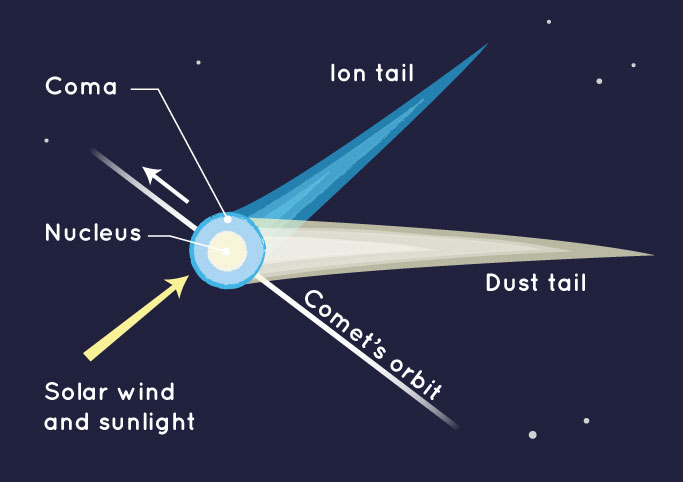







.jpg)

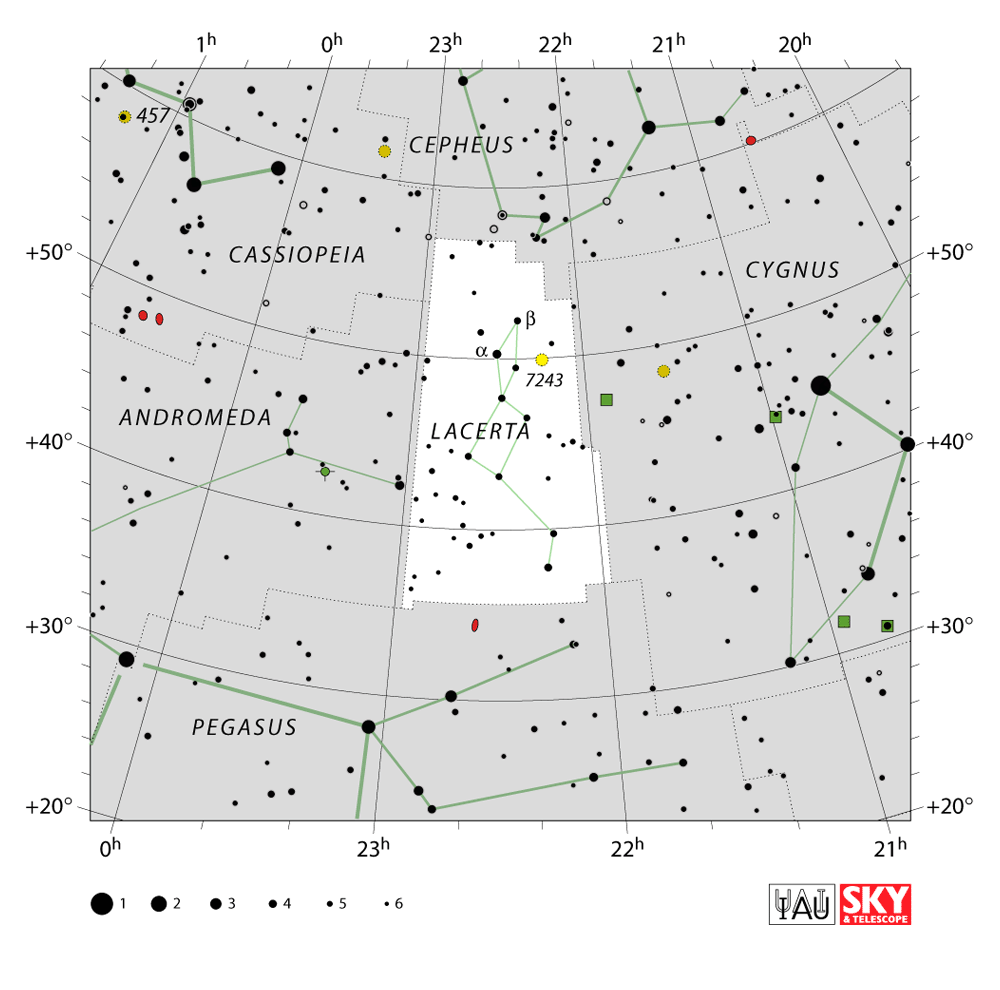





.jpg)


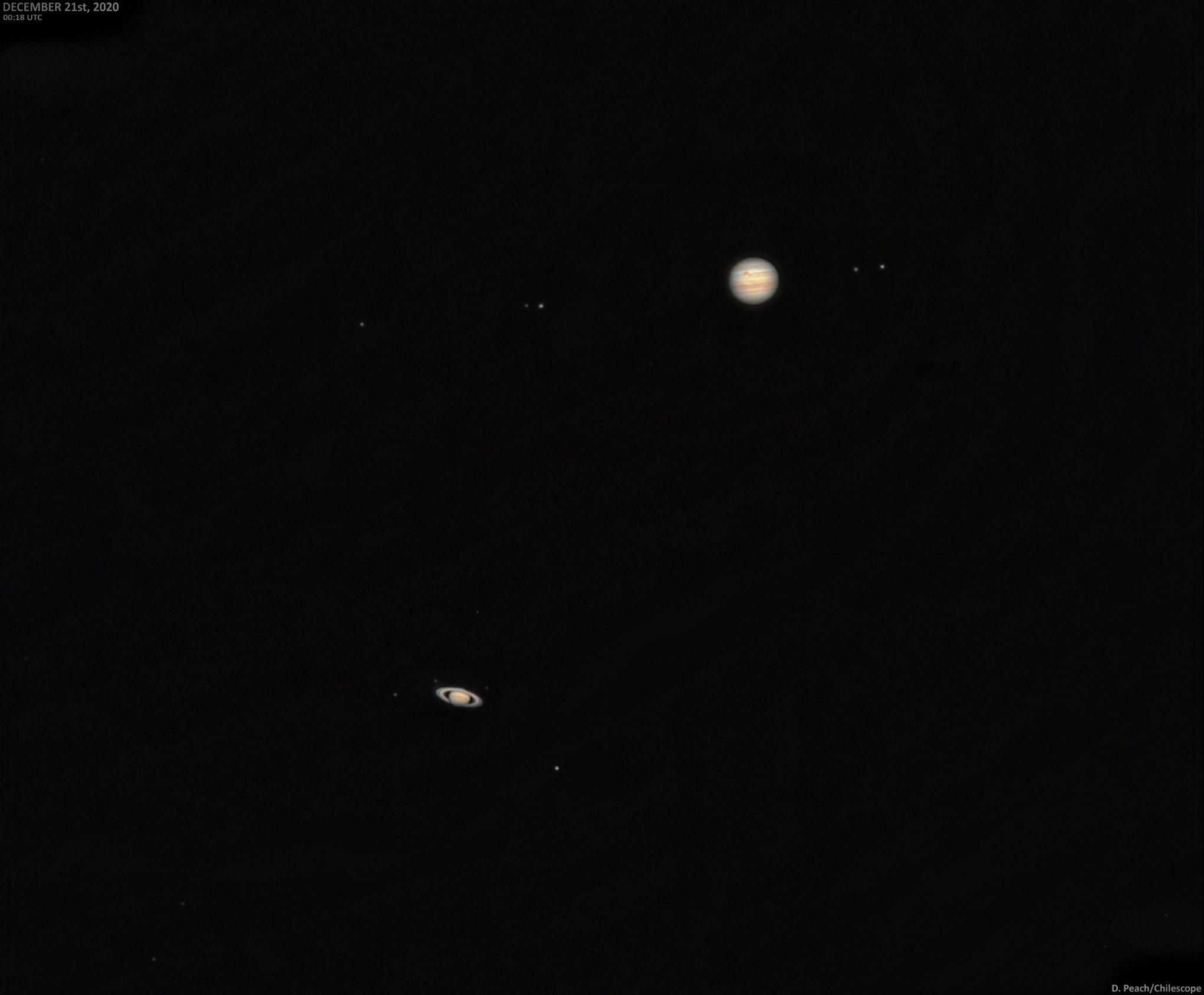

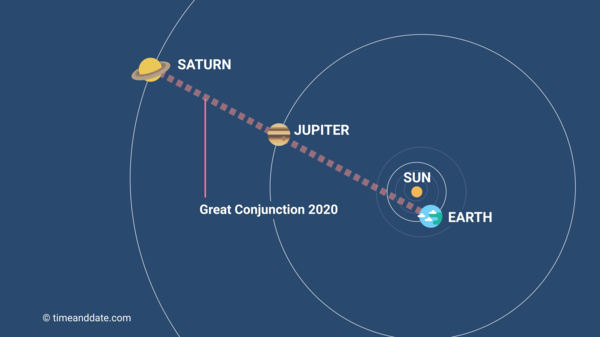




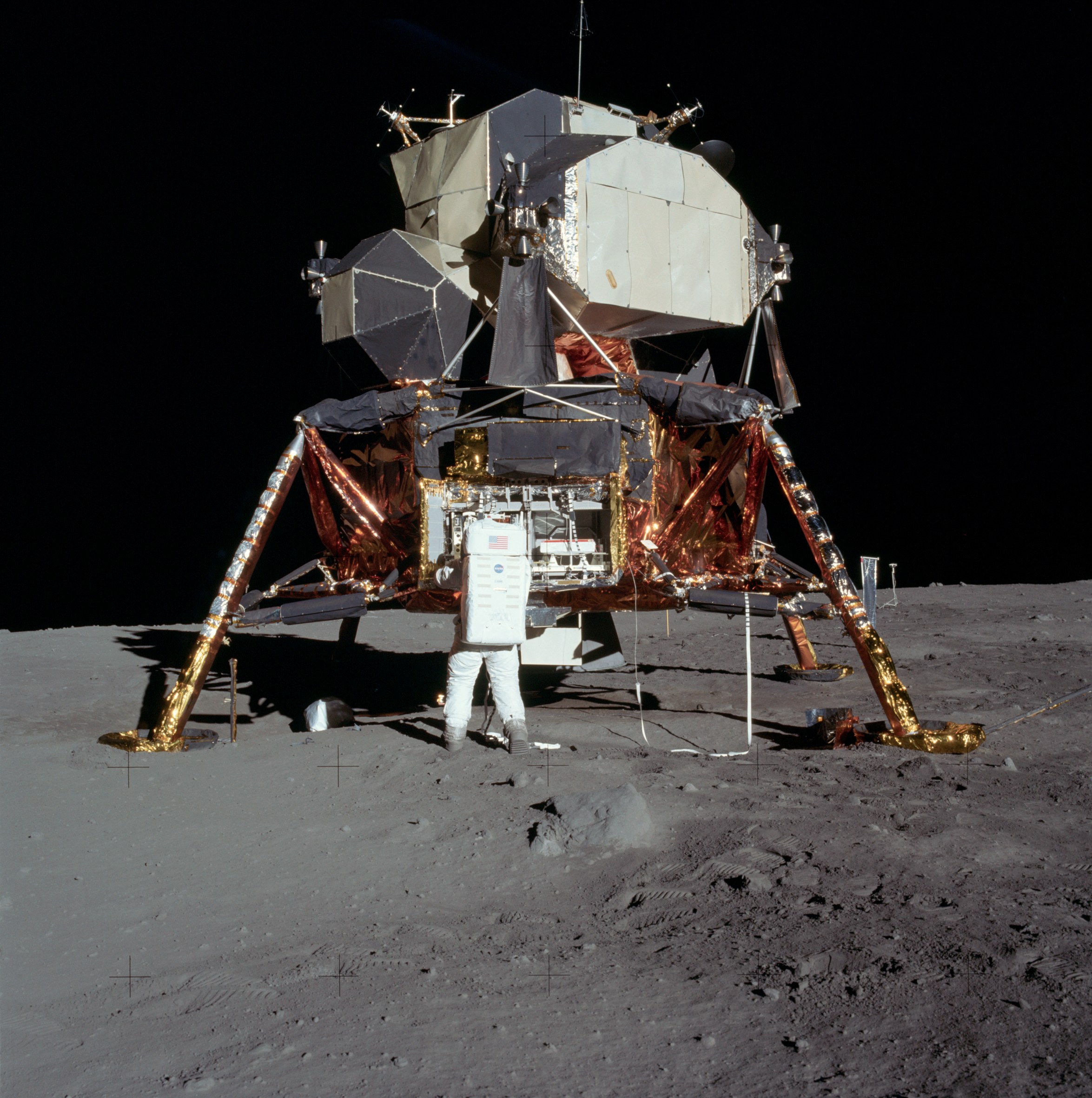

#/media/File:JM_marbles_01.jpg)