|
Astronomy Picture of the Day |
| |
Astronomy Picture of the Day |
 APOD: 2025 April 7 – NGC 4414: A Flocculent Spiral Galaxy
Explanation:
How much mass do flocculent spirals hide?
The featured image of
flocculent spiral galaxy NGC 4414 was taken with the
Hubble Space Telescope
to help answer this question.
Flocculent spirals -- galaxies without well-defined spiral arms --
are a quite common form of galaxy, and
NGC 4414
is one of the closest.
Stars and gas near the visible edge of
spiral galaxies
orbit the center so fast that the gravity from a large amount of unseen
dark matter must be present to hold them together.
Understanding the matter and
dark matter
distribution of NGC 4414
helps humanity calibrate the rest of the galaxy and, by deduction,
flocculent spirals in general.
Further, calibrating the
distance to
NGC 4414 helps
humanity calibrate the cosmological distance
scale of the entire
visible universe.
 APOD: 2023 August 6 – SN 1006: A Supernova Ribbon from Hubble
Explanation:
What created this unusual space ribbon?
The answer: one of the most
violent explosions
ever witnessed by ancient humans.
Back in the year 1006 AD, light reached Earth from a
stellar explosion in the
constellation of the Wolf
(Lupus),
creating a "guest star" in the sky that appeared brighter than
Venus and lasted for over two years.
The supernova, now cataloged at
SN 1006,
occurred about 7,000 light years away and has
left a large remnant that
continues to expand and fade today.
Pictured here is a small part of that
expanding supernova
remnant dominated by a
thin and outwardly moving
shock front that heats and ionizes
surrounding ambient gas.
The supernova remnant SN 1006
now has a diameter of nearly 60
light years.
 APOD: 2023 April 9 – The Egg Nebula in Polarized Light
Explanation:
Where is the center of the
Egg Nebula?
Emerging from a cosmic egg,
the star in the center of the Egg Nebula is casting away
shells of gas and dust as it slowly transforms itself into a
white dwarf star.
The Egg Nebula is a rapidly evolving
pre-
planetary nebula
spanning about one light year.
It lies some 3,000 light-years away toward the northern constellation
Cygnus.
Thick dust blocks the center star from view,
while the dust shells farther out reflect light from this star.
Light vibrating
in the plane defined by each dust grain, the central star,
and the observer is
preferentially reflected,
causing an effect known as polarization.
Measuring the orientation of the polarized light
for the Egg Nebula gives clues to location of the hidden source.
Taken by Hubble's
Advanced Camera for Surveys in 2002,
this image is rendered in artificial "Easter-Egg" colors coded to
highlight
the orientation of
polarization.
 APOD: 2023 January 7 - Space Stations in Low Earth Orbit
Explanation:
On January 3, two space stations
already illuminated by sunlight in low Earth orbit
crossed this dark predawn sky.
Moving west to east (left to right) across the composited
timelapse image
China's Tiangong Space Station
traced the upper trail captured
more than an hour before the local sunrise.
Seen against a starry background
Tiangong passes just below
the inverted Big Dipper asterism of Ursa Major
near the peak of its bright arc,
and above north pole star Polaris.
But less than five minutes before, the
International Space Station
had traced its own sunlit streak across the dark sky.
Its trail begins
just above the W-shape outlined by the bright
stars of Cassiopeia near the northern horizon.
The dramatic foreground spans an abandoned mine at Achada do Gamo
in southeastern Portugal.
 APOD: 2022 April 2 - Nova Scotia Northern Lights
Explanation:
This almost otherworldly
display of northern lights was captured in
clear skies during the early hours of March 31 from
44 degrees north latitude, planet Earth.
In a five second exposure the scene looks north from
Martinique Beach Provincial Park in Nova Scotia, Canada.
Stars of the W-shaped constellation Cassiopeia
shine well above the horizon,
through the red tint
of the
higher altitude auroral glow.
Auroral activity was anticipated by skywatchers
alerted to the possibility of
stormy space weather
by
Sun-staring spacecraft.
The predicted geomagnetic storm was sparked as a
coronal mass ejection, launched from
prolific
solar active region 2975, impacted our
fair planet's magnetosphere.
 APOD: 2021 December 30 - The Further Tail of Comet Leonard
Explanation:
Comet Leonard, brightest comet of 2021,
is at the lower left of these two panels
captured on December 29 in dark Atacama desert skies.
Heading for its perihelion on January 3
Comet Leonard's visible tail
has grown.
Stacked exposures with a wide angle lens
(also displayed in a reversed B/W scheme for contrast),
trace the complicated ion tail for an amazing 60 degrees, with
bright Jupiter shining near the horizon at lower right.
Material vaporizing
from Comet Leonard's nucleus,
a mass of dust, rock, and ices about 1 kilometer across,
has produced the long tail of ionized gas fluorescing in the sunlight.
Likely flares on the
comet's nucleus
and buffeting by magnetic fields and the solar wind in recent weeks
have resulted in the tail's irregular
pinched and twisted appearance.
Still days from its closest approach to the Sun,
Comet Leonard's activity
should continue.
The comet is
south of the Solar System's
ecliptic plane as it sweeps through the southern constellation Microscopium.
 APOD: 2021 November 15 - Light Pillar over Volcanic Etna
Explanation:
What happening above that volcano?
Something very unusual -- a volcanic
light pillar.
More typically, light pillars are caused by sunlight and so appear as a bright column that extends upward above a rising or setting
Sun.
Alternatively, other light pillars --
some
quite
colorful -- have been recorded above street and house lights.
This light pillar, though, was illuminated by the
red light emitted by the glowing magma of an
erupting volcano.
The volcano is
Italy's
Mount Etna, and the
featured image was
captured with a single shot a few hours after sunset in mid-June.
Freezing temperatures above the volcano's
ash cloud created
ice-crystals
either in
cirrus clouds high above the volcano --
or in condensed water vapor expelled by
Mount Etna.
These ice crystals -- mostly
flat toward the ground but fluttering --
then reflected away light from the
volcano's caldera.
 APOD: 2021 November 14 - How to Identify that Light in the Sky
Explanation:
What is that light in the sky?
Perhaps one of humanity's more common questions,
an answer may result from a few quick observations.
For example -- is it moving or blinking?
If so, and if you live near a
city,
the answer is typically an airplane,
since planes are so numerous and so few stars and
satellites are bright enough to be seen over the din of
artificial city lights.
If not, and if you live far from a city, that bright light is likely a planet such as
Venus or
Mars --
the former of which is constrained to appear near the horizon just before dawn or after dusk.
Sometimes the low apparent motion of a distant
airplane near the horizon makes it hard to tell from a
bright planet,
but even this can usually be discerned by the plane's motion over a few minutes.
Still unsure?
The featured chart gives a sometimes-humorous but mostly-accurate assessment.
Dedicated sky enthusiasts will likely note -- and are
encouraged to provide -- polite corrections.
 APOD: 2021 November 10 - Video of a Green Flash
Explanation:
Many think it is just a myth.
Others think it is true but its cause isn't known.
Adventurers pride themselves on having seen it.
It's a green flash from the
Sun.
The truth is the
green flash
does exist and its cause is well understood.
Just as the setting
Sun disappears completely from view,
a last glimmer appears startlingly
green.
The effect is typically visible only from locations with a low,
distant horizon, and lasts just a few seconds.
A green flash is also visible for a rising
Sun, but takes better timing to spot.
A dramatic
green flash
was caught on video last month as the Sun set beyond the
Ligurian Sea
from Tuscany,
Italy.
The second sequence in the
featured video shows the
green flash
in real time, while the first is sped up and the last is in
slow motion.
The Sun itself does not turn
partly green -- the effect is caused by layers of the
Earth's atmosphere acting like a prism.
 APOD: 2021 November 9 - All of These Space Images are Fake Except One
Explanation:
Why would you want to fake a universe?
For one reason -- to better understand
our real universe.
Many
astronomical projects
seeking to learn properties of our universe now start with a
robotic telescope
taking sequential images of the night sky.
Next, sophisticated
computer algorithms
crunch these digital images to find
stars and
galaxies and measure their properties.
To calibrate these algorithms, it is useful to test them on
fake images from a
fake universe
to see if the algorithms can correctly deduce purposely imprinted properties.
The featured mosaic of fake images was created to
specifically mimic the images that have appeared on
NASA's
Astronomy Picture of the Day
(APOD).
Only one image of the 225 images is real -- can you find
it?
The accomplished deceptors have made available individual
fake APOD images that can be displayed by accessing their
ThisIsNotAnAPOD webpage
or Twitter feed.
More useful for calibrating and understanding our
distant universe, however, are fake galaxies --
a sampling of which can be seen at their
ThisIsNotAGalaxy webpage.
 APOD: 2021 November 8 - A Filament Leaps from the Sun
Explanation:
Why, sometimes, does part of the Sun's atmosphere leap into space?
The reason lies in changing
magnetic fields that thread through the
Sun's surface.
Regions of strong surface magnetism, known as
active regions, are usually marked by dark
sunspots.
Active regions can channel charged gas along arching
or sweeping magnetic fields -- gas that sometimes
falls back,
sometimes escapes,
and sometimes not only escapes but
impacts our Earth.
The featured one-hour time-lapse video -- taken with a
small telescope in
France --
captured an eruptive filament that appeared to leap off the Sun late last month.
The filament is huge: for comparison,
the size of the Earth is shown on the upper left.
Just after the
filament lifted off, the
Sun emitted a powerful X-class flare
while the surface rumbled with a tremendous
solar tsunami.
A result was a cloud of charged particles that rushed into
our Solar System but mostly
missed our Earth -- this time.
However, enough solar plasma did impact our
Earth's magnetosphere
to create a few
faint auroras.
 APOD: 2021 November 7 - The Cats Eye Nebula in Optical and X-ray
Explanation:
To some it looks like a cat's eye.
To others, perhaps like a giant cosmic
conch shell.
It is actually one of brightest and most highly detailed
planetary nebula known,
composed of gas expelled in the brief yet
glorious phase near the end of life of a Sun-like star.
This nebula's dying central star may have produced the outer circular
concentric shells
by shrugging off
outer
layers in a series of regular convulsions.
The
formation of the beautiful, complex-yet-symmetric
inner structures,
however, is not well understood.
The
featured image is a composite of a digitally sharpened
Hubble Space Telescope image with
X-ray light
captured by the orbiting
Chandra Observatory.
The exquisite floating space statue spans over half a
light-year across.
Of course,
gazing into this Cat's Eye,
humanity may well be seeing
the fate of our sun, destined to enter its own
planetary nebula
phase of evolution ... in about 5 billion years.
 APOD: 2020 November 15 - Edge On Galaxy NGC 5866
Explanation:
Why is this galaxy so thin?
Many disk galaxies are just as thin as NGC 5866,
pictured here, but are not
seen edge-on from our vantage point.
One galaxy that is situated edge-on is our own
Milky Way Galaxy.
Classified as a
lenticular galaxy, NGC 5866
has numerous and complex dust lanes appearing dark and red,
while many of the bright stars in the disk give it a more blue underlying hue.
The blue disk of young stars can be seen extending past the
dust in the extremely thin galactic plane,
while the bulge in the disk center appears tinged more orange from the
older and redder stars that likely exist there.
Although similar in mass to our
Milky Way Galaxy, light takes about 60,000
years to cross
NGC 5866, about 30 percent less than light takes to cross our own Galaxy.
In general, many disk galaxies are very thin because the gas that
formed them collided with itself as it rotated about the gravitational center.
Galaxy NGC 5866
lies about 44 million light years distant toward the constellation of the Dragon
(Draco).
 APOD: 2020 September 28 - Filaments of the Cygnus Loop
Explanation:
What lies at the edge of an expanding supernova?
Subtle and delicate in appearance, these
ribbons of shocked interstellar gas are part of
a blast wave at the expanding edge of a violent
stellar explosion
that would have been easily visible to humans during the
late stone age, about 20,000 years ago.
The featured image was recorded by the
Hubble Space Telescope and is a closeup of the outer edge of
a supernova remnant known as the Cygnus Loop or
Veil Nebula.
The filamentary shock front is
moving toward
the top of the frame at about 170 kilometers per second,
while glowing in light emitted by atoms of excited
hydrogen gas.
The distances to stars thought to be interacting with the
Cygnus Loop
have recently been found by the Gaia mission to be about 2400 light years distant.
The whole Cygnus Loop spans six
full Moons across the sky, corresponding to about 130
light years,
and parts can be seen with a small telescope toward the
constellation
of the Swan (Cygnus).
 APOD: 2019 November 24 - Apollo 12: Self Portrait
Explanation:
Is this image art?
50 years ago,
Apollo 12 astronaut-photographer Charles "Pete" Conrad recorded this masterpiece while documenting colleague
Alan Bean's lunar soil collection activities on
Oceanus Procellarum.
The
featured image is
dramatic and stark.
The harsh environment of
the Moon's
Ocean of Storms is echoed in Bean's helmet, a perfectly
composed reflection
of Conrad and the
lunar horizon.
Works of photojournalists originally intent on recording the
human condition on
planet Earth,
such as
Lewis W. Hine's
images from New York City in the early 20th century, or
Margaret Bourke-White's magazine
photography are widely regarded as
art.
Similarly many
documentary astronomy and
space images might also be appreciated for their artistic and
esthetic appeal.
 APOD: 2019 August 17 - 1901 Photograph: The Orion Nebula
Explanation:
By the turn of the 20th century advances in photography
contributed an important
tool for astronomers.
Improving photographic materials,
long exposures, and new telescope designs produced astronomical
images with details not visible at
the
telescopic eyepiece alone.
Remarkably
recognizable to astrophotographers today,
this stunning image of the star forming Orion Nebula was captured in
1901 by American astronomer and telescope designer
George Ritchey.
The original glass photographic plate, sensitive to green and blue
wavelengths, has been digitized and light-to-dark inverted
to produce a positive image.
His hand written notes indicate a 50 minute long exposure that ended at
dawn and a reflecting telescope
aperture of 24 inches
masked to 18 inches to improve the sharpness of the recorded image.
Ritchey's plates from over a
hundred years ago preserve astronomical data and can still be used for
exploring astrophysical processes.
 APOD: 2019 July 17 - Apollo 11: Descent to the Moon
Explanation:
It had never been done before.
But with the words "You're Go for landing",
50 years ago
this Saturday, Apollo 11 astronauts
Aldrin and
Armstrong were cleared to make the
first try.
The next few minutes would contain more than a
bit of drama, as an unexpected boulder field and an unacceptably sloping crater loomed below.
With fuel dwindling,
Armstrong
coolly rocketed the lander above the lunar surface as
he looked for a clear and flat place to land.
With only seconds of fuel remaining, and with the help of
Aldrin and
mission control calling out data,
Armstrong finally found a safe spot -- and put
the Eagle down.
Many people on Earth listening to the live audio felt great relief on hearing "The Eagle has landed", and
great pride knowing that for the first time ever,
human beings were on
the Moon.
Combined in the
featured descent video are two audio feeds, a video feed similar to
what the astronauts saw, captions of the dialog,
and data including the tilt of the Eagle lander.
The video concludes with the
panorama of the lunar landscape visible
outside the Eagle.
A few hours later,
hundreds of millions of people across planet
Earth, drawn
together as a single species,
watched fellow humans walk on the Moon.
 APOD: 2019 January 28 - The Long Gas Tail of Spiral Galaxy D100
Explanation:
Why is there long red streak attached to this galaxy?
The streak is made mostly of
glowing hydrogen
that has been systematically stripped away as
the galaxy moved through the ambient hot gas in a cluster of galaxies.
Specifically, the galaxy is
spiral galaxy D100, and cluster is the
Coma Cluster of galaxies.
The red path connects to the center of D100 because the outer gas,
gravitationally held less strongly, has already been
stripped away by
ram pressure.
The extended gas tail is about 200,000
light-years long, contains about 400,000 times the mass of
our Sun, and stars are forming within it.
Galaxy D99, visible to D100's lower left,
appears red because it glows primarily from the light of
old red stars -- young blue stars can no longer form because D99 has been
stripped of its star-forming gas.
The featured false-color picture is a
digitally enhanced composite of images from Earth-orbiting
Hubble
and the ground-based
Subaru telescope.
Studying remarkable systems like this bolsters
our understanding of how galaxies evolve in clusters.
 APOD: 2018 July 17 - Moon and Venus over Cannon Beach
Explanation:
What's that spot next to the Moon?
Venus.
Two days ago, the crescent Moon slowly drifted past Venus, appearing
within just one degree at its closest.
This conjunction, though, was just one of several
photographic adventures for our Moon this month
(moon-th),
because, for one, a partial solar eclipse occurred
just a few days before, on July 12.
Currently, the Moon appears to be brightening, as seen from the Earth, as the fraction of its face illuminated by the Sun continues to increase.
In a few days,
the Moon
will appear more than half full, and therefore be in its
gibbous phase.
Next week the face of
the Moon
that always faces
the Earth will become, as viewed from the Earth, completely illuminated by
the Sun.
Even this full phase will bring an adventure, though, as a total eclipse of this
Thunder Moon will occur on July 27.
Don't worry about
our Luna getting tired, though, because she'll be new again next month (moon-th) -- August 11 to be exact -- just as she causes another partial eclipse of the Sun.
Pictured,
Venus and the Moon were captured from
Cannon Beach above a rock formation off the
Oregon
(USA)
coast known as the Needles.
About an hour after this image was taken,
the spin of the Earth caused both
Venus and the Moon to
set.
 APOD: 2016 November 20 - NGC 4414: A Flocculent Spiral Galaxy
Explanation:
How much mass do flocculent spirals hide?
The featured true color image of
flocculent spiral galaxy NGC 4414 was taken with the
Hubble Space Telescope
to help answer this question.
The featured image was augmented with data from the
Sloan Digital Sky Survey (SDSS).
Flocculent spirals -- galaxies without well-defined spiral arms --
are a quite common form of galaxy, and
NGC 4414
is one of the closest.
Stars and gas near the visible edge of
spiral galaxies
orbit the center so fast that the gravity from a large amount of unseen
dark matter must be present to hold them together.
Understanding the matter and dark matter distribution of NGC 4414
helps humanity calibrate the rest of the galaxy and, by deduction,
flocculent spirals in general.
Further, calibrating the
distance to
NGC 4414 helps
humanity calibrate the cosmological distance
scale of the entire
visible universe.
 APOD: 2016 October 11 - The Cygnus Wall of Star Formation
Explanation:
Sometimes, stars form in walls -- bright walls of interstellar gas.
In this vivid skyscape, stars are forming in the W-shaped ridge of emission
known as the Cygnus Wall.
Part of a larger
emission
nebula with a distinctive outline popularly called
The North America Nebula,
the cosmic ridge spans about 20 light-years.
Constructed using narrowband data to highlight the telltale
reddish glow from
ionized hydrogen
atoms recombining with electrons, the image mosaic follows an
ionization front with fine details of dark, dusty forms in silhouette.
Sculpted
by energetic radiation from the region's young, hot, massive
stars, the dark shapes inhabiting the view are clouds of cool gas and dust
with stars likely forming within.
The North America Nebula itself, NGC 7000,
is about 1,500
light-years away.
 APOD: 2016 March 18 - The W in Cassiopeia
Explanation:
A familiar, zigzag, W pattern in northern
constellation Cassiopeia
is traced by five bright stars in this colorful and broad mosaic.
Stretching about 15 degrees across rich starfields,
the celestial scene
includes
dark clouds,
bright nebulae, and
star clusters along the Milky Way.
In yellow-orange hues Cassiopeia's
alpha star
Shedar is a standout though.
The yellowish giant star is cooler than the Sun, over 40 times the
solar diameter, and so luminous it shines brightly in
Earth's night from 230 light-years away.
A massive, rapidly rotating star at the center of the W, bright
Gamma Cas
is about 550 light-years distant.
Bluish Gamma Cas is much hotter than the Sun.
Its intense, invisible ultraviolet radiation ionizes hydrogen atoms in
nearby interstellar clouds to produce
visible red H-alpha emission as the atoms recombine with electrons.
Of course, night skygazers
in the Alpha Centauri star system
would also see the recognizable outline traced by
Cassiopeia's bright stars.
But from their
perspective a mere 4.3 light-years away they would see
our Sun as a sixth bright star in Cassiopeia, extending the zigzag
pattern just beyond the left edge of this frame.
 APOD: 2015 March 12 - Along the Cygnus Wall
Explanation:
The W-shaped ridge of emission featured in
this
vivid skyscape is known as the Cygnus Wall.
Part of a larger
emission
nebula with a distinctive outline popularly called
The North America Nebula,
the cosmic ridge spans about 20 light-years.
Constructed using narrowband data to highlight the telltale
reddish glow from
ionized hydrogen
atoms recombining with electrons, the two frame mosaic image follows an
ionization front with fine details of dark, dusty forms in silhouette.
Sculpted
by energetic radiation from the region's young, hot, massive stars,
the dark shapes inhabiting the view are clouds of cool gas and dust
with stars likely forming within.
The North America Nebula itself, NGC 7000,
is about 1,500 light-years away.
 APOD: 2015 February 24 - Unusual Plumes Above Mars
Explanation:
What is creating unusual plumes on Mars?
No one is sure.
Noted and confirmed by a
global contingent of amateur astronomers on photos of the
red planet in March 2012,
possibly similar plumes have now been found on
archived images as far back as 1997.
Since the plumes reach 200 kilometers up,
they
seem too high to be related to
wind-blown surface dust.
Since one plume lasted for eleven days,
it seemed too long lasting to be related to aurora.
Amateur astronomers will surely continue to monitor the terminator and edge regions of Mars for new
high plumes, and the
armada of satellites
orbiting Mars may be called upon to verify and study any newly reported plume that become visible.
The featured 35-minute time-lapse animation was taken on 2012 March 20 by the plume's discoverer --
an attorney from
Pennsylvania,
USA.
 APOD: 2015 February 12 - Exploring the Antennae
Explanation:
Some 60 million light-years away in the southerly
constellation
Corvus, two large galaxies are
colliding.
The stars in the two galaxies, cataloged as
NGC 4038
and NGC 4039, very rarely collide in the course of the
ponderous cataclysm,
lasting hundreds of millions of years.
But their large clouds of
molecular
gas and dust often do, triggering furious
episodes of star formation near the center of the
cosmic wreckage.
Spanning about 500 thousand light-years, this
stunning composited view also reveals new star clusters and
matter flung far from the scene
of the accident by
gravitational
tidal forces.
The remarkable collaborative image is a mosaic constructed
using data from
small and large ground-based telescopes to bring out large-scale
and faint tidal streams, composited with the
bright cores
imaged in extreme detail by the Hubble Space Telescope.
Of course,
the suggestive visual appearance of the extended arcing structures
gives the galaxy pair its popular name - The Antennae.
 APOD: 2014 July 17 - 3D Homunculus Nebula
Explanation:
If
you're looking
for something
to print with that new
3D printer, try out a copy of the Homunculus Nebula.
The dusty, bipolar cosmic cloud is around 1 light-year across
but is slightly
scaled
down for printing to
about 1/4 light-nanosecond or 80 millimeters.
The full scale Homunculus surrounds Eta Carinae,
famously unstable
massive stars in a binary system
embedded in the extensive
Carina Nebula
about 7,500 light-years distant.
Between 1838 and 1845, Eta Carinae
underwent the Great Eruption becoming
the second brightest star in planet Earth's night sky
and ejecting the Homunculus Nebula.
The
new 3D model of the still expanding Homunculus
was created by
exploring
the nebula with the European Southern Observatory's
VLT/ APOD: 2014 February 24 - The Cloudy Cores of Active Galaxies
Explanation:
What would it look like to travel to the center of an active galaxy?
Most galactic centers are thought to house
black holes millions of times more massive than our Sun.
The spaces surrounding these supermassive black holes may be far from dormant, however, flickering in many colors and earning the entire object class the title of
Active Galactic Nuclei (AGN).
Pictured above
is a video illustrating how an active galactic nucleus may appear up close.
AGN typically sport massive
accretion disks feeding the central black hole, as well as
powerful jets
shooting electrically
charged matter
far into the surrounding universe.
Clouds of gas and
dust seen
orbiting the central black holes have
recently been found to be so dense that they intermittently eclipse even penetrating
x-rays
from reaching us.
These X-ray dimming events, as short as hours but as long as years, were detected in an analysis encompassing over a decade of data taken by the NASA's orbiting
Rossi
X-ray Timing Explorer (RXTE).
 APOD: 2014 January 28 - Spiral Galaxy M83: The Southern Pinwheel
Explanation:
M83 is one of
the closest and brightest
spiral galaxies on the
sky.
Visible with binoculars in the constellation of
Hydra, majestic spiral arms
have prompted its nickname as the
Southern Pinwheel.
Although discovered 250 years ago,
only
much later was it appreciated that
M83 was not a nearby gas cloud, but a
barred
spiral galaxy much like our own
Milky Way Galaxy.
M83, pictured above by the Hubble Space Telescope in a recently released image,
is a prominent member of a group of galaxies that includes
Centaurus A and
NGC 5253, all of which lie about 15 million
light years distant.
Several bright supernova explosions
have been recorded in
M83.
An intriguing double
circumnuclear ring has been discovered
at the center of of M83.
 APOD: 2013 October 24 - Little Planet Shadowrise
Explanation:
Warm shades and subtle colors come to the sky in the fading sunlight
after shadowrise on this little planet.
Of course the little planet is planet
Earth, and this
nadir-to-zenith,
around-the-horizon mosaic
maps the view from a small airfield near the town of
Intendente Alvear, La Pampa province, Argentina.
Just above the western horizon (top) the sky shines with the warm
colors
of sunset.
The slate blue
shadow of Earth
itself extending through the atmosphere
can be seen rising as it hugs the eastern horizon (bottom).
Wrapped closely above the narrow projection of Earth's shadow is
the gentle glow of reddened, backscattered sunlight called the
antitwilight
arch or the Belt of Venus.
 APOD: 2012 December 5 - Plasma Jets from Radio Galaxy Hercules A
Explanation:
Why does this galaxy emit such spectacular jets?
No one is sure, but it is likely related to an active supermassive black hole at its center.
The galaxy at the
image center,
Hercules A, appears to be a relatively normal
elliptical galaxy in visible light.
When imaged in
radio waves, however, tremendous
plasma
jets over one million light years long appear.
Detailed analyses indicate that the central galaxy, also known as
3C 348,
is actually over 1,000 times more massive than our Milky Way Galaxy,
and the central black hole is nearly 1,000 times more massive than the
black hole at our
Milky Way's center.
Pictured above
is a visible light image obtained by the Earth-orbiting
Hubble Space Telescope
superposed with a radio image taken by the recently upgraded
Very Large Array (VLA) of radio telescopes in
New Mexico,
USA.
The physics that creates
the jets remains a topic of
research with a likely energy source being infalling matter
swirling toward the central
black
hole.
 APOD: 2011 February 11 - Star Colors in Orion
Explanation:
What determines
a star's color?
Its temperature.
Red stars are cool, with surface temperatures of around 3,000
kelvins (K),
while blue stars are hotter and can have temperatures over 30,000 K.
Our own lovely "yellow" Sun's temperature is a
comforting 6,000 K.
Differences in star colors are particularly easy to see
in this intriguing composite view of
the constellation Orion, made while experimenting with a star trail
step-focus technique.
In it, a series of 35 consecutive exposures were combined to produce
trails of stars moving left to right through
the frame, while changing focus in steps.
Beginning and ending with the camera out of focus
produced a sharply focused exposure near the middle of
the series and blurs the star trails into a bow tie shape.
For the brighter stars, blurring produces more saturated colors
in the images.
At the upper left, Orion's cool red
supergiant Betelgeuse
stands out from the other, hotter, bluish stars composing
the body of the constellation.
Not a star at all, the
Orion Nebula contributes a
pinkish tint below center.
Also remarkable in the field, the fainter step focus
trail of cool, deep red carbon star
W Orionis
is near the center right edge, its red hue enhanced by a
carbon-rich composition.
 APOD: 2011 February 10 - Hanny's Voorwerp
Explanation:
Hanny's Voorwerp,
Dutch for "Hanny's Object", is enormous,
about the size
of our own Milky Way Galaxy.
Glowing strongly in the greenish light produced by
ionized oxygen atoms,
the
mysterious voorwerp is below
spiral galaxy IC 2497 in this
view from the Hubble Space Telescope.
Both lie at a distance of some 650 million light-years in
the faint constellation Leo Minor.
In fact, the enormous green cloud is now suspected to be part of a
tidal tail of material
illuminated by a quasar
inhabiting the center of IC 2497.
Powered by a massive black hole, the quasar
suddenly turned off,
leaving only galaxy and glowing voorwerp
visible in telescopes at optical wavelengths.
The sharp Hubble image also resolves a star forming region
in the voorwerp, seen in yellow on the side near IC 2497.
That region was likely compressed by an outflow of gas driven
from the galaxy's core.
The remarkable mystery object was
discovered by Dutch schoolteacher
Hanny van Arkel in 2007
while participating online in the Galaxy Zoo project.
Galaxy Zoo enlists
the public to help classify
galaxies found in the Sloan Digital Sky Survey,
and more recently in deep Hubble imagery.
 APOD: 2011 January 20 - The Once and Future Stars of Andromeda
Explanation:
The big, beautiful Andromeda Galaxy,
aka M31, is a spiral galaxy a
mere 2.5 million light-years away.
Two space-based observatories have combined to produce
this intriguing composite image of Andromeda,
at wavelengths outside the
visible spectrum.
The remarkable view
follows the locations of this galaxy's
once and future stars.
In reddish hues, image data from the large
Herschel infrared
observatory traces enormous lanes of dust,
warmed by stars, sweeping along Andromeda's spiral arms.
The dust, in conjunction with the galaxy's interstellar gas,
comprises the raw material for future
star formation.
X-ray data from the XMM-Newton
observatory in blue
pinpoint Andromeda's X-ray binary
star systems.
These systems likely contain neutron stars or stellar mass
black holes that represent final stages in stellar evolution.
More than twice the size of our own Milky Way,
the Andromeda Galaxy is over 200,000 light-years across.
 APOD: 2009 December 24 - Gamma Cas and Friends
Explanation:
Gamma Cassiopeiae
shines high in northern autumn evening skies.
The brightest spiky star in this rich and colorful Milky Way starfield,
bluish
Gamma
Cas marks the central peak in the W-shaped constellation
Cassiopeia.
A hot, variable, and rapidly
rotating
star about 600 light-years
distant, Gamma Cas also ionizes surrounding
interstellar material,
including the wispy
IC 63 (left) and IC 59 emission and reflection
nebulae.
The two faint nebulae are physically
close
to Gamma Cas, separated from the star by only a few light-years.
This well-composed, wide-field
view of
the region spans almost 2 degrees on the sky.
 APOD: 2009 August 19 - IC 1396 and Surrounding Starfield
Explanation:
Sprawling across hundreds of light-years, emission
nebula IC 1396, visible on the upper right, mixes glowing cosmic gas and
dark dust clouds.
Stars are forming in this area, only about 3,000
light-years
from Earth.
This wide angle view also
captures surrounding
emission and
absorption nebula.
The red glow in IC 1396 and across the image is created by cosmic
hydrogen
gas recapturing
electrons knocked away by energetic starlight.
The dark dust clouds are dense groups of smoke-like particles common in the disks of spiral galaxies.
Among the intriguing dark shapes within
IC 1396,
the winding Elephant's Trunk nebula lies just right of the nebula's center.
IC 1396 lies in the high and far off constellation
of Cepheus.
 APOD: 2009 April 8 - Unusual Dusty Galaxy NGC 7049
Explanation:
How was this unusual looking galaxy created?
No one is sure, especially since spiral galaxy NGC 7049 looks so strange.
NGC 7049's striking appearance is primarily due to an unusually prominent
dust ring seen mostly in
silhouette.
The opaque ring is much
darker than the din of millions of bright stars glowing behind it.
Besides the dark dust, NGC 7049 appears similar to a smooth
elliptical galaxy,
although featuring surprisingly few
globular
star clusters.
NGC 7049 is pictured above as imaged recently by the
Hubble Space Telescope.
The bright star near the top of
NGC 7049 is an unrelated foreground star in our own Galaxy.
Not visible here is an unusual central
polar ring
of gas circling out of the plane near the galaxy's center.
Since NGC 7049 is the brightest galaxy in its
cluster of galaxies,
its formation might be fostered by several prominent and recent
galaxy collisions.
NGC 7049 spans about 150 thousand light years and lies about 100 million
light years away toward the
constellation
of Indus.
 APOD: 2008 December 27 - Crab Pulsar Wind Nebula
Explanation:
The Crab Pulsar, a city-sized, magnetized
neutron star spinning 30 times a second,
lies at the center of
this
remarkable image from
the orbiting Chandra Observatory.
The deep x-ray image gives the first
clear view of
the convoluted boundaries of the Crab's pulsar wind nebula.
Like a
cosmic
dynamo the pulsar powers the x-ray
emission.
The pulsar's energy accelerates
charged particles, producing eerie, glowing x-ray jets directed
away from the poles and an intense wind in the equatorial direction.
Intriguing edges are created as the charged
particles stream away, eventually losing energy as they interact
with the pulsar's strong magnetic field.
With more mass than the Sun and the density of an
atomic nucleus,
the spinning pulsar itself is the collapsed core of a
massive star.
The stellar core collapse resulted in a supernova explosion that
was witnessed in
the year
1054.
This Chandra image spans just under 9 light-years at the Crab's
estimated distance of 6,000 light-years.
 APOD: 2008 September 15 - SN 1006: A Supernova Ribbon from Hubble
Explanation:
What created this unusual space ribbon?
Most assuredly, one of the most
violent explosions
ever witnessed by ancient humans.
Back in the year 1006 AD, light reached Earth from a stellar explosion in the
constellation of the Wolf
(Lupus),
creating a "guest star" in the sky that appeared
brighter than Venus and lasted for over two years.
The supernova, now cataloged at
SN 1006,
occurred about 7,000 light years away and has left a large remnant that continues to expand and fade today.
Pictured above is a small part of that
expanding supernova
remnant dominated by a
thin and outwardly moving
shock front that heats and ionizes
surrounding ambient gas.
SN 1006 now has a diameter of nearly 60
light years.
Within the past year, an
even more powerful explosion
occurred far across the universe that was visible to modern humans,
without any optical aid, for a few seconds.
 APOD: 2008 June 26 - M27: Not A Comet
Explanation:
Born on June 26th in 1730,
astronomer Charles Messier scanned 18th century French skies
for comets.
To avoid confusion and aid his comet hunting, he
diligently recorded this object as number 27 on
his
list of things which are definitely not comets.
In fact, 21st century astronomers would classify it as a
Planetary
Nebula, but it's not a planet either, even though it may
appear round
and planet-like in a small telescope.
Messier 27 (M27) is now
known to be an excellent example of a
gaseous emission nebula created
as a sun-like star runs out
of nuclear fuel in its core.
The nebula forms as the star's outer layers are expelled into
space, with a visible glow generated by atoms excited by the dying
star's intense but invisible
ultraviolet light.
Known by the popular name of the
Dumbbell
Nebula, the beautifully
symmetric interstellar gas cloud is over 2.5 light-years across and
about 1,200 light-years away in the
constellation
Vulpecula.
This impressive color composite highlights subtle jet
features in the nebula.
It was recorded with a robotic
telescope sited in Hawaii using narrow band
filters sensitive to emission from oxygen atoms (shown in
green) and hydrogen atoms.
The hydrogen
emission is
seen as red (H-alpha) and fainter
bluish hues (H-beta).
 APOD: 2007 November 7 - The Sloan Great Wall: Largest Known Structure
Explanation:
What is the largest structure known?
The answer might depend on how one defines "structure."
A grouping of galaxies known as the
Sloan Great Wall
was discovered in the
Sloan Digital Sky Survey and is a
leading candidate.
The Sloan
Great Wall can be seen in this
digitally recast contour map
of galaxies in the
Two Degree Field galaxy survey.
Galaxies within one billion
light
years, a
redshift of about 0.1, are depicted.
The labeled Sloan Great Wall spans over one billion light years,
longer than any structure ever measured.
Critics worry that the
Sloan Great Wall should not itself be
characterized as a coherent structure because it is not
currently gravitationally bound
together and parts of it might never become gravitationally bound.
Regardless, the beauty of the
local universe of galaxies
is evident in the image where several huge
superclusters
of galaxies --
clusters of galaxy clusters -- can also be seen.
These include the
Shapley
Supercluster of galaxies, part of the Pisces-Cetus Supercluster,
and part of the Horologium-Reticulum Supercluster.
 APOD: 2006 October 6 - Dusty NGC 1333
Explanation:
Dusty NGC 1333
is seen in visible light as a
reflection nebula,
dominated by bluish hues characteristic
of starlight reflected by dust.
But at longer infrared wavelengths, the
interstellar
dust itself glows.
Moving your cursor over the picture will match up a
visible
light view with a false-color infrared image of the region from the
Spitzer Space Telescope.
The penetrating
infrared view unmasks youthful stars
that are otherwise obscured by the
dusty clouds
that formed them.
Also revealed are greenish streaks and splotches that seem to
litter the region.
The structures trace the glow of
cosmic jets blasting away
from emerging young stellar objects and plowing into the
cold cloud material.
In all, the chaotic
environment likely resembles one in which our own
Sun formed over 4.5 billion years ago.
NGC
1333 is a mere 1,000 light-years distant in the constellation
Perseus.
 APOD: 2006 September 18 - Eris: The Largest Known Dwarf Planet
Explanation:
Is Pluto the largest dwarf planet? No!
Currently, the largest known dwarf planet is
(136199) Eris,
renamed last week from 2003 UB313.
Eris is just slightly larger than Pluto, but orbits as far as twice
Pluto's distance from the Sun.
Eris is shown above in an image taken by a 10-meter
Keck Telescope from
Hawaii,
USA.
Like Pluto, Eris has a moon, which has been
officially named by the
International Astronomical Union
as (136199) Eris I (Dysnomia).
Dysnomia is visible above just to the right of Eris.
Dwarf planets
Pluto and Eris are
trans-Neptunian objects that orbit in the
Kuiper belt
of objects past Neptune.
Eris was discovered in 2003, and is likely composed of
frozen water-ice and
methane.
Since Pluto's recent demotion by the
IAU from planet to dwarf planet status,
Pluto
has recently also been given a new numeric designation: (134340) Pluto.
Currently, the only other officially designated "dwarf planet" is (1)
Ceres.
 APOD: 2006 June 15 - Gordel van Venus
Explanation:
Scroll right and
enjoy this 180 degree panorama across the
South African Astronomical
Observatory's hilltop
Sutherland observing station.
Featured are
SAAO
telescope domes and buildings, along
with the dark, wedge-shaped shadow of planet Earth stretching into
the distance, bounded above by the delicately
colored antitwilight arch.
Visible along the antisunward horizon
at sunset,
(or sunrise)
the pinkish
antitwilight arch
is also known as the Belt of Venus.
In order, the significant structures from left to right house;
the giant SALT 11-meter instrument,
the internet telescope
MONET,
the 1.9 meter Radcliffe,
the 1.0 meter Elizabeth,
a 0.75 meter reflector,
a 0.5 meter reflector,
a garage,
YSTAR,
BiSON,
ACT,
IRSF (open),
and a storage building.
(Note to SAAO fans: in this east-facing view the planet-hunter
SuperWASP south
is hidden behind the IRSF.)
 APOD: 2006 June 12 - Edge On Galaxy NGC 5866
Explanation:
Why is this galaxy so thin?
Many disk galaxies are actually just as thin as NGC 5866,
pictured above, but are not
seen edge-on from our vantage point.
One galaxy that is situated edge-on is our own
Milky Way Galaxy.
Classified as a
lenticular galaxy, NGC 5866
has numerous and complex dust lanes appearing dark and red,
while many of the bright stars in the disk give it a more blue underlying hue.
The blue disk of young stars can be seen extending past the
dust in the extremely thin galactic plane,
while the bulge in the disk center appears tinged more orange from the
older and redder stars that likely exist there.
Although similar in mass to our Milky Way Galaxy, light takes about 60,000
years to cross
NGC 5866, about 30 percent less than light takes to cross our own Galaxy.
In general, many disk galaxies are very thin because the gas that
formed them collided with itself as it rotated about the gravitational center.
Galaxy NGC 5866
lies about 44 million light years distant toward the constellation of the Dragon
(Draco).
 APOD: 2006 April 27 - NGC 4696: Energy from a Black Hole
Explanation:
In many cosmic environments,
when material falls toward
a black hole energy is produced as some of the matter is
blasted back out in jets.
In fact, such black hole "engines" appear to be the most
efficient in the Universe, at least on a galactic scale.
This
composite image
illustrates one example of an
elliptical galaxy with an efficient
black hole engine, NGC 4696.
The large galaxy is the brightest member of the
Centaurus
galaxy cluster, some 150 million light-years away.
Exploring
NGC 4696
in x-rays (red) astronomers
can measure the rate at which infalling matter fuels the
supermassive black hole and compare
it to the energy output in the jets to
produce giant radio emitting bubbles.
The bubbles, shown here in blue, are about 10,000
light-years across.
The results confirm
that the process is much more efficient
than producing energy through
nuclear
reactions - not to mention
using fossil fuels.
Astronomers also suggest that as the black hole
pumps out energy and heats the surrounding gas, star formation
is ultimately shut off, limiting the size of large galaxies like
NGC 4696.
 APOD: 2006 January 21 - Apollo 12: Self-Portrait
Explanation:
In November of 1969,
Apollo 12 astronaut-photographer
Charles "Pete" Conrad recorded
this masterpiece while documenting colleague
Alan Bean's
lunar soil collection activities on the
Oceanus Procellarum.
The image is dramatic and stark.
The harsh environment of the Moon's Ocean of Storms is
echoed in Bean's helmet, a perfectly
composed
reflection of Conrad and
the
lunar horizon.
Is it art?
Works of photojournalists originally
intent on recording the human condition on planet Earth,
such as Lewis W. Hine's images from New York City
in the early 20th century, or
Margaret
Bourke-White's magazine photography are widely
regarded as art.
Similarly many documentary astronomy and
space images
can be appreciated for their artistic and
esthetic appeal.
 APOD: 2005 October 16 - Astronomy Quilt of the Week
Explanation:
Demonstrating her mastery of a
traditional
astronomical imaging technique
quilter and
astronomy enthusiast Judy Ross
has produced this spectacular composition of "Astronomy
Quilt Piece of the Week".
Her year-long effort resulted in an arrangement for a six by seven foot
quilt consisting
of 52 individual pieces
(11 inches by 8 inches), one for each week,
which she reports were inspired by her steady diet of
APOD's daily offerings.
Some of the pieces are based on actual pictures, such as the
Hubble Space Telescope's
view of planet forming
AB Aurigae or Bill Keel's image of the
nearby Pinwheel Galaxy.
Others, with titles like
the Blue
Carpet Nebula and
Duck
Contemplates Black Hole, are from her own creative imaginings.
 APOD: 2005 July 21 - X-Ray Stars of 47 Tuc
Explanation:
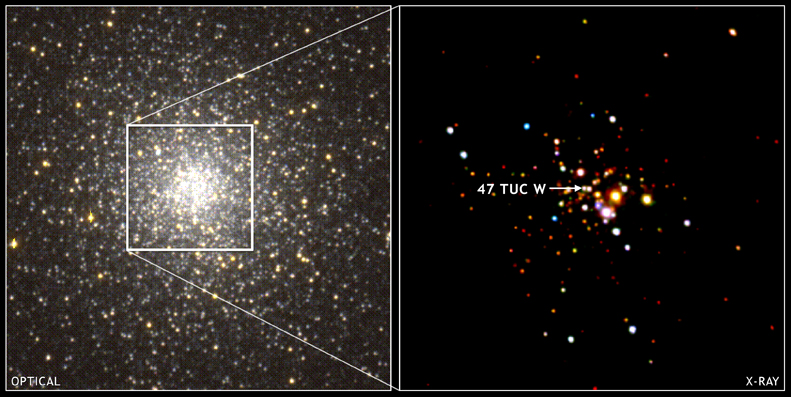
Visible light images
show the central region of globular
cluster 47
Tucanae is closely packed, with stars
less than a tenth of a light-year apart.
This Chandra false-color
x-ray view
of central 47 Tuc also shows the
cluster is a popular neighborhood for
x-ray stars,
many of which are "normal" stars
co-orbiting with extremely dense
neutron stars
-- stars with the mass of the Sun but
the diameter of Manhattan Island.
One of the most remarkable of these exotic
binary systems is
cataloged as 47 Tuc W, a bright source
near
the center of this image.
The system consists of a low mass star and a
a neutron star that spins once every 2.35
milliseconds.
Such neutron stars are known to radio astronomers
as millisecond pulsars, believed to be driven to such
rapid rotation by material falling from the normal star onto
its dense companion.
In fact, x-ray observations of the 47 Tuc W system
link this
spin-up mechanism observed to operate in other x-ray binary
stars with fast rotating millisecond
pulsars.
 APOD: 2005 May 7 - NGC 3314: When Galaxies Overlap
Explanation:
NGC 3314
consists of two large spiral
galaxies which just happen to almost exactly line-up.
The foreground spiral is viewed nearly
face-on, its
pinwheel shape defined by young bright star clusters.
But against the glow of the background galaxy, dark swirling lanes of
interstellar dust are
also seen to echo the face-on spiral's structure.
The dust lanes are
surprisingly pervasive, and this remarkable
pair of
overlapping galaxies is one of a small number of systems in which
absorption of visible light can be used to directly explore the
distribution
of dust in distant spirals.
NGC 3314 is
about 140 million light-years away in the multi-headed
constellation
Hydra.
This color composite was constructed
from Hubble Space Telescope images made in 1999 and 2000.
 APOD: 2005 April 20 - Barnard's Loop Around Orion
Explanation:
Why is the
belt of Orion surrounded by a bubble?
Although glowing like an
emission nebula,
the origin of the bubble, known as
Barnard's Loop, is currently unknown.
Progenitor hypotheses include the
winds
from bright Orion stars and the
supernovas
of stars long gone.
Barnard's Loop is too faint to be identified with the unaided eye.
The nebula
was discovered only in 1895 by
E. E. Barnard on long duration film exposures.
Orion's belt is seen as the
three bright stars across the center of the image,
the upper two noticeably blue.
Just to the right of the
lowest star in Orion's belt is a slight indentation in an
emission nebula that, when seen at
higher magnification, resolves into the
Horsehead Nebula.
To the right of the belt stars is the bright, famous, and photogenic
Orion Nebula.
 APOD: 2005 April 9 - Inside The Elephant's Trunk
Explanation:
In December of 2003, the world saw
spectacular first images
from the
Spitzer
Space Telescope,
including this penetrating interior view of an otherwise
opaque dark globule known as the
Elephant's Trunk Nebula.
Seen in a composite of infrared image data
recorded by
Spitzer's instruments, the intriguing region is
embedded within
the glowing emission nebula IC 1396 at a distance of 2,450
light-years toward the constellation Cepheus.
Previously undiscovered protostars
hidden by dust at optical wavelengths
appear as bright reddish objects within the
globule.
Shown in false-color,
winding filaments of infrared emission
span about 12 light-years and are due to dust,
molecular hydrogen gas, and complex molecules called
polycyclic aromatic hydrocarbons
or PAHs.
The
Spitzer Space Telescope was
formerly known as the Space
Infrared Telescope Facility (SIRTF) and
is presently exploring
the Universe at infrared
wavelengths.
Spitzer follows the Hubble Space Telescope,
the Compton Gamma-ray Observatory, and the Chandra X-ray Observatory
as the final element in NASA's space-borne
Great Observatories
Program.
 APOD: 2005 January 6 - UKIRT: Aloha Orion
Explanation:
At the edge of a dense
molecular
cloud, filaments of gas, cosmic dust, and
a multitude of young stars beckon in this penetrating image
of the Orion Nebula.
Alluring structures in the well-known star forming region
are
revealed here in infrared light as viewed
by a new Hawaiian eye - WFCAM - a powerful wide field camera
commissioned at the United Kingdom Infrared Telescope
(UKIRT)
on Mauna Kea.
Only a fraction
of WFCAM's full field, this
picture covers about 11 light-years at the 1,500 light-year
distance of the nebula.
In the image, otherwise invisible
infrared
light has been
mapped into visible colors.
Red represents narrow-band infrared emission from hydrogen
molecules at a wavelength of 2.12
microns,
green is emission at 2.2 microns, and
blue is emission at 1.25 microns.
Visible light has a wavelength of about 0.5 microns
(micrometers).
 APOD: 2004 November 25 - What the Hubble Saw
Explanation:
In this striking 41 inch by 38 inch quilt,
astronomy enthusiast Judy Ross has interpreted some of
the Hubble Space Telescope's
best galactic and extragalactic vistas.
Featured in past APODs,
clockwise from the lower right are; the
Red Rectangle Nebula,
NGC 2392, the
Sleeping Beauty Galaxy,
V838 Monocerotis -
the Milky Way's most mysterious star, and
supernova remnant N49 -
the cosmic debris from an exploded star.
Of course,
quilts have been used
historically
to represent astronomical concepts.
And while inspired by the
images of the cosmos that she
incorporates into her quilts, Ross reports that she is
still a little daunted by the intricacies of the
Cat's Eye Nebula revealed by
the Hubble's sharp vision.
 APOD: 2004 October 8 - Kepler's SNR from Chandra, Hubble, Spitzer
Explanation:
Light from the stellar explosion that
created this energized cosmic cloud was first seen on planet
Earth in October 1604, a mere
four hundred years
ago.
The supernova produced a bright
new star
in early 17th century skies within the constellation
Ophiuchus.
It was studied by astronomer
Johannes Kepler
and his contemporaries, with out the benefit of a telescope, as they
searched for an explanation of the heavenly apparition.
Armed with a
modern
understanding of stellar evolution,
early 21st century
astronomers continue to explore the
expanding debris cloud, but can now use
orbiting space telescopes to
survey Kepler's supernova remnant (SNR)
across the spectrum.
In this tantalizing composite image,
x-rays,
visible light, and
infrared
radiation recorded by NASA's astrophysical
observatories - the
Chandra X-Ray Observatory,
Hubble and
Spitzer
space telescopes - are combined to give a more comprehensive
view of the still enigmatic supernova remnant.
About 13,000 light years away,
Kepler's supernova
represents the most recent stellar explosion seen to
occur within
our Milky Way galaxy.
 APOD: 2004 August 7 - Giant Cluster Bends, Breaks Images
Explanation:
What are those strange blue objects?
Many are images of a single,
unusual, beaded, blue, ring-like
galaxy which just happens to line-up behind a giant
cluster of galaxies.
Cluster galaxies here appear yellow and --
together with the cluster's dark matter --
act as a gravitational lens.
A gravitational lens can create
several images of
background galaxies,
analogous to the many points of light
one would see while looking through a wine glass at a distant street light.
The distinctive shape of this background galaxy --
which is probably just forming --
has allowed astronomers to deduce that it has separate
images at 4, 8, 9 and 10
o'clock,
from the center of the cluster.
Possibly even the blue smudge just left of center is yet another image!
This
spectacular photo from the
Hubble Space Telescope
was taken in October 1994.
 APOD: 2004 July 30 - Northern Lights
Explanation:
While enjoying the
spaceweather on a
gorgeous summer evening
in mid-July, astronomer Philippe Moussette captured this
colorful fish-eye lens view looking north from the
Observatoire
Mont Cosmos, Quebec, Canada, planet Earth.
In the foreground, lights along the northern horizon give
an orange cast to the low clouds.
But far above the clouds, at altitudes of 100 kilometers
or more, are alluring green and purple hues of the
aurora borealis or
northern lights,
a glow powered by energetic particles at the edge of space.
In the background are familiar stars of the northern sky.
In particular, that famous celestial kitchen utensil,
the Big Dipper (left), and the W-shaped
constellation Cassiopeia (right)
are
easy to spot.
Then, just follow the pointer stars of the Big Dipper
to
Polaris, perhaps the most
famous northern light of all.
 APOD: 2004 March 27 - Mir Dreams
Explanation:
This
dream-like image
of Mir
was recorded by astronauts as the Space Shuttle
Atlantis
approached the Russian space station prior to docking during
the STS-76 mission.
Sporting spindly appendages and solar panels,
Mir resembles a whimsical flying insect hovering about 350 kilometers
above New Zealand's
South Island and the city of Nelson
near Cook Strait.
In late March 1996, Atlantis shuttled astronaut
Shannon W.
Lucid to Mir for a five month visit,
increasing Mir's occupancy from 2 to 3.
It returned to pick Lucid up and drop off
astronaut
John Blaha during
the STS-79 mission in August of that year.
Since becoming operational in 1986,
Mir has
been visited by over 100 spacefarers from
the nations of planet Earth including,
Russia, the United States, Great Britain,
Germany, France, Japan, Austria,
Kazakhstan and Slovakia.
After joint
Shuttle-Mir
training missions in support of the
International
Space Station, continuous occupation of Mir ended in August 1999.
The Mir was deorbited
in March 2001.
 APOD: 2003 December 25 - Venus and the 37 Hour Moon
Explanation:
At Table
Mountain Observatory, near Wrightwood California, USA
on October 26, wild fires were approaching
from the east.
But looking toward the west just
after sunset,
astronomer James Young could still enjoy this comforting
view of a
young
crescent Moon and brilliant
Venus through the the fading twilight.
Setting over the horizon of Mt. Baden-Powell, the thin crescent
was only about 37 hours "old", or 37 hours after its exact New
Moon phase.
After disappearing from morning
twilight in August,
Venus was
becoming prominent in its role
in western skies as the
evening star.
A similar lovely pairing of thin crescent Moon and stunning
evening star can be seen toward the west in
today's evening twilight.
Happy Holidays and Best Wishes from
APOD!
 APOD: 2003 December 19 - Inside The Elephant's Trunk
Explanation:
Spectacular first images
from the newly christened
Spitzer Space Telescope
include this penetrating interior view of an otherwise
opaque dark globule known as the
Elephant's Trunk Nebula.
Seen in a composite of infrared image data
recorded by
Spitzer's instruments, the intriguing region is
embedded within
the glowing emission nebula IC 1396 at a distance of 2,450
light-years toward the constellation Cepheus.
Previously undiscovered protostars
hidden by dust at optical wavelengths
appear as bright reddish objects within the
globule.
Shown in false-color,
winding filaments of infrared emission
span about 12 light-years and are due to dust,
molecular hydrogen gas, and complex molecules called
polycyclic aromatic hydrocarbons
or PAHs.
The
Spitzer Space Telescope was
formerly known as the Space
Infrared Telescope Facility (SIRTF) and
is designed to explore
the Universe at infrared
wavelengths.
Spitzer follows the Hubble Space Telescope,
the Compton Gamma-ray Observatory, and the Chandra X-ray Observatory
as the final element in NASA's space-borne
Great Observatories Program.
 APOD: 2003 December 11 - Arp 81: 100 Million Years Later
Explanation:
From planet Earth, we view this strongly interacting
pair of galaxies,
cataloged as
Arp
81, as they were only about 100 million
years after their mutual closest approach.
The havoc wreaked
by gravity during their ominous encounter is
detailed in this color composite image from the Hubble Space Telescope,
showing twisted streams of gas and dust, a chaos of massive
star formation,
and a tidal tail
stretching for 200 thousand light-years or so as it
sweeps behind the cosmic wreckage.
Also known as NGC 6622 (left) and NGC 6621, the galaxies are
roughly equal in size but
are destined to merge
into one large galaxy in the
distant future,
making repeated approaches until they finally
coalesce.
Located in the constellation
Draco,
the galaxies are 280 million
light-years away.
The dark vertical band which seems to run through NGC 6621's location is
a camera artifact.
 APOD: 2003 October 17 - Astronomy Quilt of the Week
Explanation:
Demonstrating her mastery of a
traditional
astronomical imaging technique
quilter and
astronomy enthusiast Judy Ross
has produced this spectacular composition of "Astronomy
Quilt Piece of the Week".
Her year-long effort resulted in an arrangement for a
six by seven foot quilt consisting
of 52 individual pieces
(11 inches by 8 inches), one for each week,
which she reports were inspired by her steady diet of
APOD's daily offerings.
Some of the pieces are based on actual pictures, such as the
Hubble Space Telescope's view of planet forming
AB Aurigae or Bill Keel's image of the
nearby Pinwheel Galaxy.
Others, with titles like
the Blue
Carpet Nebula and
Duck
Contemplates Black Hole, are from her own creative imaginings.
 APOD: 2003 July 14 - The Satellites that Surround Earth
Explanation:
Thousands of
satellites orbit the Earth.
Costing billions of dollars, this swarm of
high altitude robots is now vital to
communication,
orientation, and imaging both
Earth and space.
One common type of
orbit is geostationary where a satellite will appear to
hover above one point on Earth's equator.
Geostationary orbits
are very high up -- over five times the radius of the
Earth --
and possible only because the satellite
orbital period is exactly one day.
It is usually cheaper to place a
satellite in low Earth orbit, around 500 kilometers,
just high enough to avoid the effect of
Earth's atmosphere.
The above animated sequence starts by showing the halo of
Earth's satellites, including the ring at geostationary, and finishes by zooming
in on the only one currently hosting humans: the
International Space Station.
 APOD: 2003 July 2 - Aurora Over Cape Cod
Explanation:
Active
pillars of colorful
aurora were
captured dancing over a serenely smooth and nearly colorless
Cape Cod Bay last month.
North is straight ahead so that
the town lights near the center originate from Provincetown,
Massachusetts,
USA.
The unusual
red colors in the aurora slightly reflect off the ocean inlet.
Several familiar constellations are visible in the sky, including the
famous stellar W of
Cassiopeia on the far right.
 APOD: 2003 June 9 - The Pencil Nebula Supernova Shockwave
Explanation:
At 500,000 kilometers per hour, a
supernova
shockwave plows through interstellar space.
This shockwave is known as the
Pencil Nebula, or NGC 2736, and is part of the
Vela supernova remnant,
an expanding shell of a star that exploded about
11,000 years ago.
Initially the shockwave was moving at millions of kilometers
per hour, but the weight of all the gas it has
swept up has slowed it considerably.
Pictured above, the
shockwave moves from left to right,
as can be discerned by the lack of gas on the left.
The above region spans nearly a
light year across, a
small part of the 100+ light-year span of the entire
Vela supernova remnant.
The Hubble Space Telscope
ACS captured the
above image last October.
 APOD: 2003 April 9 - The Egg Nebula in Polarized Light
Explanation:
Where is the center of the unusual
Egg Nebula?
Like a baby chick pecking its way out of an egg,
the star in the center of the
Egg Nebula is casting away
shells of gas and dust as it slowly transforms itself into a
white dwarf star.
The Egg Nebula is a rapidly evolving
pre-planetary nebula
spanning about one
light year toward the constellation of
Cygnus.
Thick dust, though,
blocks the center star from view,
while the dust shells further out reflect light from this star.
Light vibrating in the
plane defined by each dust grain, the central star,
and the observer is
preferentially reflected, causing an effect known as
polarization.
Measuring the orientation of the
polarized light
for the Egg Nebula gives clues to location of the hidden source.
The above image taken by the
Advanced Camera for Surveys on the
Hubble Space Telescope is false-color coded to
highlight the orientation of polarization.
 APOD: 2003 March 15 - Apollo 12: Self-Portrait
Explanation:
Is it art?
In November of 1969,
Apollo 12 astronaut-photographer
Charles "Pete" Conrad recorded
this
masterpiece while documenting colleague
Alan Bean's
lunar soil collection activities on
the Oceanus Procellarum.
The image is dramatic and stark.
Bean is faceless.
The harsh environment of the Moon's Ocean of Storms is
echoed in his helmet's perfectly composed reflection of Conrad and
the
lunar horizon.
Works of photojournalists originally
intent on recording the human condition on planet Earth,
such as Lewis W. Hine's images from New York City
in the early 20th century, or
Margaret
Bourke-White's magazine photography are widely
regarded as art.
Similarly many documentary astronomy and
space images
can be appreciated for their artistic and
esthetic appeal.
 APOD: 2003 January 14 - 0313-192: The Wrong Galaxy
Explanation:
Centered
above is distant galaxy 0313-192,
some one billion light-years away.
Radio emission from the galaxy has been mapped by the National
Radio Astronomy Observatory's Very
Large Array and
is shown in red, composited with a visible light image from
the Hubble Space Telescope's new Advanced Camera for Surveys.
Dust lanes and other features
in the Hubble image as well as
infrared
Gemini telescope data
demonstrate clearly that 0313-192 is a spiral galaxy
seen edge-on.
(Note the unrelated spiral galaxy seen face-on
above and to the right.)
For years, double cosmic clouds
of radio emission such as those
flanking this spiral galaxy's core have been
studied and cataloged.
But, at least until now, such radio
sources were only known to arise
from the cores of giant elliptical galaxies or in
violent merging galaxy systems, making 0313-192 the wrong kind
of galaxy
to be found in this scenario.
Astronomers are
searching for clues to why this spiral galaxy,
potentially similar to our own Milky Way, shows such powerful
activity.
 APOD: 2002 December 28 - Mir Dreams
Explanation:
This
dream-like image
of Mir
was recorded by astronauts as the Space Shuttle
Atlantis
approached the Russian space station prior to docking during
the STS-76 mission.
Sporting spindly appendages and solar panels,
Mir resembles a whimsical flying insect hovering about 350 kilometers
above New Zealand's
South Island and the city of Nelson
near Cook Strait.
In late March 1996, Atlantis shuttled astronaut
Shannon W.
Lucid to Mir for a five month visit,
increasing Mir's occupancy from 2 to 3.
It returned to pick Lucid up and drop off
astronaut John Blaha during
the STS-79 mission
in August of that year.
Since becoming operational in 1986,
Mir has
been visited by over 100 spacefarers from
the nations of planet Earth including,
Russia, the United States, Great Britain,
Germany, France, Japan, Austria,
Kazakhstan and Slovakia.
After joint
Shuttle-Mir
training missions in support of the
International
Space Station, continuous occupation of Mir ended in August 1999.
The Mir was deorbited
in March 2001.
 APOD: 2002 December 19 - RAPTOR Images GRB 021211
Explanation:
On December 11 astronomers found
one of the brightest and most distant
explosions in the Universe - a gamma-ray burst -
hiding in the glare of a relatively nearby star.
The earliest image of the burst's visible
light was caught by an
earthbound RAPTOR
(RAPid Telescopes for Optical Response).
The two exposures inset above were taken by a RAPTOR unit
about 65 seconds (left) and
9 minutes (top right) after high-energy radiation from
the burst, dutifully cataloged as
GRB 021211, was identified by the
orbiting HETE-2 satellite.
One of only two optical transients (OTs)
ever found at times so
close to a burst's
gamma-ray
emission, the fading visible light source is indicated by arrows,
blended with the image of foreground stars toward
the constellation Canis Minor.
The RAPTOR unit (lower inset) is designed with
peripheral low resolution cameras and a central, sensitive
high resolution imager, in analogy with a
predator's vision.
In the future, the RAPTOR project expects its
innovative instruments to be able to
independently discover and catalog a host of cosmic things that go
bump in the night.
 APOD: 2002 September 26 - Rocket Trail at Sunset
Explanation:
Bright light from a setting Sun and pale glow from a rising Moon
both contribute to this stunning picture of a rocket exhaust trail
twisting
and drifting in the evening sky.
Looking west,
the digital telephoto view was recorded from
Table Mountain Observatory
near Wrightwood California,
USA on September 19, four days before the autumnal
equinox.
The rocket, a Minuteman III
solid fuel missile, was far down range when the image was taken.
Launched from
Vandenberg Air Force Base it carried
its test payload thousands of miles out over the Pacific Ocean.
The red/orange color
from the setting Sun dramatically intensifies
near the top of the rocket trail, but below the sunset line,
the very bottom of the trail is faintly illuminated from the
east by a nearly full Moon.
Still in full sunlight, the bright diffuse cloud at the top of the
trail, the result of a rocket stage separation, is tinged with
rainbows likely produced by high altitude ice crystals forming
in the exhaust plume.
Astronomer
James Young
comments that the cloud takes on the
appearance of a white dove flying from right to left
across the sky.
 APOD: 2002 August 22 - Shell Game in NGC 300
Explanation:
Featured in color in yesterday's episode,
big, beautiful, face-on spiral galaxy
NGC 300 is seen here through
a narrow filter that transmits only the red
light of hydrogen atoms.
Ionized by energetic starlight, a hydrogen atom emits
the characteristic red H-alpha
light as its single electron
is recaptured and
transitions to lower energy states.
As a result, this image of NGC 300
is dominated by regions filled with
massive, young stars and
shell-shaped clouds of
hydrogen gas hundreds to thousands of light-years across.
Formed in groups called OB associations, the stars are likely only
a few million years young.
The hydrogen clouds are glowing
nebulae or HII regions that have been sculpted
by the strong stellar winds and ultraviolet radiation.
While picking out your
favorite cosmic shell in this picture,
don't be misled by the relatively bright foreground stars
located in our own Milky Way galaxy.
They often show
spikes
and rings caused by the telescope and camera system.
 APOD: 2002 August 21 - Spiral Galaxy NGC 300
Explanation:
NGC 300 is so interesting because it is so normal.
An Sc-type
spiral galaxy
in the nearby
Sculptor group of galaxies,
NGC 300 shows typical flowing blue
spiral arms,
an expected compact nucleus,
and the requisite amount of
stars,
star clusters, and
nebulae.
Therefore, studying
NGC 300 should indicate how, exactly, a normal
spiral galaxy works.
Toward this goal,
NGC 300 and the surrounding area
were studied in exquisite detail,
creating and combining a series of
high-resolution images to create the
above conglomerate picture.
NGC 300 lies only 7 million
light years away, spans nearly the same amount of sky as the
full moon,
and is visible with a small
telescope toward the constellation of
Sculptor.
 APOD: 2002 August 3 - The Galactic Center A Radio Mystery
Explanation:
Tuning in
to the center of our Milky Way galaxy,
radio
astronomers explore a complex, mysterious place.
A premier high resolution view,
this startlingly beautiful picture
covers a 4x4 degree region around the galactic center.
It was constructed from 1 meter wavelength radio data
obtained by telescopes of the
Very Large Array near
Socorro, New Mexico, USA.
The
galactic center
itself is at the edge of the extremely
bright object labeled Sagittarius (Sgr) A, suspected of harboring
a million solar mass black hole.
Along the galactic plane which runs diagonally
through the image are tortured clouds of gas energized by
hot stars and bubble-shaped supernova remnants (SNRs)
- hallmarks of
a violent and
energetic cosmic environment.
But perhaps most intriguing are
the arcs, threads, and filaments which
abound in the scene.
Their uncertain origins challenge
present theories of the dynamics of the galactic center.
 APOD: 2002 May 19 - Saturn's Moon Tethys
Explanation:
Tethys is one of the larger and closer moons of Saturn.
It was visited by both
Voyager spacecraft -
Voyager 1 in November 1980 and by
Voyager 2 in August 1981.
Tethys
is now known to be composed almost completely of water ice.
Tethys shows a large
impact crater
that nearly circles the planet.
That the impact that caused this crater did not
disrupt the moon is taken as evidence that
Tethys was not completely frozen in its past.
Two smaller moons,
Telesto and
Calypso, orbit
Saturn just ahead of and behind Tethys.
Giovanni Cassini discovered Tethys in 1684.
In 1997, NASA
launched a
spacecraft named Cassini to Saturn that will arrive in 2004.
 APOD: 2002 April 5 - Gamma Ray Burst Afterglow: Supernova Connection
Explanation:
What causes the mysterious
gamma-ray bursts?
Indicated in this
Hubble Space Telescope exposure of an otherwise
unremarkable field in the constellation
Crater, is the dwindling
optical afterglow of a gamma-ray burst first
detected
by the Beppo-SAX satellite on 2001 December 11.
The burst's host galaxy,
billions of light-years distant, is the
faint smudge extending above and to the left of the afterglow position.
After rapidly catching the
fading
x-ray light from the burst with
the orbiting XMM-Newton
observatory, astronomers are
now reporting
the telltale signatures of
elements
magnesium, silicon,
sulphur, argon, and calcium - material most likely found in an
expanding debris
cloud produced by the explosion of a massive star.
The exciting result
is evidence that the gamma-ray burst itself
is linked to a very energetic supernova
explosion
which may have
preceded the powerful
flash of gamma-rays by up to a few days.
 APOD: 2002 January 17 - Pick a Galaxy Any Galaxy
Explanation:
Pick a galaxy,
any galaxy.
In the top panel you can
choose from a myriad of
distant galaxies
revealed in a deep Hubble Space Telescope image of a narrow slice of
the cosmos toward the constellation
Hercules.
If you picked the distorted reddish galaxy indicated by the yellow box,
then you've chosen one a team of infrared astronomers has recently
placed at a distance of 9 billion light-years.
Classified as an ERO (Extremely Red Object), this galaxy is
from a time
when the
Universe was only one third its
present age.
Along the bottom panel, this galaxy's
appearance
in filters ranging from visible to infrared
wavelengths
(left to right) is presented as a series of negative images.
The brightness of the galaxy in the infrared compared
to the visible suggests that light from intense star
formation activity, reddened by dust clouds within
the galaxy itself, is responsible for the extremely red color.
Astronomers estimate that this galaxy has around 100 billion stars
and may in fact be a very distant mirror -- an
analog
of our own
Milky Way
Galaxy in its
formative years.
 APOD: 2001 December 31 - A Year of Dark Cosmology
Explanation:
We live in the exciting time when humanity discovers the
nature of our entire universe.
During this year, in particular, however, the quest for cosmological understanding appears to have astronomers groping in the dark.
Dark matter and
dark energy are becoming accepted
invisible components of our universe, much like
oxygen and
nitrogen have become established invisible components of Earth-bound air.
In comprehending the nature and origin of the formerly invisible,
however, we are only just exiting the cosmological
dark age.
Relatively unexplored concepts such as
higher spatial dimensions,
string theories of
fundamental particles,
quintessence, and new forms of
inflation all vie for cornerstone roles in a
more complete theory.
As understanding invisible air has led to such useful
inventions as the
airplane and the
oxygen mask, perhaps understanding
dark matter and
dark energy can lead to even more spectacular and
useful inventions.
Pictured above, three of the
largest optical telescopes
(Keck I, Keck II, and
Subaru)
prepare to peer into the dark and distant universe.
 APOD: 2001 December 29 - The Annotated Galactic Center
Explanation:
The sky toward the center of
our Galaxy is
filled with a wide variety of
celestial wonders.
Many are easily visible with binoculars.
Constellations near the galactic center include
Sagittarius,
Libra,
Scorpius,
Scutum, and
Ophiuchus.
Nebulae include
Messier Objects
M8,
M16,
M17,
M20 and the
Pipe Nebula.
Open
star clusters include
M6,
M7,
M18,
M21,
M23,
M24,
M25.
Globular star clusters include
M9,
M22,
M28,
M54,
M69,
M70.
And don't forget
Baade's Window.
Click on the photo to get the un-annotated version.
 APOD: 2001 October 27 - Sher 25: A Pending Supernova
Explanation:
No supernova
has ever been predicted.
These dramatic stellar explosions
that destroy stars and disperse elements
that compose
people and
planets
are not so well understood that astronomers can accurately
predict when a star will explode - yet.
Perhaps Sher
25 will be the first.
Sher 25, designated by the arrow, is a blue
supergiant
star located just outside the star cluster and emission nebula
NGC 3603.
Sher 25 lies in the center of an
hourglass shaped nebula much like the
one that surrounds the last bright supernova visible from Earth:
SN1987a.
Now the hourglass shaped rings around
SN1987a
were emitted before that blue supergiant exploded.
Maybe Sher 25 has expelled these bipolar rings in a step
that closely precedes a supernova.
If so, Sher 25 may be within
a few thousand years of its spectacular finale.
 APOD: 2001 September 8 - Moon Occults Saturn
Explanation:
On September 18, 1997, many stargazers
in the U. S. were able to watch a lovely
early morning
lunar occultation as
a bright Moon
passed in front of Saturn.
Using a 1.2 meter reflector, astronomer
Kris Stanek had an
excellent view of this dream-like event from the
Whipple
Observatory atop Arizona's
Mount Hopkins.
This animated gif image was constructed by Wes Colley
from 4 frames taken by Stanek
at 35 second intervals as the ringed planet emerged from behind
the Moon's dark limb.
While lunar occultations of fairly bright stars
and planets are not extremely rare events, their
exact
timing depends critically on the observer's location.
For observers in
western
North America, the Moon will next
occult Saturn on Monday morning,
September 10.
 APOD: 2001 June 13 - M94: Beyond the Blue
Explanation:
Today's galaxy,
M94 (NGC 4736),
lies 15 million light-years away in the constellation
Canes
Venatici.
In the red light image (left), its very bright nucleus and
tightly wound spiral arms seem to slowly fade into a faint outer disk.
But when viewed in
wavelengths shorter than blue light -
ultraviolet (UV) light
- its appearance dramatically changes.
While the red light image highlights the older, cooler stars
of M94,
the UV picture (right), from the
shuttle-borne Ultraviolet Imaging
Telescope, is dominated by clusters of massive, hot stars a
mere 10 million
years young.
These UV bright young star clusters are mostly arranged in a
stunning ring nearly 7,000 light-years wide
around the galactic nucleus.
What controls this star forming activity?
Exploring
wavelengths
beyond the blue, astronomers now have
evidence that star forming activity in galaxies
like M94 can be
orchestrated
by the symmetric structure
of the galaxies themselves
instead of the titanic galaxy-galaxy collisions suspected in
yesterday's case of the Cartwheel galaxy.
 APOD: 2001 June 10 - Giant Cluster Bends, Breaks Images
Explanation:
What are those strange blue objects?
Many are images of a single,
unusual, beaded, blue, ring-like
galaxy which just happens to line-up behind a giant
cluster of galaxies.
Cluster galaxies here appear yellow and --
together with the cluster's dark matter --
act as a gravitational lens.
A gravitational lens can create
several images of
background galaxies,
analogous to the many points of light
one would see while looking through a wine glass at a distant street light.
The distinctive shape of this background galaxy --
which is probably just forming --
has allowed astronomers to deduce that it has separate
images at 4, 8, 9 and 10 o'clock, from the center of the cluster.
Possibly even the blue smudge just left of center is yet another image!
This
spectacular photo from the
Hubble Space Telescope
was taken in October 1994.
 APOD: 2001 May 24 - X-Ray Stars of 47 Tucanae
Explanation:
A deep optical image (left)
of 47 Tucanae shows an ancient
globular star cluster so dense and crowded that individual stars
can not be distinguished in its closely packed core.
An
x-ray image of its central regions (inset right) from the
Chandra
Observatory reveals a wealth of x-ray stars hidden there.
Color-coded by energy, low energies are red, medium are green,
and high energy cosmic
x-ray sources are blue, while
whitish sources are bright across the x-ray energy bands.
The x-ray stars here are double stars or "compact"
binary star systems.
They are so called because one of the pair of stellar companions is
a normal star and the other a compact object --
a white dwarf,
neutron star,
or possibly a black hole.
Chandra's
x-ray vision detects the presence of
an unexpectedly large number of these exotic star systems
within 47 Tucanae, but it also indicates the apparent
absence of a large central black hole.
The finding suggests that compact binary star systems of
47 Tucanae
may be ejected from the cluster before coalescing
to form a large black hole at its core.
 APOD: 2001 April 22 - Globular Cluster 47 Tucanae
Explanation:
Stars come in bunches.
Of the over 200
globular star clusters
that orbit the center of our
Milky Way Galaxy,
47 Tucanae is the second brightest
globular cluster
(behind Omega Centauri).
Known to some affectionately as
47 Tuc or NGC 104, it is only visible from the
Southern Hemisphere.
Light takes about 20,000 years to reach us from
47 Tuc which can be seen near the
SMC in the constellation of
Tucana.
Red Giant stars are particularly easy to see
in this picture.
The dynamics of stars near the center of 47 Tuc are not well understood,
particularly why there are so few
binary systems there.
 APOD: 2001 April 12 - STS-1: First Shuttle Launch
Explanation:
On April 12, 1981, twenty years ago today, the
space shuttle orbiter Columbia
became the first shuttle to orbit the Earth.
In this
gorgeous time exposure,
flood lights play on the Columbia and
service structures (left) as it rests atop
Complex 39's Pad A at
Kennedy Space Center in preparation for first launch.
Flown by
Commander John W. Young and Pilot Robert L. Crippen,
Columbia spent 2 days aloft on its check-out mission,
STS-1,
which ended in a smooth landing, airplane-style, at
Edwards Air Force Base in California.
Ferried back to Kennedy by a
modified Boeing 747, Columbia was
launched again seven months later on
STS-2, becoming the first
piloted reuseable orbiter.
The oldest operating shuttle orbiter, Columbia's 1981 debut was
followed by
Challenger in 1982
(destroyed in 1986),
Discovery in 1983,
Atlantis in 1985, and Challenger's replacement
Endeavour in 1991.
This shuttle orbiter fleet
has now
accomplished over 100 orbital missions.
Today also marks the 40th anniversary of the
first human in space,
Yuri Gagarin.
 APOD: 2001 March 2 - LkHa101: The Hole in the Doughnut
Explanation:
You'd need a really big cup of
coffee with this doughnut ...
because the hole in the middle is about a billion kilometers
across.
Centered on the Sun, a circle that size would lie
between the orbits of Mars and Jupiter.
In fact, this doughnut is known to surround a massive newborn star
cataloged as LkHa 101
which lies in the
constellation Perseus.
Imaged
in infrared light, the tantalizing torus-shaped cloud of gas
and dust
is slightly tilted to our view.
The cloud's material may well be the ingredients
for the formation of a
distant
solar system.
A bright source of
ultraviolet light,
the hot young star itself is much fainter in the
infrared and so not visible in this picture.
Still, the star's presence is indicated as its intense stellar wind and
radiation has apparently carved out the doughnut's hole.
This premier close-up of a stellar system in formation was accomplished
by adapting a powerful observational technique
called
interferometry to planet Earth's largest single mirror
telescope, the 10 meter Keck.
 APOD: 2000 November 4 - Apollo 12: Self-Portrait
Explanation:
Is it art?
In November of 1969,
Apollo 12 astronaut-photographer
Charles "Pete" Conrad recorded
this masterpiece while documenting colleague Alan Bean's
lunar soil collection activities on
the Oceanus Procellarum.
The image is dramatic and stark.
Bean is faceless.
The harsh environment of the Moon's Ocean of Storms is
echoed in his helmet's perfectly composed reflection of Conrad and
the lunar horizon.
Works of photojournalists originally
intent on recording the human condition on planet Earth,
such as Lewis W. Hine's images from New York City
in the early 20th century, or
Margaret
Bourke-White's magazine photography are widely
regarded as art.
Similarly many documentary
astronomy and space images
can be appreciated for their artistic and
esthetic appeal.
 APOD: 2000 November 3 - New Moons For Saturn
Explanation:
Which planet has the most moons?
For now, it's Saturn.
Four newly discovered
satellites bring the ringed planet's
total to twenty-two, just edging out
Uranus' twenty-one for
the most
known moons in the solar system.
Of course, the newfound
Saturnian
satellites are not
large and
photogenic.
The faint S/2000 S 1, the first discovered in the year 2000,
is the tiny dot indicated at the lower right of this
August 7th image made with the ESO 2.2 meter telescope at
La Silla, Chile.
(An eye-catching spiral galaxy at the upper left is in
the very distant background!)
Unlike Saturn's larger moons whose almost circular
orbits lie near the planet's equatorial plane,
all four newly discovered moons have
irregular,
skewed orbits drifting far from the planet.
With sizes in the 10 to 50 kilometer range, they are
are likely captured asteroids.
The international team of astronomers involved in the discoveries
hopes to get many observations of
the tiny satellites
allowing accurate orbital computations before
Saturn is
lost in the solar glare around March 2001.
The team has also found several other irregular satellite
candidates which are now being followed.
Saturn's only previously known irregular satellite is
Phoebe,
discovered over 100 years ago by W. H. Pickering,
 APOD: 2000 November 1 - Double Asteroid 90 Antiope
Explanation:
This eight-frame animation is based on the
first
ever images of a
double
asteroid!
Formerly thought to be a single enormous chunk of rock,
asteroid
90 Antiope resides in the
solar system's
main asteroid belt between Mars and Jupiter.
Now, these premier images reveal Antiope to actually consist of
two 50 mile wide asteroids separated by about 100 miles.
Like weights on each end of an elastic string,
the pair mutually orbit their center of mass, or balance
point in the space between them, once every 16.5 hours.
Binary asteroids and asteroids
with moons are believed
to be rare, but observations of their orbits allow a direct
determination of asteroid masses and densities.
Surprisingly, Antiope
and known
asteroid-moon systems are found
to have densities closer to ice than rock, despite their
relatively dark and unreflective surfaces.
These sharp images were made at the Keck Observatory
atop the Hawaiian volcano Mauna Kea
using newly developed adaptive optics technology to
overcome the
blurring effect of Earth's atmosphere.
 APOD: 2000 August 26 - Mir Dreams
Explanation:
This dream-like image
of Mir was recorded
by astronauts as
the Space Shuttle
Atlantis
approached the Russian space station
prior to docking during
the STS-76 mission.
Sporting spindly appendages and solar panels,
Mir resembles a whimsical flying insect hovering about 350 kilometers
above New Zealand's
South Island and the city
of Nelson,
near Cook Strait.
In late March 1996, Atlantis shuttled astronaut
Shannon W.
Lucid to Mir for a five month visit,
increasing Mir's occupancy from 2 to 3.
It returned to pick Lucid up and drop off
astronaut John Blaha during
the STS-79 mission
in August of that year.
Since becoming operational in 1986,
Mir has
been visited by over 100 spacefarers from
the nations of planet Earth including,
Russia, the United States, Great Britain,
Germany, France, Japan, Austria,
Kazakhstan and Slovakia.
After joint
Shuttle-Mir
training missions in support of the
International
Space Station, continuous occupation of Mir ended in August 1999.
Mir is still in orbit and its operation is now being pursued by
commercial
interests.
 APOD: 2000 May 11 - NGC 3314: When Galaxies Overlap
Explanation:
Can this be a spiral galaxy?
In fact,
NGC 3314 consists of two large spiral
galaxies which just happen to almost exactly line-up.
The foreground spiral is viewed nearly face-on, its
pinwheel shape defined by young bright star clusters.
But against the glow of the background galaxy, dark swirling lanes of
interstellar dust are
also seen to echo the face-on spiral's structure.
The dust lanes are
surprisingly pervasive, and this remarkable
pair of
overlapping galaxies is one of a small number of systems in which
absorption of visible light can be used to directly explore the
distribution
of dust in distant spirals.
NGC 3314 is about 140 million light-years away in the southern
constellation of Hydra.
Just released, this color
composite was constructed
from Hubble Space Telescope images made in 1999 and 2000.
 APOD: 2000 April 23 - Giant Cluster Bends, Breaks Images
Explanation:
What are those strange blue objects?
Many are images of a single,
unusual, beaded, blue, ring-like
galaxy which just happens to line-up behind a giant
cluster of galaxies.
Cluster galaxies here appear yellow and --
together with the cluster's dark matter --
act as a gravitational lens.
A gravitational lens can create
several images of background galaxies,
analogous to the many points of light
one would see while looking through a wine glass at a distant street light.
The distinctive shape of this background galaxy --
which is probably just forming --
has allowed astronomers to deduce that it has separate
images at 4, 8, 9 and 10 o'clock, from the center of the cluster.
Possibly even the blue smudge just left of center is yet another image!
This
spectacular photo from the
Hubble Space Telescope
was taken in October 1994.
 APOD: 2000 April 9 - Mysterious Pluto and Charon
Explanation:
Pluto is the only planet in our
Solar System remaining unphotographed by a passing
spacecraft. Distant
Pluto and its moon Charon therefore remain somewhat mysterious.
In addition to
direct imaging by the
Hubble Space Telescope,
careful tracking of brightness changes that
occur as each object eclipses the other have
allowed astronomers to build up the
above black & white surface maps.
These maps depict the face of
Pluto (left)
that always faces Charon, and the face of Charon
that always faces away from
Pluto. The rectangular pixels are an artifact of the mapping software. The
Pluto-Kuiper Express mission is tentatively
planned for launch in 2004 and might encounter Pluto
as early as 2012.
 APOD: 2000 March 19 - Apollo 16: Exploring Plum Crater
Explanation:
Apollo 16 spent three days on
Earth's Moon in April 1972.
The fifth lunar landing mission out of six,
Apollo 16
was famous for deploying and using an
ultraviolet telescope as the first lunar observatory, and for
collecting
rocks and data on the mysterious lunar highlands.
In the above picture, astronaut
John
W. Young photographs
Charles M. Duke, Jr.
collecting rock samples at the
Descartes
landing site.
Duke stands by Plum Crater while the
Lunar
Roving Vehicle waits parked in the background.
The Lunar Roving Vehicle allowed the astronauts to travel great
distances to investigate surface features and collect rocks.
High above, Thomas K. Mattingly
orbits in the Command Module.
 APOD: November 21, 1999 - Elliptical Galaxy NGC 4881 in Coma
Explanation:
Elliptical galaxies are unlike spiral galaxies
and hence unlike our own Milky Way Galaxy.
The giant elliptical galaxy
named NGC 4881 on the upper left lies at the edge of the giant
Coma Cluster of Galaxies.
Elliptical galaxies are ellipsoidal in shape, contain no
spiral arms,
contain little interstellar gas or
dust,
and are found mostly in rich clusters of galaxies.
Elliptical galaxies appear
typically yellow-red, as opposed to
spirals which have spiral arms that appear quite blue.
Much speculation continues on
how each type of galaxy can form,
on whether ellipticals can evolve from colliding
spirals,
or spirals can be created from colliding ellipticals, or both.
Besides the spiral galaxy on the right, all other images in
this picture are of galaxies that lie well behind the Coma Cluster.
 APOD: November 15, 1999 - In the Shade of a Historic Planet
Explanation:
For the first time, astronomers have recovered independent evidence that
distant planetary systems exist.
Last Friday, a team led by
G. W. Henry
(Tenn. State) and
G. Marcy
(UC Berkeley)
announced the discovery of a shadow of a
planet crossing a distant star.
Little known
HD 209458, a Sun-like star 150 light-years away,
had been suspected of harboring planets from a slight
wobble found in its motion.
Henry et al. now find that
this wobble exactly corresponds to a
planet crossing the face of the star,
creating the slight dimming effect of a
partial eclipse.
The astronomers were then able to make a
groundbreaking estimate of the mass and radius of the
extra-solar planet,
which they find to have about two-thirds the mass of
Jupiter but about 60 percent larger radius.
The drawing above is an artist's depiction of a
planetary eclipse in the HD 209458 system.
 APOD: November 7, 1999 - The Heart Of NGC 4261
Explanation:
Who knows what
evil lurks in the hearts of galaxies?
The Hubble knows.
This Hubble Space Telescope picture
of the center of the nearby
elliptical galaxy
NGC 4261 tells one
dramatic
tale.
The gas and
dust in this disk
are swirling into what is almost
certainly a massive black hole.
The disk is probably what remains of a
smaller galaxy that fell in hundreds of millions of years ago.
Collisions
like this may be a common way of creating such active galactic nuclei as
quasars.
Strangely, the center of
this fiery whirlpool is offset from the
exact center of the galaxy - for a reason that for now remains an
astronomical mystery.
 APOD: November 1, 1999 - The Rotten Egg Planetary Nebula
Explanation:
Not all evolving stars eject gas clouds that look like people.
OH231.8+4.2 was a star much like our
Sun that ran out of nuclear fuel to
fuse in its core.
It has therefore entered the
planetary nebula phase, where it throws off
its outer atmosphere into space leaving a core that will become a
white dwarf star.
Every Sun-like star creates a different planetary nebula though,
and OH231.8+4.2's looks eerily like a person!
Spectacular
jets of streaming gas can be seen in
this recently released photograph by the Hubble Space Telescope. The gas cloud has been dubbed the
Rotten Egg Planetary Nebula because it contains
unusually high amounts of
sulfur, an element that, when combined with other
elements, can smell like a rotten egg.
This young
planetary nebula
will likely change its appearance over the
next few thousand years and eventually disperse.
 APOD: October 22, 1999 - Iridium 52: Not A Meteor
Explanation:
While hunting for
meteors
in the night sky above the
White Mountains near Bishop, California, astrophotographer James Young
instead captured this brilliant
celestial apparition.
Recorded near twilight on August 13, the bright streak is
not the flash
of a meteor trail but sunlight glinting
from a satellite.
The satellite, Iridium 52, is one of a constellation of Iridium digital
communication satellites in Earth orbit known for producing
stunning, predictable "flares" as they
momentarily reflect sunlight from shiny antenna surfaces.
For well placed observers, the peak brightness of this
Iridium satellite flare
reached about -6
magnitude, not quite as
bright as the half illuminated moon.
At magnitude 2.5, the bright star at the left is
Alpha Pegasi, a star in the
constellation Pegasus.
 APOD: October 9, 1999 - The Frothy Milky Way
Explanation:
Astronomers have discovered that looking at dust along
the plane of our Milky Way Galaxy
is a bit like looking into a frothy glass of beer.
The dust between stars
in our galaxy appears to be arranged
like a foam with bubbles and voids -- churned by
shocks and winds generated
as stars cycle through their lives.
This processed
infrared image, based on
data from NASA's IRAS satellite, maps the radiation from
the edges of galactic dust clouds and reveals the complex distribution.
The image covers an area of about 40x60
degrees centered on the
galactic plane near the Cygnus region.
It shows bright bubble-shaped
and arc-like dust clouds around the
supernova remnants and
starbirth regions embedded in the galactic disk.
 APOD: September 11, 1999 - The Annotated Galactic Center
Explanation:
The sky toward the center of
our Galaxy is
filled with a wide variety of
celestial wonders.
Many are easily visible with binoculars.
Constellations near the galactic center include
Sagittarius,
Libra,
Scorpius,
Scutum, and
Ophiuchus.
Nebulae include
Messier Objects
M8,
M16,
M17,
M20 and the
Pipe Nebula.
Open
star clusters include
M6,
M7,
M18,
M21,
M23,
M24,
M25.
Globular star clusters include
M9,
M22,
M28,
M54,
M69,
M70.
And don't forget
Baade's Window.
Click on the photo to get the un-annotated version.
 APOD: August 21, 1999 - Galaxies Away
Explanation:
This striking pair of galaxies is far, far away ...
about 350 million light-years
from Earth.
Cataloged
as AM0500-620, the pair is located in the southern
constellation Dorado.
The background elliptical and foreground
spiral galaxy are representative of two of the
three major classes of galaxies which
inhabit our Universe.
Within the disks
of spiral galaxies, like our own
Milky Way,
gas, dust, and young blue star clusters trace out
grand spiral "arms".
The dust lanes
along the arms of this particular
spiral stand out dramatically in this Hubble Space Telescope
image as they obligingly sweep
in front of the background elliptical.
Like the central bulges of spiral galaxies,
elliptical galaxies
tend toward spherical shapes resulting from
more random motions of their stars.
But while spirals produce new stars, star formation in
ellipticals which lack gas and dust seems to have stopped.
How do galaxies evolve with
cosmic time?
Evidence is growing that
graceful galaxy shapes can hide
a violent history.
 APOD: July 19, 1999 - NGC 3372: The Great Nebula in Carina
Explanation:
In one of the brightest parts of the
Milky Way
lies a nebula where some of the oddest things occur.
NGC 3372, known as the
Great Nebula in Carina,
is home to massive stars and changing nebula.
Eta Carina,
the most energetic star in the nebula was one of the brightest stars in the sky in the 1830s,
but then faded dramatically.
The Keyhole Nebula, visible near the center,
houses several of the most massive stars
known and has also changed its appearance.
The Carina Nebula is about 7000 light-years
away in the constellation of Carina.
The
CTIO
Curtis-Schmidt Telescope in
Chile, South America took the above photograph.
Eta Carina
might explode in a dramatic
supernova
within the next thousand years, and has even
flared in brightness over just the
past two years.
 APOD: July 6, 1999 - A Sun Pillar
Explanation:
Have you ever seen a sun pillar? When the air is cold and the Sun is rising or
setting, falling
ice crystals can reflect sunlight and create an
unusual column of light.
Ice sometimes forms flat, stop-sign
shaped crystals as it falls from high-level
clouds.
Air resistance causes these crystals to lie nearly
flat much of the time as they flutter to the ground.
Sunlight reflects off crystals that are properly aligned,
creating the sun-pillar effect.
In the above picture, the sun-pillar can be traced
up to the cloud that is raining the reflecting ice-crystals.
 APOD: June 9, 1999 - NGC 4414: A Telling Spiral
Explanation:
How far away is this galaxy?
Cosmologists the world over have been working hard to find out.
Spiral galaxy
NGC 4414 contains many
Cepheid variable stars
that oscillate in a way that allows
astronomers to estimate their distance.
From analyzing distances to galaxies like this,
some astronomers have
recently announced
that they have again refined their estimate of the
expansion rate of the universe.
The running debate over this
rate is not yet over, however,
as another group of astronomers has
recently announced a distance that corresponds to a smaller universe expansion rate from a
completely new method.
NGC 4414 shows many classic
spiral galaxy features,
including thick
dust lanes,
a central region rich in old red stars,
and winding spiral arms glowing with young blue stars.
Even classic spirals contain new surprises, though, as an
unusual blue variable object has recently been found in
NGC 4414.
 APOD: May 8, 1999 - Moon Occults Saturn
Explanation:
On September 18, 1997, many stargazers
in the U. S. were able to watch a lovely
early morning
lunar occultation as
a bright Moon
passed in front of Saturn.
Using a 1.2 meter reflector, astronomer
Kris Stanek had an
excellent view of this dream-like event from the
Whipple Observatory atop Arizona's
Mount Hopkins.
This animated gif image was constructed by
Wes Colley from 4 frames taken by Stanek
at 35 second intervals as the ringed planet emerged from behind
the Moon's dark limb.
While lunar occultations of fairly bright stars
and planets are not extremely rare events, their
exact timing depends critically on the observer's location.
 APOD: April 28, 1999 - A Sundial for Mars
Explanation:
When
Mars Surveyor arrives at Mars in 2002,
it will carry a sundial.
Even though batteries and a solar array will power the
Mars Surveyor Lander,
the sundial has been included to allow a
prominent public display of time.
The sundial idea was the brainchild of
Bill Nye the Science Guy,
who noticed that a post originally used for
camera calibration could be redesigned.
Millennia ago,
sundials
were
state-of-the-art timekeepers for humans on Earth.
Since the Sun casts similar shadows on Mars and Earth,
accurate calibration of the shadow placement on the
Martian Sundial will tell a curious inspector of
returned images both the time of day and the season.
 APOD: April 16, 1999 - Upsilon Andromedae: An Extra Solar System
Explanation:
Yesterday, astronomers
announced the discovery of the first system
of planets around a normal star other than
our Sun.
Previously, only
single planet star systems had been found.
Subtle changes in the wobble of Upsilon Andromedae, a Sun-like star in the constellation of Andromeda, allowed astronomers led by
R. Paul Butler
(AAO) and
Geoffrey W. Marcy
(SFSU
/UCB)
to make the breakthrough.
This star system is quite different from our own
Solar System, however.
All three detected planets have masses near or above
Jupiter. The
discovery implies that
multiple-planet systems
are quite common, increasing speculation that
life-bearing planets similar to
Earth may one day be found.
The
drawing above is an artist's depiction of the
Upsilon Andromedae system and its innermost planet.
This planet orbits unexpectedly close to its parent star.
 APOD: April 9, 1999 - WR 104: Pinwheel Star
Explanation:
Like a cosmic lawn sprinkler, dust streaming from a rotating
star system creates a pinwheel pattern in
this false color infrared image.
Astronomers discovered the surprising star dust scenario using
a sophisticated interferometer and
the 10 meter Keck I telescope
to observe the bright Wolf-Rayet star WR 104.
Wolf-Rayet stars are thought to be massive objects on
the brink of a cataclysmic supernova explosion - having grown
so hot and bright that their intense
light begins to drive material away in a stellar wind.
The problem is, their starlight would also be so intense that any
dust flakes should be destroyed!
A possible
solution to this
dusty dilemma
is that a companion star exists hidden in the
bright central region,
generating wind interactions which shield
a relatively narrow dust forming region from the light of WR 104.
As the binary system rotates,
the spray of surviving dust particles appears to spiral outward.
 APOD: January 28, 1999 - The Galactic Center A Radio Mystery
Explanation:
Tuning in to the center of our Milky Way galaxy, radio astronomers
explore a complex, mysterious place.
A premier high resolution view,
this startlingly beautiful picture
covers a 4x4 degree region around the galactic center.
It was constructed from 1 meter wavelength radio data
obtained by telescopes of the
Very Large Array near
Socorro, New Mexico, USA.
The galactic center
itself is at the edge of the extremely
bright object labeled Sagittarius (Sgr) A, suspected of harboring
a million solar mass black hole.
Along the galactic plane which runs diagonally
through the image are tortured clouds of gas energized by
hot stars and round-shaped supernova remnants (SNRs)
- hallmarks of
a violent and
energetic cosmic environment.
But perhaps most intriguing are
the arcs, threads, and filaments which
abound in the scene.
Their uncertain origins challenge
present theories of the dynamics of the galactic center.
 APOD: November 16, 1998 - Leonids 1998: A Safe Meteor Storm
Explanation:
You're in no danger. During the meteor storm occurring tonight and tomorrow,
thousands of bits of ice and rock will likely rain onto the
Earth.
Few, if any, will
hit the ground.
Touted as potentially the most active
meteor shower since
1966, the
Leonids of 1998 will be tracked by
observers the world over.
The meteor storm is caused by the Earth
moving through the leftover debris of
Comet Temple-Tuttle.
The peak of the storm will be best
visible tomorrow from Asia, though increased activity should be
visible globally over many hours.
It is even possible to
monitor the
storm live on the web. Pictured above is a
Perseid 1997 meteor streaking across the
sky behind an illuminated California desert.
 APOD: November 13, 1998 - A Leonid Fireball From 1966
Explanation:
This bright fireball meteor was photographed from
Table Mountain Observatory
during the peak of the annual
Leonid meteor shower on November 17, 1966.
That was a good year for
Leonid meteor watchers - a meteor "storm" was
produced as the Earth swept through a dense swarm of dusty debris
from the tail of comet Tempel-Tuttle.
Observer Jim Young reported a peak rate for the 1966 shower of about 50
meteors per second and recorded 22 otherwise extremely rare,
bright fireballs
like this one in the span of 90 minutes from his
California mountain top location.
Predictions are uncertain, but this year might also produce an intense
apparition of
the Leonids shower which should again peak on the 17th.
You may need to
be well placed and
a little lucky to see the shower at its maximum, but
Leonid meteors
should be easy to see in dark skies -
particularly in early morning hours - for two or so days before and
after the peak.
How do you watch
a meteor shower?
Get a comfortable lawn chair and a warm jacket ... go outside and look up!
 APOD: November 7, 1998 - Globular Cluster 47 Tucanae
Explanation:
Stars come in bunches.
Of the over 200
globular star clusters
that orbit the center of our
Milky Way Galaxy,
47 Tucanae is the second brightest
globular cluster
(behind Omega Centauri).
Known to some affectionately as
47 Tuc or NGC 104, it is only visible from the
Southern Hemisphere.
Light takes about 20,000 years to reach us from 47 Tuc
which can be seen near the
SMC in the constellation of
Tucana.
Red Giant stars
are particularly easy to see
in this picture.
The dynamics of stars near the center of 47 Tuc are not well understood,
particularly why there are so few
binary systems there.
 APOD: November 4, 1998 - Cosmology Solved?
Explanation:
At the
Nature of the Universe Debate held last month at the
Smithsonian, top cosmologists P. James E. Peebles
(Princeton) and
Michael S. Turner
(Chicago)
argued over whether new data is finally resolving the type of
universe in which we live.
Turner, pictured speaking above,
argued that a universe that underwent an early, rapid,
inflationary expansion now looks particularly strong,
potentially explaining even
new data that indicates some sort
of dark energy.
Peebles, watching, was more cautious,
agreeing that the evidence for a
big bang is strong,
but arguing that the specific type is still unclear.
Peebles noted that a
big bang leaving little but
low-density matter still could not be ruled out.
Both Turner and Peebles agreed that this is an exciting time, as
data should continue
to pour in and curious astrophysicists scramble to decode the
geometry of the universe.
Margaret J. Geller
(Harvard Smithsonian),
the debate moderator, looks on.
The event was sponsored by the
Smithsonian, the
National Science Foundation,
NASA,
Michigan Technological University, and
USRA.
It was held in the honor of
David N. Schramm.
 APOD: October 17, 1998 - A Giant Globular Cluster in M31
Explanation:
This cluster of stars, known as G1, is the brightest
globular cluster in the whole
Local Group of galaxies.
Also called Mayall II,
it orbits the center of the largest nearby galaxy:
M31.
G1 contains over 300,000 stars and is almost as
old as the entire universe.
In fact, observations of this globular star cluster show
it to be as old as the oldest of the roughly 250 known
globular clusters
in our own Milky Way Galaxy.
Two bright foreground stars appear in
this image of G1
taken with the orbiting
Hubble Space Telescope in July of 1994.
It shows detail in the distant cluster
comparable to ground-based telescopic views of
globular star clusters in our own Galaxy.
 APOD: August 27, 1998 - Hercules Galaxies
Explanation:
These are
galaxies of the Hercules Cluster, an archipelago of
"island universes" a mere 650 million light-years distant.
This cluster is loaded with gas and dust rich, star forming,
spiral galaxies
but has relatively few
elliptical galaxies, which lack gas and dust and
the associated newborn stars.
Colors in the composite image show the star forming galaxies
with a blue tint and ellipticals with a slightly yellowish cast.
In this cosmic vista many galaxies seem to be
colliding or
merging
while others seem distorted - clear evidence that
cluster galaxies commonly interact.
Over time, the galaxy interactions are likely to affect the
the content of the cluster itself.
Researchers believe that the
Hercules
Cluster is significantly similar
to young galaxy clusters
in the distant, early Universe
and that exploring galaxy types and their interactions in nearby
Hercules will help unravel the threads
of galaxy and
cluster evolution.
 APOD: August 7, 1998 - M65 Without Moth
Explanation:
Messier 65
(M65)
is a bright spiral galaxy of stars only
35 million light-years away in
the constellation Leo.
With very tightly wound
spiral arms,
a large central bulge, and well defined dust lanes,
this galaxy is a member of a group of galaxies known as
the Leo triplet.
The faint blue smudges along the spiral arms
of M65 are large clusters
of bright, newly formed stars within the distant galaxy while
the bright individual stars are foreground objects
in our own
Milky Way galaxy.
North is to the left in
this composite of digital pictures
taken using the large
4-meter (diameter) Mayall telescope
at Kitt Peak National Observatory
in the southwestern United States.
The horizontal stripes are digital blemishes ...
but the image has been adjusted to remove the blotch created by
a moth which worked its way into
the camera's filter wheel.
 APOD: July 23, 1998 - X Ray Pulsar
Explanation:
This dramatic artist's vision shows a
city-sized
neutron star
centered in a disk of hot plasma drawn from
its enfeebled red companion star.
Ravenously
accreting material from the disk,
the neutron star spins faster and faster
emitting powerful particle beams and pulses
of X-rays as it rotates 400 times a second.
Could such a bizarre and inhospitable star system really exist in
our Universe?
Based on data from the orbiting
Rossi X-Ray Timing Explorer (RXTE)
satellite, research teams have
recently announced a discovery which fits
this exotic scenario well - a "millisecond" X-ray pulsar.
The newly detected celestial X-ray beacon
has the unassuming catalog
designation of SAX J1808.4-3658 and is located a comforting
12,000 light years away in the
constellation Sagittarius.
Its X-ray pulses offer evidence of rapid,
accretion powered rotation
and provide a much sought after
connection between
known types of radio and X-ray
pulsars and the
evolution
and ultimate demise of
binary star systems.
 APOD: July 11, 1998 - M64: The Sleeping Beauty Galaxy
Explanation:
The Sleeping Beauty galaxy
may appear peaceful at first sight but it is actually tossing
and turning.
In an unexpected twist, recent observations have
shown that the center of this
photogenic galaxy
is rotating in the opposite direction than the outer regions!
Stranger still - there is a middle region where the stars rotate
in the opposite direction from the surrounding
dust and gas.
The fascinating internal motions of
M64,
also cataloged as NGC 4826, are thought to be the result of a
collision
between a small galaxy
and a large galaxy where the resultant
mix has not yet settled down.
 APOD: July 10, 1998 - Interacting Galaxies
Explanation:
This dramatic image of an
interacting pair of galaxies was made
using the 1.5 meter telescope at the
Cerro Tololo Inter-American Observatory
near La Serena, Chile.
NGC 1531 is the background galaxy with a bright core just above
center
and NGC 1532 is the
foreground spiral galaxy laced with dust lanes.
The pair is about 70 million light-years away in the southern
constellation
Eridanus.
These
galaxies lie close enough together so that each
feels the influence of the other's gravity.
The gravitational tug-of-war has triggered
star formation in the
foreground spiral as evidenced by the
young, bright blue star clusters
along the edge of the front spiral arm.
Though the spiral galaxy in this pair is viewed nearly edge-on, astronomers
believe the system is similar to the face-on spiral and companion
known as M51, the Whirlpool Galaxy.
 APOD: July 8, 1998 - Mysterious Pluto and Charon
Explanation:
Pluto is the only planet in our
Solar System remaining unphotographed by a passing
spacecraft. Distant
Pluto and its moon Charon therefore remain somewhat mysterious.
In addition to
direct imaging by the
Hubble Space Telescope,
careful tracking of brightness changes that
occur as each object eclipses the other have
allowed astronomers to build up the
above black & white surface maps.
These maps depict the face of
Pluto (left)
that always faces Charon, and the face of Charon
that always faces away from
Pluto. The rectangular pixels are an artifact of the mapping software. The
Pluto-Kuiper Express mission is tentatively planned
for launch in 2003 and should encounter Pluto
around the year 2012.
 APOD: June 14, 1998 - Giant Cluster Bends, Breaks Images
Explanation:
What are those strange blue objects? Many are images of a single,
unusual, beaded, blue, ring-like
galaxy which just happens to line-up behind a giant
cluster of galaxies.
Cluster galaxies here appear yellow and --
together with the cluster's dark matter --
act as a
gravitational lens. A
gravitational lens can create several images of background galaxies,
analogous to the many points of light one would see while looking through a
wine glass at a distant street light.
The
distinctive shape of this background galaxy -- which is probably just forming --
has allowed astronomers to deduce that it has separate
images at 4, 8, 9 and 10 o'clock, from the center of the cluster.
Possibly even the blue smudge just left of center is yet another image!
This
spectacular photo from
HST was taken in October 1994. The first
cluster lens
was found unexpectedly by Roger Lynds
(NOAO) and
Vahe Petrosian
(Stanford)
in 1986 while testing a new type of imaging device.
Lensed arcs around
this cluster, CL0024+1654, were first discovered from the ground by
David
Koo (UCO Lick) in 1988.
 APOD: May 25, 1998 - M83: A Barred Spiral Galaxy
Explanation:
M83 is a bright
spiral galaxy
that can be found with a small telescope
in the constellation of
Hydra.
M83
is a member of the
Centaurus group of galaxies,
a nearby group dominated by the massive galaxy
Centaurus A.
It takes light about 15 million years to reach us from
M83.
The spiral arms are given a blue color by the many
bright young stars
that have recently formed there.
Dark dust lanes are also visible.
Stars and gas in spiral arms seem to be responding to
much more mass than is visible here,
implying that galaxies are predominantly
composed of some sort of dark matter. Finding the nature of this dark matter remains one of the great challenges of
modern science.
 APOD: May 6, 1998 - Beijing Ancient Observatory
Explanation:
Did observatories exist before
telescopes? One example that
still stands today is the
Beijing Ancient Observatory in China.
Starting in the 1400s astronomers erected large instruments
here to enable them to measure star and planet positions with
increasing accuracy.
Pre-telescopic observatories
throughout the world date back to before recorded
history, providing measurements that
helped to determine when to plant crops,
how to navigate ships, and when religious ceremonies
should occur. The
above hand-painted
lantern slide was originally taken in 1895.
 APOD: May 2, 1998 - The Frothy Milky Way
Explanation:
Astronomers have discovered that looking at dust along
the plane of our Milky Way Galaxy
is a bit like looking into a frothy glass of beer.
The dust between stars
in our galaxy appears to be arranged
like a foam with bubbles and voids -- churned by
shocks and winds generated
as stars cycle through their lives.
This processed
infrared image, based on
data from NASA's IRAS satellite, maps the radiation from
the edges of galactic dust clouds and reveals the complex distribution.
The image covers an area of about 40x60 degrees centered on the
galactic plane near the Cygnus region.
It shows bright bubble-shaped
and arc-like dust clouds around the
supernova remnants and
starbirth regions embedded in the galactic disk.
 APOD: April 23, 1998 - Three Dusty Stars
Explanation:
These separate radio images reveal
three dusty debris disks
surrounding three bright, young, nearby stars
- evidence for
solar systems in formation.
From left to right are the stars
Fomalhaut,
Beta Pictoris,
and Vega,
their positions indicated by star symbols.
The false color maps show the intensity of submillimeter radio emission
from the surrounding dust.
Next to each dust "disk", a vertical bar illustrates the
present size
of our own solar system.
These observations are likely examples of what
our solar system
would have looked like to
distant radio astronomers
when it was only a few hundred million years old!
Astronomers speculate that bright blobs of emission
near Vega and Beta Pictoris may represent dust clouds
around developing giant planets.
The radio images were made using
detectors cooled to
near absolute zero
and the
James Clerk Maxwell Telescope at Mauna Kea Observatory in
Hawaii.
 APOD: March 26, 1998 - Galaxies Away
Explanation:
This striking pair of galaxies is far, far away ...
about 350 million light-years
from Earth.
Cataloged
as AM0500-620, the pair is located in the southern
constellation Dorado.
The background elliptical and foreground
spiral galaxy are representative of two of the
three major classes of galaxies which
inhabit our Universe.
Within the disks
of spiral galaxies, like our own
Milky Way,
gas, dust, and young blue star clusters trace out
grand spiral "arms".
The dust lanes
along the arms of this particular
spiral stand out dramatically in this Hubble Space Telescope
image as they obligingly sweep
in front of the background elliptical.
Like the central bulges of spiral galaxies,
elliptical galaxies
tend toward spherical shapes resulting from
more random motions of their stars.
But while spirals produce new stars, star formation in
ellipticals which lack gas and dust seems to have stopped.
How do galaxies evolve with
cosmic time?
Evidence is growing that
graceful galaxy shapes can hide
a violent history.
 APOD: March 25, 1998 - Planetary Nebula NGC 7027 in Infrared
Explanation:
NGC 7027
is one of the smallest known
planetary nebulae.
Even so, NGC 7027 is 14,000 times larger than the Earth-Sun distance. Planetary nebula are so
named because
the first few discovered appeared similar to planets.
Planetary nebula
are actually dying stars, though, that have
recently run out of nuclear fuel.
The outer gaseous shells are expelled by an unknown process,
frequently creating
spectacular displays.
In the above picture in infrared light, the hot central star is visible. Our
Sun will become a
planetary nebula
in about 5 billion years.
 APOD: February 3, 1998 - A Magellanic Mural
Explanation:
Two galaxies stand out to casual observers in
Earth's Southern Hemisphere: the
Large Magellanic Cloud (LMC) and the
Small Magellanic Cloud (SMC).
These irregular galaxies are two of the closest galaxies to our
Milky Way Galaxy.
Recent observations of the LMC (on the left) have determined that it is on a
nearly circular orbit around our Galaxy, and have even helped in the determination of the composition
of dark matter in our Galaxy. The
above photograph spans 40 degrees.
Visible on the lower left of the LMC is the
Tarantula Nebula (in red).
In the foreground to the right of the SMC is globular cluster
47 Tucanae,
appearing here as a bright point of light.
 APOD: January 16, 1998 - Dusting Spiral Galaxies
Explanation:
How much dust is in spiral galaxies?
Does it block out much of the starlight?
Because astronomers rely on an accurate knowledge
of galaxy properties
to investigate a wide range of problems, like galaxy and
quasar evolution and the
nature of dark matter, answers to simple questions like this
are key.
This striking,
detailed Hubble Space Telescope image of dust in the outer reaches
of a foreground spiral galaxy
(left) back lit by an elliptical galaxy offers
an elegant approach to providing the answers.
As expected, dust lanes in the foreground galaxy seem to be associated
with spiral arms.
But surprisingly, many dust regions are not
completely opaque and the dust is more smoothly distributed
than anticipated.
This "overlapping" pair of galaxies is cataloged as AM1316-241 and is about
400 million light-years away in
the constellation Hydra.
 APOD: January 11, 1998 - Abell 2218: A Galaxy Cluster Lens
Explanation:
Gravity can bend light.
Almost all of the bright objects in
this Hubble Space Telescope image are galaxies in the cluster
known as Abell 2218.
The cluster is so massive and so compact that its
gravity bends and focuses the light
from galaxies that lie behind it.
As a result,
multiple images of these background galaxies
are distorted into faint stretched out arcs -
a simple lensing effect analogous to viewing distant street lamps through
a glass of wine.
The Abell 2218 cluster itself is about 3 billion light-years away
in the northern constellation Draco.
 APOD: January 10, 1998 - Disorder in Stephan's Quintet
Explanation:
What are five closely grouped galaxies doing in this image?
The grouping is commonly known as Stephan's
Quintet. Four of the galaxies show essentially the same redshift
suggesting that they are at the same distance from us. The large
bluish spiral below and left of
center actually has a smaller redshift
than the others, indicating it is much closer. It is probably
a foreground object which happens to lie along the line of sight
to the more distant galaxies. Of the four distant galaxies,
three seem to be colliding, showing
serious distortions due to gravitational tidal forces. The fourth
is a normal appearing elliptical galaxy
(at the lower right edge of the field). Recent results suggest
that collisions play an important role in the life cycles of galaxies.
 APOD: December 27, 1997 - Keck: The Largest Optical Telescopes
Explanation:
In buildings eight stories tall rest mirrors ten meters across that are
slowly allowing humanity to map the universe. Alone, each is the
world's
largest optical telescope: Keck.
Together, the twin Keck telescopes have the
resolving power of a single telescope 90-meter in diameter, able to discern
sources just milliarcseconds apart. Since
opening in 1992, the real power of Keck I (left) has been in its
enormous light-gathering ability - allowing
astronomers to study faint and
distant objects in
our Galaxy and the universe.
Keck II, completed last year, and its twin are located on the dormant volcano
Mauna
Kea,
Hawaii,
USA. In the distance is Maui's volcano Haleakala. One reason Keck was built was because of the
difficulty for astronomers to get funding for a smaller telescope.
 APOD: December 20, 1997 - Apollo 16: Exploring Plum Crater
Explanation:
Apollo 16
spent three days on
Earth's Moon in April 1972. The
fifth lunar landing mission out of six, Apollo 16
was famous for deploying and using an
ultraviolet telescope as the first lunar observatory, and for
collecting
rocks and data on the mysterious lunar highlands.
In the above picture, astronaut
John
W. Young photographs
Charles M. Duke, Jr.
collecting
rock samples at
the
Descartes
landing site. Duke stands by Plum Crater while the
Lunar
Roving Vehicle waits parked in the background.
The Lunar Roving Vehicle allowed the astronauts to travel great
distances to investigate surface features and collect rocks.
High above, Thomas K. Mattingly
orbits in the Command Module.
 APOD: December 18, 1997 - Gamma-ray Burster
Explanation:
Gamma-ray bursts
seem to be the most powerful explosions in the Universe.
Yet their sources continue to elude
researchers who stand in awe and
frustration at the bursts' transient, enigmatic behavior.
The blinking gif above illustrates
the latest hard-won result in the
quest to identify and understand
the nature of the bursters.
These Apache Point Observatory optical images from Monday and Tuesday
this week have helped identify a faint, fading object (red arrow) near
the position of a gamma-ray burst.
The gamma-ray burst triggered
satellite observatories on Sunday, December 14th.
Faint stars near the constellation Ursa Major (the Big Dipper) also appear
in these "negative" images of the sky.
Though thousands of bursts have been detected by satellites sensitive
to gamma rays, it is likely that this object represents only the third
known optical counterpart to a
gamma-ray burst.
 APOD: December 15, 1997 - A Farewell to Tails
Explanation:
As 1997 fades, so does the Great Comet of 1997:
Comet Hale-Bopp. Discovered even
before the
Great Comet of 1996, Comet Hale-Bopp became
the brightest comet since
1976.
Many will remember
Comet Hale-Bopp as a comet with a
coma so bright it could be
seen by eye even when near the
Moon. Others will remember
spectacular photographs
that appeared in magazines and on the web.
Amateurs, inspired by the
beauty of the comet,
took most of these photographs.
In particular, today
APOD salutes
Wally Pacholka, who took the above famous photograph.
Mr. Pacholka reports that he repeatedly drove 150 miles to a
national park,
stayed up half the night, and took hundreds of photos while
carefully waving a flashlight to momentarily illuminate the foreground.
His equipment consisted only of a standard 35-mm camera which,
for pointing accuracy, he
piggybacked on a telescope bought at age 12 with money
earned from a paper route.
 APOD: December 12, 1997 - Phi Persei: Double Star
Explanation:
It's clear who is the biggest star in
this binary system.
Based on recent results,
this artist's vision of the double star
Phi Persei, 720 light years away,
shows a bright, rapidly rotating massive star
surrounded by a
disk of gas.
A small
companion star orbits 100 million miles away.
The bigger star is presently about 9 times more massive
than the small one ...
but it wasn't always this way.
Ten million years ago the small companion was actually the most massive
star in the system and
because of its greater mass evolved into a giant star more quickly.
After losing its swollen outer layers to the now massive star,
all that remains is a stripped down,
intensely hot core of about 1 solar mass.
In another ten million years, the roles may reverse as the
now massive star swells into its own giant phase "returning" mass to
its companion.
Will these stars end their lives as
white dwarfs or
supernovae?
Astronomers consider the ultimate fate of such
mass-exchanging, interacting
binary systems an open question and a challenge for present
theories of stellar evolution.
 APOD: December 5, 1997 - Seeing Through Galaxies
Explanation:
In this dramatic picture,
spiral galaxy
NGC 5091 appears in the foreground.
Tilted nearly
edge-on,
the dust lanes between its spiral arms are clearly visible.
The large
elliptical galaxy NGC 5090 lies just beyond it -
both are about 100 million light years distant in the southern
constellation Centaurus.
Can you see through the spiral galaxy?
The detailed
answer to this question has important implications
for determining
the nature of
dark matter and the measurement of
star formation rates.
Comparing the overlapping and non-overlapping parts of
this and other
pairs of galaxies offers a neat way to find the answer.
 APOD: November 11, 1997 - The Annotated Galactic Center
Explanation:
The sky toward the center of
our Galaxy is
filled with a wide variety of
celestial wonders. Most are visible with only binoculars.
Constellations of nearby stars include
Sagittarius,
Libra,
Scorpius,
Scutum,
and
Ophiuchus.
Nebulae include
Messier Objects
M8,
M16,
M17,
M20 and the
Pipe Nebula.
Open clusters include
M6,
M7,
M18,
M21,
M23,
M24,
M25.
Globular clusters include
M9,
M22,
M28,
M54,
M69,
M70.
And don't forget
Baade's Window.
Click on the photo to get the un-annotated version.
 APOD: November 7, 1997 - Evidence for Frame Dragging Black Holes
Explanation:
Gravity can do more than floor you.
According to
recent measurements of a
star system thought to contain a black hole, it can spin you too.
This effect, called frame-dragging, is most prominent near massive, fast spinning objects.
Now, a team led by
W. Cui
(MIT)
has used the orbiting
Rossi X-ray Timing Explorer to search for it near a system
thought to contain a
black hole.
Cui's team claim that matter in this system gets caught up
and spun around the
black hole at just the rate expected from frame-dragging.
Such discoveries help scientists better understand
gravity itself.
 APOD: October 21, 1997 - The Butterfly Planetary Nebula
Explanation:
As stars age, they throw off their outer layers.
Sometimes a highly symmetric gaseous
planetary
nebula is created, as is the case in M2-9, also called the Butterfly. Most
planetary nebulae show this
bipolar appearance,
although some appear
nearly spherical.
An unusual characteristic of the Butterfly is that spots
on the "wings" appear to have moved slightly over the years.
The
above picture was taken in three bands of infrared light and
computationally shifted into the visible.
Much remains unknown about
planetary nebulae,
including why some
appear symmetric,
what creates the knots of emission
(some known as FLIERS),
and how exactly stars create them.
 APOD: October 19, 1997 - The Heart Of NGC 4261
Explanation:
What evil lurks in the hearts of galaxies?
This Hubble Space Telescope picture
of the center of the nearby
elliptical galaxy
NGC 4261 tells one
dramatic
tale.
The gas and dust in this disk are swirling into what is almost
certainly a massive black hole.
The disk is probably what remains of a
smaller galaxy that fell in hundreds of millions of years ago.
Collisions
like this may be a common way of creating such active galactic nuclei as
quasars.
Strangely, the center of this fiery whirlpool is offset from the
exact center of the galaxy - for a reason that for now remains an
astronomical mystery.
 APOD: September 24, 1997 - Moon Occults Saturn
Explanation:
Many stargazers
in the U. S. were able to watch a lovely
lunar occultation early last Thursday morning as a bright
Moon passed in front of Saturn.
Using a 1.2 meter reflector, astronomer
Kris Stanek had an
excellent view of this dream-like event from the
Whipple Observatory atop Arizona's
Mount Hopkins.
This animated gif image was constructed by
Wes Colley from 4 frames taken by Stanek
at 35 second intervals as the ringed planet emerged from behind
the Moon's dark limb.
While lunar occultations of fairly bright stars
and planets are not extremely rare events, their
exact timing depends critically on the observer's location.
 APOD: September 19, 1997 - Globular Cluster 47 Tucanae
Explanation:
Stars come in bunches. Of the over 200
globular star clusters
that orbit the center of our
Milky Way Galaxy,
47 Tucanae is the second brightest
globular cluster
(behind Omega Centauri).
Known to some affectionately as
47 Tuc or NGC 104, it is only visible from the
Southern Hemisphere.
Light takes about 20,000 years to reach us from 47 Tuc
which can be seen near the
SMC in the constellation of
Tucana.
Red Giant stars
are particularly easy to see in the
above photograph.
The dynamics of stars near the center of 47 Tuc are not well understood,
particularly why there are so few
binary systems there.
 APOD: August 20, 1997 - Bright Meteor, Dark Sky
Explanation:
Has Orion the Hunter acquired a new weapon?
If you turn your head sideways (counterclockwise)
you might notice the familiar constellation of Orion, particularly the three consecutive
bright stars that make up
Orion's belt.
But in addition to the stars that compose his
sword,
Orion appears to have added some sort of futuristic light-saber,
possibly in an attempt to finally track down
Taurus the Bull.
Actually, the bright streak is a meteor from the
Perseid Meteor Shower,
a shower that put on an impressive display last Tuesday morning,
when this photograph was taken. This meteor was likely a small icy pebble shed years ago from
Comet Swift-Tuttle that
evaporated as it entered
Earth's atmosphere.
 APOD: August 12, 1997 - Sher 25: A Pending Supernova?
Explanation:
No supernova
has ever been predicted - yet. These
dramatic stellar explosions
that destroy stars, that create and disperse the elements
that compose
people and
planets, that
light up the night sky,
are not so well understood that astronomers can accurately
predict when a star will explode - yet. Perhaps Sher 25 will be the first. Sher 25, designated by the arrow, is a blue
supergiant
star located just outside the
open star cluster and
ionized
region named NGC 3603. Sher 25 lies in the center of an
hourglass shaped nebula much like the
one that surrounds the last bright supernova visible from Earth:
SN1987a. Now the hourglass shaped rings around
SN1987a
were emitted before that blue supergiant
exploded.
Maybe Sher 25 has expelled these bipolar rings in a step that closely precedes a
supernova.
Maybe not. If so, Sher 25 may be within a few thousand years of its spectacular finale.
 APOD: August 6, 1997 - Hale-Bopp from Indian Cove
Explanation:
Good cameras were able to obtain impressive photographs of
Comet Hale-Bopp
when at its brightest earlier this year. In the
above
photograph taken April 5th, Comet Hale-Bopp was imaged from the
Indian Cove Campground in the
Joshua Tree National Forest in California, USA.
A flashlight was used to momentarily illuminate foreground rocks in this 30 second exposure. Comet Hale-Bopp is still visible to the unaided eye in
Earth's Southern Hemisphere,
with observers there reporting it to be about 4th
magnitude. The comet is now passing nearly in front of the star
Sirius, and shows only a slight
dust tail.
 APOD: August 5, 1997 - M101: The Pinwheel Galaxy
Explanation:
Why do many galaxies appear as
spirals? A striking example is
M101, shown above,
whose relatively close distance of about 22 million light years
allow it to be studied in some detail. Recent evidence indicates that a close gravitational interaction
with a neighboring galaxy created waves of high mass and condensed gas which continue to circle the
galaxy. These waves compress existing gas and cause
star formation.
One result is that
M101, also called the Pinwheel Galaxy,
has several extremely bright
star-forming regions (called HII regions)
spread across its spiral arms.
M101
is so large that its immense gravity distorts smaller nearby galaxies.
 APOD: July 26, 1997 - M81 in True Color
Explanation:
Here's is a spiral galaxy in true colors.
Previously, M81 was shown in
two colors only, but
M81's real
colors are just as dramatic. In
the above
picture, note how blue
the spiral arms are - this indicates the presence of
hot young stars and
on-going star formation.
Also note the yellow hue of the nucleus, indicating
am ancient population of stars many billions of years old.
M81
is actually a dominant member of a group of galaxies which includes
M82
and several other galaxies. Unlike our
Local Group of galaxies, large
galaxies in
the M81
group are actually colliding. It is possible that
M81's interaction with M82 create the
density
waves which generate M81's
spiral structure.
 APOD: June 22, 1997 - Distant Galaxies
Explanation:
This Hubble Space Telescope
image of a group of faint
galaxies "far, far away" is a
snap shot
of the Universe when it was young.
The bluish, irregularly shaped galaxies revealed in the image
are up to eight billion light years away and seem to
have commonly undergone
galaxy collisions and bursts of star formation.
Studying these objects is difficult because they are so faint,
however they may
provide clues to how our own
Milky Way Galaxy formed.
 APOD: May 9, 1997 - Apollo 12: Self-Portrait
Explanation:
Is it art?
In November of 1969,
Apollo 12 astronaut-photographer
Charles "Pete" Conrad recorded
this masterpiece while documenting colleague Alan Bean's
lunar soil collection activities on
the Oceanus Procellarum.
The image is dramatic and stark.
Bean is faceless - the harsh environment of the Moon's Ocean of Storms is
echoed in his helmet's perfectly composed reflection of Conrad and
the lunar horizon.
Works of photojournalists orginally
intent on recording the human condition on planet Earth,
such as Lewis W.
Hine and
Margaret
Bourke-White are widely regarded as photographic art.
Similarly many documentary
astronomy and space images can be appreciated for their artistic and
esthetic appeal.
 APOD: May 5, 1997 - Sunset with Hale-Bopp at Keck
Explanation:
A famous star cluster and observatory highlight this picture of
Comet Hale-Bopp. Taken last week from the observatory summit of
Hawaii's
Mauna Kea
Volcano, the dome of the new 10-meter
Keck II
telescope appears silhouetted on the lower left.
Comet Hale-Bopp
is visible on the upper right, and the
Pleiades
star cluster is visible below the comet. Normally sunset and clouds
are to be avoided when making astronomical observations, but
Comet
Hale-Bopp is not a normal astronomical object. In fact, were it
cloudless, Professor Keel would be inside NASA's nearby
IRTF dome preparing to observe
something else.
Comet Hale-Bopp
continues to look impressive, although it is fading and
moving
towards the south.
 APOD: May 3, 1997 - Giant Cluster Bends, Breaks Galaxy Images
Explanation:
What are those strange blue objects? Many are images of a single,
unusual, beaded, blue, ring-like
galaxy which just happens to line-up behind a giant
cluster of galaxies.
Cluster galaxies here appear yellow and --
together with the cluster's dark matter --
act as a
gravitational lens. A
gravitational lens can create several images of background galaxies,
analogous to the many points of light one would see while looking through a
wine glass at a distant street light.
The
distinctive shape of this background galaxy -- which is probably just forming --
has allowed astronomers to deduce that it has separate
images at 4, 8, 9 and 10 o'clock, from the center of the cluster.
Possibly even the blue smudge just left of center is yet another image!
This
spectacular photo from
HST was taken in October 1994. The first
cluster lens
was found unexpectedly by Roger Lynds
(NOAO) and
Vahe Petrosian
(Stanford)
in 1986 while testing a new type of imaging device.
Lensed arcs around
this cluster, CL0024+1654, were first discovered from the ground by David
Koo (UCO Lick) in 1988.
 APOD: May 1, 1997 - A Galactic Cloud of Antimatter
Explanation:
The center of our Milky Way Galaxy is full of surprises.
Its latest spectacular is
a mysterious cloud glowing in gamma rays produced
by annihilating antimatter particles!
Star Trek fans are all too familiar with the consequences of mixing
matter (electrons) and antimatter (positrons) -
the particles
catastrophically annihilate
converting their masses to energy according to Einstein's famous
E=mc2.
Positron/electron annihilation energy is emitted
as gamma rays with
photon energies of 511,000 electron volts.
Searching for these high energy photons,
the OSSE instrument onboard NASA's orbiting
Compton Gamma Ray Observatory has
recently produced this map of the
Galactic Center (GC) region. As anticipated, it shows
annihilation gamma rays
as a bright spot at the GC
with fainter horizontal emission from the galactic plane.
Astoundingly, it also reveals a large and unexpected cloud
of annihilation radiation, probably about 4,000 light years across,
extending nearly 3,500 light years above the GC.
What could have created this cloud?
Associated with no previously known object,
it seems to imply that a
fountain of antimatter positrons streams from the GC.
Present guesses about the source of the positrons include
the violent and exotic environments surrounding starbirth,
neutron star collisions, and black holes at the GC.
Are there other such clouds in our Galaxy?
 APOD: April 24, 1997 - The Frothy Milky Way
Explanation:
Astronomers have recently discovered that looking at dust along
the plane of our Milky Way Galaxy
is a bit like looking into a frothy glass of beer.
The dust between stars
in our galaxy is arranged
like a foam with bubbles and voids -- apparently churned by
shocks and winds generated
as stars cycle through their lives.
This processed
infrared image, based on
data from NASA's IRAS satellite, maps the radiation from
the edges of galactic dust clouds and reveals the complex distribution.
The image covers an area of about 40x60 degrees centered on the
galactic plane near the Cygnus region.
It shows bright bubble-shaped
and arc-like dust clouds around the
supernova remnants and
starbirth regions embedded in the galactic disk.
 APOD: March 22, 1997 - M64: The Sleeping Beauty Galaxy
Explanation: The Sleeping Beauty galaxy
may appear peaceful at first sight but it is actually tossing
and turning. In an unexpected twist, recent observations have
shown that the center of this photogenic galaxy
is rotating in the opposite direction than the outer regions!
Stranger still - there is a middle region where the stars rotate
in the opposite direction from the surrounding dust
and gas.
The fascinating internal motions of M64,
also cataloged as NGC 4826, are thought to be the result of a
collision between a small galaxy
and a large galaxy - where the resultant
mix has not yet settled down.
 APOD: February 8, 1997 - M104: The Sombrero Galaxy
Explanation: The famous Sombrero galaxy (M104) is a bright
nearby spiral galaxy. The prominent
dust lane and halo of stars and globular clusters
give this galaxy its name. Something very energetic is going on
in the Sombrero's
center, as much X-ray light
has been detected from it. This X-ray
emission coupled with unusually high central stellar velocities
cause many astronomers to speculate that a black hole
lies at the Sombrero's center
- a black hole
a billion times the mass of our Sun.
 APOD: February 4, 1997 - Clyde W. Tombaugh: 1906-1997
Explanation:
Astronomer Clyde Tombaugh, discoverer of Pluto, died on January 17th.
Inspiring many during his long and exceptional career,
he had been living in Las Cruces, New Mexico
with his wife of 60 years, Patsy.
Today would have been his 91st
birthday.
He is pictured above in 1995 in his backyard
with a telescope he knew well -
a 9 inch Newtonian reflector he built in 1927 with discarded
farm machinery and car parts.
Using this telescope under the dark night skies of
Western Kansas, he
made drawings of Mars and Jupiter and submitted them to
Lowell Observatory in 1928.
Hired to work at Lowell in 1929, Tombaugh
embarked on a systematic photographic search
for the long sought
Planet X with a newly constructed
13 inch astrograph.
In 1930 Tombaugh triumphed in
his struggle to find the 9th planet,
discovering faint and distant Pluto orbiting at the edge
of our Solar System.
Founding father of
New Mexico State University's Astronomy Department,
he retired as professor emeritus in 1973 but continued to
tour as a lecturer and promoter until failing health
prevented it.
Always an active stargazer, he was asked by the Smithsonian if they
could have the telescope he used to make his 1928
drawings. His response: "I told them I was still using it."
 APOD: January 25, 1997 - M51: The Whirlpool Galaxy
Explanation: The Whirlpool Galaxy is a classic spiral galaxy.
At only 15 million light years distant, M51,
also cataloged as NGC 5194,
is one of the brighter and more picturesque galaxies
on the sky. The smaller galaxy appearing here above and to the
right is also well behind M51,
as can be inferred by the dust in M51's
spiral arm blocking light from this smaller galaxy. Astronomers
speculate that M51's spiral structure
is primarily due to it's gravitational interaction with this smaller
galaxy.
 APOD: December 13, 1996 - Disorder in Stephan's Quintet
Explanation: Five closely grouped galaxies are visible
in this image
made using the Kitt Peak National Observatory
2.1 meter telescope. The grouping is commonly known as Stephan's
Quintet. Four of the galaxies show essentially the same redshift
suggesting that they are at the same distance from us. The large
bluish spiral below and left of
center actually has a smaller redshift
than the others, indicating it is much closer. It is probably
a foreground object which happens to lie along the line of sight
to the more distant galaxies. Of the four distant galaxies,
three seem to be colliding, showing
serious distortions due to gravitational tidal forces. The fourth
is a normal appearing elliptical galaxy
(at the lower right edge of the field). Recent results suggest
that collisions play an important role in the life cycles of galaxies.
 APOD: November 6, 1996 - Elliptical Galaxy NGC 4881 in Coma
Explanation: Elliptical galaxies are unlike spiral galaxies
and hence unlike our own Milky Way Galaxy.
The giant elliptical galaxy
named NGC
4881 on the upper left lies at the edge of the giant Coma Cluster of Galaxies.
Elliptical galaxies are ellipsoidal
in shape, contain no spiral arms,
contain little interstellar gas
or dust, and are found mostly
in rich clusters of galaxies.
Elliptical galaxies appear
typically yellow-red, as opposed to spirals
which have spiral arms that appear quite blue.
Much speculation continues on how each type of galaxy can form,
on whether ellipticals can
evolve from colliding spirals,
or spirals can be created from colliding ellipticals, or both.
Besides the spiral galaxy on the right, all other images in this picture
are of galaxies
that lie well behind the Coma Cluster.
 APOD: September 11, 1996 - In the Center of Spiral M77
Explanation:
What is happening in the center of nearby spiral galaxy M77? To find out, astronomers used the
Hubble Space Telescope to peer deep into the
dusty chaos of this
active galactic nucleus
in 1994.
They found a network of filamentary gas and opaque dust that provides only clues as to what central monster had left this mess. Due to the presence of hot ionized gas clouds near the core, changes in brightness that can take less than a week, and the
ultraviolet halo surrounding the whole galaxy, the leading hypothesis is that a supermassive
black hole lies at the center of this
Seyfert Type 2 galaxy. Also known as
NGC 1068, this galaxy lies only about 50 million light years distant and is visible with only a small telescope.
 APOD: September 5, 1996 - Watch Galaxies Form
Explanation:
Snips and snails and puppy dog tails, is that what galaxies were
made of? In a
report
released yesterday and soon to be published in
Nature,
astronomers have imaged an interesting
distant patch of sky
with the orbiting
Hubble Space Telescope.
They found many merging groups of
stars and
gas which have been
dubbed "pre-galactic blobs." A particularly dense bunch of
these small blue merging objects
are visible in the above picture. This may be a snapshot of
galaxies actually being formed!
Although peculiar by present standards of
galaxies,
these blobs may have been normal in the distant past, many billions of
years ago. This adds evidence that
galaxies
formed from the
conglomeration of smaller objects instead of the
fragmentation of larger objects.
 APOD: July 23, 1996 - Hale-Bopp, Jupiter, and the Milky Way
Explanation:
Shining brightly,
the mighty Jupiter rules this gorgeous
Kodacolor photo of
the Milky Way near Sagittarius.
Astronomer Bill Keel took the picture earlier this month (July 7)
while standing near the summit of
Hawaii's Mauna Kea
contemplating the sky in the direction of the
center of the Galaxy (right of picture center).
In addition to the gas giant planet, which
is well placed for evening viewing,
the image contains an impressive sampler of celestial goodies.
Many famous emission nebulae
are visible as reddish patches -
M16, the Eagle nebula,
is just above and right of center, with
the Horseshoe nebula, M17, just below it and farther to the right.
Also, look for the Lagoon Nebula, M8, as
the brightest red patch at the right of the picture with
the Trifid Nebula, M20,
just above it and to the left.
The milky glow of distant unresolved stars
in the plane of our Galaxy (thus the term Milky Way) runs through
the image cut by dark, absorbing, interstellar
dust clouds.
The much anticipated
comet Hale-Bopp is also clearly visible. Where's the
comet? Click on the picture to view the comet's location
flanked by superposed vertical lines.
The comet was discovered while
still beyond the orbit of Jupiter
a year ago today independently by
Alan Hale
and Thomas Bopp. Astronomers monitoring
Hale-Bopp's activity report that
having now brightened to almost 6th
magnitude
it is still on track for becoming
an extremely bright naked-eye comet in early 1997.
 APOD: July 15, 1996 - Keck: The Largest Optical Telescope
Explanation:
In buildings eight stories tall rest mirrors ten meters across that are
slowly allowing humanity to map the universe. Alone, each is the
world's
largest optical telescope:
Keck.
Together, the twin Keck telescopes have the
resolving power of a single telescope 90-meter in diameter, able to discern
sources just milliarcseconds
apart. Since
opening in 1992, the real power of Keck I (left) has been in its
enormous
light-gathering ability - allowing
astronomers to
study faint and
distant objects in
our Galaxy and
the universe.
Keck II,
completed earlier this year, and its twin are located on the dormant volcano
Mauna
Kea,
Hawaii,
USA. In the distance is Maui's volcano Haleakala. One reason Keck was built was because of the
difficultly for astronomers to get funding for a smaller telescope.
 APOD: June 7, 1996 - Apollo 16: Exploring Plum Crater
Explanation:
Apollo 16
spent three days on
Earth's Moon in April 1972. The
fifth lunar landing mission out of six,
Apollo 16
was famous for deploying and using an
ultraviolet telescope as the first lunar observatory, and for
collecting
rocks and data on the mysterious lunar highlands.
In the above picture, astronaut
John
W. Young
photographs
Charles M. Duke, Jr.
collecting
rock samples at
the
Descartes
landing site. Duke stands by Plum Crater while the
Lunar
Roving Vehicle waits parked in the background.
The Lunar Roving Vehicle allowed the astronauts to travel great
distances to investigate surface features and collect rocks.
High above, Thomas K. Mattingly
orbits in the Command Module.
 APOD: June 3, 1996 - Mir Dreams
Explanation:
This dream-like image of Mir was recorded
by astronauts as the Space Shuttle
Atlantis approached the Russian Space Station
prior to docking during
the STS-76 mission. Sporting spindly
appendages and solar pannels, Mir resembles a whimsical flying insect
as it orbits above
New Zealand's South Island near the Cook Strait.
Atlantis shuttled astronaut
Shannon W. Lucid to Mir for a 140 day visit,
increasing the Mir's occupancy from 2 to 3. It will return to
pick Lucid up and drop off
astronaut John Blaha during
the STS-79 mission presently
scheduled for launch on July 31, 1996.
 APOD: May 13, 1996 - Hubble's Constant And The Expanding Universe (I)
Explanation:
Our Universe is expanding. Distant galaxies appear to recede from us
at ever-increasing speeds. What is the rate of expansion? How long has it
been expanding? What will be its ultimate fate?
Two groups of astronomers
are searching vigorously for answers to these fundamental
questions using the Hubble Space Telescope (HST).
The teams
have recently announced conflicting measurements of
the Hubble constant,
a number which represents the expansion rate of the Universe.
Astronomer Wendy Freedman and her collaborators
have used pulsating stars called
Cepheids to measure the distance to galaxies like the Fornax cluster
barred spiral galaxy NGC1365 shown above. The ground based
photo (left) shows an inset locating the HST image (right)
which Freedman and team have used to identify some 50 Cepheids.
Their distance and velocity measurements determine Hubble's constant
to be about 80 kilometers per second per megaparsec which means that galaxies
one megaparsec (3 million lightyears) distant appear to recede from
us at a speed of 80 kilometers per second.
Conflicting results indicating a substantially slower expansion rate
(smaller Hubble constant)
are being reported by astronomer Allan Sandage and collaborators.
The value of Hubble's constant was recently the subject of a popular
public debate titled
"The Scale of the Universe 1996: The Value of Hubble's Constant".
 APOD: April 24, 1996 - Giant Cluster Bends, Breaks Galaxy Images
Explanation:
What are those strange blue objects? Many are images of a single,
unusual, beaded, blue, ring-like
galaxy which just happens to line-up behind a giant
cluster of galaxies.
Cluster galaxies here appear yellow and --
together with the cluster's dark matter --
act as a
gravitational lens. A
gravitational lens can create several images of background galaxies,
analogous to the many points of light one would see while looking through a
wine glass at a distant street light.
The
distinctive shape of this
background galaxy -- which is probably just forming --
has allowed astronomers to deduce that it has separate
images at 4, 8, 9 and 10 o'clock, from the center of the cluster.
Possibly even the blue smudge just left of center is yet another image!
This
spectacular photo from
HST was taken in October 1994. The first
cluster lens
was found unexpectedly by Roger Lynds
(NOAO) and
Vahe Petrosian
(Stanford)
in 1986 while testing a new type of imaging device.
Lensed arcs around
this cluster, CL0024+1654, were first discovered from the ground by David
Koo (UCO Lick) in 1988.
 APOD: February 12, 1996 - Pluto Not Yet Explored
Explanation:
Cold, distant, Pluto is the only planet in our Solar System which
has not been visited by a spacecraft from Earth.
The story goes that the legend
"Pluto Not Yet Explored" on a
US postal stamp
depicting the tiny, mysterious world inspired a JPL employee
to develop plans for a Pluto flyby. These plans evolved into the current
"Pluto Express" mission intended for launch early in the next decade.
The type of small, high-tech spacecraft proposed
is depicted above in an artist's vision approaching
Pluto's mottled surface. A tenuous, transient atmosphere is visible as
blue haze beyond the bright limb
while Pluto's companion Charon looms in the distance.
Images and data from such a mission would be an incredible
boon to those
studying these bizarre, inaccessible worlds as evidence mounts that
Pluto itself is only the largest of many small ice dwarf
mini-planets. Some have dubbed the yet unexplored
Pluto-Charon system the last "astronomers' planet".
Note: Pluto's discoverer, astronomer Clyde Tombaugh, celebrated his
90th birthday on February 4.
 APOD: January 10, 1996 - The Cepheids of M100
Explanation:
Can this blinking star tell us how fast the universe is expanding? Many
astronomers also believe it may also tell us the age of the universe! The
photographed
"Cepheid
variable" star in
M100 brightens and dims over the
course of days as its atmosphere expands and contracts. A longer
blinking cycle
means an intrinsically brighter star.
Cepheids variable
stars are therefore used as
distance
indicators. By noting exactly how long
the blinking period is and exactly how bright the star appears to be, one
can tell the distance to the star and hence the star's parent galaxy. This
distance can then be used to match-up easily measured recessional velocity
("redshift") with distance. Once this
"Hubble
relation" is determined for
M100, it should be the same for all galaxies -
and hence tell us how fast the
universe is expanding. The exact magnitude
of this calibration is under dispute and so a real live debate involving
the value of
Hubble's
constant titled
"The Scale of the Universe" will
occur in April 1996 in Washington, DC.
 APOD: January 9, 1996 - M100 and the Expanding Universe
Explanation:
The distance to the swirling grand design
spiral
M100 is causing quite a
stir among astronomers. Many believe that the
Hubble Space Telescope's
recent distance measurement to this galaxy accurately calibrates the
expansion rate of the
universe. Others believe this distance
measurement is misleading. The universe's expansion rate is usually given
as a quantity called
"Hubble's constant", a factor dividing
well-measured recession velocity of a galaxy to give actual distance.
Scientific debate over the value of
Hubble's
constant has been ongoing since it was first measured by
Edwin Hubble in 1929. A real live debate involving the value of
Hubble's constant titled
"The Scale of the Universe" will occur in April
1996 in Washington, DC.
 APOD: December 28, 1995 - NGC 6240: When Galaxies Collide
Explanation:
Sometimes even
galaxies can suffer a fatal attraction. Here
gravity causes two
galaxies to collide in a spectacular display of
energetic
gas,
dust, and light. When
galaxies collide it is rare that any
stars in the galaxies
themselves collide, or that any change will be seen in a human lifetime.
Rather the structure of one or both galaxies gets slowly disrupted, while
interior gas condenses to new
star forming regions. Stellar motions in the
center of the
NGC 6240
frenetic mix are among the highest in any stellar
system. Galaxy mergers may emit energetic radiations across the
electromagnetic spectrum. This galactic jumble is, in fact, extremely
bright in
infrared light.
 APOD: December 5, 1995 - The Swirling Center of NGC 4261
Explanation:
What evil lurks in the hearts of galaxies? The
above picture
by the
Hubble Space Telescope of the center of the
nearby galaxy NGC 4261 tells us one
dramatic
tale. Here
gas and
dust are
seen swirling near this
elliptical galaxy's center into what is almost
certainly a massive
black hole. The disk is probably what remains of a
smaller galaxy that fell in hundreds of millions of years ago. Collisions
like this may be a common way of creating such active galactic nuclei as
quasars.
Strangely, the center of this fiery whirlpool is offset from the
exact center of the galaxy - for a reason that for now remains an
astronomical mystery.
 APOD: November 15, 1995 - A Quintet of Galaxies
Explanation:
Five closely grouped galaxies are visible in this image
made using the
Kitt Peak National Observatory 2.1 meter telescope.
The grouping is commonly known as
Stephan's Quintet.
Four of the galaxies show essentially the same
redshift suggesting
that they are at the same distance from us.
The large bluish spiral below and left of center actually has
a smaller redshift than the others, indicating it is much closer.
It is probably a foreground object which happens to lie
along the line of sight to the more
distant galaxies.
Of the four distant galaxies, three seem to be colliding, showing serious
distortions due to gravitational tidal forces.
The fourth is a normal appearing elliptical galaxy (at the lower
right edge of the field).
Recent results suggest that collisions play an important
role in the life cycles of galaxies.
 APOD: November 9, 1995 - M104: The Sombrero Galaxy
Explanation:
The famous Sombrero galaxy (M104) is a bright nearby
spiral galaxy. The
prominent
dust lane and halo of
stars and
globular clusters give this
galaxy its name. Something
very energetic is going on in the Sombrero's center, as much
X-ray
light has been detected from it. This X-ray emission
coupled with unusually high central stellar velocities cause many
astronomers to speculate that a
black hole
lies at the Sombrero's center - a
black hole a billion times the mass of our
Sun. This image was taken
in blue light by the 0.9 meter telescope at Kitt Peak National Observatory.
 APOD: July 10, 1995 - Abell 2218: A Galaxy Cluster Lens
Explanation:
Sometimes one of the largest concentrations of mass known can act like a lens.
Almost all of the bright objects in this image are galaxies in the cluster
known as Abell 2218. The cluster is so massive and so compact that it bends
light from galaxies that lie behind it, causing many of them to appear as
stretched out arcs. Many dim, elongated arcs are visible on this photograph.
This picture was taken with the Wide Field Planetary Camera 2 on board the
Hubble Space Telescope.
Return to Search Page
Today's Astronomy Picture of the Day







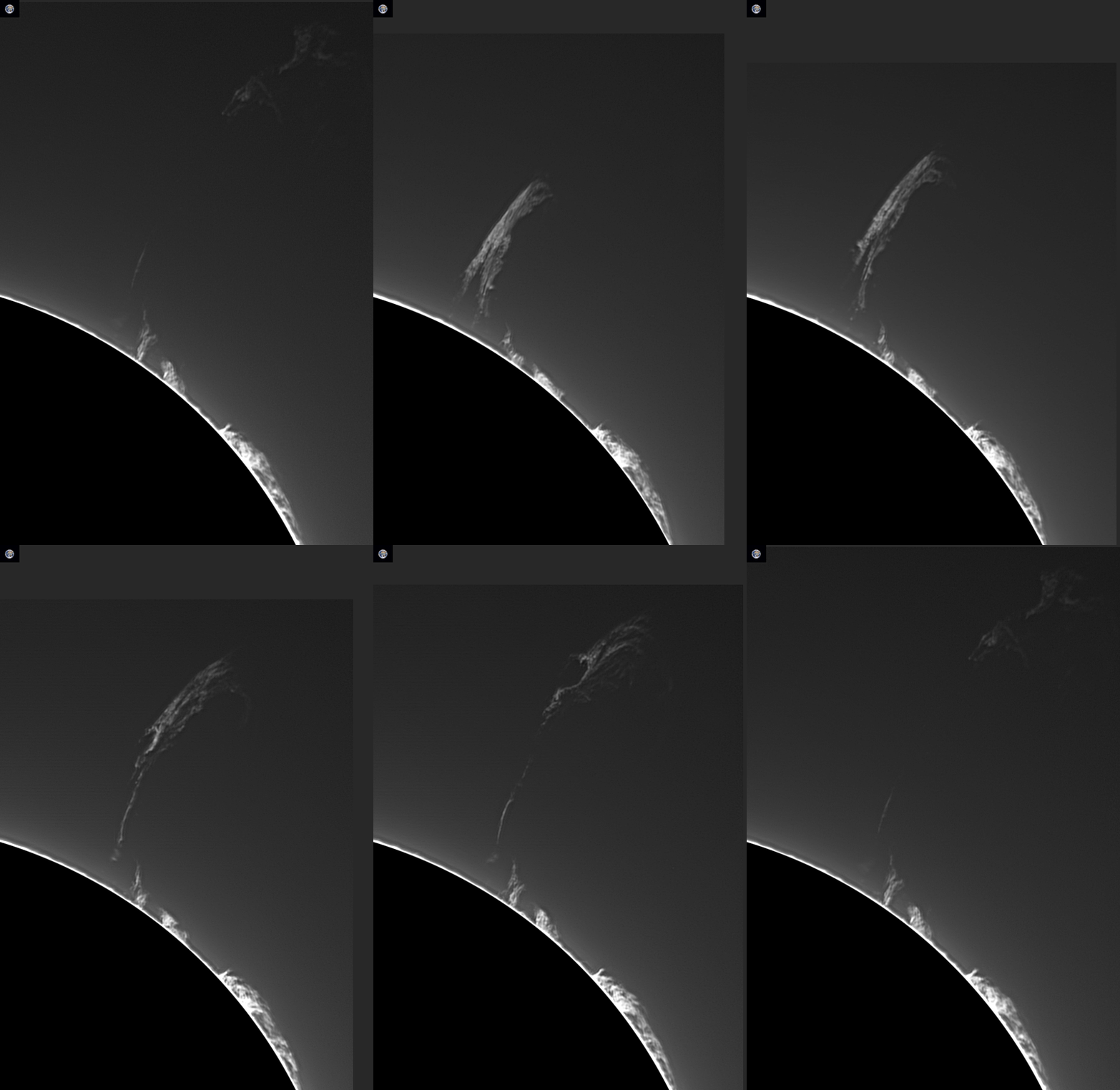


.jpg)