|
Astronomy Picture of the Day |
| |
Astronomy Picture of the Day |
 APOD: 2026 March 21 – Galaxies in the River: NGC 1300 and NGC 1297
Explanation:
Spiral NGC 1300 and elliptical NGC 1297 are galaxies that
lie on the banks of the southern constellation
Eridanus (The River).
At 70 million light-years distant or more,
both are members of the
Eridanus Galaxy Cluster.
About 100,000 light-years across, at lower left in this sharp,
galaxy group photo
NGC 1300 is seen face-on
with a prominent central bar and grand, sweeping spiral arms.
Like other
spiral galaxies,
including our own barred spiral Milky Way Galaxy, NGC 1300 is
thought to have a supermassive central black hole.
A contrast in appearance and slightly more distant, NGC 1297 is
the roughly spherical large
elliptical galaxy near the top of the frame.
With little active star formation,
elliptical galaxies
are composed of older populations of stars and are likely
he result of multiple
collisions and mergers with spirals.
 APOD: 2025 December 11 - Galaxies in the River
Explanation:
Large galaxies grow by eating small ones.
Even our own galaxy engages in
a sort of galactic
cannibalism, absorbing small galaxies that are too close and
are captured by
the Milky Way's gravity.
In fact, the
practice is common
in the universe and illustrated by this striking pair of interacting
galaxies
from the banks of the southern constellation
Eridanus,
The River.
Located over 50 million light years away,
the large, distorted spiral NGC 1532 is seen
locked in a gravitational struggle with
dwarf galaxy NGC 1531,
a struggle the smaller galaxy will
eventually lose.
Seen nearly edge-on
in this sharp image,
spiral NGC 1532 spans about 100,000 light-years.
The NGC 1532/1531 pair is thought to be similar
to the well-studied system of face-on spiral and small companion
known as M51.
 APOD: 2025 December 4 - Galaxies in the Furnace
Explanation:
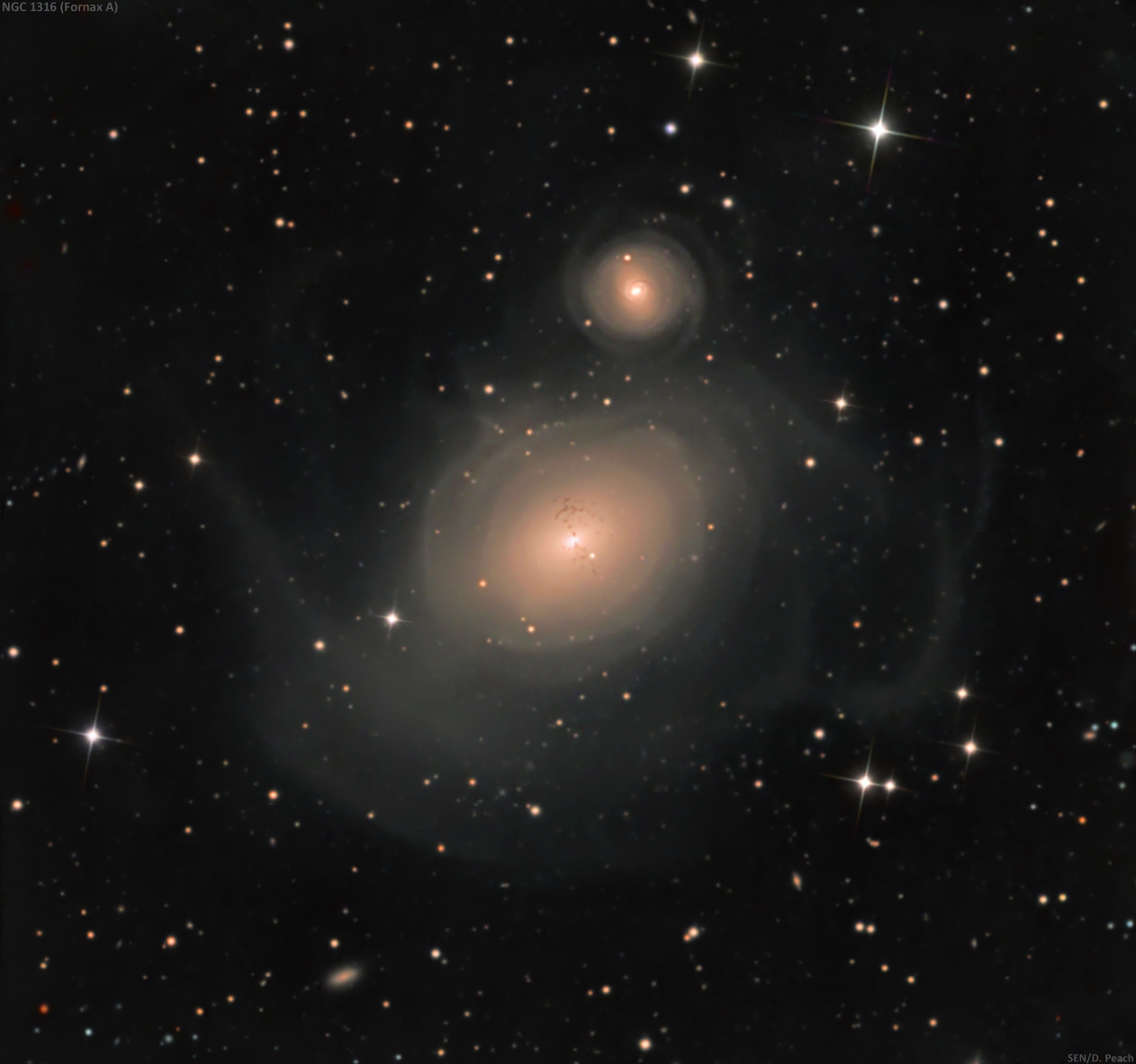
An example of violence on a cosmic scale, enormous
elliptical galaxy NGC 1316 lies about 75 million light-years away
toward Fornax,
the southern constellation of the Furnace.
Investigating
the startling sight, astronomers suspect the giant
galaxy of colliding with smaller neighbor NGC 1317 seen just right of
the large galaxy's center, producing far flung
star streams in loops and shells.
Light from their close encounter would
have
reached Earth some 100 million years ago.
In the sharp telescopic image,
the central regions of NGC 1316 and NGC 1317
appear separated by over 100,000 light-years.
Complex dust lanes
visible within also indicate that NGC 1316
is itself the result of a merger of galaxies in the distant past.
Found on the outskirts of the
Fornax galaxy cluster, NGC 1316 is known as Fornax A.
One of the visually brightest of the Fornax cluster galaxies it is one
of the strongest and largest celestial radio sources with radio emission
extending well beyond
this one degree wide field-of-view.
 APOD: 2025 October 3 – Pandora's Cluster of Galaxies
Explanation:
This deep field mosaicked image
presents a stunning view of galaxy cluster Abell 2744 recorded by
the James Webb Space Telescope's NIRCam.
Also dubbed Pandora's Cluster, Abell 2744 itself
appears to be a ponderous merger of three different massive galaxy
clusters.
It lies some 3.5 billion light-years away, toward the constellation
Sculptor.
Dominated by dark matter,
the mega-cluster warps and distorts the fabric of spacetime,
gravitationally lensing
even more distant objects.
Redder than the Pandora cluster galaxies,
many of the lensed sources are very distant galaxies in the early
Universe, their lensed images stretched and distorted into arcs.
Of course, distinctive
diffraction spikes mark foreground Milky Way stars.
At the Pandora Cluster's estimated
distance, this cosmic box spans about 6 million light-years.
But don't panic.
You can explore the tantalizing region in a
2 minute video tour.
 APOD: 2025 August 28 – Galaxies, Stars, and Dust
Explanation:
This well-composed telescopic field of view covers over a Full Moon on the
sky toward the high-flying constellation Pegasus.
Of course the brighter stars show
diffraction spikes, the commonly
seen effect of internal
supports
in reflecting telescopes, and lie well within our own
Milky Way galaxy.
The faint but pervasive clouds of interstellar dust
ride above the galactic plane
and dimly reflect the Milky Way's starlight.
Known as galactic cirrus or integrated flux nebulae they are
associated with the Milky Way's molecular clouds.
In fact, the diffuse cloud cataloged as
MBM 54,
less than a thousand light-years distant, fills the scene.
The galaxy seemingly tangled
in the dusty cloud is the striking spiral galaxy NGC 7497.
It's some 60 million light-years away, though.
Seen almost edge-on near the center of the field,
NGC 7497's own spiral arms and dust lanes echo
the colors of stars and dust
in our own Milky Way.
 APOD: 2025 August 19 – Giant Galaxies in Pavo
Explanation:
Over 500,000 light years across,
NGC 6872
(bottom left) is a truly
enormous barred spiral galaxy.
At least 5 times the size of our own large Milky Way,
NGC 6872 is the largest
known spiral galaxy.
About 200 million light-years distant
toward the southern constellation Pavo, the Peacock,
the appearance of this giant galaxy's
stretched out spiral arms suggest the wings of a giant bird.
So its popular moniker is the Condor galaxy.
Lined with massive young, bluish star clusters and
star-forming regions,
the extended and distorted spiral arms are
due to NGC 6872's past gravitational interactions with the nearby smaller
galaxy IC 4970,
visible here below the giant spiral galaxy's core.
Other members of the southern
Pavo galaxy group
are scattered through this
magnificent galaxy group portrait,
with the dominant giant elliptical galaxy, NGC 6876,
above and right of the soaring Condor galaxy.
 APOD: 2025 April 17 - Virgo Cluster Galaxies
Explanation:
Galaxies of the Virgo Cluster
are scattered across this nearly 4 degree wide
telescopic field of view.
About 50 million light-years distant, the
Virgo Cluster
is the closest large galaxy cluster to our own local galaxy group.
Prominent here are Virgo's bright elliptical galaxies from the
Messier
catalog,
M87 at bottom left, and M86 and M84 near center right.
M86 and M84 are recognized as part of
Markarian's Chain,
the visually striking line-up of galaxies on the
that runs through the upper portion of this frame.
Near the middle of the chain lies an intriguing interacting pair of
galaxies, NGC 4438 and NGC 4435,
known to some as Markarian's Eyes.
Still,
giant elliptical galaxy M87
dominates the Virgo cluster.
It's the home of a super massive black hole,
the first black hole ever imaged by planet Earth's
Event Horizon
Telescope.
 APOD: 2025 March 8 - Galaxies in Space
Explanation:
The plane of our Milky Way
galaxy extends beyond
the limb of planet Earth in this
space age exposure
captured by astronaut Don Pettit.
His camera,
with low light and
long duration settings, was pointed
out the window
of a Dragon crew spacecraft docked with the International Space Station
on January 29.
The orbital outpost was at an altitude of about 400 kilometers above
the Pacific Ocean at the time.
Motion blurs the Earth below, while
the gorgeous view from low Earth orbit
includes the Milky Way's prominent satellite
galaxies, known as the Large and Small Magellanic Clouds,
near the upper left in the frame.
Fans of southern skies
can also spot the Southern Cross.
The four brightest stars
of the famous southern constellation Crux
are near picture center, just beyond the edge of the bright horizon and
shining through Earth's orange tinted atmospheric glow.
 APOD: 2025 January 9 - Peculiar Galaxies of Arp 273
Explanation:
The colorful, spiky stars
are in the foreground of this image taken with a small telescope
on planet Earth.
They lie well within our own
Milky Way Galaxy.
But the two eye-catching galaxies in the frame lie far beyond the Milky Way,
at a distance of over 300 million light-years.
The galaxies' twisted and distorted appearance is due to
mutual gravitational tides as the pair engage in close encounters.
Cataloged as Arp 273 (also as
UGC 1810), these galaxies do look
peculiar,
but interacting galaxies are now understood to be
common in the universe.
Closer to home, the large spiral Andromeda Galaxy is known to be
some 2 million light-years away and
inexorably approaching
the Milky Way.
In fact the far away peculiar galaxies of Arp 273 may
offer an analog of the
far future encounter
of Andromeda and Milky Way.
Repeated galaxy encounters on a
cosmic timescale ultimately result in a merger into a single galaxy of stars.
From our perspective,
the bright cores of the Arp 273 galaxies are
separated by only a little over 100,000 light-years.
 APOD: 2025 January 6 – Colliding Spiral Galaxies from Webb and Hubble
Explanation:
Billions of years from now, only one of these two galaxies will remain.
Until then, spiral galaxies NGC 2207 and IC 2163 will slowly pull each other apart,
creating tides of matter,
sheets of
shocked gas, lanes of
dark dust, bursts of
star formation, and streams of
cast-away stars.
The featured image in scientifically assigned colors is a composite of
Hubble exposures in
visible light and
Webb exposures in
infrared light.
Astronomers predict that NGC 2207, the larger galaxy on the right, will
eventually incorporate IC 2163, the smaller galaxy on the left.
In the most
recent encounter that about peaked 40 million years ago,
the smaller galaxy is swinging around counter-clockwise
and is now
slightly behind the larger galaxy.
The space between stars is so vast that when
galaxies collide,
the stars in them usually do not collide.
 APOD: 2024 November 7 - Shell Galaxies in Pisces
Explanation:
This spectacular
intergalactic skyscape features Arp 227,
a curious system of galaxies from the 1966
Atlas of Peculiar Galaxies.
Some 100 million light-years distant
within the boundaries of the constellation Pisces,
Arp 227 consists of the two galaxies prominent
above and left of center, the
shell galaxy NGC 474
and its blue, spiral-armed neighbor NGC 470.
The readily apparent shells and star streams of
NGC 474 are likely tidal features
originating from the accretion
of another smaller galaxy during close gravitational encounters
that began over a billion years ago.
The large galaxy on the bottom righthand side of the deep image,
NGC 467, appears to be surrounded by faint shells and streams too,
evidence of another
merging galaxy system.
Intriguing background galaxies are scattered around
the field that also includes spiky foreground stars.
Of course, those stars lie well within our own
Milky Way Galaxy.
The telescopic field of view spans 25 arc minutes or just under 1/2 degree
on the sky.
 APOD: 2024 July 30 – Arp 142: Interacting Galaxies from Webb
Explanation:
To some, it looks like a penguin.
But to people who study the universe, it is an interesting example of two big galaxies interacting.
Just a few hundred million years ago, the upper NGC 2936 was likely a
normal spiral galaxy:
spinning, creating stars, and minding its own business.
Then it got too close to the massive
elliptical galaxy
NGC 2937, below, and took a dive.
Together known as Arp 142, they are
featured
in this new
Webb
infrared image, while a
visible light
Hubble
image appears in comparison.
NGC 2936 is not only being deflected, but
distorted, by this close gravitational interaction.
When massive galaxies
pass near each other,
gas is typically condensed from which
new stars form.
A young group of stars appears as the nose of the penguin toward the right of the upper galaxy, while in the center of the
spiral,
bright stars together appear as an eye.
Before a billion years, the
two galaxies will likely merge into one larger galaxy.
 APOD: 2024 June 8 - Pandora's Cluster of Galaxies
Explanation:
This deep field mosaicked image
presents a stunning view of galaxy cluster Abell 2744 recorded by
the James Webb Space Telescope's NIRCam.
Also dubbed Pandora's Cluster, Abell 2744 itself
appears to be a ponderous merger of three different massive galaxy
clusters.
It lies some 3.5 billion light-years away, toward the constellation
Sculptor.
Dominated by
dark matter,
the mega-cluster warps and distorts
the fabric of spacetime,
gravitationally lensing
even more distant objects.
Redder than the Pandora cluster galaxies
many of the lensed sources are very distant galaxies in the early
Universe, their lensed images stretched and distorted into arcs.
Of course distinctive
diffraction spikes mark foreground Milky Way
stars.
At the Pandora Cluster's estimated
distance this cosmic box spans about 6 million light-years.
But don't panic.
You can explore the tantalizing region in a
2 minute video tour.
 APOD: 2024 March 27 – The Coma Cluster of Galaxies
Explanation:
Almost every object in the
featured photograph is a galaxy.
The Coma Cluster of Galaxies pictured here is one of the densest
clusters known - it contains thousands of
galaxies.
Each of these galaxies houses billions of stars -
just as our own
Milky Way Galaxy does.
Although nearby when compared to most other
clusters,
light from the Coma Cluster
still takes hundreds of millions of years to reach us.
In fact, the
Coma Cluster is so big it takes light millions of years just to go from one side to the other.
Most galaxies in Coma and other clusters are
ellipticals,
while most
galaxies outside of clusters are
spirals.
The nature of
Coma's X-ray emission is
still being investigated.
 APOD: 2024 February 20 – AM1054: Stars Form as Galaxies Collide
Explanation:
When galaxies collide, how many stars are born?
For AM1054-325,
featured here in a recently released image by the
Hubble Space Telescope, the answer is millions.
Instead of stars
being destroyed
as galaxy AM1054-325 and a nearby galaxy
circle each other,
their gravity and motion has
ignited stellar creation.
Star formation occurs rapidly in the gaseous debris stretching from
AM1054-325’s yellowish body due to the other galaxy’s gravitational pull.
Hydrogen gas surrounding newborn
stars glows pink.
Bright infant
stars shine blue
and cluster together in compact nurseries of thousands to
millions of stars.
AM1054-325 possesses over 100 of these intense-blue,
dot-like star clusters, some appearing like a
string
of
pearls.
Analyzing
ultraviolet light helped determine that most of these stars are less than 10 million years old:
stellar babies.
Many of these nurseries may grow up to be
globular star clusters, while the bundle of young stars at the bottom tip may even
detach and form a small galaxy.
 APOD: 2024 February 7 – The Heart Shaped Antennae Galaxies
Explanation:
Are these two galaxies really attracted to each other?
Yes, gravitationally, and the result appears as an
enormous
iconic heart -- at least for now.
Pictured is the pair of galaxies cataloged as
NGC 4038 and NGC 4039,known as the
Antennae Galaxies.
Because they are only 60 million
light years away, close by
intergalactic standards,
the pair is one of the best studied
interacting galaxies on the night sky.
Their
strong attraction
began about a billion years ago
when they passed unusually close to each other.
As the two
galaxies interact, their
stars rarely collide, but new stars are
formed when their interstellar gases crash together.
Some new stars have already formed, for example, in the long antennae seen extending out from the sides of the dancing duo.
By the time the
galaxy merger is complete, likely over a
billion years from now, billions of new stars may have formed.
 APOD: 2023 December 21 - Three Galaxies and a Comet
Explanation:
Distant galaxies abound in this
one degree wide field of view toward
the southern constellation Grus (The Crane).
But the three spiral galaxies at the lower right are quite striking.
In fact, all three galaxies are grouped about 70 million light years away
and sometimes known as
the Grus Triplet.
They share the pretty telescopic frame, recorded on December 13,
with the
comet
designated
C/2020 V2 ZTF.
Now outbound from the inner Solar System and swinging below
the ecliptic plane in a
hyperbolic
orbit, the comet was about 29 light-minutes from our fair planet in this image.
And though this comet ZTF was brighter when it was
closest to the Sun last May and closest to Earth in September of 2023,
it still shines in telescopes pointed toward southern night skies,
remaining almost as bright as the Grus Triplet galaxies.
 APOD: 2023 November 2 - The Fornax Cluster of Galaxies
Explanation:
Named for the southern
constellation
toward which most of its galaxies can be found, the
Fornax
Cluster is one of the closest clusters of galaxies.
About 62 million light-years away, it's over 20 times more
distant than our neighboring
Andromeda Galaxy, but
only about 10 percent farther along than the better known and more
populated Virgo Galaxy Cluster.
Seen across
this three degree wide
field-of-view, almost every
yellowish splotch on the image is an elliptical galaxy in the
Fornax cluster.
Elliptical galaxies
NGC 1399 and NGC
1404
are the dominant, bright cluster members toward the bottom center.
A standout, large barred spiral galaxy,
NGC 1365,
is visible on the upper right as a prominent Fornax cluster member.
 APOD: 2023 October 24 – Arp 87: Merging Galaxies from Hubble
Explanation:
This dance is to the death.
As these two large galaxies duel, a
cosmic bridge of stars, gas, and dust currently stretches over 75,000 light-years and joins them.
The bridge itself is strong evidence
that these two immense star systems have
passed close to each other
and experienced
violent tides induced by mutual gravity.
As further evidence, the face-on spiral galaxy on
the right, also known as NGC 3808A,
exhibits many young blue star clusters produced in a burst
of star formation.
The twisted edge-on spiral on the left (NGC 3808B) seems to be wrapped
in the material bridging the galaxies and
surrounded by a curious
polar ring.
Together, the system is known as
Arp 87.
While such interactions are drawn out over billions of years, repeated
close passages
will ultimately create one merged galaxy.
Although
this scenario
does look unusual, galactic mergers are thought
to be common, with Arp 87 representing a stage in
this
inevitable process.
The Arp 87 dancing pair are
about 300 million
light-years
distant toward the constellation of the Lion
(Leo).
The prominent edge-on spiral
galaxy at the far left
appears to be a more distant background galaxy and
not involved in the on-going merger.
 APOD: 2023 October 20 - Galaxies and a Comet
Explanation:
Galaxies abound in this sharp
telescopic image recorded on
October 12 in dark skies over June Lake, California.
The celestial scene spans nearly 2 degrees within the boundaries
of the well-trained northern constellation Canes Venatici.
Prominent at the upper left 23.5 million light-years distant
is big, beautiful spiral galaxy NGC 4258,
known to some as Messier 106.
Eye-catching edge-on spiral NGC 4217 is above and right of center
about 60 million light-years away.
Just passing through the pretty field of view is comet
C/2023 H2 Lemmon,
discovered last April in image data from the
Mount Lemmon Survey.
Here the comet sports more of a lime green coma though, along
with a faint, narrow ion tail stretching
toward the top of the frame.
This
visitor to the inner Solar System
is presently less than 7 light-minutes away and still difficult to spot
with binoculars, but it's growing brighter.
Comet C/2023 H2 Lemmon
will reach
perihelion, its closest point to the Sun, on October 29 and
perigee, its closest to our fair planet, on November 10
as it transitions from morning to evening northern skies.
 APOD: 2023 August 27 – Three Galaxies and a Comet
Explanation:
Diffuse starlight and dark nebulae
along the southern
Milky Way arc over the
horizon and sprawl diagonally through this
gorgeous nightscape.
The breath-taking mosaic spans a wide
100 degrees, with the rugged
terrain of the
Patagonia,
Argentina
region in the foreground.
Along with the
insider's view of
our own galaxy, the image
features our outside perspective on two irregular satellite galaxies -
the Large and
Small Magellanic Clouds.
The scene also captures the
broad tail
and bright coma of
Comet McNaught, the
Great Comet of 2007.
 APOD: 2023 July 27 - Galaxies in the River
Explanation:
Large galaxies grow by eating small ones.
Even our own galaxy engages in
a sort of galactic
cannibalism, absorbing small galaxies that are too close and
are captured by
the Milky Way's gravity.
In fact, the
practice is common
in the universe and illustrated by this striking pair of interacting
galaxies
from the banks of the southern constellation
Eridanus,
The River.
Located over 50 million light years away,
the large, distorted spiral NGC 1532 is seen
locked in a gravitational struggle with
dwarf galaxy NGC 1531,
a struggle the smaller galaxy will
eventually lose.
Seen nearly edge-on, spiral NGC 1532 spans about 100,000 light-years.
The merging galaxies are captured
in this sharp image from the
Dark Energy Camera mounted on the National Science Foundation’s
Blanco 4-meter Telescope at Cerro Tololo Inter-American
Observatory in Chile.
The NGC 1532/1531 pair is thought to be similar
to the well-studied system of face-on spiral and small companion
known as M51.
 APOD: 2023 July 1 - Three Galaxies in Draco
Explanation:
This tantalizing trio of galaxies sometimes called the Draco Group,
is located in the northern constellation of (you guessed it)
Draco, the Dragon.
From left to right are
face-on spiral NGC 5985,
elliptical galaxy NGC 5982, and
edge-on spiral NGC 5981,
all found within this
single telescopic field of view that spans a little more than
the width of the full moon.
While the group is far too small to be a
galaxy cluster,
and has not been
catalogued
as a compact galaxy group,
the three galaxies all do lie roughly
100 million light-years from planet Earth.
Not as well known as other tight
groupings of galaxies,
the contrast in visual appearance
still makes this triplet an attractive subject for astroimagers.
On close examination with
spectrographs,
the bright core of striking spiral NGC 5985 shows
prominent emission in specific wavelengths of light, prompting
astronomers to classify it as a
Seyfert, a type of active galaxy.
This
impressively deep exposure
hints at a faint dim halo along with sharp-edged shells surrounding
elliptical NGC 5982, evidence of past galactic mergers.
It also reveals many even more
distant background galaxies.
 APOD: 2023 June 9 - Pandora's Cluster of Galaxies
Explanation:
This deep field mosaicked image
presents a stunning view of galaxy cluster Abell 2744 recorded by
the James Webb Space Telescope's NIRCam.
Also dubbed Pandora's Cluster, Abell 2744 itself
appears to be a ponderous merger of three different massive galaxy
clusters.
It lies some 3.5 billion light-years away, toward the constellation Sculptor.
Dominated by dark matter,
the mega-cluster warps and distorts
the fabric of spacetime,
gravitationally lensing
even more distant objects.
Redder than the Pandora cluster galaxies
many of the lensed sources are very distant galaxies in the early
Universe, their lensed images stretched and distorted into arcs.
Of course distinctive
diffraction spikes mark foreground Milky Way
stars.
At the Pandora Cluster's estimated
distance this cosmic box spans about 6 million light-years.
But don't panic.
You can explore the tantalizing region in a
2 minute video tour.
 APOD: 2023 May 26 - Virgo Cluster Galaxies
Explanation:
Galaxies of the Virgo Cluster
are scattered across this nearly 4 degree wide
telescopic field of view.
About 50 million light-years distant, the Virgo Cluster is the
closest large galaxy cluster to our own local galaxy group.
Prominent here are Virgo's bright elliptical galaxies
Messier catalog,
M87 at bottom center, and M84 and M86 (top to bottom)
near top left.
M84 and M86 are recognized as part of
Markarian's Chain,
a visually striking line-up of galaxies on the
left side of this frame.
Near the middle of the chain lies an intriguing interacting pair of galaxies,
NGC 4438 and NGC 4435,
known to some as Markarian's Eyes.
Of course
giant elliptical galaxy M87
dominates the Virgo cluster.
It's the home of a super massive black hole,
the first black hole ever imaged by planet Earth's
Event Horizon Telescope.
 APOD: 2023 February 16 - The Hydra Cluster of Galaxies
Explanation:
 APOD: 2023 January 23 – The Colliding Spiral Galaxies of Arp 274
Explanation:
Two galaxies are squaring off in Virgo and here are the latest pictures.
When two
galaxies collide,
the stars that compose them usually do not.
This is because galaxies
are mostly empty space and, however bright,
stars only take up only a small fraction of that space.
But during the
collision, one galaxy can rip the other apart gravitationally,
and dust and gas common to both
galaxies does
collide.
If the two galaxies merge, black holes that likely resided in each galaxy center
may eventually merge.
Because the distances are so large, the
whole thing takes place in
slow motion -- over hundreds of millions of years.
Besides the two
large spiral galaxies,
a smaller third galaxy is visible on the far left of the
featured image of
Arp 274, also known as NGC 5679.
Arp 274 spans about 200,000
light years across and lies about 400 million light years away toward the
constellation of Virgo.
 APOD: 2022 November 8 - Galaxies: Wilds Triplet from Hubble
Explanation:
How many galaxies are interacting here?
This grouping of galaxies is called the
Wild Triplet, not only for the
discoverer, but for the number of bright galaxies that appear.
It had been assumed that all three galaxies,
collectively cataloged as
Arp 248, are
interacting,
but more
recent investigations reveal that only the
brightest two galaxies are sparring gravitationally:
the big galaxies at the top and bottom.
The spiral galaxy in the middle of the
featured image by the
Hubble Space Telescope is actually far in the distance,
as is the galaxy just below it and all of the other
numerous galaxies in the field.
A striking result of these
giants jousting is a tremendous
bridge of stars, gas, and
dust that stretches between them -- a bridge almost 200,000
light-years long.
Light we see today from Wild's Triplet left about
200 million years ago, when
dinosaurs roamed the Earth.
In perhaps a billion years or so, the
two interacting galaxies will merge to form a
single large spiral galaxy.
 APOD: 2022 June 15 - In the Heart of the Virgo Cluster
Explanation:
The Virgo Cluster of Galaxies
is the closest cluster of galaxies to our
Milky Way Galaxy.
The Virgo Cluster
is so close that it spans more than 5 degrees
on the sky - about 10 times the angle made by a
full Moon.
With its heart lying about 70 million light years distant,
the Virgo Cluster
is the nearest
cluster of galaxies, contains over 2,000 galaxies, and has a
noticeable gravitational pull on the galaxies of the
Local Group of Galaxies surrounding our
Milky Way Galaxy.
The cluster contains not only galaxies filled with stars but also
gas so hot it glows in
X-rays.
Motions of
galaxies in and around clusters indicate that they contain more
dark matter than any visible matter we can see.
Pictured here, the heart of the
Virgo Cluster
includes bright
Messier galaxies such as
Markarian's Eyes on the upper left,
M86 just to the upper right of center,
M84 on the far right,
as well as spiral galaxy NGC 4388 at the bottom right.
 APOD: 2022 May 17 - NGC 1316: After Galaxies Collide
Explanation:
Astronomers turn detectives when trying to
figure out the cause of startling sights like
NGC 1316.
Investigations indicate that
NGC 1316
is an enormous elliptical galaxy
that started, about 100 million years ago, to devour a smaller
spiral galaxy neighbor,
NGC 1317, just on the upper right.
Supporting evidence includes the dark
dust lanes
characteristic of a
spiral galaxy,
and faint swirls and shells of stars and gas visible in this
wide and deep image.
One thing that
>remains unexplained is the unusually small
globular star clusters,
seen as faint dots on the image.
Most elliptical galaxies have
more and brighter globular clusters than
NGC 1316.
Yet the observed
globulars are too old to have been
created by the recent
spiral collision.
One hypothesis is that these
globulars
survive from an even earlier
galaxy
that was subsumed into
NGC 1316.
Another surprising attribute of
NGC 1316,
also known as Fornax A, is its
giant lobes of gas that glow brightly in
radio waves.
 APOD: 2022 February 19 - Peculiar Galaxies of Arp 273
Explanation:
The spiky stars
in the foreground of this backyard
telescopic frame are well within our own
Milky Way Galaxy.
But the two eye-catching galaxies lie far beyond the Milky Way,
at a distance of over 300 million light-years.
Their distorted appearance is due to gravitational tides
as the pair engage in close encounters.
Cataloged as Arp 273 (also as
UGC 1810), the galaxies do look
peculiar,
but interacting galaxies are now understood to be
common in the universe.
Nearby, the large spiral Andromeda Galaxy is known to be
some 2 million light-years away and approaching the Milky Way.
The peculiar galaxies of Arp 273 may offer an analog of their
far future encounter.
Repeated galaxy encounters on a
cosmic timescale can ultimately
result in a merger into a single galaxy of stars.
From our perspective, the bright cores of the Arp 273 galaxies are
separated by only a little over 100,000 light-years.
 APOD: 2022 January 29 - The Fornax Cluster of Galaxies
Explanation:
Named for the southern
constellation
toward which most of its galaxies can be found, the
Fornax
Cluster is one of the closest clusters of galaxies.
About 62 million light-years away, it is almost 20 times more
distant than our neighboring
Andromeda Galaxy, and
only about 10 percent farther than the better known and more
populated Virgo Galaxy Cluster.
Seen across this two degree wide field-of-view, almost every
yellowish splotch on the image is an elliptical galaxy in the
Fornax
cluster.
Elliptical galaxies
NGC 1399 and NGC 1404
are the dominant, bright cluster members toward the upper left
(but not the spiky foreground stars).
A standout barred spiral galaxy
NGC 1365
is visible on the lower right as a prominent Fornax cluster member.
 APOD: 2021 November 17 - NGC 3314: When Galaxies Overlap
Explanation:
Why doesn't the nearby galaxy create a
gravitational lensing effect on the background galaxy?
It does, but since both
galaxies
are so nearby, the angular shift is much smaller than the angular sizes
of the galaxies themselves.
The featured
Hubble image of
NGC 3314
shows two large spiral galaxies which happen to
line up exactly.
The foreground spiral
NGC 3314a appears nearly face-on with its
pinwheel shape defined by young bright star clusters.
Against the glow of the background galaxy NGC 3314b, though, dark swirling lanes of
interstellar dust can also be seen tracing the nearer spiral's structure.
Both galaxies appear on the edge of the
Hydra Cluster of Galaxies,
a cluster that is about 200 million light years away.
Gravitational lens distortions
are much easier to see when the
lensing galaxy is smaller and further away.
Then, the background galaxy may even be distorted into a
ring around the nearer.
Fast gravitational lens flashes due to stars in the foreground galaxy
momentarily magnifying the light from stars in the background galaxy might one day be visible in future observing campaigns with high-resolution telescopes.
 APOD: 2021 September 7 - NGC 520: Colliding Galaxies from Hubble
Explanation:
Is this one galaxy or two?
The jumble of stars, gas, and
dust that is
NGC 520 is now thought
to incorporate the remains of two separate disk galaxies.
A defining component of
NGC 520 --
as seen in great detail in the
featured image from the
Hubble Space Telescope -- is its
band of intricately interlaced dust
running vertically down the spine of the
colliding galaxies.
A similar looking collision might be expected in a few billion
years when our disk
Milky Way Galaxy to
collides with our large-disk galactic neighbor
Andromeda (M31).
The collision that defines
NGC 520
started about 300 million years ago.
Also known as Arp 157, NGC 520 lies about 100 million light years
distant, spans about 100 thousand
light years,
and can be seen with a small telescope toward the
constellation of the Fish
(Pisces).
Although the speeds of stars in
NGC 520 are fast, the distances are
so vast that the
battling pair
will surely not change its shape noticeably during our lifetimes.
 APOD: 2021 September 1 - Dancing Ghosts: Curved Jets from Active Galaxies
Explanation:
Why would galaxies emit jets that look like ghosts?
And furthermore, why do they appear to be
dancing?
The curled and fluffy jets from the
supermassive black holes at the
centers of two host
galaxies
(top center and lower left) are unlike anything seen before.
They were found by astronomers using the
Australian Square Kilometer Array Pathfinder (ASKAP) radio telescope
when creating maps tracing the evolution of galaxies.
Images preceding this
Evolutionary Map of the Universe survey only showed
amorphous blobs.
Eventually, comparisons of relative amounts of
energy emitted revealed the glowing elongated structures were
created by
electrons streaming
around magnetic field lines.
Overlaying the
radio data on an
optical view of the sky
(Dark Energy Survey)
confirmed that the
electron streams originated from the
centers of
active galaxies.
Usually such
Active Galactic Nuclei (AGN) produce
straight jets.
A leading hypothesis for the geometric origin of
these unusually graceful shapes involves the flow of
large-scale intergalactic
winds.
 APOD: 2021 January 26 - Central NGC 1316: After Galaxies Collide
Explanation:
How did this strange-looking galaxy form?
Astronomers turn detectives when trying to figure out
the cause of unusual jumbles of stars, gas, and dust like NGC 1316.
Inspection indicates that NGC 1316 is an enormous
elliptical galaxy
that somehow includes dark dust lanes usually found in a
spiral galaxy.
Detailed images taken by the
Hubble Space Telescope
shows details, however, that help in reconstructing the history of this
gigantic tangle.
Deep and wide images show
huge collisional shells,
while deep central images reveal fewer
globular clusters of stars toward NGC 1316's interior.
Such effects are expected in galaxies that have undergone collisions or merging with other
galaxies in the past few billion years.
The dark knots and lanes of
dust, prominent in the
featured image,
indicate that one or more of the devoured galaxies were spiral galaxies.
NGC 1316
spans about 50,000 light years and lies about 60 million
light years away
toward the constellation of the Furnace
(Fornax).
 APOD: 2021 January 1 - Galaxies and the South Celestial Pole
Explanation:
The South Celestial Pole
is easy to spot in star trail images of the southern sky.
The extension of Earth's axis of rotation to the south, it's
at the center of all the southern star trail arcs.
In this starry panorama
streching about 60 degrees across deep southern skies
the South Celestial Pole is somewhere near the middle though,
flanked by bright galaxies and southern celestial gems.
Across the top of the frame are the stars and nebulae along the plane
of our own Milky Way Galaxy.
Gamma Crucis, a yellowish giant star
heads the Southern Cross near top
center, with the dark expanse of the Coalsack nebula tucked under the
cross arm on the left.
Eta Carinae and the reddish glow of the Great Carina Nebula shine along
the galactic plane near the right edge.
At the bottom are the Large and Small Magellanic clouds,
external galaxies
in their own right and satellites of the mighty Milky Way.
A line from Gamma Crucis through the blue star at the bottom of the
southern cross, Alpha Crucis, points toward the South Celestial Pole,
but where exactly is it?
Just look
for south pole star
Sigma Octantis.
Analog to Polaris the north pole star,
Sigma Octantis is little over one degree fom the
the South Celestial pole.
 APOD: 2020 December 3 - The Antennae Galaxies in Collision
Explanation:
Sixty million light-years away toward the southerly constellation Corvus,
these two large galaxies are colliding.
The cosmic train wreck captured in stunning detail in this
Hubble Space Telescope snapshot
takes hundreds of millions of years to play out.
Cataloged as NGC 4038 and NGC 4039, the galaxies' individual stars don't
often collide though.
Their large clouds of molecular gas and dust do,
triggering furious episodes of star formation near the center of
the wreckage.
New star clusters and interstellar matter are jumbled and
flung far from the scene of the accident by gravitational forces.
This Hubble close-up frame is about 50,000 light-years across
at the estimated distance of the colliding galaxies.
In wider-field views their suggestive visual appearance,
with extended structures arcing for hundreds of thousands of
light-years, gives the galaxy pair its popular name,
The Antennae Galaxies.
 APOD: 2020 November 7 - The Hercules Cluster of Galaxies
Explanation:
These are galaxies of the Hercules Cluster, an archipelago of
island universes a mere
500 million light-years away.
Also known as
Abell 2151,
this cluster is loaded with gas and dust rich,
star-forming spiral galaxies
but has relatively few elliptical galaxies,
which lack gas and dust and the associated newborn stars.
The colors in
this deep composite
image clearly show the star forming galaxies with a blue tint and
galaxies with older stellar populations with a yellowish cast.
The sharp picture spans about 1/2 degree across the
cluster center, corresponding to over 4 million light-years at the
cluster's estimated distance.
Diffraction spikes around brighter foreground stars in our
own Milky Way galaxy are produced by the imaging telescope's
mirror support vanes.
In the cosmic vista many galaxies seem to be
colliding or
merging
while others seem
distorted - clear evidence that
cluster galaxies
commonly interact.
In fact,
the Hercules Cluster itself may be seen as the result of
ongoing mergers of smaller galaxy clusters and is thought to be similar
to
young galaxy clusters in
the much more distant,
early Universe.
 APOD: 2020 October 15 - Galaxies in Pegasus
Explanation:
This sharp telescopic view
reveals galaxies scattered
beyond
the stars of the Milky Way,
at the northern boundary of the high-flying constellation
Pegasus.
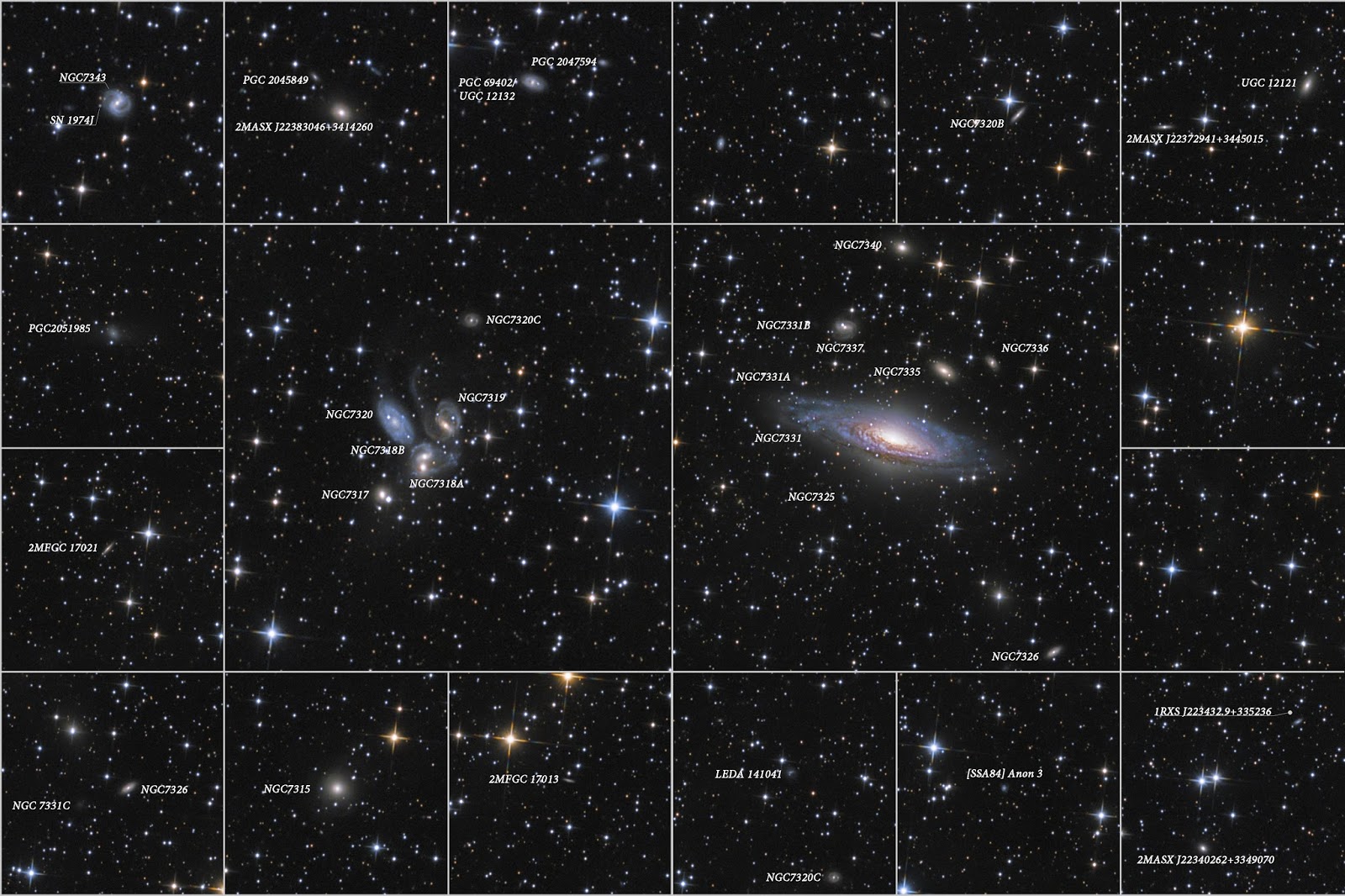
Prominent at the upper right is NGC 7331.
A mere 50 million light-years away, the large spiral is one
of the brighter galaxies not included in
Charles Messier's famous 18th century catalog.
The disturbed looking group of galaxies at the lower left is
well-known as Stephan's Quintet.
About 300 million light-years distant, the quintet
dramatically illustrates a multiple galaxy collision, its
powerful, ongoing
interactions posed for a brief cosmic snapshot.
On the sky, the quintet and
NGC 7331 are separated by about half a degree.
 APOD: 2020 October 10 - Virgo Cluster Galaxies
Explanation:
Galaxies of the Virgo Cluster
are scattered across this deep telescopic field of view.
The cosmic scene spans about three Full Moons, captured in dark skies near
Jalisco, Mexico, planet Earth.
About 50 million light-years distant, the Virgo Cluster is the
closest large galaxy cluster to our own local galaxy group.
Prominent here are Virgo's bright elliptical galaxies from the
Messier catalog,
M87 at the top left, and M84 and M86 seen
(bottom to top) below and right of center.
M84 and M86 are recognized as part of
Markarian's Chain,
a visually striking line-up of galaxies vertically on the
right side of this frame.
Near the middle of the chain lies an intriguing interacting pair of galaxies,
NGC 4438 and NGC 4435,
known to some as Markarian's Eyes.
Of course
giant elliptical galaxy M87
dominates the Virgo cluster.
It's the home of a super massive black hole,
the first black hole ever imaged by planet Earth's
Event Horizon Telescope.
 APOD: 2020 August 27 - Shell Galaxies in Pisces
Explanation:
This intergalactic skyscape features a peculiar system
of galaxies cataloged as Arp 227 some 100 million light-years
distant.
Swimming within the boundaries of the
constellation Pisces,
Arp 227 consists of the two galaxies
prominent right of center,
the curious shell galaxy NGC 474 and its blue,
spiral-armed neighbor NGC 470.
The faint, wide arcs or
shells
of NGC 474 could have been formed by a
gravitational encounter with neighbor NGC 470.
Alternately the shells could be
caused by a merger with a
smaller galaxy producing an effect analogous to ripples across
the surface of a pond.
The large galaxy on the top lefthand side of the deep image,
NGC 467, appears to be surrounded by faint shells too,
evidence of another
interacting galaxy system.
Intriguing background galaxies are scattered around
the field that also includes spiky foreground stars.
Of course, those stars lie well within our own
Milky Way Galaxy.
The field of view spans 25 arc minutes or about 1/2 degree
on the sky.
 APOD: 2020 June 6 - Comet PanSTARRs and the Galaxies
Explanation:
Comet PanSTARRs, C/2017 T2,
shared this stunning telescopic field of
view with galaxies
M81 and M82 on May 22/23.
Of course, the galaxies were some 12 million light-years distant and
the comet about 14 light-minutes away, seen in
planet Earth's sky toward the Big Dipper.
A new visitor
from the Oort Cloud, this
Comet PanSTARRs
was discovered in 2017 by the PanSTARRs survey telescope when
the comet was over 1 light-hour from the Sun, almost as distant
as the orbit of Saturn.
With a beautiful
coma and dust tail,
this comet has been a
solid northern hemisphere performer for telescope wielding
comet watchers this May, following its closest approach to the Sun
on May 4.
In this deep image
from dark California skies the outbound comet even seems to
develop a short anti-tail as it leaves
the inner Solar System.
 APOD: 2020 March 21 - Comet ATLAS and the Mighty Galaxies
Explanation:
Comet ATLAS C/2019 Y4
was discovered by the NASA funded
Asteroid Terrestrial-impact Last Alert System,
the last comet discovery reported in 2019.
Now growing brighter in northern night skies, the comet's pretty
greenish coma is at the upper left of
this telescopic skyview
captured from a remotely operated observatory
in New Mexico on March 18.
At lower right are M81 and M82, well-known as
large, gravitationally interacting galaxies.
Seen through faint dust clouds above the Milky Way,
the galaxy pair lies about 12 million light-years distant, toward
the constellation Ursa Major.
In bound Comet ATLAS is about 9 light-minutes from Earth, still beyond the
orbit of Mars.
The comet's elongated orbit is similar to
orbit of the
Great
Comet of 1844
though, a trajectory that will return
this comet to the inner Solar System in about 6,000 years.
Comet ATLAS
will reach a perihelion
or closest approach to the Sun on May 31 inside the orbit of Mercury and
may become a naked-eye comet
in
the coming days.
 APOD: 2020 March 4 - The Slow Dance of Galaxies NGC 5394 and 5395
Explanation:
If you
like slow dances,
then this may be one for you.
A single turn in this dance takes
several hundred million years.
Two galaxies, NGC 5394 and NGC 5395,
slowly whirl about each other in a
gravitational interaction
that sets off a flourish of sparks in the form of new
stars.
The featured image, taken with the
Gemini North 8-meter telescope on
Maunakea,
Hawaii,
USA, combines
four different colors.
Emission from
hydrogen gas, colored red, marks
stellar nurseries where new stars drive the evolution of the
galaxies.
Also visible are dark
dust lanes that mark gas that will eventually become
stellar nurseries.
If you look carefully you will see
many more galaxies in
the background, some involved in their own slow
cosmic dances.
 APOD: 2020 January 8 - Galaxies in the River
Explanation:
Large galaxies grow by eating small ones.
Even our own galaxy engages in
a sort of galactic
cannibalism, absorbing small galaxies that are too close and
are captured by
the Milky Way's gravity.
In fact, the
practice is common
in the universe and illustrated by this striking pair of interacting
galaxies
from the banks of the southern constellation
Eridanus,
The River.
Located over 50 million light years away,
the large, distorted
spiral NGC 1532 is seen locked in a
gravitational struggle with dwarf galaxy NGC 1531 (right of center),
a struggle the smaller galaxy will
eventually lose.
Seen edge-on, spiral NGC 1532 spans about 100,000 light-years.
Nicely detailed in this sharp image, the
NGC 1532/1531 pair is thought to be similar
to the well-studied system of face-on spiral and small companion
known as M51.
 APOD: 2019 November 20 - Arp 273: Battling Galaxies from Hubble
Explanation:
What's happening to these spiral galaxies?
Although details remain
uncertain, there sure seems to be a titanic battle going on.
The
upper galaxy
is labelled UGC 1810 by itself, but together with its
collisional partners is known as
Arp 273.
The overall shape of the UGC 1810 -- in particular its
blue outer ring --
is likely a result of wild and
violent
gravitational
interactions.
The blue color of the outer ring at the top is caused by massive stars that are
blue hot
and have formed only in the past few million years.
The inner part of the upper galaxy -- itself an older spiral galaxy -- appears redder and threaded with cool
filamentary dust.
A few bright
stars appear well in the foreground, unrelated to
colliding galaxies, while several far-distant galaxies are visible in the background.
Arp 273 lies about 300 million light years away
toward
the constellation of Andromeda.
Quite likely, UGC 1810 will
devour its
galactic sidekicks over the next billion years and settle into a classic
spiral form.
 APOD: 2019 November 5 - Spiral Galaxies Spinning Super Fast
Explanation:
Why are these galaxies spinning so fast?
If you estimated each
spiral's mass by how
much light it emits, their fast rotations should
break them apart.
The leading hypothesis as to why these galaxies don't break apart is
dark matter --
mass so dark we can't see it.
But these galaxies are even out-spinning this break-up limit --
they are the
fastest rotating disk galaxies known.
It is therefore
further hypothesized
that their
dark matter halos are so massive -- and their spins so fast --
that it is harder for them to form stars than
regular spirals.
If so, then these galaxies may be among the
most massive spirals possible.
Further study of surprising super-spirals like these will continue,
likely including observations taken by
NASA's
James Webb Space Telescope
scheduled for launch in 2021.
 APOD: 2019 August 11 - Arp 87: Merging Galaxies from Hubble
Explanation:
This dance is to the death.
Along the way, as these two large galaxies duel, a
cosmic bridge of stars, gas, and dust currently stretches
over 75,000 light-years and joins them.
The bridge itself is strong evidence
that these two immense star systems have
passed close to each other
and experienced
violent tides induced by mutual gravity.
As further evidence, the face-on spiral galaxy on
the right, also known as NGC 3808A,
exhibits many young blue star clusters produced in a burst
of star formation.
The twisted edge-on spiral on the left (NGC 3808B) seems to be wrapped
in the material bridging the galaxies and
surrounded by a curious
polar ring.
Together, the system is known as
Arp 87
and morphologically classified, technically, as
peculiar.
While such interactions are drawn out over billions of years, repeated
close passages
should ultimately result in the death of one galaxy in the sense that
only one galaxy will eventually result.
Although
this scenario
does look peculiar, galactic mergers are thought
to be common, with Arp 87 representing a stage in
this
inevitable process.
The
Arp 87 pair are
about 300 million light-years
distant toward the constellation Leo.
The prominent edge-on spiral
galaxy at the far left
appears to be a more distant background galaxy and
not involved in the on-going merger.
 APOD: 2019 March 31 - Markarian's Chain of Galaxies
Explanation:
Across the heart of the
Virgo Cluster of Galaxies
lies a striking string of galaxies known as
Markarian's Chain.
The chain,
pictured here, is highlighted on the right with
two large but featureless
lenticular galaxies,
M84 and
M86.
Prominent to their lower left is a pair of interacting galaxies known as
The Eyes.
The home Virgo Cluster is the nearest
cluster of galaxies, contains over 2000 galaxies,
and has a noticeable gravitational pull on the galaxies of the
Local Group of Galaxies surrounding our
Milky Way Galaxy.
The center of the
Virgo Cluster is located about 70 million
light years away toward the constellation of Virgo.
At least seven galaxies in the chain
appear to move coherently,
although others appear to be superposed by chance.
 APOD: 2019 February 1 - Twin Galaxies in Virgo
Explanation:
Spiral galaxy pair NGC 4567 and NGC 4568 share
this
sharp cosmic vista with lonely elliptical galaxy NGC 4564.
All are members of the large
Virgo Galaxy Cluster.
With their classic spiral arms, dust lanes, and star clusters,
the eye-catching spiral pair is also known as the Butterfly Galaxies.
Very close together, the galaxy twins don't seem to
be too distorted by gravitational tides.
Their giant molecular clouds are
known
to be colliding though and
are likely fueling the formation of massive star clusters.
The galaxy twins are about 52 million light-years
distant,
while their bright cores appear separated by about 20,000 light-years.
Of course, the spiky foreground stars lie within our own Milky Way.
 APOD: 2018 December 6 - Cetus Galaxies and Supernova
Explanation:
Large spiral galaxy NGC 1055 at top left joins
spiral Messier 77 (bottom right) in
this cosmic view
toward the aquatic
constellation
Cetus.
The narrowed, dusty appearance of edge-on spiral
NGC 1055
contrasts nicely with the face-on view of
M77's bright nucleus and spiral arms.
Both over 100,000 light-years across, the pair are dominant members
of a small galaxy group about 60 million light-years away.
At that estimated distance,
M77
is one of the most remote objects in
Charles Messier's catalog,
and is separated from fellow island universe NGC 1055 by at
least 500,000 light-years.
The field of view is about the size of the full Moon
on the sky and
includes colorful foreground Milky Way stars
along with more distant background galaxies.
Taken on November 28, the sharp image also includes newly discovered
supernova SN2018ivc,
its location indicated in the arms of M77.
The light from the explosion of one of M77's massive stars
was discovered by telescopes
on
planet Earth only a few days earlier on November 24.
 APOD: 2018 October 23 - Hyperion: Largest Known Galaxy Proto Supercluster
Explanation:
How did galaxies form in the early universe?
To help find out,
astronomers surveyed
a patch of dark night sky with the
Very Large Telescope array in
Chile
to find and count galaxies that formed when our universe was very young.
Analysis of the
distribution of some distant galaxies
(redshifts near 2.5)
found an enormous
conglomeration of galaxies
that spanned 300 million
light years and contained about 5,000 times the mass of our
Milky Way Galaxy.
Dubbed
Hyperion, it is currently the largest and most massive
proto-supercluster yet discovered
in the early universe.
A proto-supercluster is a group of young galaxies that is gravitationally collapsing to create a
supercluster,
which itself a group of several
galaxy clusters,
which itself is a group of hundreds of
galaxies,
which itself is a group of billions of
stars.
In the
featured visualization, massive galaxies are depicted in white,
while regions containing a large amount of smaller galaxies are shaded blue.
Identifying and understanding such large groups of early galaxies contributes to humanity's understanding of the
composition and evolution of the universe as a whole.
 APOD: 2018 May 25 - Galaxies Away
Explanation:
This stunning group of galaxies is far, far away,
about 450 million light-years from
planet Earth
and cataloged as galaxy cluster Abell S0740.
Dominated by the cluster's large central elliptical galaxy
(ESO 325-G004), this reprocessed
Hubble
Space Telescope view takes in a
remarkable assortment of galaxy shapes and sizes with
only a few spiky foreground stars
scattered through the field.
The giant elliptical galaxy
(right of center)
spans over 100,000 light years and
contains about 100 billion stars, comparable in
size to our own spiral Milky Way galaxy.
The Hubble data can reveal a
wealth
of detail in even these distant galaxies, including
arms and dust lanes, star clusters, ring structures,
and gravitational lensing arcs.
 APOD: 2018 May 10 - Galaxies in the River
Explanation:
Large galaxies grow by eating small ones.
Even our own galaxy practices galactic
cannibalism, absorbing small galaxies that get too close and
are captured by
the Milky Way's gravity.
In fact, the
practice is common
in the universe and illustrated by this striking pair of interacting galaxies
from the banks of the southern constellation
Eridanus,
The River.
Located over 50 million light years away,
the large, distorted spiral NGC 1532 is seen locked in a
gravitational
struggle with dwarf galaxy NGC 1531 (right of center),
a struggle the smaller galaxy will
eventually lose.
Seen edge-on, spiral NGC 1532 spans about 100,000 light-years.
Nicely detailed in this sharp image, the
NGC 1532/1531 pair is thought to be similar
to the well-studied system of face-on spiral and small companion
known as M51.
 APOD: 2018 March 26 - The Coma Cluster of Galaxies
Explanation:
Almost every object in the above photograph is a galaxy.
The Coma Cluster of Galaxies pictured here is one of the densest
clusters known - it contains thousands of
galaxies.
Each of these galaxies houses billions of stars -
just as our own
Milky Way Galaxy does.
Although nearby when compared to most other
clusters,
light from the Coma Cluster
still takes hundreds of millions of years to reach us.
In fact, the
Coma Cluster is so big it takes light
millions of years just to go from one side to the other.
Most galaxies in Coma and other clusters are
ellipticals,
while most
galaxies outside of clusters are
spirals.
The nature of
Coma's X-ray emission is
still being investigated.
 APOD: 2018 January 14 - Three Galaxies and a Comet
Explanation:
Diffuse starlight and dark nebulae
along the southern
Milky Way arc over the
horizon and sprawl diagonally through this
gorgeous nightscape.
The breath-taking mosaic spans a wide
100 degrees, with the rugged
terrain of the
Patagonia,
Argentina
region in the foreground.
Along with the
insider's view of
our own galaxy, the image
features our outside perspective on two irregular satellite galaxies -
the Large and
Small Magellanic Clouds.
The scene also captures the
broad tail
and bright coma of
Comet McNaught, the
Great Comet of 2007.
 APOD: 2018 January 10 - NGC 2623: Merging Galaxies from Hubble
Explanation:
Where do stars form when galaxies collide?
To help find out, astronomers imaged the nearby galaxy merger
NGC 2623 in high resolution with the
Hubble Space Telescope.
Analysis of this and other Hubble images as well as images of
NGC 2623 in
infrared light by the
Spitzer Space Telescope, in
X-ray light by
XMM-Newton, and in
ultraviolet light by
GALEX,
indicate that two originally
spiral galaxies appear now to be
greatly convolved and that their cores have unified into one
active galactic nucleus (AGN).
Star formation continues around this core near the
featured image center, along the stretched out
tidal tails visible on either side,
and perhaps surprisingly, in an off-nuclear region on the upper left where
clusters of bright blue stars appear.
Galaxy collisions can take hundreds of millions of years and take several gravitationally destructive passes.
NGC 2623,
also known as
Arp 243,
spans about 50,000 light years and lies about
250 million light years away toward the constellation of
the Crab (Cancer).
Reconstructing the original galaxies and how
galaxy mergers happen is often challenging,
sometimes impossible, but generally important to understanding
how our universe evolved.
 APOD: 2017 February 2 - NGC 1316: After Galaxies Collide
Explanation:
An example of violence on a cosmic scale, enormous
elliptical galaxy NGC 1316 lies about 75 million light-years away
toward Fornax,
the southern constellation of the Furnace.
Investigating
the startling sight, astronomers suspect the giant
galaxy of colliding with smaller neighbor NGC 1317 seen just
above, causing far flung loops and shells of stars.
Light from their close encounter would
have
reached Earth some 100 million years ago.
In
the deep, sharp image, the central regions of NGC 1316 and NGC 1317
appear separated by over 100,000 light-years.
Complex dust lanes visible within also indicate that NGC 1316
is itself the result of a merger of galaxies in the distant past.
Found on the outskirts of the
Fornax
galaxy cluster, NGC 1316 is known as Fornax A.
One of the visually brightest of the Fornax cluster galaxies it is one
of the strongest and
largest radio sources with radio emission
extending well beyond this telescopic field-of-view, over several
degrees on the sky.
 APOD: 2017 January 5 - Peculiar Galaxies of Arp 273
Explanation:
The spiky stars in the foreground of this
sharp cosmic
portrait are well within our own
Milky Way
Galaxy.
The two eye-catching galaxies lie far
beyond the Milky Way,
at a distance of over 300 million light-years.
Their distorted appearance is due to gravitational tides
as the pair engage
in
close encounters.
Cataloged
as
Arp 273 (also as UGC 1810), the galaxies do look
peculiar,
but interacting galaxies are now understood to be
common in the universe.
In fact, the nearby large spiral Andromeda Galaxy is known to be
some 2 million light-years away and approaching the Milky Way.
Arp 273 may offer an analog of their
far future encounter.
Repeated galaxy encounters on a
cosmic timescale can ultimately
result in a merger into a single galaxy of stars.
From our perspective, the bright cores of the Arp 273 galaxies are
separated by only a little over 100,000 light-years.
 APOD: 2016 December 3 - Galaxies in Pegasus
Explanation:
This wide,
sharp telescopic view reveals galaxies scattered
beyond
the stars of the Milky Way at the northern boundary of the
high-flying constellation
Pegasus.
Prominent at the upper right is
NGC 7331.
A mere 50 million light-years away, the large spiral is one
of the brighter galaxies not included in
Charles
Messier's famous 18th century catalog.
The disturbed looking group of galaxies
at the lower left is
well-known as Stephan's Quintet.
About 300 million light-years distant, the quintet
dramatically illustrates a multiple galaxy collision, its
powerful, ongoing
interactions posed for a brief cosmic snapshot.
On the sky, the
quintet and
NGC 7331 are separated by about half a degree.
 APOD: 2016 November 28 - Arp 240: A Bridge between Spiral Galaxies from Hubble
Explanation:
Why is there a bridge between these two spiral galaxies?
Made of gas and stars, the bridge provides strong evidence that these two
immense star systems have passed close to each other and experienced
violent tides induced by mutual gravity.
Known together as
Arp 240 but individually as
NGC 5257 and
NGC 5258,
computer modelling and the ages of star clusters
indicate that the two galaxies completed a first passage
near each other only about 250 million years ago.
Gravitational tides not only pulled away matter,
they compress gas and so caused star formation in both galaxies and the
unusual bridge.
Galactic mergers are thought to be common, with Arp 240 representing a
snapshot
of a brief stage in this
inevitable process.
The Arp 240
pair are about 300 million
light-years distant and can be seen with a
small telescope toward the constellation of
Virgo.
Repeated
close passages should ultimately result in a
merger and with the emergence of a
single combined galaxy.
 APOD: 2016 November 1 - Arp 299: Black Holes in Colliding Galaxies
Explanation:
Is only one black hole spewing high energy radiation -- or two?
To
help find out,
astronomers trained
NASA's Earth-orbiting
NuSTAR and
Chandra
telescopes on
Arp 299, the enigmatic colliding galaxies expelling the radiation.
The two galaxies of Arp 299 have been locked in a
gravitational combat for millions of years,
while their central black holes will soon
do battle themselves.
Featured, the high-resolution visible-light image was taken by
Hubble, while the superposed diffuse glow of
X-ray light
was imaged by NuSTAR and shown in false-color red, green, and blue.
NuSTAR
observations show that only one of the
central black holes is seen fighting its way through a region of gas and dust -- and so absorbing matter and emitting X-rays.
The energetic radiation, coming only from the galaxy center on the right, is surely
created nearby -- but
outside -- the central
black hole's
event horizon.
In a billion years or so, only one
composite galaxy will remain, and only one
central supermassive black hole.
Soon thereafter, though, another galaxy may enter the fray.
 APOD: 2016 October 18 - The Antlia Cluster of Galaxies
Explanation:
Galaxies dot the sky in this impressively wide and deep image of the Antlia Cluster.
The third closest cluster of galaxies to Earth after
Virgo and
Fornax, the
Antlia cluster is known for its compactness and its high fraction of
elliptical galaxies over
(spirals.
Antlia, cataloged as
Abell S0636, spans about 2 million light years and lies about 130 million
light years
away toward the constellation of the Air Pump
(Antlia).
The cluster has two prominent galaxy groups - bottom center and upper left -- among its over 200 galactic members, but no single
central dominant galaxy.
The vertical red ribbon of gas on the left is thought related to the foreground
Antlia supernova remnant and not associated with the cluster.
The featured image composite, taken from
New Zealand,
resulted from 150+ hours of exposures taken over six months.
 APOD: 2016 October 13 - Galaxies from the Altiplano
Explanation:
The central bulge of our Milky Way Galaxy rises over
the northern Chilean Atacama altiplano in this
postcard from planet Earth.
At an altitude of 4500 meters, the strange beauty of the
desolate landscape could almost belong to
another world though.
Brownish red and yellow tinted sulfuric patches lie along the
whitish salt flat beaches of the Salar de Aguas Calientes region.
In the distance along the Argentina border is the
stratovolcano
Lastarria, its peak at 5700 meters (19,000 feet).
In the clear, dark sky above, stars, nebulae, and cosmic dust clouds
in the Milky Way echo the colors of the altiplano at night.
Extending the view across extragalactic space, the
Large and Small
Magellanic Clouds, satellite galaxies of the Milky Way, shine near
the horizon through a faint greenish airglow.
 APOD: 2016 August 10 - Colliding Galaxies in Stephans Quintet
Explanation:
Will either of these galaxies survive?
In what might be dubbed as a semi-final round in a galactic elimination tournament, the two spirals of
NGC 7318 are colliding.
The
featured picture was created from images taken by the
Hubble Space Telescope.
When galaxies crash into each other, many things may happen including gravitational
distortion, gas condensing to produce
new episodes of star formation, and ultimately the
two galaxies combining into one.
Since these two galaxies are part of
Stephan's Quintet,
a final round of battling galaxies will likely
occur over the next few billion years with the
eventual result of many scattered stars and one large galaxy.
Quite possibly, the
remaining galaxy
will not be easily identified with any of its initial galactic components.
Stephan's Quintet was the first identified galaxy group, lies about 300 million light years away, and is
visible through a moderately-sized telescope
toward
the constellation of the Winged Horse
(Pegasus).
 APOD: 2016 June 11 - The Fornax Cluster of Galaxies
Explanation:
Named for the southern
constellation
toward which most of its galaxies can be found, the
Fornax
Cluster is one of the closest clusters of galaxies.
About 62 million light-years away, it is almost 20 times more
distant than our neighboring
Andromeda Galaxy, and
only about 10 percent further than the better known and more
populated Virgo Galaxy Cluster.
Seen across this two degree wide field-of-view, almost every
yellowish splotch on the image is an elliptical galaxy in the
Fornax
cluster.
A standout barred spiral galaxy
NGC 1365
is visible on the lower right as a prominent Fornax cluster member.
The spectacular
image was taken by the VLT Survey Telescope at ESO's Paranal Observatory.
 APOD: 2016 February 10 - Galaxies in the River
Explanation:
Large galaxies grow by eating small ones.
Even our own galaxy practices galactic
cannibalism, absorbing small galaxies that get too close and
are captured by
the Milky Way's gravity.
In fact, the practice is common in the universe and
illustrated by this striking pair of interacting galaxies
from the banks of the southern constellation
Eridanus,
The River.
Located over 50 million light years away,
the large, distorted spiral NGC 1532 is seen locked in a
gravitational
struggle with dwarf galaxy NGC 1531 (right of center),
a struggle the smaller galaxy will
eventually lose.
Seen edge-on, spiral NGC 1532 spans about 100,000 light-years.
Nicely detailed
in this sharp image, the
NGC 1532/1531 pair is thought to be similar
to the well-studied system of face-on spiral and small companion
known as M51.
 APOD: 2015 December 9 - Arp 87: Merging Galaxies from Hubble
Explanation:
This dance is to the death.
Along the way, as these two large galaxies duel, a
cosmic bridge of stars, gas, and dust currently stretches
over 75,000 light-years and joins them.
The bridge itself is strong evidence
that these two immense star systems have
passed close to each other
and experienced violent tides induced by
mutual
gravity.
As further evidence, the face-on spiral galaxy on
the right, also known as NGC 3808A,
exhibits many young blue star clusters produced in a burst
of star formation.
The twisted edge-on spiral on the left (NGC 3808B) seems to be wrapped
in the material bridging the galaxies and
surrounded by a curious
polar ring.
Together, the system is known as
Arp 87
and morphologically classified, technically, as
peculiar.
While such interactions are drawn out over billions of years, repeated
close passages
should ultimately result in the death of one galaxy in the sense that
only one galaxy will eventually result.
Although
this scenario
does look peculiar, galactic mergers are thought
to be common, with Arp 87 representing a stage in
this
inevitable process.
The Arp 87 pair are
about 300 million light-years
distant toward the constellation Leo.
The prominent edge-on spiral at the far left
appears to be a more distant background galaxy and
not involved in the on-going merger.
 APOD: 2015 September 9 - NGC 1316: After Galaxies Collide
Explanation:
Astronomers turn detectives when trying to
figure out the cause of startling sights like
NGC 1316.
Their investigation indicates that
NGC 1316
is an enormous elliptical galaxy
that started, about 100 million years ago, to devour a smaller
spiral galaxy neighbor,
NGC 1317, just above it.
Supporting evidence includes the dark
dust lanes
characteristic of a
spiral galaxy,
and faint swirls and shells of stars and gas visible in this
wide and deep image.
One thing that
remains unexplained is the unusually small
globular star clusters,
seen as faint dots on the image.
Most elliptical galaxies have
more and brighter globular clusters than
NGC 1316.
Yet the observed
globulars are too old to have been
created by the recent
spiral collision.
One hypothesis is that these
globulars
survive from an even earlier galaxy that was subsumed into
NGC 1316.
Another surprising attribute of
NGC 1316,
also known as Fornax A, is its
giant lobes of gas that glow brightly in
radio waves.
 APOD: 2015 August 9 - HCG 87: A Small Group of Galaxies
Explanation:
Sometimes galaxies form groups.
For example, our own
Milky Way Galaxy is part of the
Local Group of Galaxies.
Small, compact groups, like Hickson Compact Group 87
(HCG 87)
shown above,
are interesting partly because they slowly self-destruct.
Indeed, the galaxies of
HCG
87 are gravitationally stretching each other during their 100-million year
orbits around a common center.
The pulling creates colliding gas that causes bright bursts of
star formation and feeds matter into their
active galaxy centers.
HCG 87
is composed of a large
edge-on
spiral galaxy visible near the image center, an
elliptical galaxy
visible to its right, and a
spiral galaxy visible near the top.
The small spiral near the center might be far in the distance.
Several stars from
our Galaxy are also visible in the foreground.
Studying groups like HCG 87 allows insight into how all
galaxies form and evolve.
 APOD: 2015 August 4 - Virgo Cluster Galaxies
Explanation:
Well over a thousand galaxies are known members of
the Virgo Cluster,
the closest large cluster of galaxies to our own
local group.
In fact, the galaxy cluster is difficult
to
appreciate all at once because
it covers such a large area on the sky.
This careful wide-field
mosaic of telescopic images
clearly records the central region of the Virgo Cluster through faint
foreground dust
clouds lingering above the plane of our own Milky Way galaxy.
The cluster's dominant giant elliptical
galaxy M87, is just below and to the left of the frame center.
To the right of M87 is a string of galaxies known as
Markarian's Chain.
A closer examination of the image will
reveal many Virgo cluster member
galaxies as small fuzzy patches.
Sliding your cursor over the image will label the larger galaxies
using NGC catalog designations.
Galaxies are also shown with
Messier
catalog numbers, including
M84, M86,
and prominent colorful spirals
M88,
M90, and
M91.
On average, Virgo Cluster galaxies are measured to be
about 48 million light-years away.
The Virgo
Cluster distance has been used to give an important
determination of the Hubble Constant and
the scale of the Universe.
 APOD: 2015 May 21 - NGC 6240: Merging Galaxies
Explanation:
NGC 6240 offers a rare, nearby glimpse of a cosmic catastrophe in its
final throes.
The titanic
galaxy-galaxy
collision
takes place
a mere 400 million light-years away in the constellation
Ophiuchus.
The merging galaxies
spew distorted tidal tails
of stars, gas, and dust and undergo
fast and furious
bursts of star formation.
The two supermassive
black holes in the original galactic cores
will also coalesce into a single, even more massive black hole and
soon, only one large galaxy will remain.
This
dramatic image of the scene is a
composite of narrowband and near-infrared to visible broadband
data from Hubble's ACS and WPC3 cameras,
a view that spans over 300,000 light-years at the estimated distance
of NGC 6240.
 APOD: 2015 April 7 - In the Heart of the Virgo Cluster
Explanation:
The Virgo Cluster of Galaxies
is the closest cluster of galaxies to our
Milky Way Galaxy.
The Virgo Cluster
is so close that it spans more than 5 degrees on the sky - about 10 times the angle made by a
full Moon.
With its heart lying about 70 million light years distant,
the Virgo Cluster
is the nearest
cluster of galaxies, contains over 2,000 galaxies,
and has a noticeable gravitational pull on the galaxies of the
Local Group of Galaxies surrounding our
Milky Way Galaxy.
The cluster contains not only galaxies filled with stars but also
gas so hot it glows in
X-rays.
Motions of
galaxies in and around clusters indicate that they contain more
dark matter than any visible matter we can see.
Pictured above, the heart of the
Virgo Cluster
includes bright
Messier galaxies such as
Markarian's Eyes on the upper left,
M86 just to the upper right of center,
M84 on the far right,
as well as spiral galaxy NGC 4388 at the bottom right.
 APOD: 2015 March 1 - Inside the Coma Cluster of Galaxies
Explanation:
Almost every object in the above photograph is a galaxy.
The Coma Cluster of Galaxies
pictured above
is one of the densest
clusters known - it contains thousands of galaxies.
Each of these galaxies houses billions of stars -
just as our own Milky Way Galaxy does.
Although nearby when compared to most other
clusters, light from the Coma Cluster
still takes hundreds of millions of years to reach us.
In fact, the
Coma Cluster is so big it takes light
millions of years just to go from one side to the other!
The above mosaic of images of a small portion of
Coma was taken in unprecedented detail in 2006 by the
Hubble Space Telescope
to investigate how galaxies in rich clusters form and evolve.
Most galaxies in Coma and other clusters are
ellipticals, although some
imaged here are clearly spirals.
The spiral galaxy on the upper left of the
above image can also be found as one of the bluer galaxies on the upper left of
this wider field image.
In the background thousands of unrelated galaxies are
visible far across the universe.
 APOD: 2014 October 23 - Galaxies in Pegasus
Explanation:
This wide,
sharp telescopic view reveals
galaxies
scattered beyond the stars and faint
dust
nebulae
of the Milky Way at the northern boundary of the high-flying constellation
Pegasus.
Prominent at the upper right is
NGC 7331.
A mere 50 million light-years away, the large spiral is one
of the brighter galaxies not included in
Charles
Messier's famous 18th century catalog.
The disturbed looking group of galaxies
at the lower left is
well-known as Stephan's Quintet.
About 300 million light-years distant, the quintet
dramatically illustrates a multiple galaxy collision, its
powerful, ongoing
interactions posed for a brief cosmic snapshot.
On the sky, the
quintet and
NGC 7331 are separated by about half a degree.
 APOD: 2014 September 10 - Laniakea: Our Home Supercluster of Galaxies
Explanation:
It is not only one of the largest structures known -- it is our home.
The just-identified Laniakea Supercluster
of galaxies contains thousands of galaxies that includes our
Milky Way Galaxy, the
Local Group of galaxies,
and the entire nearby
Virgo Cluster of Galaxies.
The colossal supercluster is shown in the
above computer-generated visualization, where green areas are rich with white-dot galaxies and white lines indicate motion towards the supercluster center.
An outline of
Laniakea is given in orange, while the blue dot shows our location.
Outside the orange line, galaxies flow into other galactic concentrations.
The Laniakea Supercluster spans about 500 million light years and contains about 100,000 times the mass of our Milky Way Galaxy.
The discoverers of
Laniakea gave it a name that means "immense heaven" in
Hawaiian.
 APOD: 2014 July 15 - A Blue Bridge of Stars between Cluster Galaxies
Explanation:
Why is there a blue bridge of stars across the center of this galaxy cluster?
First and foremost the cluster, designated
SDSS J1531+3414,
contains many large yellow
elliptical galaxies.
The cluster's center, as
pictured above
by the Hubble Space Telescope, is surrounded by many unusual, thin,
and curving blue filaments that are actually galaxies far
in the distance whose images have become magnified and
elongated by the gravitational lens
effect of the massive cluster.
More unusual, however, is a
squiggly blue filament
near the two large
elliptical galaxies
at the cluster center.
Close inspection
of the filament indicates that it is most likely a bridge created by tidal effects
between the two merging central elliptical
galaxies
rather than a background galaxy with an image distorted by
gravitational lensing.
The knots in the bridge are
condensation regions that glow blue from the light of massive young stars.
The central cluster region will likely undergo continued study as its uniqueness makes it an interesting laboratory of
star formation.
 APOD: 2014 June 25 - The Hercules Cluster of Galaxies
Explanation:
These are galaxies of the
Hercules
Cluster, an archipelago of
island universes a mere
500 million light-years away.
Also known as
Abell 2151,
this cluster is loaded with gas and dust rich,
star-forming spiral galaxies
but has relatively few elliptical galaxies,
which lack gas and dust and the associated newborn stars.
The colors in
this remarkably deep composite image
clearly show the star forming galaxies with a blue tint and
galaxies with older stellar populations with a yellowish cast.
The sharp picture spans about 3/4 degree across the
cluster center, corresponding to over 6 million light-years at the
cluster's estimated distance.
Diffraction spikes around brighter foreground stars in our
own Milky Way galaxy are produced by the imaging telescope's
mirror support vanes.
In the cosmic vista many galaxies seem to be
colliding or
merging
while others seem
distorted - clear evidence that
cluster galaxies
commonly interact.
In fact,
the Hercules Cluster itself may be seen as the result of
ongoing mergers of smaller galaxy clusters and is thought to be similar to
young galaxy clusters in
the much more distant,
early Universe.
 APOD: 2014 June 11 - Three Galaxies over New Zealand
Explanation:
No, radio dishes cannot broadcast galaxies.
Although they
can detect them, the
above image
features a photogenic superposition during a dark night in
New Zealand about two weeks ago.
As pictured above,
the central part of our
Milky Way Galaxy is
seen rising
to the east on the image left and arching high overhead.
Beneath the
Galactic arc and just above the horizon are the two brightest satellite galaxies of our Milky Way, with the
Small Magellanic Cloud to the left and the
Large Magellanic Cloud on the right.
The radio dish is the
Warkworth Satellite Station located just north of
Auckland.
 APOD: 2014 March 16 - The Antennae Galaxies in Collision
Explanation:
Two galaxies are squaring off in
Corvus and
here are the latest pictures.
When two
galaxies collide, the stars that compose them usually do not.
That's because
galaxies are mostly empty space and, however bright,
stars only take up only a small amount of that space.
During the slow, hundred million year
collision,
one galaxy can still rip the other apart gravitationally, and
dust and
gas common to both galaxies does
collide.
In this clash of the
titans, dark
dust pillars mark massive
molecular clouds are being compressed during the
galactic encounter,
causing the rapid birth of millions of stars,
some of which are gravitationally bound together in
massive star clusters.
 APOD: 2014 February 24 - The Cloudy Cores of Active Galaxies
Explanation:
What would it look like to travel to the center of an active galaxy?
Most galactic centers are thought to house
black holes millions of times more massive than our Sun.
The spaces surrounding these supermassive black holes may be far from dormant, however, flickering in many colors and earning the entire object class the title of
Active Galactic Nuclei (AGN).
Pictured above
is a video illustrating how an active galactic nucleus may appear up close.
AGN typically sport massive
accretion disks feeding the central black hole, as well as
powerful jets
shooting electrically
charged matter
far into the surrounding universe.
Clouds of gas and
dust seen
orbiting the central black holes have
recently been found to be so dense that they intermittently eclipse even penetrating
x-rays
from reaching us.
These X-ray dimming events, as short as hours but as long as years, were detected in an analysis encompassing over a decade of data taken by the NASA's orbiting
Rossi
X-ray Timing Explorer (RXTE).
 APOD: 2014 January 19 - Spiral Galaxies in Collision
Explanation:
Billions of years from now, only one of these two galaxies will remain.
Until then, spiral galaxies NGC 2207 and IC 2163 will slowly pull each other apart,
creating tides of matter, sheets of
shocked gas, lanes of
dark dust, bursts of
star formation, and streams of
cast-away stars.
Astronomers predict that NGC 2207, the larger galaxy on the left, will
eventually incorporate IC 2163, the smaller galaxy on the right.
In the most
recent encounter that about peaked 40 million years ago,
the smaller galaxy is swinging around counter-clockwise,
and is now slightly behind the larger galaxy.
The space between stars is so vast that when
galaxies collide,
the stars in them usually do not collide.
 APOD: 2013 October 20 - Three Galaxies and a Comet
Explanation:
Diffuse starlight and dark nebulae
along the southern
Milky Way
arc over the
horizon and sprawl diagonally through this
gorgeous nightscape.
The breath-taking mosaic spans a wide
100 degrees, with the rugged
terrain
of the Patagonia, Argentina region in the foreground.
Along with the insider's view of our own galaxy, the image
features our outside perspective on two irregular satellite galaxies -
the Large and
Small Magellanic Clouds.
The scene also captures the
broad tail
and bright coma of Comet McNaught, the
Great Comet of 2007.
Currently, many
sky
enthusiasts are following the development of
Comet ISON, a comet which might become the
Great Comet of 2013.
 APOD: 2013 October 16 - Three Galaxies in Draco
Explanation:
This intriguing trio of galaxies is sometimes
called the Draco Group, located in the northern
constellation of (you guessed it)
Draco.
From left to right are
edge-on spiral NGC 5981,
elliptical galaxy NGC 5982, and
face-on spiral NGC 5985 --
all within this single telescopic
field of view spanning a little more than
half the width of the full moon.
While the group is far too small to be a
galaxy cluster
and has not been
catalogued
as a compact group, these galaxies all do lie roughly
100 million light-years from planet Earth.
On close examination with spectrographs, the bright core of the
striking face-on spiral NGC 5985 shows
prominent emission in specific wavelengths of light, prompting
astronomers to classify it as a
Seyfert, a type of active galaxy.
Not as well known as other tight
groupings of galaxies,
the contrast in visual appearance
makes this triplet an attractive subject for
astrophotographers.
This
impressively
deep exposure hints at faint, sharp-edged shells surrounding
elliptical NGC 5982, evidence of past galactic mergers.
It also reveals many even more distant
background galaxies.
 APOD: 2013 August 25 - The Colliding Spiral Galaxies of Arp 271
Explanation:
What will become of these galaxies?
Spiral galaxies
NGC 5426 and NGC 5427 are passing dangerously close to each other,
but each is likely to survive this collision.
Typically when
galaxies collide,
a large galaxy eats a much smaller galaxy.
In this case, however, the two galaxies are quite similar, each being a
sprawling spiral with expansive arms and a compact core.
As the galaxies advance over the next tens of millions of years, their component stars are unlikely to collide, although new stars will form in the bunching of gas caused by
gravitational tides.
Close inspection of the
above image taken by the 8-meter
Gemini-South Telescope in
Chile shows a
bridge of material momentarily connecting the two giants.
Known collectively as
Arp 271,
the interacting pair spans about 130,000
light years and lies about 90 million light-years away toward the
constellation of
Virgo.
Recent predictions hold that our
Milky Way Galaxy will undergo a
similar collision with the neighboring
Andromeda Galaxy in a few billion years.
 APOD: 2013 January 11 - The Fornax Cluster of Galaxies
Explanation:
How do clusters of galaxies form and evolve?
To help find out, astronomers continue to study the second closest cluster of galaxies to Earth: the
Fornax cluster, named for the southern
constellation
toward which most of its galaxies can be found.
Although almost 20 times more distant than our
neighboring Andromeda galaxy,
Fornax is only about 10 percent further that the better known and more populated Virgo cluster of galaxies.
Fornax has a well-defined central region that contains many galaxies,
but is still evolving.
It has other
galaxy groupings that appear distinct
and have yet to merge.
Seen here, almost every
yellowish splotch on the image is an elliptical galaxy in the
Fornax cluster.
The picturesque barred spiral galaxy
NGC 1365 visible on the lower right is also a prominent Fornax cluster member.
 APOD: 2012 October 13 - Galaxies, Stars, and Dust
Explanation:
Spiky stars and spooky shapes abound in
this
deep cosmic skyscape.
Its well-composed field of view covers
about 2 Full Moons on the
sky toward the constellation Pegasus.
Of course the brighter stars show diffraction spikes, the commonly
seen effect of internal
supports
in reflecting telescopes, and lie
well within our own Milky Way galaxy.
The faint but pervasive clouds of interstellar dust
ride above the galactic plane and dimly reflect the
Milky Way's
combined starlight.
Known as high latitude cirrus or integrated flux nebulae they are
associated with molecular clouds.
In this case, the diffuse cloud cataloged as
MBM 54,
less than a thousand light-years distant, fills the scene.
Other galaxies far beyond the Milky Way are visible through the
ghostly apparitions, including the striking spiral galaxy NGC 7497
some 60 million light-years away.
Seen almost edge-on
near the center of the field,
NGC 7497's own spiral arms and dust lanes echo the colors of the
Milky Way's stars and dust.
 APOD: 2012 May 12 - The Hydra Cluster of Galaxies
Explanation:
Two stars within our own Milky Way galaxy anchor the foreground
of this cosmic snapshot.
Beyond them lie the galaxies of
the
Hydra Cluster.
In fact, while the spiky foreground stars are hundreds of light-years
distant, the Hydra Cluster galaxies are over 100 million light-years
away.
Three large galaxies near the cluster center, two yellow
ellipticals
(NGC 3311, NGC 3309) and one prominent blue spiral (NGC 3312),
are the dominant galaxies, each about 150,000 light-years in diameter.
An intriguing overlapping galaxy pair cataloged as
NGC 3314 is just
above and left of NGC 3312.
Also known as Abell 1060, the Hydra galaxy cluster is one of three large
galaxy clusters within 200 million light-years of the Milky Way.
In the
nearby universe,
galaxies are gravitationally bound into clusters which themselves are
loosely bound
into superclusters
that in turn are seen to align over even larger
scales.
At a distance of 100 million light-years
this picture would be about 1.3 million light-years
across.
 APOD: 2011 August 3 - The Leo Triplet Galaxies from VST
Explanation:
This popular group is famous as the
Leo Triplet
- a gathering of three magnificent galaxies in one field of view.
Crowd pleasers when imaged with even modest
telescopes, these galaxies can be introduced individually as
NGC 3628 (left),
M66 (bottom right), and M65 (top right).
All three are large
spiral galaxies.
They tend to look dissimilar because their
galactic disks are
tilted at different angles to our line of sight.
NGC 3628 is seen
edge-on,
with obscuring dust lanes
cutting across the plane of the galaxy, while the disks
of M66 and
M65 are
both inclined enough to show off their spiral structure.
Gravitational interactions between galaxies in the group
have also left
telltale signs, including the
warped and inflated
disk of NGC 3628 and the drawn out spiral arms of
M66.
This gorgeous
deep view of the region was taken by the new
VLT Survey Telescope (VST) and spans about one degree
(two full moons) on the sky.
The field covers over 500 thousand
light-years at the
trio's estimated distance of 30 million light-years.
 APOD: 2011 July 15 - NGC 3314: When Galaxies Overlap
Explanation:
NGC 3314
is actually two large spiral
galaxies which just happen to almost exactly line up.
The foreground spiral is viewed nearly
face-on, its
pinwheel shape defined by young bright star clusters.
But against the glow of the background galaxy, dark swirling lanes of
interstellar dust appear to
dominate the face-on spiral's structure.
The dust lanes are
surprisingly pervasive, and this remarkable
pair of
overlapping galaxies is one of a small number of systems in which
absorption of light from beyond a galaxy's own stars
can be used to directly
explore
its distribution of dust.
NGC 3314 is
about 140 million light-years (background galaxy) and 117 million
light-years (foreground galaxy) away in the multi-headed
constellation
Hydra.
The background galaxy would span nearly 70,000
light-years at its estimated distance.
A synthetic third channel was created to
construct this dramatic
new
composite of the overlapping galaxies
from two color image data in the Hubble Legacy Archive.
 APOD: 2011 July 12 - The Perseus Cluster of Galaxies
Explanation:
Here is one of the
largest objects that anyone will ever see on the sky.
Each of these fuzzy blobs is a galaxy, together making up the
Perseus Cluster, one of the closest
clusters of galaxies.
The cluster is seen through a foreground of faint stars in our own
Milky Way Galaxy.
Near the cluster center, roughly 250 million light-years
away, is the cluster's dominant galaxy NGC 1275,
seen above as a large galaxy on the image left.
A prodigious source of
x-rays and radio emission,
NGC 1275 accretes
matter as gas and galaxies fall into it.
The Perseus Cluster of Galaxies, also cataloged as Abell 426,
is part of the Pisces-Perseus supercluster
spanning over 15 degrees and containing over 1,000 galaxies.
At the distance of NGC 1275, this view covers about 15 million
light-years.
 APOD: 2011 June 29 - Abell 2744: Pandora's Cluster of Galaxies
Explanation:
Why is this cluster of galaxies so jumbled?
Far from a smooth distribution,
Abell 2744 not only has knots of galaxies, but the
X-ray emitting hot gas (colored red) in the cluster appears distributed differently than the
dark matter.
The dark matter, taking up over 75 percent of the
cluster mass and colored blue in the
above image, was inferred by that needed to create the distortion of background galaxies by gravitational lensing.
The
jumble appears
to result from the
slow motion
collision of at least four smaller galaxy clusters over the past few billion years.
The above
picture combines optical images from the
Hubble Space Telescope and the
Very Large Telescope with X-ray images from the
Chandra X-Ray Observatory.
Abell 2744, dubbed
Pandora's cluster, spans over two million light years and can best be seen with a really large telescope toward the constellation of the
Sculptor.
 APOD: 2011 April 22 - Virgo Cluster Galaxies
Explanation:
Well over a thousand galaxies are known members of
the Virgo
Cluster,
the closest large cluster of galaxies to our own
local group.
In fact, the galaxy cluster is difficult
to
appreciate all at once because
it covers such a large area on the sky.
Spanning about 5x3 degrees, this careful
mosaic of telescopic images
clearly records the central
region of the Virgo Cluster through faint
foreground dust
clouds lingering above the plane of our own Milky Way galaxy.
The cluster's dominant giant elliptical
galaxy M87, is just below center in the frame.
Above M87 is the famous interacting galaxy pair NGC 4438,
also known as The Eyes.
A closer examination of the image will
reveal many Virgo cluster member galaxies as small fuzzy patches.
Sliding your cursor over the image will label the larger galaxies
using NGC catalog designations.
Galaxies are also shown with
Messier
catalog numbers, including
M84, M86,
and prominent colorful spirals
M88,
M90, and M91.
On average, Virgo Cluster galaxies are measured to be
about 48 million light-years away.
The Virgo
Cluster distance has been used to give an important
determination of the Hubble Constant and
the scale of the Universe.
(Editor's Note: Labels courtesy of
Astrometry.net.)
 APOD: 2011 April 21 - Peculiar Galaxies of Arp 273
Explanation:
The spiky stars in the foreground of
this
sharp cosmic portrait are well within our own
Milky Way
Galaxy.
The two eye-catching galaxies lie far
beyond the Milky Way,
at a distance of over 300 million light-years.
Their distorted appearance is due to gravitational tides
as the pair engage
in
close encounters.
Cataloged
as
Arp 273 (also as UGC 1810), the galaxies do look
peculiar,
but interacting galaxies are now understood to be
common in the universe.
In fact, the nearby large spiral Andromeda Galaxy is known to be
some 2 million light-years away and approaching the Milky Way.
Arp 273 may offer an analog of their
far future encounter.
Repeated galaxy encounters on a
cosmic timescale can ultimately
result in a merger into a single galaxy of stars.
From our perspective, the bright cores of the Arp 273 galaxies are
separated by only a little over 100,000 light-years.
The release of this
stunning vista celebrates the 21st anniversary of
the Hubble Space Telescope in orbit.
 APOD: 2011 February 26 - Shell Galaxies in Pisces
Explanation:
This colorful cosmic skyscape
features a peculiar system
of galaxies cataloged as Arp 227 some 100 million light-years
distant.
Swimming
within
the boundaries of the
constellation Pisces,
Arp 227 consists of the two galaxies
prominent on the left;
the curious shell galaxy NGC 474 and its blue,
spiral-armed neighbor NGC 470.
The faint, wide arcs or
shells
of NGC 474 could have been formed by a
gravitational encounter with neighbor NGC 470.
Alternately the shells could be
caused by a merger with a
smaller galaxy producing an effect analogous to ripples across
the surface of a pond.
Remarkably, the large galaxy on the right hand side of the deep image,
NGC 467, appears to be surrounded by faint shells too,
evidence of another
interacting
galaxy system.
Intriguing background galaxies are scattered around
the field that also includes
spiky foreground stars.
Of course, those stars lie well within our own
Milky Way Galaxy.
The field of view spans 25 arc minutes or about 1/2 degree
on the sky.
 APOD: 2010 December 27 - One Million Galaxies
Explanation:
Are the nearest galaxies distributed randomly?
A plot of over one million of the brightest "extended sources" detected by the
Two Micron All Sky Survey (2MASS) shows that they are not.
The vast majority of these
infrared
extended sources are
galaxies.
Visible above is an incredible tapestry of structure that
provides limits
on how the universe formed and evolved.
Many
galaxies are
gravitationally bound together to form
clusters,
which themselves are loosely bound into
superclusters, which in turn are sometimes seen to
align over even larger scale structures.
In contrast, very bright stars inside our own
Milky Way Galaxy
cause the vertical blue sash.
 APOD: 2010 July 18 - The Antennae Galaxies in Collision
Explanation:
Two galaxies are squaring off in
Corvus and
here are the latest pictures.
But when two
galaxies collide, the stars that compose them usually do not.
That's because
galaxies are mostly empty space and, however bright,
stars only take up only a small amount of that space.
During the slow, hundred million year
collision,
one galaxy can still rip the other apart gravitationally, and
dust and
gas common to both galaxies does
collide.
In
this clash of the
titans, dark
dust pillars mark massive
molecular clouds are being compressed during the
galactic encounter,
causing the rapid birth of millions of stars,
some of which are gravitationally bound together in
massive star clusters.
 APOD: 2010 July 17 - Galaxies in the River
Explanation:
Large galaxies grow by eating small ones.
Even our own galaxy practices
galactic cannibalism,
absorbing small galaxies that get too close and
are captured by
the Milky Way's gravity.
In fact, the practice is common in the universe and
illustrated by this striking pair of interacting galaxies
from the banks of the southern constellation
Eridanus
(The River).
Located over 50 million light years away,
the large, distorted spiral NGC 1532 is seen locked in a
gravitational
struggle with dwarf galaxy NGC 1531, a struggle the smaller galaxy
will eventually lose.
Seen edge-on, spiral NGC 1532 spans about 100,000 light-years.
Nicely detailed in this sharp image, the
NGC 1532/1531 pair is thought to be similar
to the well-studied system of face-on spiral and small companion
known as M51.
 APOD: 2010 July 6 - HCG 87: A Small Group of Galaxies
Explanation:
Sometimes galaxies form groups. For example, our own
Milky Way Galaxy is part of the
Local Group of Galaxies.
Small, compact groups, like Hickson Compact Group 87
(HCG 87)
shown above, are interesting partly because they slowly self-destruct.
Indeed, the galaxies of
HCG 87 are gravitationally stretching each other during their 100-million year
orbits around a common center.
The pulling creates colliding gas that causes bright bursts of
star formation and feeds matter into their
active galaxy centers.
HCG 87
is composed of a large
edge-on
spiral galaxy visible on the lower left, an
elliptical galaxy
visible on the lower right, and a
spiral galaxy visible near the top.
The small spiral near the center might be far in the distance.
Several stars from
our Galaxy are also visible in the foreground.
The above picture was taken in 1999 July by the
Hubble Space Telescope's
Wide Field Planetary Camera 2.
Studying groups like HCG 87 allows insight into how all
galaxies form and evolve.
 APOD: 2010 July 2 - Galaxies on a String
Explanation:
Galaxies
NGC 5216
(top) and NGC 5218 really do look like
they are connected by a string.
Of course, that string is
a
cosmic trail of gas, dust, and stars about 22,000 light-years long.
Also known
as
Keenan's system (for its
discoverer)
and Arp 104, the interacting galaxy pair is some 17 million
light-years away in the constellation Ursa Major.
The
debris trail that joins them, along with NGC 5218's comma-shaped
extension and the distorted arms of NGC 5216, are a consequence of
mutual gravitational tides.
The tides disrupt the galaxies as they repeatedly
swing close to one another.
Drawn out over billions of years,
the encounters will likely result in
their merger into a single galaxy of stars.
Such spectacular
galactic mergers are now understood to be a normal
part of the evolution of galaxies,
including
our own Milky Way.
 APOD: 2010 May 29 - Black Holes in Merging Galaxies
Explanation:
Violent
galaxy mergers can feed supermassive
black holes.
Theoretically, the result is intense emission from regions
near the supermassive black holes, creating the some of the
most luminous objects in the universe.
Astronomers dub these
Active Galactic Nuclei, or just AGN.
But for decades only about 1 percent of AGN seemed to be associated
with galaxy mergers.
New results from a premier sky survey
by NASA's Swift satellite
at hard (energetic) X-ray energies now
solidly show a strong association of AGN with
merging galaxies, though.
The hard X-rays more readily penetrate dust and gas clouds in
merging galaxies and reveal the presence of emission from
the active black holes.
In fact, these panels show the location (circled) of Swift
X-ray detected
supermassive black holes in a variety of
merging galaxy systems.
The optical images are from the Kitt Peak National Observatory in
Arizona.
At top center is NGC 7319 and the compact galaxy group
known as Stephan's Quintet.
 APOD: 2010 May 2 - The Coma Cluster of Galaxies
Explanation:
Almost every object in the above photograph is a galaxy.
The Coma Cluster of Galaxies
pictured above is one of the densest
clusters known - it contains thousands of
galaxies.
Each of these galaxies houses billions of stars -
just as our own
Milky Way Galaxy does.
Although nearby when compared to most other
clusters,
light from the Coma Cluster
still takes hundreds of millions of years to reach us.
In fact, the
Coma Cluster is so big it takes light
millions of years just to go from one side to the other!
Most galaxies in Coma and other clusters are
ellipticals,
while most
galaxies outside of clusters are
spirals.
The nature of
Coma's X-ray emission is
still being investigated.
 APOD: 2010 March 9 - Galaxies Beyond the Heart: Maffei 1 and 2
Explanation:
The two galaxies on the far left were unknown until 1968.
Although they would have appeared as two of the brighter galaxies on the night sky, the opaque dust of the
central band of our
Milky Way Galaxy had
obscured them from being seen in visible light.
The above image in
infrared light taken by the recently launched
Wide-Field
Infrared Survey Explorer
(WISE),
however, finds these galaxies in
great detail
far behind -- but seemingly next to -- the
photogenic Heart nebula (IC 1805).
The spiral galaxy
near the top is the easiest to spot and is known as
Maffei 2.
Just below and to its right is fuzzy-looking
Maffei 1,
the closest giant
elliptical galaxy to Earth.
The above
false-colored image spans three
full moons from top to bottom.
The Maffei galaxies each span about 15,000 light years across and lie about 10 million
light years away toward the
constellation of the Queen of
Ethiopia (Cassiopeia).
On the image right, stars, gaseous filaments, and warm
dust highlight a detailed
infrared view
of the Heart nebula.
 APOD: 2009 December 9 - HUDF Infrared: Dawn of the Galaxies
Explanation:
When did galaxies form?
To help find out, the deepest
near-infrared image of the sky ever has been taken of the
same field
as the optical-light
Hubble Ultra Deep Field (HUDF) in 2004.
The new image was taken this summer by the newly installed
Wide Field Camera 3 on the
refurbished Hubble Space Telescope.
Faint red smudges identified on the
above image likely surpass
redshift 8 in distance.
These galaxies
therefore likely existed when the
universe was only a few percent of its
present age,
and may well be members of the
first class of galaxies.
Some large modern
galaxies
make a colorful foreground to the distant galaxies.
Analyses by the
HUDF09 team
indicate that at least some of these
early galaxies
had very little interstellar dust.
This early class
of low luminosity galaxies likely contained
energetic stars emitting light that
transformed much of the remaining
normal matter in the universe from a cold gas to a hot
ionized plasma.
 APOD: 2009 August 6 - Galaxies in Pegasus
Explanation:
This wide,
sharp
telescopic view reveals
galaxies
scattered beyond the stars at the northern boundary of the
high-flying constellation
Pegasus.
Prominent at the upper right is
NGC 7331.
A mere 50 million light-years away, the large spiral is one
of the brighter galaxies not included in
Charles Messier's famous 18th century catalog.
The disturbed looking group of galaxies
at the lower left is
well-known as Stephan's Quintet.
About 300 million light-years distant, the quintet
dramatically illustrates a multiple galaxy collision, its
powerful, ongoing
interactions posed for a brief cosmic snapshot.
On the sky, the
quintet and
NGC 7331 are separated by about half a degree.
 APOD: 2009 July 16 - The Hercules Cluster of Galaxies
Explanation:
These are galaxies of the
Hercules
Cluster, an archipelago of
island universes a mere
500 million light-years away.
Also known as
Abell 2151,
this cluster is loaded with gas and dust rich,
star-forming spiral galaxies
but has relatively few elliptical galaxies,
which lack gas and dust and the associated newborn stars.
The colors in
this remarkably
deep composite image
clearly show the star forming galaxies with a blue tint and
galaxies with older stellar populations with a yellowish cast.
The sharp picture spans about 3/4 degree across the
cluster center, corresponding to over 6 million light-years at the
cluster's estimated distance.
In the cosmic vista many galaxies seem to be
colliding or
merging
while others seem
distorted - clear evidence that
cluster galaxies
commonly interact.
In fact, the Hercules Cluster itself may be seen as the result of
ongoing mergers of smaller galaxy clusters and is thought to be
similar to young galaxy clusters in
the much more distant,
early Universe.
 APOD: 2009 July 1 - Three Galaxies in Draco
Explanation:
This intriguing trio of galaxies is sometimes
called the Draco Group, located in the northern
constellation of (you guessed it)
Draco.
From left to right are
edge-on spiral NGC 5981,
elliptical galaxy NGC 5982, and
face-on spiral NGC 5985 --
all within this single telescopic
field of view spanning a little more than
half the width of the full moon.
While the group is far too small to be a
galaxy cluster
and has not been
cataloged
compact group, these galaxies all do lie roughly
100 million light-years from planet Earth.
On close examination with spectrographs, the bright core of the
striking face-on spiral NGC 5985 shows
prominent emission in specific wavelengths of light, prompting
astronomers to classify it as a
Seyfert, a type of active galaxy.
Not as well known as other tight
groupings of galaxies,
the contrast in visual appearance
makes this triplet an attractive subject for
astrophotographers.
This impressively
deep exposure of the region also reveals faint
and even more distant
background galaxies.
 APOD: 2009 June 18 - NGC 6240: Merging Galaxies
Explanation:
NGC 6240 offers a rare glimpse of a cosmic catastrophe in its
final throes.
The titanic galaxy-galaxy
collision
is located a mere 400 million light-years away in the constellation
Ophiuchus.
One of the brightest sources in the
infrared sky, the merging galaxies
spew distorted tidal tails
of stars, gas, and dust and undergo frantic bursts of star
formation.
The two supermassive
black holes in the original galactic cores
will also coalesce into a single, even more massive black hole.
Soon, only one large galaxy will remain.
This dramatic image of the scene is a
multiwavelength composite;
red colors trace infrared emission from dust recorded by the
Spitzer Space Telescope, with Hubble visible light
images of stars and gas in green and blue hues.
The view spans over 300,000 light-years at the estimated distance
of NGC 6240.
 APOD: 2009 June 9 - Markarian's Chain of Galaxies
Explanation:
Across the heart of the
Virgo Cluster of Galaxies
lies a striking string of galaxies known as Markarian's Chain.
The chain,
pictured above, is highlighted on the upper right with
two large but featureless
lenticular galaxies,
M84 and
M86.
Prominent to their lower left is a pair of interacting galaxies known as
The Eyes.
The home Virgo Cluster is the nearest
cluster of galaxies, contains over 2000 galaxies,
and has a noticeable gravitational pull on the galaxies of the
Local Group of Galaxies surrounding our
Milky Way Galaxy.
The center of the
Virgo Cluster is located about 70 million
light years away toward the constellation of Virgo.
At least seven galaxies in
the chain
appear to move coherently,
although others appear to be superposed by chance.
 APOD: 2009 May 8 - Galaxies of the Perseus Cluster
Explanation:
This colorful
telescopic skyscape is filled with galaxies that
lie nearly 250 million light-years away, the galaxies of
the Perseus cluster.
Their extended and sometimes surprising shapes are seen beyond a
veil of foreground stars in our own Milky Way.
Ultimately consisting of over a thousand galaxies,
the
cluster is filled with yellowish
elliptical and
lenticular galaxies,
like those scattered throughout this view of the cluster's
central region.
Notably, the large galaxy
at the
left is the massive and
bizarre-looking NGC 1275.
A prodigious source of high-energy emission,
active galaxy NGC 1275
dominates the Perseus cluster, accreting matter as entire galaxies
fall into it and feed
the supermassive black hole at the galaxy's core.
Of course, spiral galaxies also inhabit
the Perseus cluster, including the small, face-on spiral
NGC
1268, right of picture center.
The bluish spot on the outskirts of NGC 1268 is supernova SN 2008fg.
At the estimated distance of the Perseus galaxy cluster, this field
spans about 1.5 million light-years.
 APOD: 2009 April 7 – The Colliding Spiral Galaxies of Arp 274
Explanation:
Two galaxies are squaring off in Virgo and here are the latest pictures.
When two
galaxies collide, the stars that compose them usually do not.
This is because galaxies
are mostly empty space and, however bright, stars only take up only a small fraction of that space.
But during the
collision, one galaxy can rip the other apart gravitationally, and dust and gas common to both galaxies does
collide.
If the two galaxies merge, black holes that likely resided in each galaxy center
may eventually
merge.
Because the distances are so large, the
whole thing takes place in slow motion -- over hundreds of millions of years.
Besides the two
large spiral galaxies,
a smaller third galaxy is visible on the far left of the
above image of Arp 274, also known as NGC 5679.
Arp 274 spans about 200,000
light years across and lies about 400 million light years away toward the
constellation of Virgo.
 APOD: 2009 March 7 - Comet Lulin and Distant Galaxies
Explanation:
Now fading in our night sky, Comet Lulin
has provided some lovely
cosmic
vistas.
Moving rapidly against the
background of stars, Lulin briefly
posed with the likes
of Saturn, and
Regulus (Alpha Leo).
But here it is seen against a field of distant galaxies.
To reveal the faint
background galaxies and trace the
comet's fading tail,
the remarkable picture is a blended composite
of telescopic exposures aligned with the both the stars and
the
speedy comet.
The largest galaxies seen left of the comet's head
or coma are
cataloged as NGC 3016, NGC 3019, NGC 3020 and NGC 3024 and lie
at a distance of 100 million light-years or so.
When the exposures were made, on February 28,
the comet was about 3.6
light-minutes
from Earth.
 APOD: 2008 November 27 - Galaxies in the River
Explanation:
Large galaxies grow by eating small ones.
Even our own galaxy practices
galactic cannibalism,
absorbing small galaxies that get too close and
are captured by
the Milky Way's gravity.
In fact, the practice is common in the universe and
well
illustrated by this striking pair of interacting galaxies
from the banks of the southern constellation
Eridanus
(The River).
Located over 50 million light years away,
the large, distorted spiral NGC 1532 is seen locked in a
gravitational
struggle with dwarf galaxy NGC 1531, a struggle the smaller galaxy
will eventually lose.
Seen edge-on, spiral NGC 1532 spans about 100,000 light-years.
The NGC 1532/1531 pair is thought to be similar
to the system of face-on spiral and small companion known as M51, the
Whirlpool Galaxy.
 APOD: 2008 November 4 - The Double Ring Galaxies of Arp 147 from Hubble
Explanation:
How could a galaxy become shaped like a ring?
Even more strange: how could two?
The rim of the blue galaxy
pictured on the right shows an immense ring-like structure 30,000 light years in diameter composed of newly formed, extremely bright,
massive stars.
This blue galaxy is part of the interacting galaxy system known as
Arp 147, and shows a ring because it has recently collided with the other galaxy in the frame, the red galaxy on the left.
Unusually, even this red galaxy shows a
ring like band, although it is seen nearly edge-on.
When galaxies collide, they pass through each other -- their individual stars rarely come into contact.
Clouds of
interstellar gas and
dust become condensed, causing a wave of star formation to move out from the impact point like a ripple across the surface of a pond.
The above image was taken last week by NASA's
Hubble Space Telescope
to demonstrate the ability of its
Wide Field
Planetary Camera 2 after some recent technical difficulties.
 APOD: 2008 September 2 - NGC 1316: After Galaxies Collide
Explanation:
Astronomers turn detectives when trying to
figure out the cause of startling sights like
NGC 1316.
Their investigation indicates that
NGC 1316
is an enormous
elliptical galaxy
that started, about 100 million years ago, to devour a smaller
spiral galaxy neighbor,
NGC 1317, just above it.
Supporting evidence includes the dark
dust lanes
characteristic of a
spiral galaxy,
and faint swirls of stars and gas visible in this
wide and deep image.
What remains unexplained are the unusually small
globular star clusters,
seen as faint dots on
the image.
Most elliptical
galaxies have
more and brighter globular
clusters than
NGC 1316.
Yet the observed
globulars are too old to have been
created by the recent
spiral collision. One
hypothesis is that these
globulars
survive from an even earlier galaxy
that was subsumed into
NGC 1316.
 APOD: 2008 July 31 - Galaxies on a String
Explanation:
Galaxies NGC 5216 (top right) and NGC 5218 really do look like
they are connected by a string.
Of course, that string is
a
cosmic trail of gas, dust, and stars about 22,000 light-years long.
Also known
as
Keenan's system (for its
discoverer)
and Arp 104, the interacting galaxy pair is some 17 million
light-years away in the constellation Ursa Major.
The
debris trail that joins them, along with NGC 5218's comma-shaped
extension and the distorted arms of NGC 5216 are a consequence of
mutual gravitational tides that disrupt the galaxies as they repeatedly
swing close to one another.
Drawn out over billions of years,
the encounters will likely result in
their merger into a single galaxy of stars.
Such spectacular
galactic mergers are now understood to be a normal
part of the evolution of galaxies, including our own
Milky Way.
 APOD: 2008 July 21 - The Colliding Spiral Galaxies of Arp 271
Explanation:
What will become of these galaxies?
Spiral galaxies
NGC 5426 and NGC 5427 are passing dangerously close to each other,
but each is likely to survive this collision.
Most frequently when
galaxies collide,
a large galaxy eats a much smaller galaxy.
In this case, however, the two galaxies are quite similar, each being a
sprawling spiral with expansive arms and a compact core.
As the galaxies advance over the next tens of millions of years, their component stars are unlikely to collide, although new stars will form in the bunching of gas caused by
gravitational tides.
Close inspection of the
above image taken by the 8-meter
Gemini-South Telescope in
Chile shows a
bridge of material momentarily connecting the two giants.
Known collectively as
Arp 271,
the interacting pair spans about 130,000
light years and lies about 90 million light-years away toward the
constellation of
Virgo.
Quite possibly, our
Milky Way Galaxy will undergo a
similar collision with the neighboring
Andromeda Galaxy in about five billion years.
 APOD: 2008 July 17 - Extra Galaxies
Explanation:
A careful look at the full field of view for
this
sharp image reveals a surprising number of
galaxies both near and far toward the constellation
Ursa
Major.
The most striking is clearly
NGC 3718,
the warped spiral galaxy right of center.
NGC 3718's faint spiral arms look
twisted and extended,
its bright central region crossed by obscuring dust lanes.
A mere 150 thousand light-years to the left
is another large spiral galaxy, NGC 3729.
The two are likely
interacting gravitationally,
accounting for the peculiar
appearance of NGC 3718.
While this galaxy pair lies about 52 million light-years away,
the remarkable
Hickson Group 56 can also be
seen clustered just below NGC 3718.
Hickson
Group 56
consists of five
interacting galaxies and lies over 400 million light-years away.
 APOD: 2008 July 8 - In the Heart of the Virgo Cluster
Explanation:
The Virgo Cluster of Galaxies
is the closest cluster of galaxies to our
Milky Way Galaxy.
The Virgo Cluster
is so close that it spans more than 5 degrees on the sky - about 10 times the angle made by a
full Moon.
With its heart lying about 70 million light years distant,
the Virgo Cluster
is the nearest
cluster of galaxies, contains over 2,000 galaxies,
and has a noticeable gravitational pull on the galaxies of the
Local Group of Galaxies surrounding our
Milky Way Galaxy.
The cluster contains not only galaxies filled with stars but also
gas so hot it glows in
X-rays.
Motions of galaxies in and around clusters indicate that they contain more
dark matter than any visible matter we can see.
Pictured above, the heart of the
Virgo Cluster
includes bright
Messier galaxies such as
Markarian's Eyes on the upper left,
M86 just to the upper right of center,
M84 on the far right,
as well as spiral galaxy NGC 4388 at the bottom right.
 APOD: 2008 June 16 - Inside the Coma Cluster of Galaxies
Explanation:
Almost every object in the above photograph is a galaxy.
The Coma Cluster of Galaxies
pictured above
is one of the densest
clusters known - it contains thousands of
galaxies.
Each of these galaxies houses billions of stars -
just as our own Milky Way Galaxy does.
Although nearby when compared to most other
clusters,
light from the Coma Cluster
still takes hundreds of millions of years to reach us.
In fact, the
Coma Cluster is so big it takes light
millions of years just to go from one side to the other!
The above mosaic of images of a small portion of
Coma was taken in unprecedented detail by the
Hubble Space Telescope
to investigate how galaxies in rich clusters form and evolve.
Most galaxies in Coma and other clusters are
ellipticals, although some
imaged here are clearly spirals.
The spiral galaxy on the upper left of the
above image can also be found as one of the bluer galaxies on the upper left of
this wider field image.
In the background thousands of unrelated galaxies are
visible far across the universe.
 APOD: 2008 May 20 - The Perseus Cluster of Galaxies
Explanation:
Here is one of the
largest objects that anyone will ever see on the sky.
Each of these fuzzy blobs is a galaxy, together making up the
Perseus Cluster, one of the closest
clusters
of galaxies.
The cluster is seen through a foreground of faint stars in our own
Milky Way Galaxy.
Near the cluster center, roughly 250 million light-years
away, is the cluster's dominant galaxy NGC 1275,
seen above as the large galaxy on the image left.
A prodigious source of
x-rays and radio emission,
NGC 1275 accretes
matter as gas and galaxies fall into it.
The Perseus Cluster of Galaxies
is part of the Pisces-Perseus supercluster
spanning over 15 degrees and containing over 1,000 galaxies.
At the distance of NGC 1275, this view covers about 7.5 million
light-years.
 APOD: 2008 May 6 - Galaxies Collide in NGC 3256
Explanation:
Galaxies don't normally look like this.
NGC 3256
actually shows a current picture of two galaxies that are slowly
colliding.
Quite possibly, in hundreds of millions of years, only one galaxy will remain.
Today, however,
NGC 3256
shows intricate filaments of dark dust, unusual
tidal tails of stars, and a
peculiar center that contains two distinct nuclei.
Although it is likely that no stars in the two
galaxies will directly collide,
the gas, dust, and ambient magnetic fields do interact directly.
NGC 3256,
part of the vast
Hydra-Centaurus supercluster of galaxies, spans over 100 thousand
light-years
across and is located about 100 million light-years away.
 APOD: 2008 April 20 - Spiral Galaxies in Collision
Explanation:
Billions of years from now, only one of these two galaxies will remain.
Until then, spiral galaxies NGC 2207 and IC 2163 will slowly pull each other apart,
creating tides of matter, sheets of
shocked gas, lanes of
dark dust, bursts of
star formation, and streams of
cast-away stars.
Astronomers predict that NGC 2207, the larger galaxy on the left, will
eventually incorporate IC 2163, the smaller galaxy on the right.
In the most
recent encounter that peaked 40 million years ago,
the smaller galaxy is swinging around counter-clockwise,
and is now slightly behind the larger galaxy.
The space between stars is so vast that when
galaxies collide,
the stars in them usually do not collide.
 APOD: 2007 November 24 - Galaxies in Pegasus
Explanation:
This wide, sharp
telescopic view reveals
galaxies scattered
beyond the stars near the northern boundary of the
high-flying constellation
Pegasus.
Prominent at the upper right is
NGC 7331.
A mere 50 million light-years away, the large spiral is one
of the brighter galaxies not included in
Charles
Messier's famous 18th century catalog.
The disturbed looking group of galaxies
at the lower left is
well-known as Stephan's Quintet.
About 300 million light-years distant, the quintet
dramatically illustrates a multiple galaxy collision, its
powerful, ongoing
interactions posed for a brief cosmic snapshot.
On the sky, the
quintet and
NGC 7331 are separated by about half a degree.
 APOD: 2007 October 7 - Two Million Galaxies
Explanation:
Our universe is filled with galaxies.
Galaxies
-- huge conglomerations of stars,
gas,
dust -- and mysterious
dark matter
are the basic building blocks of the
large-scale universe.
Although distant galaxies move away from each other as the
universe expands, gravity attracts neighboring
galaxies to each other, forming
galaxy groups,
clusters of galaxies,
and even larger expansive filaments.
Some of these structures are visible on one of the most comprehensive maps
of the sky ever made in galaxies: the
APM
galaxy survey map completed in the early 1990s.
Over 2 million galaxies are depicted above in a region 100
degrees across centered toward our
Milky Way Galaxy's south pole.
Bright regions indicate more
galaxies,
while bluer colors denote larger average galaxies.
Dark ellipses have been cut away where
bright local stars
dominate the sky.
Many scientific discoveries resulted from analyses of the map data,
including that the
universe was
surprisingly complex on large scales.
 APOD: 2007 September 10 - Building Galaxies in the Early Universe
Explanation:
What was the very early universe like?
To help find out, astronomers pointed the
Hubble Space Telescope
between bright nearby objects to create one of the deepest images ever -- the
Hubble Ultra Deep Field (HUDF).
The resulting HUDF is like a
jewel box of strange and distant galaxies.
A recent analysis of the
HUDF
focused on the smallest, faintest and most compact galaxies imaged.
These small galaxies are thought to be the
building blocks of
modern galaxies.
Analysis shows that these small galaxies are indeed themselves frequently merging to form large galaxies.
An image of this field with the
Spitzer Space Telescope
shows a lack of
infrared
emission that would be expected from old stars,
indicating that these small galaxies are very young, possibly only a few million years old.
Therefore the young blue stars might be members of the
first-ever generation of stars.
Part of the HUDF is
shown above,
while one blue building-block galaxy, highly
redshifted by the universe so as to appear more yellow,
is shown in the upper left inset.
 APOD: 2007 July 19 - The Hercules Cluster of Galaxies
Explanation:
These are galaxies of the
Hercules
Cluster, an archipelago of
island universes a mere
500 million light-years away.
Also known as
Abell 2151,
this cluster is loaded with gas and dust rich,
star-forming spiral galaxies
but has relatively few elliptical galaxies,
which lack gas and dust and the associated newborn stars.
The colors in
this remarkably
deep composite image
clearly show the star forming galaxies with a blue tint and
galaxies with older stellar populations with a yellowish cast.
The sharp picture spans about 1/2 degree across the
cluster center, corresponding to over 4 million light-years at the
cluster's estimated distance.
In the cosmic vista many galaxies seem to be
colliding or
merging
while others seem
distorted - clear evidence that
cluster galaxies
commonly interact.
In fact, the Hercules Cluster itself may be seen as the result of
ongoing mergers of smaller galaxy clusters and is thought to be
similar to young galaxy clusters in
the much more distant,
early Universe.
 APOD: 2007 May 31 - Dwarf Galaxies in the Coma Cluster
Explanation:
In visible
light images, over a thousand galaxies are seen to
lie within a volume about 20 million light-years across in
the rich Coma Galaxy Cluster.
But infrared images of the Coma Cluster have now been used
to add thousands more to the Coma's galaxy count in the form
of previously
undiscovered dwarf galaxies.
This composite combines infrared
Spitzer Space Telescope image data
(red and green) with visible light Sloan Sky Survey data (blue)
for the central part of the cluster.
Over 1 degree wide, the field is
dominated by two giant
elliptical galaxies in blue.
Still, many of the small green smudges (see magnified inset)
are identified as dwarf galaxies,
roughly comparable to the
Small Magellanic Cloud.
Dwarf galaxies are thought to form
first, providing building blocks for larger galaxies.
The well-studied,
friendly,
Coma Cluster
is 320 million light-years away.
 APOD: 2007 March 30 - Three Galaxies and a Comet
Explanation:
Diffuse starlight and dark nebulae
along the southern
Milky Way
arc over the horizon and sprawl diagonally through this
gorgeous nightscape.
The breath-taking mosaic spans a wide
100 degrees, with the rugged
terrain
of the Patagonia, Argentina region in the foreground.
Along with the insider's view of our own galaxy, the image
features our outside perspective on two irregular satellite galaxies -
the Large and
Small Magellanic Clouds.
Recorded on January 28, the scene also captures the
broad tail
and bright coma of Comet McNaught, The
Great Comet of 2007.
 APOD: 2007 February 8 - Galaxies Away
Explanation:
This stunning group of galaxies is far, far away -
about 450 million light-years from
planet Earth -
cataloged as galaxy cluster Abell S0740.
Dominated by the cluster's large central elliptical galaxy
(ESO 325-G004), this sharp Hubble view
takes in a remarkable assortment of
galaxy shapes and sizes with
only a few spiky foreground stars
scattered through the field.
The giant elliptical galaxy
spans over 100,000 light years and
contains about 100 billion stars, comparable in
size to our own spiral Milky Way.
The Hubble data reveal a
wealth
of detail in even these distant
galaxies, including magnificent
arms and dust lanes,
star clusters, ring structures,
and gravitational lensing arcs.
 APOD: 2006 October 24 - The Antennae Galaxies in Collision
Explanation:
Two galaxies are squaring off in
Corvus and
here are the latest pictures.
When two
galaxies collide, however, the stars that compose them usually do not.
This is because galaxies are mostly empty space and, however bright, stars only take up only a small amount of that space.
During the slow, hundred million year
collision,
however, one galaxy can rip the other apart gravitationally, and
dust and
gas common to both galaxies does collide.
In the
above clash of the
titans, dark
dust pillars mark massive
molecular clouds are being compressed during the
galactic encounter, causing the rapid birth of millions of stars,
some of which are gravitationally bound together in
massive star clusters.
 APOD: 2006 October 11 - Markarian's Chain of Galaxies
Explanation:
Across the heart of the
Virgo Cluster of Galaxies
lies a striking string of galaxies known as Markarian's Chain.
The chain,
pictured above, is highlighted on the lower right with two large but featureless
lenticular galaxies,
M84 and
M86,
and connects through several large
spiral to the upper left, including M88.
The home Virgo Cluster is the nearest
cluster of galaxies, contains over 2,000 galaxies,
and has a noticeable gravitational pull on the galaxies of the
Local Group of Galaxies surrounding our
Milky Way Galaxy.
The center of the
Virgo Cluster is located about 70 million
light years away toward the constellation of Virgo.
At least seven galaxies in
the chain
appear to move coherently,
although others appear to be superposed by chance.
The above image is just a small part of a mosaic dubbed the
Big Picture taken by the
Samuel Oschin Telescope at
Palomar Observatory,
in California,
USA.
A mural of the Big Picture will be displayed at the newly renovated
Griffith Observatory near
Los Angeles, California.
 APOD: 2006 August 31 - Extra Galaxies
Explanation:
Careful inspection of the full field of view for
this
sharp composite image reveals a surprising number of
galaxies both near and far toward the constellation
Ursa Major.
The most striking is clearly
NGC 3718,
a warped spiral galaxy found near picture center.
NGC 3718's faint spiral arms look
twisted and extended,
its bright central region crossed by obscuring dust lanes.
A mere 150 thousand light-years to the right
is another large spiral galaxy, NGC 3729.
The two are likely
interacting
gravitationally, accounting for
the peculiar appearance of NGC 3718.
While this galaxy pair lies about 52 million light-years away,
the remarkable
Hickson Group 56 can also be
seen clustered just below NGC 3718.
Hickson
Group 56
consists of five
interacting galaxies and lies over 400 million light-years away.
 APOD: 2006 May 17 - The Host Galaxies of Long Duration GRBs
Explanation:
What causes the powerful explosions known as gamma-ray bursts?
Astrophysicists still aren't sure, but the longest duration
gamma-ray bursts
(GRBs) seem to involve very massive stars.
A new clue indicating this was uncovered recently by a series of images taken by the
orbiting Hubble Space Telescope.
These images,
shown above, indicate that
long duration GRBs typically appear to come from galaxies and
regions of galaxies with bright regions rich with
star formation and bright, massive stars.
Long GRBs are therefore different than many types of
supernovas,
which occur more uniformly distributed in their host galaxies.
Since such active star forming regions are
relatively rare in our
Milky Way Galaxy, the chances of a
nearby GRB affecting life on Earth are
relatively slight.
 APOD: 2006 May 6 - Three Galaxies in Draco
Explanation:
This intriguing trio of galaxies is sometimes
called the NGC 5985/Draco Group
and so (quite reasonably) is located in the northern
constellation
Draco.
From left to right are
face-on spiral NGC 5985,
elliptical galaxy NGC 5982, and
edge-on spiral NGC 5981 --
all within this single telescopic
field of view spanning a little more than
half the width of the full moon.
While this grouping is far too small to be a
galaxy cluster
and has not been
cataloged
as a compact group,
these galaxies all do lie roughly
100 million light-years from planet Earth.
On close examination with spectrographs, the bright core of the
striking face-on spiral NGC 5985 shows
prominent emission in specific wavelengths of light, prompting
astronomers to classify it as a
Seyfert, a type of active galaxy.
Not as well known as other tight
groupings of galaxies,
the contrast in visual appearance
makes this triplet an attractive subject for
astrophotographers.
This impressively deep exposure of region also reveals faint
and even more distant
background galaxies.
 APOD: 2006 March 21 - The Coma Cluster of Galaxies
Explanation:
Almost every object in the above photograph is a galaxy.
The Coma Cluster of Galaxies
pictured above is one of the densest
clusters known - it contains thousands of
galaxies.
Each of these galaxies houses billions of stars -
just as our own Milky Way Galaxy does.
Although nearby when compared to most other
clusters,
light from the Coma Cluster
still takes hundreds of millions of years to reach us.
In fact, the
Coma Cluster is so big it takes light
millions of years just to go from one side to the other!
Most galaxies in Coma and other clusters are
ellipticals,
while most
galaxies outside of clusters are
spirals.
The nature of
Coma's X-ray emission is
still being investigated.
 APOD: 2005 December 30 - The Perseus Cluster of Galaxies
Explanation:
Here is one of the
largest objects that anyone will
ever see on the sky.
Each of these fuzzy blobs is a galaxy, together making up the
Perseus Cluster, one of the closest
clusters
of galaxies.
The cluster is seen through a foreground of faint stars in our own
Milky Way Galaxy.
Near the cluster center, roughly 250 million light-years
away, is the cluster's dominant galaxy NGC 1275,
seen
here just left of picture center.
A prodigious source of
x-rays and radio emission,
NGC 1275 accretes
matter as gas and galaxies fall into it.
The Perseus Cluster of Galaxies
is part of the
Pisces-Perseus supercluster
spanning over 15 degrees and containing over 1,000 galaxies.
At the distance of NGC 1275, this view covers about 1.5 million
light-years.
 APOD: 2005 November 22 - A Galactic Collision in Cluster Abell 1185
Explanation:
What is a guitar doing in a cluster of galaxies? Colliding.
Clusters of galaxies are sometimes packed so tight that the
galaxies that compose them
collide.
A prominent example occurs on the left of the
above image of the rich
cluster of galaxies Abell 1185.
There at least two galaxies, cataloged as
Arp 105 and dubbed
The Guitar
for their familiar appearance, are pulling each other apart gravitationally.
Most of Abell 1185's hundreds of galaxies are
elliptical galaxies, although
spiral,
lenticular, and
irregular galaxies are all clearly evident.
Many of the spots on the above image are fully galaxies themselves containing
billions of stars, but some spots are foreground stars in our own
Milky Way Galaxy.
Recent observations of
Abell 1185 have found unusual globular clusters of stars that appear to belong
only to the galaxy cluster and not to any individual galaxy.
Abell 1185 spans about one million
light years and lies 400 million light years distant.
 APOD: 2005 September 26 - Streams of Stars in the Virgo Cluster of Galaxies
Explanation:
How do huge clusters of galaxies evolve?
To help find out, astronomers pointed the wide-angle
Burrell-Schmidt telescope on
Kitt Peak National Observatory in
Arizona,
USA at the nearby
Virgo Cluster of Galaxies.
After hundreds of 15-minute exposures taken over two months in early 2004,
the result is a dramatically deep and wide angle image of
Virgo, the closest
cluster of galaxies to our
Milky Way Galaxy.
Bright foreground stars have been digitally removed from
the image but are still represented by numerous unusual dark spots.
Inspection of the
above image
shows unusually large halos for the brightest galaxies as well as
unusual faint streams of stars connecting
Virgo galaxies
that previously appeared unrelated.
The above image
allows a better reconstruction of the past few billion years
of the gigantic
Virgo cluster and illuminates the dynamics of
clusters of galaxies in general.
 APOD: 2005 September 12 - The Colliding Galaxies of NGC 520
Explanation:
Is this one galaxy or two?
The jumble of stars, gas, and
dust that is NGC 520 is now thought
to incorporate the remains of two separate galaxies.
A combination of observations and simulations indicate the
NGC 520
is actually the collision of two disk galaxies.
Interesting features of NGC 520 include an unfamiliar looking
tail of stars at the image bottom
and a perhaps more familiar looking
band of dust
running diagonally across the image center.
A similar looking collision might be expected were our disk
Milky Way Galaxy to
collide with our large galactic neighbor
Andromeda (M31).
The collision that defines
NGC 520
started about 300 million years ago and continues today.
Although the speeds of stars are fast, the distances are so vast that the interacting pair will surely not change its shape noticeably during our lifetimes.
NGC 520, at visual
magnitude 12,
has been noted to be one of the brightest interacting galaxies on the sky,
after interacting pairs of galaxies known as the
Antennae.
NGC 520 was
imaged above in spectacular fashion by the
Gemini Observatory in
Hawaii,
USA.
Also known as
Arp 157,
NGC 520 lies about 100 million
light years
distant, spans about 100 thousand light years, and can be seen with a
small telescope toward the
constellation of the Fish
(Pisces).
 APOD: 2005 June 7 - Galaxies in View
Explanation:
Galaxies abound in
this cosmic scene, a well chosen telescopic
view toward the northern constellation of
Ursa
Major.
Most noticeable are the striking pair of
spiral
galaxies -
NGC 3718
(above, right) and NGC 3729 (below center) - a mere
52 million light-years distant.
In particular, NGC 3718 has dramatic
dust lanes sweeping through
its bright central region and extensive but faint spiral arms.
Seen about 150 thousand light-years apart,
these two galaxies are likely
interacting gravitationally,
accounting for the warped and peculiar appearance of NGC 3718.
While a careful study of the deep image reveals a number
of fainter and more distant
background galaxies, another
remarkable galaxy grouping known as
Hickson Group 56 can
be found just to the right of NGC 3718.
Hickson
Group 56
contains five interacting galaxies and lies
over 400 million light-years away.
 APOD: 2005 May 12 - Stars, Galaxies, and Comet Tempel 1
Explanation:
Faint
comet
Tempel 1 sports a fuzzy blue-tinted tail,
just right of center in this
lovely field of stars.
Recorded on May 3rd slowly sweeping through the
constellation Virgo,
periodic comet Tempel 1
orbits the Sun once every 5.5 years.
Also caught in the skyview are two galaxies
at the upper left -
NGC 4762 and NGC 4754 -
both members of the large
Virgo
Cluster of galaxies.
Classified as a
lenticular
galaxy, NGC 4762
presents an edge-on disk as a narrow gash of light
while NGC 4754 is a football-shaped
elliptical galaxy.
Similar in apparent size,
the galaxies and comet make for an intriguing
visual comparison,
but Tempel 1 is only about 3 light-minutes from planet Earth.
The two Virgo cluster galaxies are 50 million
light-years away.
NASA's
Deep Impact
spacecraft is scheduled to encounter
Tempel 1 on July 4th, launching a probe to impact
the comet's nucleus.
 APOD: 2005 May 7 - NGC 3314: When Galaxies Overlap
Explanation:
NGC 3314
consists of two large spiral
galaxies which just happen to almost exactly line-up.
The foreground spiral is viewed nearly
face-on, its
pinwheel shape defined by young bright star clusters.
But against the glow of the background galaxy, dark swirling lanes of
interstellar dust are
also seen to echo the face-on spiral's structure.
The dust lanes are
surprisingly pervasive, and this remarkable
pair of
overlapping galaxies is one of a small number of systems in which
absorption of visible light can be used to directly explore the
distribution
of dust in distant spirals.
NGC 3314 is
about 140 million light-years away in the multi-headed
constellation
Hydra.
This color composite was constructed
from Hubble Space Telescope images made in 1999 and 2000.
 APOD: 2005 April 27 - The Hercules Cluster of Galaxies
Explanation:
These are
galaxies of the Hercules Cluster, an archipelago of
"island universes" a mere 650 million light-years distant.
This cluster is loaded with gas and dust rich, star forming,
spiral galaxies
but has relatively few
elliptical galaxies, which lack gas and dust and
the associated newborn stars.
Colors in the composite image show the star forming galaxies
with a blue tint and ellipticals with a slightly yellowish cast.
In this cosmic vista many galaxies seem to be
colliding or
merging
while others seem distorted - clear evidence that
cluster galaxies commonly interact.
Over time, the galaxy interactions are likely to affect the
the content of the cluster itself.
Researchers believe that the
Hercules
Cluster is significantly similar
to young galaxy clusters
in the distant, early Universe
and that exploring galaxy types and their interactions in nearby
Hercules will help unravel the threads
of galaxy andcluster evolution.
 APOD: 2005 April 4 - NGC 1316: After Galaxies Collide
Explanation:
How did this strange-looking galaxy form?
Astronomers turn detectives when trying to
figure out the cause of unusual jumbles of stars, gas, and
dust like
NGC 1316.
A preliminary inspection indicates that
NGC 1316 is an enormous
elliptical galaxy
that includes dark dust lanes usually found in a spiral.
The above image taken by the
Hubble Space Telescope
shows details, however, that help in
reconstructing the history of this gigantic jumble.
Close inspection finds fewer low mass
globular clusters
of stars toward NGC 1316's center.
Such an effect is expected in galaxies that have undergone
collisions or
merging with other galaxies in the past few billion years.
After such collisions, many
star clusters would be
destroyed in the dense galactic center.
The dark knots and lanes of dust
indicate that one or more of the devoured galaxies were
spiral galaxies.
NGC 1316
spans about 60,000 light years and lies about 75 million
light years away toward the constellation of the Furnace.
 APOD: 2005 March 16 - Markarian's Chain of Galaxies
Explanation:
Across the heart of the
Virgo Cluster of Galaxies
lies a striking string of galaxies known as Markarian's Chain.
The chain,
pictured above, is highlighted on the upper right with
two large but featureless
lenticular galaxies,
M84 and
M86,
and connects to the large
spiral on the lower left,
M88.
Prominent on the lower right but not part of
Markarian's Chain is the giant
elliptical galaxy
M87.
The home Virgo Cluster is the nearest
cluster of galaxies, contains over 2000 galaxies,
and has a noticeable gravitational pull on the galaxies of the
Local Group of Galaxies surrounding our
Milky Way Galaxy.
The center of the
Virgo Cluster is located about 70 million
light years away toward the constellation of Virgo.
At least seven galaxies in
the chain
appear to move coherently,
although others appear to be superposed by chance.
 APOD: 2005 March 1 - NGC 1531/2: Interacting Galaxies
Explanation:
This dramatic image of an
interacting pair of galaxies was made using 8-meter
Gemini
South telescope at
Cerro Pachon,
Chile.
NGC 1531 is the background galaxy with a bright core just above center and
NGC 1532 is the foreground
spiral galaxy
laced with dust lanes.
The pair is about 55 million
light-years away in the southern constellation Eridanus.
These galaxies lie close enough together so that each feels
the influence of the other's
gravity.
The gravitational
tug-of-war has triggered
star formation
in the foreground spiral as evidenced by the young,
bright blue star clusters
along the upper edge of the front
spiral arm.
Though the spiral galaxy in
this pair is viewed nearly edge-on, astronomers believe the system is similar to the face-on spiral and companion known as
M51, the Whirlpool Galaxy.
 APOD: 2004 November 21 - Spiral Galaxies in Collision
Explanation:
Billions of years from now, only one of these two galaxies will remain.
Until then, spiral galaxies NGC 2207 and IC 2163 will slowly pull each other apart,
creating tides of matter, sheets of
shocked gas, lanes of
dark dust, bursts of
star formation, and streams of
cast-away stars.
Astronomers predict that NGC 2207, the larger galaxy on the left, will
eventually incorporate IC 2163, the smaller galaxy on the right.
In the most
recent encounter that peaked 40 million years ago,
the smaller galaxy is swinging around counter-clockwise,
and is now slightly behind the larger galaxy.
The space between stars is so vast that when
galaxies collide,
the stars in them usually do not collide.
 APOD: 2004 October 25 - The Perseus Cluster of Galaxies
Explanation:
Here is one of the largest objects that anyone will ever see on the sky.
Each of the fuzzy blobs in the
above picture is a galaxy, together making up the
Perseus Cluster, one of the closest
clusters of galaxies.
The cluster is seen through the foreground of faint stars in our own
Milky Way Galaxy.
It takes light roughly 300 million years to get here
from this region of the Universe, so we see this
cluster as it existed before the age of the
dinosaurs.
Also known as Abell 426, the center of the
Perseus Cluster is a prodigious source of
X-ray radiation, and so helps astronomers explore
how clusters formed and how gas and
dark matter interact.
The Perseus Cluster of Galaxies is part of the
Pisces-Perseus supercluster of galaxies, which spans over
15 degrees and contains over 1000 galaxies.
 APOD: 2004 September 29 - HUDF: Dawn of the Galaxies
Explanation:
When did galaxies form?
Faint red smudges identified on the
deepest optical sky image
ever taken may well be members of the first class of galaxies.
Detailed inspection of the
Hubble Ultra Deep Field (HUDF), taken by the
Advanced Camera for Surveys
on the
Hubble Space Telescope,
found the galaxies, circled above, and used their distance and abundance to
probe the universe
when it was only a few percent of its present age.
Analyses indicate that the discovered class of galaxies is exclusively composed of these smaller
dwarf galaxies from which larger
modern galaxies must have formed.
Some large modern galaxies make a colorful foreground to the above
HUDF.
The first class of dwarf galaxies likely contained
energetic stars emitting light that
transformed much of the remaining
normal matter in the universe from a cold gas to a hot
ionized plasma.
 APOD: 2004 February 3 - X-Rays From Antennae Galaxies
Explanation:
A bevy of
black holes and
neutron stars
shine as bright, point-like
sources against bubbles of
million degree gas in this
false-color
x-ray image from the
orbiting Chandra Observatory.
The striking picture spans about 80 thousand light-years across the
central regions of two
galaxies, NGC 4038 and NGC 4039, locked in a titanic collision
some 60 million light-years away in the
constellation Corvus.
In visible light images, long, luminous,
tendril-like structures emanating
from the wreckage lend the pair their
popular moniker, the Antennae Galaxies.
Galactic collisions are now thought to be
fairly common, but when
they happen individual stars rarely collide.
Instead gas and dust clouds merge and compress, triggering furious
bursts of massive star formation with
thousands of resulting supernovae.
The exploding stars litter the scene with bubbles of shocked gas
enriched
in heavy elements, and collapsed stellar cores.
Transfixed by this cosmic accident
astronomers watch and are beginning
to appreciate the
collision-driven evolution
of galaxies, not unlike our own.
 APOD: 2003 October 12 - The Coma Cluster of Galaxies
Explanation:
Almost every object in the above photograph is a galaxy.
The Coma Cluster of Galaxies
pictured above is one of the densest
clusters known - it contains thousands of
galaxies.
Each of these galaxies houses billions of stars -
just as our own Milky Way Galaxy does.
Although nearby when compared to most other
clusters,
light from the Coma Cluster
still takes hundreds of millions of years to reach us.
In fact, the
Coma Cluster is so big it takes light
millions of years just to go from one side to the other!
Most galaxies in Coma and other clusters are
ellipticals,
while most galaxies outside of clusters are
spirals.
The nature of
Coma's X-ray emission is
still being investigated.
 APOD: 2003 June 25 - Galaxies in the GOODS
Explanation:
This tantalizing view of galaxies scattered near and far is part of the
Hubble Space Telescope's
contribution
to the GOODS - the
Great Observatories Origins Deep Survey project.
The GOODS'
goal is to study
galaxy
formation and evolution over an unprecedent wide range of
cosmic
distances, therefore spanning
time from
the present to the early Universe.
Joined by the
Chandra
X-ray Observatory and soon by the anticipated
Space
Infrared Telescope Facility
along with major ground-based
observatories, the project expands greatly on the past
Hubble Deep Fields of regions in the northern constellation of
Ursa Major and southern constellation Tucana.
Across the
electromagnetic
spectrum, a sample of
large nearby galaxies,
like the interacting pair at the lower left above, will be compared with
distant younger
galaxies in a search for clues to the origins of
these lighthouses of the cosmos.
Preliminary results of the project confirm that the birth rate
of stars was higher in the past and that galaxies
have indeed been constructed from
the "bottom up", growing
from mergers and accretion of small infant galaxies to their
present day forms.
 APOD: 2003 June 11 - Two Million Galaxies
Explanation:
Our universe is filled with galaxies.
Galaxies
-- huge conglomerations of stars,
gas,
dust -- and mysterious
dark matter
are the basic building blocks of the
large-scale universe.
Although distant galaxies move away from each other as the
universe expands, gravity attracts neighboring
galaxies to each other, forming
galaxy groups,
clusters of galaxies,
and even larger expansive filaments.
Some of these structures are visible on one of the most comprehensive maps
of the sky ever made in galaxies: the
APM galaxy survey map completed in the early 1990s.
Over 2 million galaxies are depicted above in a region 100
degrees across centered toward our
Milky Way Galaxy's south pole.
Bright regions indicate more
galaxies,
while bluer colors denote larger average galaxies.
Dark ellipses have been cut away where
bright local stars
dominate the sky.
Many scientific discoveries resulted from analyses of the map data,
including that the
universe was
surprisingly complex on large scales.
 APOD: 2002 April 11 - Antennae Galaxies in Near Infrared
Explanation:
What happens when
galaxies collide?
One of the best
studied
examples of the jumble of star clusters,
gas, and dust clouds produced by such a
cosmic train wreck
is the interacting galaxy pair NGC 4038 / NGC 4039,
the Antennae Galaxies, only
sixty million light-years away.
In visible light images, long, luminous tendrils of material seem to
reach out from the galactic wreckage,
lending the entwined pair an insect-like appearance.
But this penetrating view from the new Wide-field InfraRed Camera
(WIRC)
attached to the
Palomar Observatory's 200 inch Hale
telescope shows, in false-color,
details of some otherwise hidden features.
The large central nuclei of the two original galaxies dominate
the near-infrared scene speckled with other bright sources
which are themselves giant, newly formed
star clusters.
Remarkably the northern (topmost) nucleus, obscured in optical
images, is also revealed here to have a barred, mini-spiral structure
reminiscent of many "single" spiral galaxies.
 APOD: 2002 February 3 - The Coma Cluster of Galaxies
Explanation:
Almost every object in the above photograph is a galaxy.
The Coma Cluster of Galaxies
pictured above is one of the densest
clusters known - it contains thousands of
galaxies.
Each of these galaxies houses billions of stars -
just as our own Milky Way Galaxy does.
Although nearby when compared to most other
clusters,
light from the Coma Cluster
still takes hundreds of millions of years to reach us.
In fact, the
Coma Cluster is so big it takes light
millions of years just to go from one side to the other!
Most galaxies in Coma and other clusters are
ellipticals,
while most galaxies outside of clusters are
spirals.
The nature of
Coma's X-ray emission is
still being investigated.
 APOD: 2002 January 19 - Stars Without Galaxies
Explanation:
Galaxies are made up
of stars, but are all stars
found within galaxies?
Using the Hubble Space Telescope,
researchers
exploring the
Virgo
Cluster of galaxies have found about 600 red giant stars
adrift
in intergalactic space.
Above is an artist's vision of the sky from a hypothetical planet
of such a lonely sun.
The night sky on a world orbiting an intergalactic star
would be a stark contrast to Earth's - which features
a spectacle of stars, all members of our own
Milky Way Galaxy.
As suggested by the illustration, a setting red sun
would leave behind a dark sky flecked only with faint, fuzzy,
apparitions of Virgo Cluster galaxies.
Possibly ejected from their home galaxies during
galaxy-galaxy collisions, these isolated suns
may well represent part of a large,
previously unseen stellar population, filling
the space between Virgo Cluster galaxies.
 APOD: 2001 September 4 - 2dF Sees Waves of Galaxies
Explanation:
How are galaxies distributed in the universe?
This question is of more than aesthetic interest
because the answer likely holds clues to
composition of the universe itself.
The
above map shows the distribution of nearly
200,000 galaxies and is the latest answer obtained
by one of the most complex astronomical instruments yet created: the
Two-Degree Field (2dF) system.
The 2dF system measures galaxy
redshifts, allowing astronomers to estimate
distances to some of the millions of galaxies visible,
and hence to make a
three-dimensional map of the local universe.
Although the distribution of galaxies appears
nearly uniform on the largest scale,
waves of galaxies are
discernable extending up to 100 million light-years.
Detailed analyses of the incoming data
indicate that to create such a network of waves, normal
baryonic matter must make up only 15 percent of
all matter, while all matter must make up only about 30 percent of that
needed to make the
universe
geometrically flat.
Is the remaining 70 percent
dark energy?
 APOD: 2001 June 8 - Three Galaxies in Draco
Explanation:
This intriguing trio of galaxies is sometimes
called the NGC 5985/Draco Group
and so (quite reasonably) is located in the northern
constellation
Draco.
From left to right are
face-on spiral NGC 5985,
elliptical galaxy NGC 5982, and
edge-on spiral NGC 5981 --
all within this single
telescopic
field of view spanning a little more than
half the width of the full moon.
While this grouping is far too small to be a
galaxy cluster
and has not been
cataloged
as a compact group,
these galaxies do lie roughly 100 million light-years from planet Earth.
On close examination with spectrographs, the bright core of the
striking face-on spiral NGC 5985 shows
prominent emission in specific wavelengths of light, prompting astronomers
to classify it as a
Seyfert, a type of active galaxy.
Not as well known as other tight
groupings of galaxies,
the contrast in
visual
appearance makes this triplet an attractive subject for
avid astrophotographers.
 APOD: 2001 April 16 - The Hydra Cluster of Galaxies
Explanation:
The Hydra Cluster of Galaxies contains well over
100 bright galaxies - but perhaps fewer
galaxies than
might be expected from its mass.
Clusters of galaxies
are the largest gravitationally bound objects in the universe.
Most of a
cluster's mass, however, appears to be in a form
too dark to see, as analyses of the
distribution of X-ray light,
gravitational lensing,
and internal motions indicate.
Abell 1060, as the
above cluster is also known,
appears to have an even higher fraction of
dark matter than seen in a similar cluster, a situation
astronomers cannot easily reconcile
with both clusters forming solely from gravitational attraction.
The Hydra Cluster of Galaxies, named for its
home constellation, spans about ten million light years.
 APOD: 2001 February 8 - Distant Galaxies in Radio Vision
Explanation:
Radio waves,
like visible light, are
electromagnetic radiation
and radio telescopes can "see" --
their signals translate into
radio images
of the cosmos.
While individually
even the largest
radio telescopes have
very blurry vision compared
to their
optical
counterparts, networks of
radio telescopes can combine signals to
produce
sharper pictures.
In fact, using an
NRAO
supercomputer in New Mexico, USA and technique called
VLBI
(Very Long Baseline Interferometry), the
European
network of radio telescopes
(EVN)
has produced pictures of distant galaxies at a resolution
some three times higher than the Hubble Space Telescope.
Penetrating obscuring dust,
the false-color EVN
radio images are inset above
according to their relative location in
an optical image of the famous
Hubble Deep Field region of the sky.
(Yellow lines superimposed on the optical image are
radio intensity contours from a single telescope.)
The bright cosmic radio source in the middle of each inset
corresponds to a galaxy.
Impressively, the radio sources appear to be so small,
less than about 600 light-years across in
actual size, that they are thought
to be associated
with massive central black holes
in the distant deep field galaxies.
 APOD: 2001 January 26 - Galaxies Of The Virgo Cluster
Explanation:
Well over a thousand galaxies are known members of
the Virgo Cluster,
the closest large cluster of galaxies to our own
local group.
The galaxy cluster is difficult
to see
all at once because
it covers such a large area
on the sky.
Still,
this excellent
telescopic view records the region of the
Virgo Cluster around its dominant giant elliptical
galaxy M87.
M87 can be seen as a fuzzy patch near the picture's bottom center.
In fact, a close examination of the image will
reveal that many of the "stars" are
actually surrounded by a telltale fuzz, indicating
that they are
Virgo Cluster galaxies.
How many galaxies can you pick out?
Click on the image for an uncropped, labeled version which includes the
NGC catalog
numbers for most of the visible galaxies.
On average,
Virgo Cluster galaxies are measured to be
about 48 million light-years away.
The Virgo
Cluster distance has been used to give an important
determination of the Hubble Constant and
the scale of the Universe.
 APOD: 2000 August 18 - X-Rays From Antennae Galaxies
Explanation:
A bevy of
black
holes and
neutron stars
shine as bright, point-like
sources against bubbles of
million degree gas in this
false-color x-ray image from the
orbiting Chandra Observatory.
The striking picture shows the central regions of two
galaxies, NGC 4038 and NGC 4039, locked in a titanic collision
some 60 million light-years distant in the
constellation Corvus.
In visible
light images, long, luminous, tendril-like structures emanating
from the wreckage lend the pair their
popular moniker, the Antennae Galaxies.
Galactic collisions are now thought to be fairly common, but when
they happen individual stars rarely collide.
Instead gas and dust clouds merge and compress, triggering furious
bursts of massive
star
formation with thousands of resulting supernovae.
The exploding stars litter the scene with
bubbles
of shocked hot gas and
collapsed stellar cores.
Transfixed by this cosmic accident
astronomers watch and are beginning
to
appreciate the collision-driven evolution
of galaxies, not unlike
our own.
 APOD: 2000 August 6 - The Coma Cluster of Galaxies
Explanation:
Almost every object in the above photograph is a galaxy.
The Coma Cluster of Galaxies
pictured above is one of the densest
clusters known - it contains thousands of
galaxies.
Each of these galaxies houses billions of stars -
just as our own Milky Way Galaxy does.
Although nearby when compared to most other
clusters,
light from the Coma Cluster
still takes hundreds of millions of years to reach us.
In fact, the
Coma Cluster is so big it takes light
millions of years just to go from one side to the other!
Most galaxies in Coma and other clusters are
ellipticals,
while most galaxies outside of clusters are
spirals.
The nature of
Coma's X-ray emission is
still being investigated.
 APOD: 2000 May 11 - NGC 3314: When Galaxies Overlap
Explanation:
Can this be a spiral galaxy?
In fact,
NGC 3314 consists of two large spiral
galaxies which just happen to almost exactly line-up.
The foreground spiral is viewed nearly face-on, its
pinwheel shape defined by young bright star clusters.
But against the glow of the background galaxy, dark swirling lanes of
interstellar dust are
also seen to echo the face-on spiral's structure.
The dust lanes are
surprisingly pervasive, and this remarkable
pair of
overlapping galaxies is one of a small number of systems in which
absorption of visible light can be used to directly explore the
distribution
of dust in distant spirals.
NGC 3314 is about 140 million light-years away in the southern
constellation of Hydra.
Just released, this color
composite was constructed
from Hubble Space Telescope images made in 1999 and 2000.
 APOD: 2000 February 20 - The Virgo Cluster of Galaxies
Explanation:
Pictured are several galaxies of the Virgo Cluster,
the closest
cluster of galaxies to our
Milky Way Galaxy.
The
Virgo Cluster spans more than 5 degrees on the sky -
about 10 times the angle made by a
full Moon.
It contains over 100 galaxies of many types - including
spirals,
ellipticals, and
irregular
galaxies.
The
Virgo Cluster is so massive that it is noticeably
pulling our Galaxy toward it.
The cluster contains not only galaxies filled with stars but also
gas so hot it glows in
X-rays.
Motions of galaxies in and around clusters indicate
that they contain more
dark matter than any visible matter we can see.
Notable bright galaxies in the Virgo Cluster include
bright Messier objects such as
M61,
M87,
M90, and
M100.
 APOD: 2000 January 4 - Galaxies Cluster Toward the Great Attractor
Explanation:
Galaxies dot the sky like
jewels in the direction
of a mass so large it is known simply as the
Great Attractor.
The galaxies
pictured above are part of a
cluster of galaxies
called
ACO 3627 near the center of the Great Attractor.
Previously, this
cluster of galaxies, also known as the Norma Cluster, was largely
unstudied because dust in the disk of
our own Galaxy obscured much of its light.
The Great Attractor is a diffuse mass concentration
fully 250 million light-years away,
but so large it pulls our own
Milky Way Galaxy and
millions of other galaxies towards it.
Many of the galaxies in
ACO 3627
are slowly heading towards
collisions with each other.
 APOD: November 9, 1999 - Spiral Galaxies in Collision
Explanation:
Billions of years from now, only one of these two galaxies will remain.
Until then, spiral galaxies NGC 2207 and IC 2163 will slowly pull each other apart,
creating tides of matter, sheets of
shocked gas, lanes of
dark dust, bursts of
star formation, and streams of
cast-away stars.
Astronomers predict that NGC 2207, the larger galaxy on the left, will
eventually incorporate IC 2163, the smaller galaxy on the right.
In the most
recent encounter that peaked 40 million years ago,
the smaller galaxy is swinging around counter-clockwise,
and is now slightly behind the larger galaxy.
The space between stars is so vast that when
galaxies collide,
the stars in them
usually do not collide.
 APOD: September 6, 1999 - HCG 87: A Small Group of Galaxies
Explanation:
Sometimes galaxies form groups. For example, our own
Milky Way Galaxy is part of the
Local Group of Galaxies.
Small, compact groups, like Hickson Compact Group 87 (HCG 87)
shown above, are interesting partly
because they slowly self-destruct.
Indeed, the galaxies of
HCG 87 are gravitationally
stretching each other during their 100-million year
orbits around a common center.
The pulling creates colliding gas that causes bright bursts of
star formation and feeds matter into their
active galaxy centers.
HCG 87 is composed of a large
edge-on
spiral galaxy visible on the lower left, an
elliptical galaxy
visible on the lower right, and a
spiral galaxy visible near the top.
The small spiral near the center might be far in the distance.
Several stars from
our Galaxy are also visible in the foreground.
The above picture was taken in July by the
Hubble Space Telescope's
Wide Field Planetary Camera 2.
Studying groups like HCG 87 allows insight into how all
galaxies form and evolve.
 APOD: August 21, 1999 - Galaxies Away
Explanation:
This striking pair of galaxies is far, far away ...
about 350 million light-years
from Earth.
Cataloged
as AM0500-620, the pair is located in the southern
constellation Dorado.
The background elliptical and foreground
spiral galaxy are representative of two of the
three major classes of galaxies which
inhabit our Universe.
Within the disks
of spiral galaxies, like our own
Milky Way,
gas, dust, and young blue star clusters trace out
grand spiral "arms".
The dust lanes
along the arms of this particular
spiral stand out dramatically in this Hubble Space Telescope
image as they obligingly sweep
in front of the background elliptical.
Like the central bulges of spiral galaxies,
elliptical galaxies
tend toward spherical shapes resulting from
more random motions of their stars.
But while spirals produce new stars, star formation in
ellipticals which lack gas and dust seems to have stopped.
How do galaxies evolve with
cosmic time?
Evidence is growing that
graceful galaxy shapes can hide
a violent history.
 APOD: March 28, 1999 - The Coma Cluster of Galaxies
Explanation:
Almost every object in the above photograph is a galaxy. The
Coma Cluster of Galaxies
pictured is one of the densest clusters known - it contains thousands of galaxies.
Each of these galaxies house billions of stars - just as our
own Milky Way Galaxy does.
Although nearby when compared to most other clusters, light
from the Coma Cluster still takes hundreds of millions of years to reach us.
In fact, the Coma Cluster is so big it takes light millions of years just
to go from one side to the other!
Most galaxies in Coma and other clusters are
ellipticals,
while most galaxies outside of clusters are
spirals.
The nature of Coma's X-ray emission is still being investigated.
 APOD: March 27, 1999 - Stars Without Galaxies
Explanation:
Galaxies are made up
of stars, but are all stars found within galaxies?
Using the Hubble Space Telescope,
researchers exploring
the Virgo Cluster of galaxies have now found about 600
red giant stars adrift in intergalactic space.
Above is an artist's vision of the sky from a hypothetical planet
of such a lonely sun.
The night sky on a world orbiting an intergalactic star
would be a stark contrast to Earth's - which features
a spectacle of stars, all members of
our own Milky Way galaxy.
As suggested by the illustration, a setting swollen red sun
would leave behind a dark sky flecked only with faint, fuzzy,
apparitions of
Virgo Cluster galaxies.
Possibly ejected from their home galaxies during
galaxy-galaxy collisions, these isolated suns
may well represent part of a large,
previously unseen stellar population,
filling the space between
Virgo Cluster galaxies.
 APOD: February 22, 1999 - NGC 1316: After Galaxies Collide
Explanation:
Astronomers turn detectives when trying to
figure out the cause of unusual sites like
NGC 1316.
A preliminary inspection indicates that
NGC 1316 is an enormous
elliptical galaxy
that started devouring a smaller
spiral galaxy
neighbor about 100 million years ago.
Supporting evidence includes the dark
dust lanes
uniquely indicative of a
spiral.
What remains unexplained are the unusually small
globular star clusters,
visible as faint dots on the
above photograph. Most
elliptical galaxies have
more and brighter globular clusters
than evident in
NGC 1316.
Yet the observed
globulars are too old to have been
created by the recent
spiral collision. One
hypothesis therefore holds that these
globulars
survive from an even earlier galaxy
that was subsumed into NGC 1316.
 APOD: January 1, 1999 - ESO202-G23: Merging Galaxies
Explanation:
ESO202-G23 is a colorful mess.
It is a collision between two galaxies taking place over
hundreds of millions of years.
The representative colors give astronomers
some idea of what is going on. Visible in this jumble is an
active nucleus spewing
ultraviolet radiation
which lights up surrounding gas (blue);
galactic arms contorted by the
gravity of the collision (green); a
star forming complex
left of center (blue); and
dust (red).
In billions of years this mess
might settle into a relatively
normal looking galaxy.
 APOD: September 29, 1998 - A Peculiar Cluster of Galaxies
Explanation:
Far across the universe, an unusual
cluster of galaxies has been evolving.
A diverse group of galaxies populate this cluster,
including, on the left, an unusual galaxy showing an
equatorial polar ring and a
large spiral.
Above looms a large
elliptical galaxy.
The reason for the small size of galaxies on the
right is not yet known - these galaxies might be smaller
or might just lie even farther in the distance.
Almost every spot in
this picture is a galaxy. Studying
distant clusters
like this may help astronomers better understand
when and how these cosmic giants formed.
 APOD: August 27, 1998 - Hercules Galaxies
Explanation:
These are
galaxies of the Hercules Cluster, an archipelago of
"island universes" a mere 650 million light-years distant.
This cluster is loaded with gas and dust rich, star forming,
spiral galaxies
but has relatively few
elliptical galaxies, which lack gas and dust and
the associated newborn stars.
Colors in the composite image show the star forming galaxies
with a blue tint and ellipticals with a slightly yellowish cast.
In this cosmic vista many galaxies seem to be
colliding or
merging
while others seem distorted - clear evidence that
cluster galaxies commonly interact.
Over time, the galaxy interactions are likely to affect the
the content of the cluster itself.
Researchers believe that the
Hercules
Cluster is significantly similar
to young galaxy clusters
in the distant, early Universe
and that exploring galaxy types and their interactions in nearby
Hercules will help unravel the threads
of galaxy and
cluster evolution.
 APOD: August 15, 1998 - The Perseus Cluster of Galaxies
Explanation:
Here is one of
the largest objects that anyone will ever see on the sky.
Each of the fuzzy blobs in the above picture is a galaxy, together
making up the Perseus Cluster, one of the closest
clusters of galaxies.
We view the cluster through the foreground of faint stars in our own
Milky Way Galaxy.
It takes light roughly 300 million years to get here
from this region of
the Universe, so we
see this cluster as it existed before
the age of the dinosaurs.
Also known as
Abell 426, the center of the Perseus Cluster
is a prodigious source of
X-ray radiation, and so helps
astronomers explore
how clusters formed and
how gas and
dark matter interact.
The Perseus Cluster of Galaxies is part of the
Pisces-Perseus
supercluster of galaxies,
which spans over 15 degrees and contains over 1000
galaxies.
 APOD: July 10, 1998 - Interacting Galaxies
Explanation:
This dramatic image of an
interacting pair of galaxies was made
using the 1.5 meter telescope at the
Cerro Tololo Inter-American Observatory
near La Serena, Chile.
NGC 1531 is the background galaxy with a bright core just above
center
and NGC 1532 is the
foreground spiral galaxy laced with dust lanes.
The pair is about 70 million light-years away in the southern
constellation
Eridanus.
These
galaxies lie close enough together so that each
feels the influence of the other's gravity.
The gravitational tug-of-war has triggered
star formation in the
foreground spiral as evidenced by the
young, bright blue star clusters
along the edge of the front spiral arm.
Though the spiral galaxy in this pair is viewed nearly edge-on, astronomers
believe the system is similar to the face-on spiral and companion
known as M51, the Whirlpool Galaxy.
 APOD: March 26, 1998 - Galaxies Away
Explanation:
This striking pair of galaxies is far, far away ...
about 350 million light-years
from Earth.
Cataloged
as AM0500-620, the pair is located in the southern
constellation Dorado.
The background elliptical and foreground
spiral galaxy are representative of two of the
three major classes of galaxies which
inhabit our Universe.
Within the disks
of spiral galaxies, like our own
Milky Way,
gas, dust, and young blue star clusters trace out
grand spiral "arms".
The dust lanes
along the arms of this particular
spiral stand out dramatically in this Hubble Space Telescope
image as they obligingly sweep
in front of the background elliptical.
Like the central bulges of spiral galaxies,
elliptical galaxies
tend toward spherical shapes resulting from
more random motions of their stars.
But while spirals produce new stars, star formation in
ellipticals which lack gas and dust seems to have stopped.
How do galaxies evolve with
cosmic time?
Evidence is growing that
graceful galaxy shapes can hide
a violent history.
 APOD: February 15, 1998 - Stars Without Galaxies
Explanation:
Galaxies are made up
of stars, but are all stars found
within galaxies?
Using the Hubble Space Telescope,
researchers exploring
the Virgo Cluster of galaxies have now found about 600
red giant stars adrift in intergalactic space.
Above is an artist's vision of the sky from a hypothetical planet
of such a lonely sun.
The night sky on a world orbiting an intergalactic star
would be a stark contrast to Earth's - which features
a spectacle of stars, all members of
our own Milky Way galaxy.
As suggested by the illustration, a setting swollen red sun
would leave behind a dark sky flecked only with faint, fuzzy,
apparitions of Virgo Cluster galaxies.
Possibly ejected from their home galaxies during
galaxy-galaxy collisions, these isolated suns
may well represent part of a large,
previously unseen stellar population,
filling the space between
Virgo Cluster galaxies.
 APOD: January 16, 1998 - Dusting Spiral Galaxies
Explanation:
How much dust is in spiral galaxies?
Does it block out much of the starlight?
Because astronomers rely on an accurate knowledge
of galaxy properties
to investigate a wide range of problems, like galaxy and
quasar evolution and the
nature of dark matter, answers to simple questions like this
are key.
This striking,
detailed Hubble Space Telescope image of dust in the outer reaches
of a foreground spiral galaxy
(left) back lit by an elliptical galaxy offers
an elegant approach to providing the answers.
As expected, dust lanes in the foreground galaxy seem to be associated
with spiral arms.
But surprisingly, many dust regions are not
completely opaque and the dust is more smoothly distributed
than anticipated.
This "overlapping" pair of galaxies is cataloged as AM1316-241 and is about
400 million light-years away in
the constellation Hydra.
 APOD: December 13, 1997 - The Coma Cluster of Galaxies
Explanation:
Almost every object in the above photograph
is a galaxy. The Coma Cluster of Galaxies
pictured is one of the densest clusters
known - it contains thousands of galaxies.
Each of these galaxies house billions of stars - just as our
own Milky Way Galaxy does. Although nearby
when compared to most other clusters, light from the Coma Cluster
still takes hundreds of millions of years to reach us. In fact,
the Coma Cluster
is so big it takes light millions of years just to go from one
side to the other! Most galaxies in Coma and other clusters
are ellipticals, while most galaxies
outside of clusters are spirals.
The nature of Coma's X-ray emission
is still being investigated.
 APOD: December 7, 1997 - A Distant Cluster of Galaxies
Explanation:
In
this 1994
Hubble Space Telescope photograph,
every bright
object is a galaxy.
Oddly - most of them are spiral galaxies.
This rich
cluster of galaxies, named
CL 0939+4713, is almost half way
across the visible universe.
Photos like this indicate that
clusters
in the past contained a higher fraction of spirals than do
nearby clusters which are usually dominated by
elliptical galaxies.
 APOD: December 5, 1997 - Seeing Through Galaxies
Explanation:
In this dramatic picture,
spiral galaxy
NGC 5091 appears in the foreground.
Tilted nearly
edge-on,
the dust lanes between its spiral arms are clearly visible.
The large
elliptical galaxy NGC 5090 lies just beyond it -
both are about 100 million light years distant in the southern
constellation Centaurus.
Can you see through the spiral galaxy?
The detailed
answer to this question has important implications
for determining
the nature of
dark matter and the measurement of
star formation rates.
Comparing the overlapping and non-overlapping parts of
this and other
pairs of galaxies offers a neat way to find the answer.
 APOD: October 22, 1997 - The Antennae Galaxies
Explanation:
A ground-based telescopic view (left) of the collision between the galaxies
NGC4038 and NGC4039
reveals long arcing insect-like "antennae" of luminous matter flung from
the scene of the accident.
Investigators using the Hubble Space Telescope to sift through the
cosmic wreckage near the two galaxy cores
have recently announced the discovery of over a thousand
bright young clusters of stars - the result of a burst of star formation
triggered by the collision.
The green outline shows the area covered by the higher resolution
Hubble image (right).
At the distance of the Antennae galaxies
(about 63 million light-years),
a pixel in this image corresponds to about 15 light-years.
Dust clouds around the two galactic nuclei give them a
dimmed and reddened appearance while the
massive, hot, young stars of the newly formed clusters are blue.
How do colliding galaxies evolve with time?
Determining the ages of star clusters formed in galaxy collisions
can provide significant clues.
The Antennae galaxies are seen in
the southerly constellation Corvus.
 APOD: August 9, 1997 - The Hydra Cluster of Galaxies
Explanation:
You are flying through space and come to ... the Hydra Cluster of Galaxies.
Listed as Abell 1060, the
Hydra
Cluster contains well over 100 bright galaxies.
Clusters of galaxies are the
largest gravitationally-bound objects in the
universe. All of the bright extended
images in the above picture are galaxies in the Hydra Cluster with the
exception of unrelated
diffraction crosses centered on bright stars. Several proximate
clusters
and
galaxy groups
might together create an even larger entity - a
supercluster
- but these clumps of matter are not (yet) falling toward each other. In
fact, the Hydra cluster is thought to be part of the Hydra-Centaurus Supercluster of galaxies. Similarly, our own
Milky Way Galaxy is part of the
Local Group of Galaxies which is
part of the
Virgo
Supercluster of Galaxies.
 APOD: June 22, 1997 - Distant Galaxies
Explanation:
This Hubble Space Telescope
image of a group of faint
galaxies "far, far away" is a
snap shot
of the Universe when it was young.
The bluish, irregularly shaped galaxies revealed in the image
are up to eight billion light years away and seem to
have commonly undergone
galaxy collisions and bursts of star formation.
Studying these objects is difficult because they are so faint,
however they may
provide clues to how our own
Milky Way Galaxy formed.
 APOD: April 26, 1997 - The Perseus Cluster of Galaxies
Explanation: Here is one of the largest objects that anyone
will ever see on the sky. Each of the fuzzy blobs in the above
picture is a galaxy, together making
up the Perseus Cluster,
one of the closest clusters of galaxies.
We view the cluster through the foreground of faint stars in our
own Milky Way Galaxy. It takes light
roughly 300 million years to get here from there, so we only see
this cluster as it existed during the age of the dinosaurs. Also
known as Abell 426, the center of Perseus cluster is a prodigious
source of X-ray radiation, and so
helps astronomers study how clusters formed and how gas
and dark matter
interact. The Perseus Cluster of Galaxies is part of the Pisces-Perseus supercluster
of galaxies, which spans over 15 degrees and contains over 1000
galaxies.
 APOD: February 3, 1997 - Stars Without Galaxies
Explanation:
Galaxies are made up
of stars, but are all stars found
within galaxies?
Apparently not. Using the Hubble Space Telescope,
researchers exploring
the Virgo Cluster of galaxies have now found about 600
red giant stars adrift in intergalactic space.
Above is an artist's vision of the sky from a hypothetical planet
of such a lonely sun.
The night sky on a world orbiting an intergalactic star
would be a stark contrast to Earth's - which features
a nightly parade of stars, all members of
our own Milkyway galaxy.
As suggested by the illustration, a setting swollen red sun
would leave behind a dark sky speckled only with faint, fuzzy,
apparitions of
Virgo Cluster galaxies.
Possibly ejected from their home galaxies during
galaxy-galaxy collisions, these isolated suns
may well represent part of a large,
previously unseen stellar population,
filling the the space between Virgo cluster galaxies.
 APOD: November 5, 1996 - The Coma Cluster of Galaxies
Explanation: Almost every object in the above photograph
is a galaxy. The Coma Cluster of Galaxies
pictured is one of the densest clusters
known - it contains thousands of galaxies.
Each of these galaxies house billions of stars - just like our
own Milky Way Galaxy. Although nearby
when compared to most other clusters, light from the Coma Cluster
still takes hundreds of millions of years to reach us. In fact,
the Coma Cluster
is so big it takes light millions of years just to go from one
side to the other! Most galaxies in Coma and other clusters
are ellipticals, while most galaxies
outside of clusters are spirals.
The nature of Coma's X-ray emission
is still being investigated.
 APOD: September 5, 1996 - Watch Galaxies Form
Explanation:
Snips and snails and puppy dog tails, is that what galaxies were
made of? In a
report
released yesterday and soon to be published in
Nature,
astronomers have imaged an interesting
distant patch of sky
with the orbiting
Hubble Space Telescope.
They found many merging groups of
stars and
gas which have been
dubbed "pre-galactic blobs." A particularly dense bunch of
these small blue merging objects
are visible in the above picture. This may be a snapshot of
galaxies actually being formed!
Although peculiar by present standards of
galaxies,
these blobs may have been normal in the distant past, many billions of
years ago. This adds evidence that
galaxies
formed from the
conglomeration of smaller objects instead of the
fragmentation of larger objects.
 APOD: August 1, 1996 - The Hydra Cluster of Galaxies
Explanation:
You are flying through space and come to ... the Hydra Cluster of Galaxies.
Listed as Abell 1060, the
Hydra
Cluster contains well over 100 bright galaxies.
Clusters of galaxies are the
largest gravitationally-bound objects in the
universe. All of the bright extended
images in the above picture are galaxies in the Hydra Cluster with the
exception of unrelated
diffraction crosses centered on bright stars. Several proximate
clusters
and
galaxy groups
might together create an even larger entity - a
supercluster
- but these clumps of matter are not (yet) falling toward each other. In
fact, the Hydra cluster is thought to be part of the Hydra-Centaurus Supercluster of galaxies. Similarly, our own
Milky Way Galaxy is part of the
Local Group of Galaxies which is
part of the
Virgo
Supercluster of Galaxies.
 APOD: April 5, 1996 - The Perseus Cluster of Galaxies
Explanation:
Here is one of the largest objects that anyone will ever see on the
sky. Each of the fuzzy blobs in the above picture is a
galaxy, together making up the Perseus Cluster,
one of the closest
clusters
of galaxies.
We view the cluster through the foreground of faint stars in our own
Milky Way galaxy.
It takes light roughly 300 million years to get here from there, so we only
see this cluster as it existed during the age of the dinosaurs. Also known
as Abell 426, the center of Perseus cluster is a prodigious
source of X-ray radiation,
and so helps us study how
clusters formed and how
gas and
dark
matter interact.
The Perseus Cluster of Galaxies is part of the Pisces-Perseus supercluster
of galaxies, which spans over 15 degrees and contains over 1000 galaxies.
 APOD: January 14, 1996 - A Distant Cluster of Galaxies
Explanation:
Every bright object in
this 1994
photograph by the
Hubble Space Telescope is a
galaxy. Oddly - most of the objects are
spiral galaxies. This rich
cluster of galaxies, named
CL
0939+4713, is almost half way
across the visible universe. Photos like this indicate that
clusters in the past contained a higher fraction of
spirals than do
nearby clusters, which are usually dominated by
elliptical galaxies.
 APOD: December 28, 1995 - NGC 6240: When Galaxies Collide
Explanation:
Sometimes even
galaxies can suffer a fatal attraction. Here
gravity causes two
galaxies to collide in a spectacular display of
energetic
gas,
dust, and light. When
galaxies collide it is rare that any
stars in the galaxies
themselves collide, or that any change will be seen in a human lifetime.
Rather the structure of one or both galaxies gets slowly disrupted, while
interior gas condenses to new
star forming regions. Stellar motions in the
center of the
NGC 6240
frenetic mix are among the highest in any stellar
system. Galaxy mergers may emit energetic radiations across the
electromagnetic spectrum. This galactic jumble is, in fact, extremely
bright in
infrared light.
 APOD: November 15, 1995 - A Quintet of Galaxies
Explanation:
Five closely grouped galaxies are visible in this image
made using the
Kitt Peak National Observatory 2.1 meter telescope.
The grouping is commonly known as
Stephan's Quintet.
Four of the galaxies show essentially the same
redshift suggesting
that they are at the same distance from us.
The large bluish spiral below and left of center actually has
a smaller redshift than the others, indicating it is much closer.
It is probably a foreground object which happens to lie
along the line of sight to the more
distant galaxies.
Of the four distant galaxies, three seem to be colliding, showing serious
distortions due to gravitational tidal forces.
The fourth is a normal appearing elliptical galaxy (at the lower
right edge of the field).
Recent results suggest that collisions play an important
role in the life cycles of galaxies.
 APOD: November 13, 1995 - Virgo Cluster Galaxies
Explanation:
Pictured are several galaxies of the Virgo Cluster, the closest
cluster of galaxies to the
Milky Way. The Virgo Cluster spans more than
5 degrees on the sky - about 10 times the angle made by a full
Moon. It contains over 100 galaxies of many
types - including
spirals,
ellipticals, and
irregular galaxies. The Virgo
Cluster is so massive that it is noticeably pulling our Galaxy toward it.
The above picture includes two galaxies that are also
Messier objects: M84
and M86. M84 is the bright elliptical galaxy just above the center of the
photograph, and M86 is the bright elliptical galaxy to its right.
 APOD: September 17, 1995 - Thousands of Coma Cluster Galaxies
Explanation:
Almost every object in the above photograph is a
galaxy. The Coma Cluster of galaxies pictured
is a dense cluster containing many thousands of
galaxies. Many of these
galaxies contain as many stars as our own
Milky Way Galaxy. Although nearby
when compared to most other clusters, light from the Coma Cluster
still takes hundreds of millions of years to reach us. In
fact, the Coma Cluster is so big it takes light millions of years just to
go from one side to the other! This picture was created at the WWW site
Skyview, a "virtual
observatory" where it is possible to view any part of
the sky in wavelengths from radio to gamma-ray.
 APOD: September 7, 1995 - Distant Galaxies
Explanation:
This Hubble Space Telescope
image of a group of faint
galaxies "far, far away" is a
snap shot
of the Universe when it was young.
The bluish,
irregularly shaped galaxies revealed in the image
are up to eight billion light years away and seem to
have commonly undergone galaxy collisions and bursts of star formation.
Studying these objects is difficult because they are so faint,
however they may provide clues to how our own
Milky Way Galaxy
formed.





#/media/File:Rosalia_alpina_side.JPG)