|
Astronomy Picture of the Day |
| |
Astronomy Picture of the Day |
 APOD: 2025 September 17 – Nebulas and Clusters in Sagittarius
Explanation:
Can you spot famous celestial objects in this image?
18th-century astronomer
Charles Messier cataloged only two of them: the bright
Lagoon Nebula (M8) at the bottom, and the colorful
Trifid Nebula (M20) at the upper right.
The one on the left that resembles a
cat's paw is
NGC 6559,
and it is much fainter than the other two.
Even harder to spot are the thin blue filaments on the left, from
supernova remnant (SNR G007.5-01.7).
Their glow comes from small amounts of
glowing oxygen atoms that are so faint that it took over
17 hours of exposure
with just one blue color to bring up.
Framing this scene of stellar birth and death are two star clusters: the
open cluster
M21
just above Trifid, and the
globular cluster
NGC 6544 at lower left.
 APOD: 2025 July 21 – Cats Paw Nebula from Webb Space Telescope
Explanation:
Nebulas are perhaps as famous for being identified
with familiar shapes as perhaps
cats are for getting into
trouble.
Still, no known cat could have created the vast
Cat's Paw Nebula
visible toward
the constellation of the Scorpion
(Scorpius).
At 5,700
light years
distant, Cat's
Paw is an
emission nebula within a larger molecular cloud.
Alternatively known as the
Bear Claw Nebula and cataloged as
NGC 6334,
stars nearly ten times the mass of our
Sun have been born
there in only the past few million years.
Pictured
here
is a recently released image of the Cat's Paw taken in
infrared light by the
James Webb Space Telescope.
This newly detailed view into
the nebula helps provide insight for how
turbulent
molecular clouds turn gas into stars.
 APOD: 2025 May 10 - Yogi and Friends in 3D
Explanation:
This picture from July 1997
shows a ramp from the Pathfinder lander, the Sojourner robot rover,
deflated landing airbags, a couch, Barnacle Bill and
Yogi
Rock appear together
in this 3D stereo view of the surface of Mars.
Barnacle Bill is the rock just left of the house cat-sized,
solar-paneled Sojourner.
Yogi is the big friendly-looking boulder at top right.
The "couch" is the angular rock shape visible near center
on the horizon.
Look at the image with red/blue glasses (or just hold a piece of
clear red plastic over your left eye and blue or green over your right)
to get the dramatic 3D perspective.
The stereo view was recorded by the remarkable Imager for Mars
Pathfinder (IMP) camera.
The IMP had two optical paths for stereo imaging and ranging and was
equipped with an array of color filters for spectral analysis.
Operating as the first astronomical
observatory on Mars, the IMP also
recorded images of the Sun and Deimos, the smallest of Mars' two
tiny moons.
 APOD: 2025 May 7 – Galaxy Wars: M81 versus M82
Explanation:
In the upper left corner, surrounded by blue arms and
dotted with red nebulas, is spiral galaxy
M81.
In the lower right corner, marked by a light central line and surrounded by
red glowing gas, is irregular galaxy
M82.
This stunning vista
shows these two mammoth galaxies locked in
gravitational combat,
as they have been for the past billion years.
The gravity from each galaxy
dramatically affects the
other during each hundred-million-year pass.
Last go-round, M82's gravity likely raised
density waves rippling around
M81,
resulting in the richness of
M81's
spiral arms.
But M81 left
M82 with
violent star forming regions and colliding gas clouds so energetic the galaxy
glows
in X-rays.
This big battle is
seen from Earth through the faint glow of an
Integrated Flux Nebula,
a little studied complex of diffuse gas and dust clouds in our
Milky Way Galaxy.
In a few billion years, only one galaxy
will remain.
 APOD: 2025 April 16 – Halo of the Cats Eye
Explanation:
What created the unusual halo around the Cat's Eye Nebula?
No one is sure.
What is sure is that
the Cat's Eye Nebula
(NGC 6543) is one of the best known
planetary nebulae on the sky.
Although haunting symmetries are seen
in the bright central region,
this image was taken to feature its
intricately structured outer halo, which spans over three
light-years across.
Planetary
nebulae have long been appreciated as a final phase
in the life
of a Sun-like star.
Only recently however, have some planetaries been
found to have expansive halos,
likely formed from material shrugged off during earlier
puzzling episodes in the
star's evolution.
While the planetary nebula phase is
thought to last for around 10,000 years,
astronomers estimate the age of the
outer filamentary portions of the
Cat's Eye Nebula's halo to be 50,000 to 90,000 years.
 APOD: 2024 January 7 – The Cats Eye Nebula in Optical and X-ray
Explanation:
To some it looks like a cat's eye.
To others, perhaps like a giant cosmic
conch
shell.
It is actually one of the brightest and most highly detailed
planetary nebula known,
composed of gas expelled in the brief yet
glorious phase near the end of life of a Sun-like star.
This nebula's dying central star may have produced the outer circular
concentric shells
by shrugging off
outer
layers in a series of regular convulsions.
The
formation of the beautiful, complex-yet-symmetric
inner structures,
however, is not well understood.
The
featured image is a composite of a digitally sharpened
Hubble Space Telescope image with
X-ray light
captured by the orbiting
Chandra Observatory.
The exquisite floating space statue spans over half a
light-year across.
Of course,
gazing into this Cat's Eye,
humanity may well be seeing
the fate of our sun, destined to enter its own
planetary nebula
phase of evolution ... in
about 5 billion years.
 APOD: 2023 May 25 - Cat's Eye Wide and Deep
Explanation:
The Cat's
Eye Nebula (NGC 6543) is one of the best known
planetary nebulae in the sky.
Its more
familiar outlines are seen in the brighter
central region of
the nebula in this impressive wide-angle view.
But this wide and deep image combining
data from two telescopes also reveals
its extremely faint outer halo.
At an estimated distance of 3,000 light-years, the
faint outer halo is over 5 light-years across.
Planetary nebulae have long been appreciated as a final phase
in the life of a sun-like star.
More recently, some planetary nebulae are found to
have halos like
this one, likely formed of material shrugged off during
earlier episodes in the star's evolution.
While the planetary nebula phase
is thought to last for around 10,000 years,
astronomers estimate the age of the outer filamentary portions
of this halo to be 50,000 to 90,000 years.
Visible on the right, some 50 million light-years beyond
the watchful planetary nebula, lies spiral galaxy NGC 6552.
 APOD: 2022 August 3 - Halo of the Cat's Eye
Explanation:
What created the unusual halo around the Cat's Eye nebula?
No one is sure.
What is sure is that
the Cat's Eye Nebula
(NGC 6543) is one of the best known
planetary nebulae on the sky.
Although haunting symmetries are seen
in the bright central region,
this image was taken to feature its intricately structured outer halo,
which spans over three
light-years across.
Planetary
nebulae have long been appreciated as a final phase
in the life of a Sun-like star.
Only recently however, have some planetaries been
found to have expansive halos,
likely formed from material shrugged off during earlier
puzzling episodes in the
star's evolution.
While the planetary nebula phase is
thought to last for around 10,000 years,
astronomers estimate the age of the
outer filamentary portions of the
Cat's Eye Nebula's halo to be 50,000 to 90,000 years.
 APOD: 2022 July 10 - In the Center of the Cat's Eye Nebula
Explanation:
Three thousand light-years away,
a dying star throws off shells of glowing gas.
This image from the
Hubble Space Telescope reveals the
Cat's Eye Nebula (NGC 6543), to be one of the most complex
planetary nebulae known.
Spanning half a
light-year,
the features seen in the
Cat's Eye
are so complex that astronomers suspect the bright
central object
may actually be a
binary star system.
The term planetary nebula, used to describe this
general class of objects, is
misleading.
Although these objects may appear round and
planet-like in small telescopes,
high resolution images with large telescopes reveal them to be
stars surrounded by
cocoons of gas blown off in the late stages of
stellar evolution.
Gazing into this Cat's Eye,
astronomers may well be seeing more than detailed structure,
they may be seeing the fate of our Sun, destined to enter its own
planetary nebula phase of evolution ... in about
5 billion years.
 APOD: 2022 May 11 - Gravity's Grin
Explanation:
Albert
Einstein's
general theory of relativity, published over 100 years
ago, predicted the phenomenon of gravitational lensing.
And that's what gives these distant galaxies such a whimsical
appearance,
seen
through the looking glass of X-ray and optical
image data from the Chandra and Hubble space telescopes.
Nicknamed the Cheshire Cat galaxy group, the group's two
large elliptical galaxies are suggestively framed by arcs.
The arcs are optical images
of distant background galaxies
lensed by the foreground group's total distribution
of gravitational mass.
Of course, that gravitational mass is dominated
by dark matter.
The two large elliptical "eye" galaxies represent
the brightest members of their own galaxy groups which are merging.
Their relative collisional speed of nearly 1,350 kilometers/second
heats gas to millions of degrees producing the X-ray glow shown
in purple hues.
Curiouser about
galaxy group mergers?
The Cheshire Cat
group
grins
in the constellation Ursa Major, some 4.6 billion light-years away.
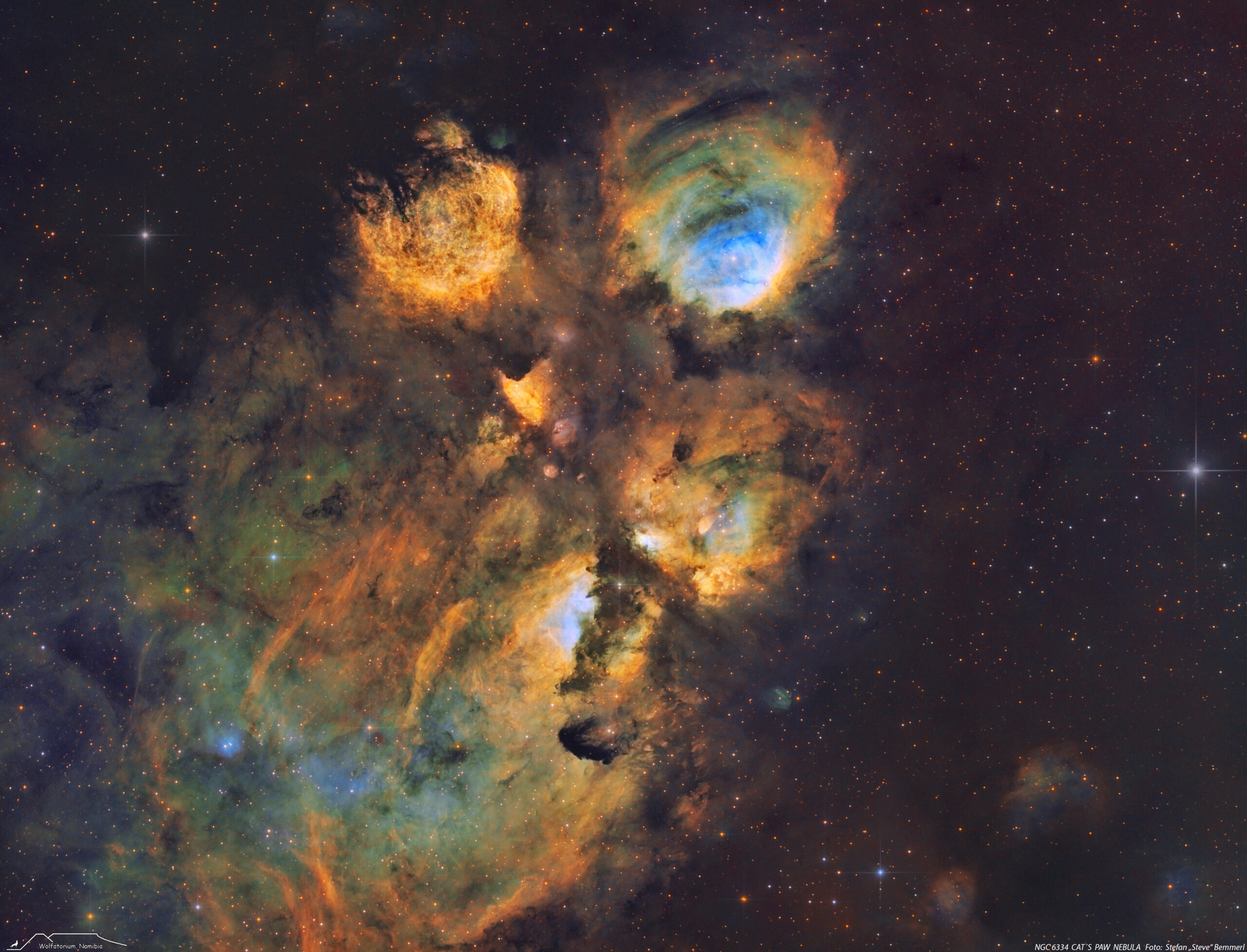
 APOD: 2022 May 10 - NGC 6334: The Cats Paw Nebula
Explanation:
Nebulas are perhaps as famous for being identified with familiar shapes as perhaps
cats
are for getting into
trouble.
Still, no known cat could have created the vast
Cat's Paw Nebula
visible toward
the constellation of the Scorpion
(Scorpius.
At 5,500
light years
distant, Cat's
Paw is an
emission nebula with a red color that originates from an abundance of
ionized
hydrogen atoms.
Alternatively known as the
Bear Claw Nebula and cataloged as
NGC 6334,
stars nearly ten times the mass of our
Sun have been born
there in only the past few million years.
Pictured here is
a deep field image of the
Cat's Paw
Nebula in light emitted by
hydrogen, oxygen, and sulfur.
 APOD: 2022 April 24 - Split the Universe
Explanation:
Just now, before you hit the button, two future universes are possible.
After pressing the button, though, you will live in only one.
A real-web version of the famous
Schrödinger's cat experiment
clicking the red button in the
featured astronaut image should transform that image into
a picture of the same astronaut holding one of two cats -- one living, or one dead.
The timing of your click, combined with the
wiring of your brain and the millisecond timing of your device, will all conspire together to create a
result dominated, potentially, by the
randomness of quantum mechanics.
Some believe that your personally-initiated
quantum decision
will split the universe in two, and that both the
live-cat and dead-cat universes exist in separate parts of a
larger multiverse.
Others believe that the result of your click will
collapse the two possible
universes
into one -- in a way that could not have been predicted beforehand.
Yet others believe that
the universe is classically
deterministic, so that by pressing the button you did not really split the universe, but just carried out an action predestined since time began.
We at
APOD believe that however
silly
you may feel clicking the red button, and regardless of the outcome,
you should have a thought-provoking day.
Or two.
 APOD: 2021 November 7 - The Cats Eye Nebula in Optical and X-ray
Explanation:
To some it looks like a cat's eye.
To others, perhaps like a giant cosmic
conch shell.
It is actually one of brightest and most highly detailed
planetary nebula known,
composed of gas expelled in the brief yet
glorious phase near the end of life of a Sun-like star.
This nebula's dying central star may have produced the outer circular
concentric shells
by shrugging off
outer
layers in a series of regular convulsions.
The
formation of the beautiful, complex-yet-symmetric
inner structures,
however, is not well understood.
The
featured image is a composite of a digitally sharpened
Hubble Space Telescope image with
X-ray light
captured by the orbiting
Chandra Observatory.
The exquisite floating space statue spans over half a
light-year across.
Of course,
gazing into this Cat's Eye,
humanity may well be seeing
the fate of our sun, destined to enter its own
planetary nebula
phase of evolution ... in about 5 billion years.
 APOD: 2020 June 7 - Halo of the Cat's Eye
Explanation:
The Cat's Eye Nebula
(NGC 6543) is one of the best known planetary
nebulae in the sky.
Its haunting symmetries are seen
in the very central region of
this stunning false-color picture, processed to reveal the
enormous but extremely faint halo of gaseous material, over three
light-years across, which surrounds the brighter,
familiar
planetary nebula.
Made with data from the
Nordic Optical Telescope in the
Canary Islands,
the composite picture shows extended emission from the nebula.
Planetary
nebulae have long been appreciated as a final phase
in the life of a Sun-like star.
Only much more recently however, have some planetaries been
found to have halos
like this one, likely formed of material shrugged off during
earlier active episodes in the
star's evolution.
While the planetary nebula phase is
thought to last for around 10,000 years,
astronomers estimate the age of the
outer filamentary portions
of this halo to be 50,000 to 90,000 years.
 APOD: 2019 October 26 - Gravity s Grin
Explanation:
Albert
Einstein's
general theory of relativity, published over 100 years
ago, predicted the phenomenon of gravitational lensing.
And that's what gives these distant galaxies such a whimsical
appearance,
seen
through the looking glass of X-ray and optical
image data from the Chandra and Hubble space telescopes.
Nicknamed the Cheshire Cat galaxy group, the group's two
large elliptical galaxies are suggestively framed by arcs.
The arcs are optical images
of distant background galaxies
lensed by the foreground group's total distribution
of gravitational mass.
Of course, that gravitational mass is dominated
by dark matter.
The two large elliptical "eye" galaxies represent
the brightest members of their own galaxy groups which are merging.
Their relative collisional speed of nearly 1,350 kilometers/second
heats gas to millions of degrees producing the X-ray glow shown
in purple hues.
Curiouser about
galaxy group mergers?
The Cheshire Cat
group
grins
in the constellation Ursa Major, some 4.6 billion light-years away.
 APOD: 2019 May 1 - The Cat's Eye Nebula in Optical and X-ray
Explanation:
To some it looks like a cat's eye.
To others, perhaps like a giant cosmic
conch shell.
It is actually one of brightest and most highly detailed
planetary nebula known,
composed of gas expelled in the brief yet
glorious phase near the end of life of a Sun-like star.
This nebula's dying central star may have produced the outer circular
concentric shells
by shrugging off
outer
layers in a series of regular convulsions.
The
formation of the beautiful, complex-yet-symmetric inner structures,
however, is not well understood.
The
featured image is a composite of a digitally sharpened
Hubble Space Telescope image with
X-ray light
captured by the orbiting
Chandra Observatory.
The exquisite floating space statue spans over half a
light-year across.
Of course,
gazing into this Cat's Eye,
humanity may well be seeing
the fate of our sun, destined to enter its own
planetary nebula
phase of evolution ... in about 5 billion years.
 APOD: 2018 October 20 - Halo of the Cat's Eye
Explanation:
Not a Falcon 9
rocket launch after sunset, the Cat's Eye Nebula (NGC 6543) is
one of the best known planetary nebulae in the sky.
Its haunting symmetries are seen
in the very central region of
this
composited picture, processed to reveal an
enormous but extremely faint halo of gaseous material, over three
light-years across.
Made with data from ground- and space-based telescopes
it shows the extended emission which surrounds the brighter, familiar
planetary nebula.
Planetary nebulae have long been appreciated as a final phase
in
the life of a sun-like star.
But only more recently have some planetaries been
found to have halos
like this one, likely formed of material shrugged off during
earlier active episodes in the star's evolution.
While the planetary nebula phase is thought to last for around
10,000 years, astronomers estimate the
outer filamentary
portions of this halo to be 50,000 to 90,000 years old.
 APOD: 2018 June 10 - The Cat's Eye Nebula from Hubble
Explanation:
To some, it may look like a cat's eye.
The
alluring Cat's Eye
nebula, however, lies three thousand light-years from Earth across interstellar space.
A classic
planetary
nebula, the Cat's Eye (NGC 6543) represents a final, brief
yet
glorious phase in the life of a sun-like star.
This nebula's dying central star may have produced the simple,
outer pattern of dusty
concentric shells
by shrugging off
outer
layers in a series of regular convulsions.
But the formation of the beautiful, more complex
inner structures is not well understood.
Seen so clearly in
this digitally sharpened Hubble Space Telescope image,
the truly cosmic eye is over half a
light-year across.
Of course,
gazing into this Cat's Eye,
astronomers may well be seeing
the fate of our sun, destined to enter its own
planetary nebula
phase of evolution ... in about 5 billion years.
 APOD: 2017 September 13 - NGC 6334: The Cats Paw Nebula
Explanation:
Nebulas are perhaps as famous for being identified with familiar shapes as perhaps
cats are for getting into
trouble.
Still, no known cat could have created the vast
Cat's Paw Nebula visible in Scorpius.
At 5,500 light years distant, Cat's
Paw is an
emission nebula with a red color that originates from an abundance of
ionized
hydrogen atoms.
Alternatively known as the
Bear Claw Nebula or
NGC 6334,
stars nearly ten times the mass of our
Sun have been born
there
in only the past few million years.
Pictured here is
a deep field image of the
Cat's Paw
Nebula in light emitted by
hydrogen, oxygen, and
sulfur.
 APOD: 2017 August 5 - Gravity's Grin
Explanation:
Albert
Einstein's
general theory of relativity, published over 100 years
ago, predicted the phenomenon of gravitational lensing.
And that's what gives these distant galaxies such a whimsical
appearance,
seen
through the looking glass of X-ray and optical
image data from the Chandra and Hubble space telescopes.
Nicknamed the Cheshire Cat galaxy group, the group's two
large elliptical galaxies are suggestively framed by arcs.
The arcs are optical images
of distant background galaxies
lensed by the foreground group's total distribution
of gravitational mass.
Of course, that gravitational mass is dominated
by dark matter.
The two large elliptical "eye" galaxies represent
the brightest members of their own galaxy groups which are merging.
Their relative collisional speed of nearly 1,350 kilometers/second
heats gas to millions of degrees producing the X-ray glow shown
in purple hues.
Curiouser about
galaxy group mergers?
The Cheshire Cat
group grins
in the constellation Ursa Major, some 4.6 billion light-years away.
 APOD: 2017 April 1 - Split the Universe
Explanation:
Just now, before you hit the button, two future universes are possible.
After pressing the button, though, you will live in only one.
A real-web version of the famous
Schrödinger's cat experiment, clicking the red button in the
featured astronaut image should transform that image into
a picture of the same astronaut holding one of two cats -- one living, or one dead.
The timing of your click, combined with the
wiring of your brain and the millisecond timing of your device, will all conspire together to create a
result dominated, potentially, by the
randomness of quantum mechanics.
Some believe that your personally-initiated
quantum decision
will split the universe in two, and that both the
live-cat and dead-cat universes exist in separate parts of a
larger multiverse.
Others believe that the result of your click will
collapse the two possible
universes
into one -- in a way that could not have been predicted beforehand.
Yet others believe that the universe is classically
deterministic, so that by pressing the button you did not really split the universe, but just carried out an action predestined since time began.
We at APOD believe that however
foolish you may feel clicking the red button,
and regardless of the outcome,
you should have a happy
April Fool's Day.
 APOD: 2017 February 7 - NGC 6357: The Lobster Nebula
Explanation:
Why is the Lobster Nebula forming some of the most massive stars known?
No one is yet sure.
Near the more obvious
Cat's Paw nebula on the upper right,
the
Lobster Nebula, on the lower left and cataloged as NGC 6357, houses the open star cluster
Pismis 24, home to these tremendously bright and blue stars.
The overall red glow near the inner star forming region results from the
emission of
ionized
hydrogen gas.
The surrounding nebula,
featured here,
holds a complex tapestry of gas,
dark dust, stars still forming, and newly born stars.
The intricate patterns are caused by complex interactions between
interstellar winds,
radiation pressures,
magnetic fields, and
gravity.
The full
zoomable version
of this image contains about two billion pixels,
making it one of the largest space images ever released.
NGC 6357 spans about 400 light years and lies about 8,000
light years away toward the constellation of the
Scorpion.
 APOD: 2017 January 30 - The Cat's Eye Nebula from Hubble
Explanation:
To some, it may look like a cat's eye.
The
alluring Cat's Eye
nebula, however, lies three thousand light-years from Earth across interstellar space.
A classic
planetary
nebula, the Cat's Eye (NGC 6543) represents a final, brief
yet
glorious phase in the life of a sun-like star.
This nebula's dying central star may have produced the simple,
outer pattern of dusty
concentric shells
by shrugging off
outer
layers in a series of regular convulsions.
But the formation of the beautiful, more complex
inner structures is not well understood.
Seen so clearly in
this digitally reprocessed Hubble Space Telescope image,
the truly
cosmic eye
is over half a light-year across.
Of course,
gazing into this Cat's Eye,
astronomers may well be seeing
the fate of our sun, destined to enter its own
planetary nebula
phase of evolution ... in about
5 billion years.
 APOD: 2016 July 3 - The Cat's Eye Nebula
Explanation:
Three thousand light-years away,
a dying star throws off shells of glowing gas.
This image from the
Hubble Space Telescope reveals the
Cat's Eye Nebula to be one of the most complex
planetary nebulae known.
In fact, the features seen in the
Cat's Eye
are so complex that astronomers suspect the bright
central object
may actually be a
binary star system.
The term planetary
nebula, used to describe this
general class of objects, is
misleading.
Although these objects may appear round and
planet-like in small telescopes,
high resolution images reveal them to be
stars surrounded by cocoons of gas blown off in the late stages of
stellar evolution.
 APOD: 2016 May 28 - Cat's Eye Wide and Deep
Explanation:
The Cat's
Eye Nebula (NGC 6543) is one of the best known
planetary nebulae in the sky.
Its more
familiar outlines are seen in the brighter central region of
the nebula in this impressive wide-angle view.
But the composite image combines many
short and long exposures to also reveal an extremely faint outer halo.
At an estimated distance of 3,000 light-years, the
faint outer halo is over 5 light-years across.
Planetary nebulae have long been appreciated as a final phase
in the life of a sun-like star.
More recently, some planetary nebulae are found to
have halos like
this one, likely formed of material shrugged off during
earlier episodes in the star's evolution.
While the planetary
nebula phase is thought to last for around 10,000 years,
astronomers estimate the age of the outer filamentary portions
of this halo to be 50,000 to 90,000 years.
Visible on the left, some 50 million light-years beyond
the watchful planetary nebula, lies spiral galaxy NGC 6552.
 APOD: 2015 November 27 - Gravity's Grin
Explanation:
Albert Einstein's
general theory of relativity, published 100 years
ago this month, predicted the phenomenon of gravitational lensing.
And that's what gives these distant galaxies such a whimsical appearance,
seen
through the looking glass of X-ray and optical
image data from the Chandra and Hubble space telescopes.
Nicknamed the Cheshire Cat galaxy group, the group's two
large elliptical galaxies are suggestively framed by arcs.
The arcs are optical images
of distant background galaxies
lensed by the foreground group's total distribution
of gravitational mass dominated by dark matter.
In fact the two large elliptical "eye" galaxies represent
the brightest members of their own galaxy groups which are merging.
Their relative collisional speed of nearly 1,350 kilometers/second
heats gas to millions of degrees producing the X-ray glow shown
in purple hues.
Curiouser about
galaxy group mergers?
The Cheshire Cat
group grins
in the constellation Ursa Major, some 4.6 billion light-years away.
 APOD: 2014 November 9 - The Cat's Eye Nebula from Hubble
Explanation:
To some, it may look like a cat's eye.
The
alluring Cat's Eye
nebula, however, lies three thousand light-years from Earth across interstellar space.
A classic
planetary
nebula, the Cat's Eye (NGC 6543) represents a final, brief
yet
glorious phase in the life of a sun-like star.
This nebula's dying central star may have produced the simple,
outer pattern of dusty
concentric shells
by shrugging off
outer
layers in a series of regular convulsions.
But the formation of the beautiful, more complex
inner structures is not well understood.
Seen so clearly in
this digitally sharpened Hubble Space Telescope image,
the truly cosmic eye is over half a light-year across.
Of course,
gazing into this Cat's Eye,
astronomers may well be seeing
the fate of our sun, destined to enter its own
planetary nebula
phase of evolution ... in about
5 billion years.
 APOD: 2014 June 18 - NGC 6334: The Cat's Paw Nebula
Explanation:
Nebulas are perhaps as famous for being identified with familiar shapes as perhaps
cats are for getting into
trouble.
Still, no known cat could have created the vast
Cat's Paw Nebula visible in Scorpius.
At 5,500 light years distant, Cat's
Paw is an
emission nebula with a red color that originates from an abundance of ionized
hydrogen atoms.
Alternatively known as the
Bear Claw Nebula or
NGC 6334,
stars nearly ten times the mass of our
Sun have been born
there
in only the past few million years.
Pictured above is
a deep field image of the
Cat's Paw
nebula.
 APOD: 2014 June 1 - Halo of the Cat's Eye
Explanation:
The Cat's Eye Nebula
(NGC 6543) is one of the best known planetary
nebulae in the sky.
Its haunting symmetries are seen
in the very central region of
this stunning false-color picture, processed to reveal the
enormous but extremely faint halo of gaseous material, over three
light-years across, which surrounds the brighter,
familiar
planetary nebula.
Made with data from the
Nordic Optical Telescope in the
Canary Islands,
the composite picture shows extended emission from the nebula.
Planetary
nebulae have long been appreciated as a final phase
in the life of a sun-like star.
Only much more recently however, have some planetaries been
found to have halos
like this one, likely formed of material shrugged off during
earlier active episodes in the star's evolution.
While the planetary
nebula phase is thought to last for around 10,000 years,
astronomers estimate the age of the
outer filamentary portions
of this halo to be 50,000 to 90,000 years.
 APOD: 2014 February 5 - NGC 2683: Edge On Spiral Galaxy
Explanation:
Does spiral galaxy NGC 2683 have a bar across its center?
Being so nearly like our own
barred Milky Way Galaxy, one might guess it has.
Being so nearly edge-on, however, it is
hard to tell.
Either way, this gorgeous island universe, cataloged
as NGC 2683, lies a mere
20 million light-years distant in the northern constellation of the Cat
(Lynx).
NGC 2683 is seen nearly edge-on in
this cosmic vista combining data and images from the ground-based
Subaru telescope and the space-based
Hubble Space Telescope.
More distant
galaxies are seen scattered in the background.
Blended light from a large population of old yellowish stars forms
the remarkably bright
galactic core.
Starlight silhouettes the dust lanes along winding spiral arms, dotted
with the telltale blue glow of young star clusters
in this galaxy's star forming regions.
 APOD: 2013 December 18 - Light Pillars over Finland
Explanation:
What's happening behind those houses?
Pictured above are not
aurora but nearby
light pillars,
a local phenomenon that can appear as a distant one.
In most places on Earth, a lucky viewer can see a
Sun-pillar, a column of light
appearing to extend up from the
Sun caused by flat fluttering
ice-crystals reflecting sunlight from the upper atmosphere.
Usually these
ice crystals
evaporate before reaching the ground.
During freezing temperatures, however,
flat fluttering ice crystals may form near the
ground in a form of light snow, sometimes known as a
crystal fog.
These ice crystals may then reflect ground lights
in columns not unlike a
Sun-pillar.
While going out to buy
cat food, a quick thinking photographer captured the
above light pillars extending up from bright parking lot lights in
Oulu,
Finland.
 APOD: 2013 October 22 - A Massive Star in NGC 6357
Explanation:
For reasons unknown, NGC 6357 is forming some of the most massive stars ever discovered.
One such massive star, near the center of
NGC 6357, is
framed above carving out its own
interstellar castle with its energetic light from surrounding gas and dust.
In the greater nebula,
the intricate patterns are caused by
complex interactions between
interstellar winds,
radiation pressures,
magnetic fields, and
gravity.
The overall glow of the nebula results from the
emission of light from
ionized
hydrogen gas.
Near the more obvious
Cat's Paw nebula,
NGC 6357 houses the open star cluster
Pismis 24,
home to many of these tremendously bright and blue stars.
The central part of
NGC 6357 shown spans about 10 light years
and lies about 8,000
light years away toward the constellation of the
Scorpion.
 APOD: 2012 August 31 - Halo of the Cat's Eye
Explanation:
The Cat's Eye Nebula
(NGC 6543) is one of the best known planetary
nebulae in the sky.
Its haunting symmetries are seen
in the very central region of
this tantalizing image, processed to reveal the
enormous but extremely faint halo of gaseous material,
about 6 light-years across, which surrounds the brighter,
familiar planetary nebula.
Made with narrow and broadband data
the composite picture shows the remarkably strong extended emission from
twice ionized oxygen atoms in blue-green hues and ionized hydrogen
and nitrogen in red.
Planetary
nebulae have long been appreciated as a final phase
in the life of a sun-like star.
But recently many planetaries have been
found to have halos like this one, likely formed of material shrugged
off during earlier active episodes in the star's evolution.
While the
planetary
nebula phase is thought to last for around 10,000 years,
astronomers estimate the age of the
outer filamentary
portions of this halo to be 50,000 to 90,000 years.
 APOD: 2012 August 26 - The Cat's Eye Nebula
Explanation:
Three thousand light-years away,
a dying star throws off shells of glowing gas.
This image from the
Hubble Space Telescope reveals the
Cat's Eye Nebula to be one of the most
complex
planetary nebulae known.
In fact, the features seen in the
Cat's Eye
are so complex that astronomers suspect the bright
central object
may actually be a
binary star system.
The term planetary
nebula, used to describe this
general class of objects, is
misleading.
Although these objects may appear round and
planet-like in small telescopes,
high resolution images reveal them to be
stars surrounded by cocoons of gas blown off in the late stages of
stellar evolution.
 APOD: 2012 January 6 - A Wide Field Image of the Galactic Center
Explanation:
From Sagittarius to Scorpius, the central
Milky Way is a truly beautiful part of planet Earth's night sky.
The gorgeous region is captured in this wide field image
spanning about 30 degrees.
The impressive cosmic vista, taken in 2010, shows off intricate dust lanes, bright nebulae, and star clusters
scattered through our galaxy's rich
central starfields.
Starting on the left, look for the
Lagoon and Trifid nebulae, the
Cat's Paw, while on the right lies
the Pipe dark nebula, and the colorful clouds of
Rho Ophiuchi and Antares (right).
The actual
center of our Galaxy lies about 26,000 light years away and
can be found
here.
 APOD: 2011 April 24 - The Cat's Eye Nebula from Hubble
Explanation:
Staring across interstellar space, the
alluring Cat's Eye
nebula lies three thousand light-years from Earth.
A classic
planetary
nebula, the Cat's Eye (NGC 6543) represents
a final, brief
yet
glorious phase in the life of a sun-like star.
This nebula's dying central star may have produced the simple,
outer pattern of dusty
concentric shells
by shrugging off
outer
layers in a series of regular convulsions.
But the formation of the beautiful, more complex
inner structures is not well understood.
Seen so clearly in
this sharp Hubble Space Telescope image,
the truly cosmic eye is over half a light-year across.
Of course,
gazing into the Cat's Eye,
astronomers may well be seeing
the fate of our sun, destined to enter its own
planetary nebula
phase of evolution ... in about
5 billion years.
 APOD: 2011 April 18 - Visual Effects: Wonders of the Universe
Explanation:
What visual effects are depicted in this video?
The effects were created by
BDH for the
BBC television show
Wonders
of the Universe, but are unlabeled in this version.
Even so, some stills in the video are easily identified, such as the
Hubble image of the
Carina Nebula that occurs at about 2:22,
the Crab Nebula at about 7:45, and the
Cat's Eye Nebula that occurs at about 8:16.
A pan away from a spiral galaxy occurs at about 4:00, and breathtaking vistas of the spiral occur until past 5:00.
Pulsars and supernovas seem to take over at about 9:00 and are truly spectacular.
Binary star systems containing a pulsar and an
accretion disk occur beginning at about 14:30.
Past that, the entire computer animated video seems to sparkle with unknown stars, unknown planets, and sequences where unknown gas is flowing toward unknown places.
What, for example, is being depicted at 13:00?
Please help create a companion explanation for the video by
contributing to APOD's discussion page.
 APOD: 2011 February 18 - Planetary Nebula Project
Explanation:
Cast off by dying sunlike stars,
planetary nebulae
are a brief but glorious final phase of stellar evolution.
The gaseous shrouds are ionized by an extremely hot central source,
the shrinking core of a star running out of
fuel for nuclear fusion.
Shining in the cosmic night, their simple
symmetries
are fascinating and have inspired this
planetary nebula poster project.
In it, nine planetaries are displayed for comparison in a 3x3 grid.
Of course, planetary nebula fans should be able to
pick out the bright
Messier objects
M27 - the Dumbbell Nebula,
M76 - the Little Dumbbell, and
M57 - the Ring Nebula, as well as
NGC 6543, aka the Cat's Eye Nebula.
Lesser known nebulae include the
Medusa and the
Bug.
All the images were made with detailed narrow band data and
are shown at the same
angular scale,
spanning 20 arc minutes (1/3 degree).
At that scale, the grey circle represents the apparent size of
the Full Moon.
These planetary nebulae
hint at the fate of our own
Sun as its core runs out of nuclear fuel in another
5 billion years.
 APOD: 2010 November 21 - A Massive Star in NGC 6357
Explanation:
For reasons unknown, NGC 6357 is forming some of the most massive stars ever discovered.
One such massive star, near the center of
NGC 6357, is
framed above carving out its own
interstellar castle with its energetic light from surrounding gas and dust.
In the greater nebula,
the intricate patterns are caused by
complex interactions between
interstellar winds,
radiation pressures,
magnetic fields, and
gravity.
The overall glow of the nebula results from the
emission of light from
ionized
hydrogen gas.
Near the more obvious
Cat's Paw nebula,
NGC 6357 houses the open star cluster
Pismis 24,
home to many of these tremendously bright and blue stars.
The central part of
NGC 6357 shown spans about 10 light years
and lies about 8,000
light years away toward the constellation of the
Scorpion.
 APOD: 2010 October 11 - NGC 2683: Spiral Edge On
Explanation:
Does spiral galaxy NGC 2683 have a bar across its center?
Being so nearly like our own barred Milky Way Galaxy, one might guess it has.
Being so nearly edge-on, however, it is
hard to tell.
Either way, this gorgeous island universe, cataloged
as
NGC 2683, lies a mere
20 million light-years distant in the northern constellation of the Cat
(Lynx).
NGC 2683 is seen nearly edge-on in
this
cosmic vista, with more distant
galaxies scattered in the background.
Blended light from a large population of old yellowish stars forms
the remarkably bright
galactic core.
Starlight silhouettes the dust lanes along winding spiral arms, dotted
with the telltale blue glow of young star clusters
in this galaxy's star forming regions.
 APOD: 2010 August 31 - The Annotated Galactic Center
Explanation:
The sky toward the center of our Galaxy is filled with a wide variety of
celestial wonders,
many of which are visible from a dark location with common
binoculars.
Constellations near the
Galactic Center include
Sagittarius,
Libra,
Scorpius,
Scutum, and
Ophiuchus.
Nebulas include
Messier objects
M8,
M16,
M20, as well as the
Pipe and
Cat's Paw nebulas.
Visible
open star clusters include
M6,
M7,
M21,
M23,
M24, and
M25, while
globular star cluster
M22 is also visible.
A hole in the dust toward the
Galactic Center reveals a bright region filled with distant stars known as
Baade's Window, which is visible between
M7 and
M8.
Moving your cursor over the
above image the will bring up an un-annotated version.
 APOD: 2010 July 19 - Dark River Wide Field
Explanation:
A Dark River of dust seems to run from our Galactic Center,
then pool into a
starfield containing photogenic sky wonders.
Scrolling right will reveal many of these objects including (can you find?) the bright orange star
Antares, a
blue(-eyed) horsehead nebula, the white
globular star cluster M4,
the bright blue star system Rho Ophiuchi,
the dark brown Pipe nebula,
the red Lagoon nebula,
the red and blue Trifid nebula,
the red Cat's Paw Nebula,
and the multicolored but still important
center of our Galaxy.
This wide view
captures in exquisite detail about 50 degrees of the
nighttime sky,
100 times the size of the full Moon, covering constellations from
the Archer
(Sagittarius) through
the Snake Holder
(Ophiuchus), to
the Scorpion
(Scorpius).
The Dark River itself can be identified as the brown dust lane connected to
Antares,
and spans about 100 light years.
Since the Dark River
dust lane lies only about 500 light years away, it only appears as a bridge to the much more distant Galactic Center, that actually lies about 25,000 light years farther away.
 APOD: 2010 May 9 - Halo of the Cat's Eye
Explanation:
The Cat's Eye Nebula
(NGC 6543) is one of the best known planetary
nebulae in the sky.
Its haunting symmetries are seen
in the very central region of
this stunning false-color picture, processed to reveal the
enormous but extremely faint halo of gaseous material, over three
light-years across, which surrounds the brighter,
familiar
planetary nebula.
Made with data from the
Nordic Optical Telescope in the
Canary Islands,
the composite picture shows extended emission from the nebula.
Planetary
nebulae have long been appreciated as a final phase
in the life of a sun-like star.
Only much more recently however, have some planetaries been
found to have halos
like this one, likely formed of material shrugged off during
earlier active episodes in the star's evolution.
While the planetary
nebula phase is thought to last for around 10,000 years,
astronomers estimate the age of the
outer filamentary portions
of this halo to be 50,000 to 90,000 years.
 APOD: 2010 April 21 - Wide Angle: The Cat's Paw Nebula
Explanation:
Nebulae are perhaps as famous for being identified with familiar shapes as perhaps
cats are for getting into
trouble.
Still, no known
cat
could have created the vast
Cat's Paw Nebula visible in Scorpius.
At 5,500 light years distant, Cat's
Paw is an
emission nebula with a red color that originates from an abundance of ionized
hydrogen atoms.
Alternatively known as the
Bear Claw Nebula or
NGC 6334,
stars nearly ten times the mass of our
Sun have been born
there
in only the past few million years.
Pictured above,
a wide angle, deep field image of the
Cat's Paw
nebula was culled from the second
Digitized Sky Survey.
 APOD: 2009 December 27 - The Cat's Eye Nebula
Explanation:
Three thousand light-years away,
a dying star throws off shells of glowing gas.
This image from the
Hubble Space Telescope reveals the
Cat's Eye Nebula to be one of the most
complex
planetary nebulae known.
In fact, the features seen in the
Cat's Eye
are so complex that astronomers suspect the bright
central object
may actually be a
binary star system.
The term planetary
nebula, used to describe this
general class of objects, is misleading.
Although these objects may appear round and
planet-like in small telescopes,
high resolution images reveal them to be
stars surrounded by cocoons of gas blown off in the late stages of
stellar evolution.
 APOD: 2009 September 25 - Gigagalaxy Zoom: Galactic Center
Explanation:
From Sagittarius to Scorpius, the central
Milky Way is a truly beautiful part of planet Earth's night sky.
The gorgeous region is captured here,
an expansive
gigapixel mosaic of 52 fields spanning 34 by 20 degrees
in 1200 individual images and 200 hours of exposure time.
Part of ESO's
Gigagalaxy Zoom Project,
the images were collected
over 29 nights with a small telescope
under the exceptionally clear, dark skies of the ESO
Paranal Observatory in Chile.
The breathtaking cosmic vista shows off intricate dust lanes,
bright nebulae, and star clusters
scattered through our galaxy's rich central starfields.
Starting on the left, look for the
Lagoon and Trifid nebulae, the
Cat's Paw, the
Pipe dark nebula, and the colorful clouds of
Rho Ophiuchi and Antares (right).
 APOD: 2008 August 4 - X-Rays from the Cat's Eye Nebula
Explanation:
Haunting patterns within planetary nebula
NGC 6543
readily suggest its popular moniker -- the
Cat's Eye nebula.
Starting in 1995, stunning false-color optical images
from the Hubble
Space Telescope detailed the swirls of this
glowing nebula, known to
be the gaseous shroud expelled from a dying
sun-like
star about 3,000 light-years from Earth.
This composite picture
combines the latest Hubble optical image of the Cat's Eye with new x-ray data from the
orbiting Chandra Observatory and reveals
surprisingly intense x-ray emission indicating the presence
of extremely hot gas.
X-ray emission is shown as blue-purple hues superimposed on the nebula's center.
The nebula's central star itself is clearly immersed in
the multimillion degree, x-ray emitting gas.
Other pockets of x-ray hot gas seem to be bordered by cooler
gas emitting strongly at optical wavelengths, a clear indication
that expanding hot gas is sculpting the
visible Cat's Eye
filaments and structures.
Gazing into the Cat's Eye, astronomers see
the fate of our sun,
destined to enter its own
planetary nebula phase
of evolution ... in about
5 billion
years.
 APOD: 2008 March 22 - Cat's Eye Hubble Remix
Explanation:
Staring across interstellar space, the alluring
Cat's Eye
Nebula lies three thousand light-years from Earth.
One of the most famous
planetary
nebulae in the sky, the Cat's Eye (NGC 6543) is over half
a light-year across and represents a final, brief yet
glorious phase
in the life of a sun-like star.
This nebula's dying central star may have
produced the simple, outer pattern of dusty concentric shells by
shrugging off
outer
layers in a series of regular convulsions.
But the formation of the beautiful,
more complex inner structures is not well understood.
Here, Hubble Space Telescope archival image data has been
reprocessed to
create another look the cosmic cat's eye.
Compared to well-known
Hubble pictures,
the alternative processing strives to sharpen and improve the visiblility
of details in light and dark areas of the nebula and also applies a
more complex color
palette.
Of course, gazing into the Cat's Eye, astronomers may well be seeing the
fate of our Sun, destined to enter its own
planetary nebula
phase of evolution ... in about 5 billion years.
 APOD: 2008 March 4 - NGC 6334: The Cats Paw Nebula
Explanation:
Nebulae are perhaps as famous for being identified with familiar shapes as perhaps
cats are for getting into
trouble.
Still, no known
cat
could have created the vast
Cat's Paw Nebula visible in Scorpius.
At 5,500 light years distant, Cat's
Paw is an
emission nebula with a red color that originates from an abundance of ionized
hydrogen atoms.
Alternatively known as the
Bear Claw Nebula or
NGC 6334,
stars nearly ten times the mass of our
Sun have been born
there in only the past few million years.
Pictured above,
the end of the
Cat's Paw
nebula was imaged from the
Blanco 4-meter Telescope in
Chile.
 APOD: 2007 June 29 - Cat's Eye Wide and Deep
Explanation:
The Cat's Eye Nebula
(NGC 6543) is one of the best known
planetary
nebulae in the sky.
Its more familiar outlines are seen in the brighter central region of
this impressive wide-angle view.
But the composite image also combines many
short and long exposures to reveal the nebula's
extremely faint halo.
At an estimated distance of 3,000 light-years, the
faint outer halo is over 5 light-years across.
Planetary
nebulae have long been appreciated as a final phase
in the life of a sun-like star.
More recently, some planetary nebulae are
found to have
halos like this one, likely formed of material shrugged off during
earlier episodes in the star's evolution.
While the planetary
nebula phase is thought to last for around 10,000 years,
astronomers estimate the age of the outer filamentary portions
of this halo to be 50,000 to 90,000 years.
Visible on the right, some 50 million light-years beyond
the Cat's Eye, lies spiral galaxy
NGC 6552.
 APOD: 2007 May 13 - The Cat's Eye Nebula from Hubble
Explanation:
Staring across interstellar space, the
alluring Cat's Eye
nebula lies three thousand light-years from Earth.
A classic
planetary
nebula, the Cat's Eye (NGC 6543) represents
a final, brief
yet
glorious phase in the life of a sun-like star.
This nebula's dying central star may have produced the simple,
outer pattern of dusty
concentric shells
by shrugging off
outer layers in a series of regular convulsions.
But the formation of the beautiful, more complex
inner structures is not well understood.
Seen so clearly in
this sharp Hubble Space
Telescope image,
the truly cosmic eye is over half a light-year across.
Of course,
gazing into the Cat's Eye,
astronomers may well be seeing
the fate of our sun, destined to enter its own
planetary nebula phase of
evolution ... in about
5 billion years.
 APOD: 2006 December 20 - Star Forming Region NGC 6357
Explanation:
For reasons unknown, NGC 6357 is forming some of the most massive stars ever discovered.
Near the more obvious
Cat's Paw nebula, NGC 6357 houses the open star cluster
Pismis 24, home to these tremendously bright and blue stars.
The overall red glow near the inner star forming region results from the
emission of
ionized
hydrogen gas.
The surrounding nebula,
shown above, holds a complex tapestry of gas,
dark dust, stars still forming, and newly born stars.
The intricate patterns are caused by complex interactions between
interstellar winds,
radiation pressures,
magnetic fields, and
gravity.
NGC 6357 spans about 400 light years and lies about 8,000
light years away toward the constellation of the
Scorpion.
 APOD: 2006 November 12 - The Cat's Eye Nebula
Explanation:
Three thousand light-years away,
a dying star throws off shells of glowing gas.
This image from the
Hubble Space Telescope reveals the
Cat's Eye Nebula to be one of the most
complex
planetary nebulae known.
In fact, the features seen in the
Cat's Eye
are so complex that astronomers suspect the bright
central object may actually be a
binary star system.
The term planetary
nebula, used to describe this
general class of objects, is misleading.
Although these objects may appear round and
planet-like in small telescopes,
high resolution images reveal them to be stars
surrounded by cocoons of gas blown off in the late stages of
stellar evolution.
 APOD: 2006 June 28 - The Cat's Paw Nebula
Explanation:
Nebulae are perhaps as famous for being identified with
familiar shapes as cats are for getting into trouble.
Still, no known cat could have created the vast
Cat's Paw Nebula visible in Scorpius.
At 5,500 light years distant, Cat's
Paw is an
emission nebula with a red color that
originates from an abundance of ionized
hydrogen atoms.
Alternatively known as the
Bear Claw Nebula or
NGC 6334, stars nearly ten times the mass of our
Sun have been born
there in only the past few million years.
This
deep wide-field image of the Cat's Paw nebula
was photographed from
New South Wales,
Australia.
 APOD: 2005 September 24 - Cat s Eye
Explanation:
Staring across interstellar space, the
alluring Cat's Eye
nebula lies three thousand light-years from Earth.
A classic
planetary
nebula, the Cat's Eye (NGC 6543) represents
a final, brief
yet
glorious phase in the life of a sun-like star.
This nebula's dying central star may have produced the simple,
outer pattern of dusty
concentric shells
by shrugging off outer layers
in a series of regular convulsions.
But the formation of the beautiful, more complex
inner structures is not well understood.
Seen so clearly in
this sharp Hubble Space
Telescope image,
the truly cosmic eye is over half a light-year across.
Of course,
gazing into the Cat's Eye,
astronomers may well be seeing
the fate of our sun, destined to enter its own
planetary nebula phase of
evolution ... in about
5 billion years.
 APOD: 2004 November 25 - What the Hubble Saw
Explanation:
In this striking 41 inch by 38 inch quilt,
astronomy enthusiast Judy Ross has interpreted some of
the Hubble Space Telescope's
best galactic and extragalactic vistas.
Featured in past APODs,
clockwise from the lower right are; the
Red Rectangle Nebula,
NGC 2392, the
Sleeping Beauty Galaxy,
V838 Monocerotis -
the Milky Way's most mysterious star, and
supernova remnant N49 -
the cosmic debris from an exploded star.
Of course,
quilts have been used
historically
to represent astronomical concepts.
And while inspired by the
images of the cosmos that she
incorporates into her quilts, Ross reports that she is
still a little daunted by the intricacies of the
Cat's Eye Nebula revealed by
the Hubble's sharp vision.
 APOD: 2004 September 10 - Cat's Eye
Explanation:
Staring across interstellar space, the
alluring Cat's Eye
nebula lies three thousand light-years from Earth.
A classic
planetary
nebula, the Cat's Eye (NGC 6543) represents
a final, brief
yet
glorious phase in the life of a sun-like star.
This nebula's dying central star may have produced the simple,
outer pattern of dusty
concentric shells
by shrugging off outer layers
in a series of regular convulsions.
But the formation of the beautiful, more complex
inner structures is not well understood.
Seen so clearly in
this sharp Hubble Space
Telescope image,
the truly cosmic eye is over half a light-year across.
Of course,
gazing into the Cat's Eye,
astronomers may well be seeing
the fate of our sun, destined to enter its own
planetary nebula phase of
evolution ... in about
5 billion years.
 APOD: 2003 November 1 - Halo of the Cat's Eye
Explanation:
The Cat's Eye Nebula
(NGC 6543) is one of the best known planetary
nebulae in the sky.
Its haunting symmetries are seen in the very central region
of this stunning false-color picture, processed to reveal the
enormous but extremely faint halo of gaseous material, over three
light-years across, which surrounds the brighter,
familiar planetary nebula.
Made with data from the
Nordic Optical Telescope
in the Canary Islands, the composite picture
shows emission from
nitrogen atoms as red and oxygen atoms as green and blue shades.
Planetary
nebulae have long been appreciated as a final phase
in the life of a sun-like star.
Only much more recently however, have some planetaries been
found to have halos
like this one, likely formed of material shrugged off during
earlier active episodes in the star's evolution.
While the planetary
nebula phase is thought to last for around 10,000 years,
astronomers estimate the age of the outer filamentary portions
of this halo to be 50,000 to 90,000 years.
 APOD: 2003 July 17 - The Cat's Paw Nebula
Explanation:
As soon as we find out whose cat did this . . .
Nebulae are as famous for being identified with
familiar shapes as perhaps
cats are for getting into trouble.
No cat, though, could have created the vast
Cat's Paw Nebula visible in Scorpius.
At 5500 light years distant,
Cat's Paw is an emission nebula with a red color that
originates from an abundance of ionized
hydrogen atoms.
Alternatively known as the
Bear Claw Nebula or
NGC 6334, stars nearly ten times the mass of our
Sun have been born
there in only the past few million years.
Pictured above, the Cat's Paw nebula was photographed
during an astrophotography expedition to
Namibia.
 APOD: 2003 June 14 - The Planetary Nebula Show
Explanation:
What do the Owl, the Cat's Eye, the Ghost of Jupiter, and Saturn
have in common?
They're all
planetary nebulae
of course, glowing gaseous
shrouds shed by dying sun-like stars
as
they run out of nuclear fuel.
Beautiful to
look at,
the symmetric,
planet-like
shapes of these
cosmic clouds,
typically 1,000 times the size of our
solar system,
evoke their popular names.
Flipping through digital pictures made by
participants in the Kitt Peak
National Observatory Visitor Center's
Advanced Observing Program,
astronomer Adam Block created this
delightful animation.
Ten different planetary nebula images are presented, each registered
on the central star.
In order, their catalog designations are
NGC
1535,
NGC 3242 (Ghost of Jupiter),
NGC 6543 (Cat's Eye),
NGC 7009 (Saturn Nebula),
NGC 2438,
NGC 6772,
Abell 39,
NGC 7139,
NGC 6781,
and M97 (Owl Nebula).
This glorious final phase
in the life of a star lasts only about 10,000 years.
 APOD: 2002 September 4 - Halo of the Cat's Eye
Explanation:
The Cat's Eye Nebula
(NGC 6543) is one of the best known planetary
nebulae in the sky.
Its haunting symmetries are seen in the very central region
of this stunning false-color picture, processed to reveal the
enormous but extremely faint halo of gaseous material, over three
light-years across, which surrounds the brighter,
familiar planetary nebula.
Made with data from the
Nordic Optical Telescope
in the Canary Islands, the composite picture
shows emission from
nitrogen atoms as red and oxygen atoms as green and blue shades.
Planetary
nebulae have long been appreciated as a final phase
in the life of a sun-like star.
Only much more recently however, have some planetaries been
found to have halos
like this one, likely formed of material shrugged off during
earlier active episodes in the star's evolution.
While the planetary
nebula phase is thought to last for around 10,000 years,
astronomers estimate the age of the outer filamentary portions
of this halo to be 50,000 to 90,000 years.
 APOD: 2002 March 24 - The Cat's Eye Nebula
Explanation:
Three thousand light-years away,
a dying star throws off shells of glowing gas.
This image from the
Hubble Space Telescope reveals the Cat's Eye Nebula to be one of the most
complex
planetary nebulae known.
In fact, the features seen in the
Cat's Eye
are so complex that astronomers suspect the bright
central object may actually be a
binary star system.
The term planetary
nebula, used to describe this
general class of objects, is misleading.
Although these objects may appear round and
planet-like in small telescopes,
high resolution images reveal them to be stars
surrounded by cocoons of gas blown off in the
late
stages of stellar evolution.
 APOD: 2001 October 3 - The Planetary Nebula Show
Explanation:
What do the Owl, the Cat's Eye, the Ghost of Jupiter, and Saturn
have in common?
They're all
planetary nebulae
of course(!), glowing gaseous
shrouds shed by dying sun-like stars
as
they run out of nuclear fuel.
Beautiful to
look at,
the symmetric,
planet-like
shapes of these
cosmic clouds,
typically 1,000 times the size of our
solar system,
evoke their popular names.
Flipping through digital pictures made by
participants in the Kitt Peak
National Observatory Visitor Center's
Advanced Observing Program,
astronomer Adam Block created this
delightful animation.
Ten different planetary nebula images are presented, each registered
on the central star.
In order, their catalog designations are
NGC
1535,
NGC 3242 (Ghost of Jupiter),
NGC 6543 (Cat's Eye),
NGC 7009 (Saturn Nebula),
NGC 2438,
NGC 6772,
Abell 39,
NGC 7139,
NGC 6781,
and M97 (Owl Nebula).
This glorious final phase
in the life of a star lasts only about 10,000 years.
 APOD: 2001 January 11 - X-rays From The Cat's Eye
Explanation:
Haunting patterns within planetary nebula
NGC 6543
readily suggest its popular moniker -- the Cat's Eye nebula.
In 1995, a stunning false-color optical image
from the Hubble
Space Telescope detailed the swirls of this
glowing nebula, known to
be the gaseous shroud expelled from a dying
sun-like
star about 3,000 light-years from Earth.
This composite picture combines the famous Hubble image
with new x-ray data from the
orbiting
Chandra Observatory and reveals
surprisingly intense x-ray emission indicating the presence
of extremely hot gas.
X-ray emission is shown as blue-purple hues superimposed on red and
green optical emission.
The nebula's central star itself is clearly immersed in
the multimillion degree, x-ray emitting gas.
Other pockets of x-ray hot gas seem to be bordered by cooler
gas emitting strongly at optical wavelengths, a clear indication
that expanding hot gas is sculpting the
visible Cat's Eye
filaments and structures.
Gazing into the Cat's Eye, astronomers see
the fate of our sun,
destined to enter its own
planetary nebula phase
of evolution ... in about
5 billion
years.
 APOD: December 7, 1999 - The Cat's Paw Nebula
Explanation:
As soon as we find out whose cat did this . . .
Nebulae are as famous for being identified with
familiar shapes as perhaps
cats are for getting into trouble.
No cat, though, could have created the vast
Cat's Paw Nebula visible in Scorpius.
The Cat's Paw Nebula is the glowing red nebula near the top of the
above picture -- the lower nebula is
NGC 6357.
At 5500 light years distant,
Cat's Paw is an emission nebula with a red color that
originates from an abundance of ionized
hydrogen atoms.
Alternatively known as the
Bear Claw Nebula or
NGC 6334, stars nearly ten times the mass of our
Sun have been born
there in only the past few million years.
 APOD: October 31, 1999 - The Cat's Eye Nebula
Explanation:
Three thousand light-years away,
a dying star throws off shells of glowing gas.
This image from the Hubble Space Telescope
reveals The Cat's Eye Nebula to be
one of the most
complex
planetary nebulae known.
In fact, the features seen in
the Cat's Eye are so complex that astronomers suspect the bright
central object may actually be a
binary star system.
The term planetary
nebula, used to describe this
general class of objects, is misleading.
Although these objects may appear round and
planet-like in small telescopes,
high resolution images reveal them to be stars
surrounded by cocoons of gas blown off in the
late
stages of stellar evolution.
On planet Earth, of course, cats and
other creatures may be on the prowl tonight.
Keep your eyes peeled and have a safe and
happy Halloween!
 APOD: September 16, 1999 - The Incredible Expanding Cats Eye
Explanation:
Watch closely.
As this animation blinks between two
Hubble Space Telescope images
of NGC 6543 - the first from 1994 and the second from 1997 -
the intricate filaments of this nebula are seen to shift.
The shift is due to the actual expansion of this gaseous shroud
shed by a dying star!
NGC 6543 is more popularly known as
the Cat's Eye Nebula.
Classified as a "planetary nebula", its complex,
interwoven shells of expanding gas have been castoff by the central star
as it evolves from a red giant to its final white dwarf phase.
The planetary nebula phase of a star's life is known to be
relatively brief, lasting 10,000 years or so.
In fact,
combined with other data,
this nebula's detectable shift over a three year period
allows the expansion age of its bright inner shells to be estimated
at only around 1,000 years while its
distance can be gauged at about 3,000 light-years.
 APOD: November 1, 1998 - The Cat's Eye Nebula
Explanation:
Three thousand light years away,
a dying star throws off shells of glowing gas.
This image from the
Hubble Space Telescope
reveals The Cat's Eye Nebula to be
one of the most complex
planetary nebulae
known.
In fact, the features seen in
this image
are so complex that astronomers suspect the bright
central object may actually be a
binary star system. The term
planetary
nebula, used to describe this
general class of objects, is misleading.
Although these objects may appear round and
planet-like in small telescopes,
high resolution images reveal them to be stars
surrounded by cocoons of gas blown off in the
late
stages of stellar evolution.
 APOD: August 2, 1997 - The Cat's Eye Nebula
Explanation:
Three thousand light years away, a dying star throws off shells of glowing
gas.
This image from the
Hubble Space Telescope
reveals "The Cat's Eye Nebula" to be
one of the most complex
planetary nebulae
known. In fact, the features seen in
this image
are so complex that astronomers suspect the bright
central object may actually be a
binary star system. The term
planetary
nebula, used to describe this general class of objects, is misleading.
Although these objects may appear round and planet-like in small
telescopes,
high resolution
images reveal them to be stars surrounded by
cocoons of gas blown off in the
late
stages of stellar evolution.
 APOD: July 10, 1997 - Sojourner's View: The Sagan Memorial Station
Explanation:
The robot rover
Sojourner sees Mars from
the perspective of
a house cat.
During the 7 month
cruise to Mars
aboard the Pathfinder spacecraft, Sojourner measured only
seven inches tall in a stowed position but prowling the martian
landscape it has stretched to its full height of 1 foot (30 centimeters).
In this mosaic of images
Sojourner's cameras look back on its mother ship, now
the Sagan Memorial Station, which seems to loom above it.
The deployment ramp
is visible along with deflated airbags, instrumentation
masts and tracks left in the martian soil by the robot's six cleated 5-inch
aluminum wheels.
So far the rover
has been directed to analyze soil and
the composition of two rocks,
Barnacle Bill
(seen just to the right of the ramp) and Yogi.
Human operators select Sojourner's targets but
the robot rover is relied on to
navigate to its destination autonomously.
Click here to download a movie gif of Sojourner creeping toward Yogi.
 APOD: July 4, 1996 - The Cat's Eye Nebula (Revisited)
Explanation:
Three thousand light years away, a dying star throws off shells of glowing
gas.
This image from the
Hubble Space Telescope
reveals "The Cat's Eye Nebula" to be
one of the most complex
planetary nebulae
known. In fact, the features seen in
this image
are so complex that astronomers suspect the bright
central object may actually be a
binary star system. The term
planetary
nebula, used to describe this general class of objects, is misleading.
Although these objects may appear round and planet-like in small
telescopes,
high resolution
images reveal them to be stars surrounded by
cocoons of gas blown off in the
late
stages of stellar evolution.
 APOD: June 28, 1995 - The Cat's Eye Nebula
Explanation:
Three thousand light years away, a dying star throws off shells of glowing
gas. This Hubble Space Telescope image reveals "The Cat's Eye Nebula"
to be one of the most complex "planetary nebulae" known. In fact, the
features seen in this image are so complex that astronomers
suspect the visible central star may actually be a double star system.
The term planetary nebula, used to describe this general class of
objects, is misleading. Although these objects may appear round and
planet-like in small telescopes, high resolution images reveal them to
be stars surrounded by cocoons of gas blown off in the late stages of
evolution.
:max_bytes(150000):strip_icc():focal(144x0:146x2)/000829300-1-166c18e3f54846d287baa774ae29b18e.jpg)