|
Astronomy Picture of the Day |
| |
Astronomy Picture of the Day |
 APOD: 2024 August 28 – Tulip Nebula and Black Hole Cygnus X 1
Explanation:
When can you see a black hole, a tulip, and a swan all at once?
At night -- if the timing is right,
and if your telescope is pointed in the
right direction.
The complex and beautiful
Tulip Nebula blossoms about 8,000
light-years away toward the
constellation of Cygnus the Swan.
Ultraviolet radiation from young energetic stars
at the edge of the Cygnus
OB3 association, including
O star HDE 227018,
ionizes the atoms and powers the emission from the Tulip Nebula.
Stewart Sharpless cataloged this nearly 70 light-years
across reddish glowing cloud of interstellar gas and dust in
1959, as
Sh2-101.
Also in the
featured field of view is the black hole
Cygnus X-1,
which is also a
microquasar because it
is one of strongest
X-ray
sources in planet Earth's sky.
Blasted by powerful jets from a
lurking black hole,
its fainter bluish curved
shock front
is only faintly visible beyond
the cosmic Tulip's petals, near the right side of the frame.
 APOD: 2024 August 21 – Fermi's 12-year All-Sky Gamma-ray Map
Explanation:
Forget
X-ray vision — imagine what you could see with
gamma-ray vision!
The
featured all-sky map
shows what the universe looks like to NASA's
Fermi Gamma-ray Space Telescope.
Fermi sees light with energies about a
billion times what the human eye can see, and
the map
combines 12 years of Fermi observations.
The colors represent the brightness of the
gamma-ray sources,
with brighter sources appearing lighter in color.
The prominent stripe across the middle is the central plane of our
Milky Way galaxy.
Most of the red and yellow dots scattered above
and below the Milky Way’s plane are very
distant galaxies, while most of those within
the plane are nearby
pulsars.
The blue background that fills the image is the
diffuse glow of gamma-rays from distant sources
that are too dim to be detected individually.
Some gamma-ray sources remain unidentified and topics of research — currently
no one knows what they are.
 APOD: 2024 July 23 – The Crab Nebula from Visible to X Ray
Explanation:
What powers the Crab Nebula?
A city-sized magnetized
neutron star spinning around 30 times a second.
Known as the Crab Pulsar, it is the bright spot in the center
of the gaseous swirl at the nebula's core.
About 10 light-years across, the
spectacular picture of the
Crab Nebula
(M1) frames a swirling central disk and complex filaments of surrounding and expanding glowing gas.
The picture combines
visible light from the
Hubble Space Telescope in red and blue with
X-ray light
from the
Chandra X-ray Observatory shown in white,
and diffuse X-ray emission detected by
Imaging X-ray Polarimetry Explorer (IXPE) in diffuse purple.
The central pulsar
powers the
Crab Nebula's
emission and
expansion
by slightly slowing its spin rate,
which drives out a
wind of energetic
electrons.
The
featured image released today, the
25th Anniversary
of the
launch of NASA's
flagship-class X-ray Observatory:
Chandra.
 APOD: 2024 January 7 – The Cats Eye Nebula in Optical and X-ray
Explanation:
To some it looks like a cat's eye.
To others, perhaps like a giant cosmic
conch
shell.
It is actually one of the brightest and most highly detailed
planetary nebula known,
composed of gas expelled in the brief yet
glorious phase near the end of life of a Sun-like star.
This nebula's dying central star may have produced the outer circular
concentric shells
by shrugging off
outer
layers in a series of regular convulsions.
The
formation of the beautiful, complex-yet-symmetric
inner structures,
however, is not well understood.
The
featured image is a composite of a digitally sharpened
Hubble Space Telescope image with
X-ray light
captured by the orbiting
Chandra Observatory.
The exquisite floating space statue spans over half a
light-year across.
Of course,
gazing into this Cat's Eye,
humanity may well be seeing
the fate of our sun, destined to enter its own
planetary nebula
phase of evolution ... in
about 5 billion years.
 APOD: 2023 November 10 - UHZ1: Distant Galaxy and Black Hole
Explanation:
Dominated by dark matter,
massive cluster of galaxies Abell 2744 is known to some as
Pandora's Cluster.
It lies 3.5 billion light-years away toward the constellation Sculptor.
Using the galaxy cluster's enormous mass as a gravitational lens
to warp spacetime and magnify even more distant objects
directly behind it, astronomers
have found a background galaxy, UHZ1, at a
remarkable
redshift of
Z=10.1.
That puts UHZ1 far beyond Abell 2744,
at a distance of 13.2 billion light-years, seen when
our universe was about 3 percent of its current age.
UHZ1 is identified in
the insets
of this composited image combining X-rays (purple hues) from the
spacebased Chandra X-ray Observatory and
infrared light from the James Webb Space Telescope.
The X-ray emission from UHZ1 detected in the Chandra data is
the telltale signature of a growing supermassive black hole
at the center of the ultra high redshift galaxy.
That makes UHZ1's growing black hole the most
distant black hole ever detected in X-rays,
a result that now hints at how and when the first supermassive
black holes in the universe formed.
 APOD: 2023 July 25 – The Eagle Nebula with Xray Hot Stars
Explanation:
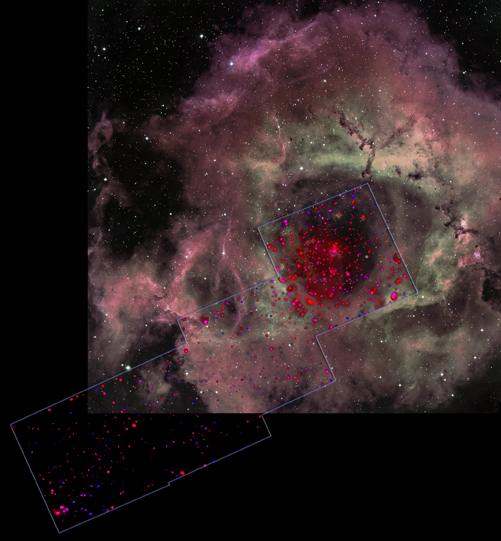
What do the famous
Eagle Nebula star pillars look like in X-ray light?
To find out, NASA's orbiting
Chandra X-ray Observatory
peered in and through these interstellar mountains of star formation.
It was found that in
M16 the
dust pillars themselves do not emit many
X-rays,
but a lot of small-but-bright X-ray sources became evident.
These sources are shown as bright dots on the
featured image which is a composite of exposures from
Chandra
(X-rays),
XMM (X-rays),
JWST
(infrared),
Spitzer
(infrared),
Hubble
(visible), and the
VLT
(visible).
What stars produce these X-rays remains a
topic of research, but some are
hypothesized to be hot,
recently-formed, low-mass stars, while others are
thought to be hot, older, high-mass stars.
These X-ray hot stars
are scattered around the frame -- the
previously identified
Evaporating Gaseous Globules (EGGS) seen in
visible light
are not currently hot enough to emit X-rays.
 APOD: 2023 June 1 - Recycling Cassiopeia A
Explanation:
Massive stars in our Milky Way Galaxy live spectacular lives.
Collapsing from vast cosmic clouds, their nuclear furnaces
ignite and create heavy elements in their cores.
After a few million years, the
enriched material is blasted
back into interstellar space where star formation can begin anew.
The expanding debris cloud known as Cassiopeia A is an example
of this final phase of the stellar life cycle.
Light from the explosion which created this supernova remnant
would have been first
seen in planet Earth's sky
about 350 years ago,
although it took that light about 11,000 years to reach us.
This false-color image, composed of X-ray and optical image data
from the Chandra X-ray Observatory and Hubble Space Telescope,
shows the still hot filaments and knots in the remnant.
It spans about 30 light-years at the estimated distance of Cassiopeia A.
High-energy X-ray emission from specific elements has been color coded,
silicon in red, sulfur in yellow, calcium in green
and iron in purple, to help
astronomers explore
the recycling of our galaxy's
star stuff.
Still expanding, the outer blast wave is seen in blue hues.
The bright speck
near the center is a neutron star,
the incredibly dense, collapsed remains of the massive stellar core.
 APOD: 2022 October 17 - X-Ray Rings Around a Gamma Ray Burst
Explanation:
Why would x-ray rings appear around a gamma-ray burst?
The surprising answer has little to do with the explosion
itself but rather with light reflected off areas of
dust-laden gas in our own
Milky Way Galaxy.
GRB 221009A
was a tremendous explosion -- a very bright
gamma-ray burst (GRB) that occurred
far across the universe
with radiation just arriving in
our Solar System last week.
Since GRBs
can also emit copious amounts of
x-rays,
a bright flash of x-rays arrived nearly simultaneously with the
gamma-radiation.
In this case,
the X-rays also bounced off regions high in dust right here in our
Milky Way Galaxy,
creating the
unusual reflections.
The greater the
angle between reflecting
Milky Way dust and the GRB, the greater the radius of the
X-ray rings, and, typically, the longer it takes for these
light-echoes to arrive.
 APOD: 2022 September 1 - The Tulip and Cygnus X-1
Explanation:
Framing a bright emission region,
this telescopic view
looks out along
the plane of our Milky Way Galaxy toward the nebula rich constellation
Cygnus the Swan.
Popularly called the Tulip Nebula,
the reddish glowing cloud of interstellar gas and dust
is also found in the
1959 catalog
by astronomer Stewart Sharpless
as Sh2-101.
Nearly 70 light-years across, the complex and beautiful Tulip Nebula
blossoms about 8,000 light-years away.
Ultraviolet radiation from young energetic stars at the edge of the Cygnus
OB3 association,
including
O star HDE 227018,
ionizes the atoms
and powers the emission from the Tulip Nebula.
Also in the field of view is microquasar
Cygnus X-1,
one of the strongest X-ray sources in planet Earth's sky.
Blasted by powerful jets from a
lurking black hole
its fainter bluish curved shock front is
only just visible though, beyond
the cosmic Tulip's petals near the right side of the frame.
 APOD: 2022 February 5 - Symbiotic R Aquarii
Explanation:
Variable star R Aquarii
is actually an interacting binary star system,
two stars that
seem to have a close symbiotic relationship.
Centered in this
space-based optical/x-ray
composite image it lies about 710 light years away.
The intriguing system consists of a cool
red giant star
and hot, dense
white dwarf star
in mutual orbit around their common center of mass.
With binoculars you can watch as R Aquarii
steadily changes its brightness over the course of a year or so.
The binary system's visible light is dominated by the red giant,
itself a Mira-type long period
variable star.
But material in the cool giant star's extended envelope
is pulled by gravity
onto the surface of the smaller, denser white dwarf,
eventually triggering
a thermonuclear explosion, blasting material into space.
Astronomers have seen such outbursts over recent decades.
Evidence for much older outbursts is seen in
these spectacular structures
spanning almost a light-year as
observed by the Hubble Space Telescope (in red and blue).
Data from the Chandra X-ray Observatory (in purple) shows
the X-ray glow from shock waves created as a jet from the white dwarf
strikes surrounding material.
 APOD: 2021 November 23 - The Sun in X-rays from NuSTAR
Explanation:
Why are the regions above sunspots so hot?
Sunspots
themselves are a bit cooler than the surrounding
solar surface because the magnetic fields that create them reduce convective heating.
It is therefore unusual that regions overhead --
even much higher up in the
Sun's corona --
can be hundreds of times hotter.
To help find the cause,
NASA directed the Earth-orbiting
Nuclear Spectroscopic Telescope Array (NuSTAR)
satellite to point its very sensitive X-ray telescope at the Sun.
Featured here is the Sun in
ultraviolet light,
shown in a red hue as taken by the orbiting
Solar Dynamics Observatory (SDO).
Superimposed in false-colored green and blue is emission above
sunspots detected by
NuSTAR
in different bands of high-energy
X-rays,
highlighting regions of extremely
high temperature.
Clues about the Sun's atmospheric
heating
mechanisms come from NuSTAR images like this and shed light
on solar nanoflares and
microflares as brief
bursts of energy that may drive the unusual heating.
 APOD: 2021 November 19 - NGC 281: Starless with Stars
Explanation:
In visible light the stars have been removed from this narrow-band image
of NGC 281,
a star forming region some 10,000 light-years away toward
the constellation Cassiopeia.
Stars were digitally added back to the resulting
starless image though.
But instead of using visible light image data, the stars were added with
X-ray data
(in purple) from the Chandra X-ray Observatory and
infrared data
(in red) from the Spitzer Space Telescope.
The merged
multiwavelength
view reveals a multitude of
stars in the region's embedded star cluster
IC 1590.
The young stars are normally hidden in visible light images by
the natal cloud's gas and obscuring dust.
Also known to backyard astro-imagers as the
Pacman
Nebula for its overall appearance in visible light,
NGC 281 is about 80 light-years across.
 APOD: 2021 November 7 - The Cats Eye Nebula in Optical and X-ray
Explanation:
To some it looks like a cat's eye.
To others, perhaps like a giant cosmic
conch shell.
It is actually one of brightest and most highly detailed
planetary nebula known,
composed of gas expelled in the brief yet
glorious phase near the end of life of a Sun-like star.
This nebula's dying central star may have produced the outer circular
concentric shells
by shrugging off
outer
layers in a series of regular convulsions.
The
formation of the beautiful, complex-yet-symmetric
inner structures,
however, is not well understood.
The
featured image is a composite of a digitally sharpened
Hubble Space Telescope image with
X-ray light
captured by the orbiting
Chandra Observatory.
The exquisite floating space statue spans over half a
light-year across.
Of course,
gazing into this Cat's Eye,
humanity may well be seeing
the fate of our sun, destined to enter its own
planetary nebula
phase of evolution ... in about 5 billion years.
 APOD: 2021 July 29 - The Tulip and Cygnus X 1
Explanation:
This tall telescopic field of view
looks out along the plane of our Milky Way Galaxy
toward the nebula rich constellation
Cygnus
the Swan.
Popularly called the Tulip Nebula,
the brightest glowing cloud of interstellar gas and dust
above center is also found in the
1959 catalog
by astronomer Stewart Sharpless
as Sh2-101.
Nearly 70 light-years across the complex and beautiful Tulip Nebula
blossoms about 8,000 light-years away, shown in a
Hubble palette image that maps the glow of the
nebula's sulfur, hydrogen, and oxygen ions into
red, green, and blue colors.
Ultraviolet radiation from young energetic stars
at the edge of the Cygnus
OB3 association, including
O star HDE 227018,
ionizes the atoms
and powers the emission from the Tulip Nebula.
Also in the field of view is microquasar
Cygnus X-1,
one of the strongest X-ray sources in planet Earth's sky.
Driven by powerful jets from a black hole accretion disk,
its fainter bluish curved shock front is
only just visible though, directly
above
the cosmic Tulip's petals near the top of the frame.
 APOD: 2021 January 23 - Recycling Cassiopeia A
Explanation:
Massive stars in our Milky Way Galaxy live spectacular lives.
Collapsing from vast cosmic clouds, their nuclear furnaces
ignite and create heavy elements in their cores.
After a few million years, the
enriched material is blasted
back into interstellar space where star formation can begin anew.
The expanding debris cloud known as Cassiopeia A is an example
of this final phase of the stellar life cycle.
Light from the explosion which created this supernova remnant
would have been first
seen
in planet Earth's sky about 350 years ago,
although it took that light about 11,000 years to reach us.
This false-color image, composed of X-ray and optical image data
from the Chandra X-ray Observatory and Hubble Space Telescope,
shows the still hot filaments and knots in the remnant.
It spans about 30 light-years at the estimated distance of Cassiopeia A.
High-energy X-ray emission from specific elements has been color coded,
silicon in red, sulfur in yellow, calcium in green
and iron in purple, to help
astronomers explore
the recycling of our galaxy's
star stuff.
Still expanding, the outer blast wave is seen in blue hues.
The bright speck
near the center is a neutron star,
the incredibly dense, collapsed remains of the massive stellar core.
 APOD: 2020 June 23 - The X Ray Sky from eROSITA
Explanation:
What if you could see X-rays?
The night sky would seem a strange and unfamiliar place.
X-rays are about 1,000 times more energetic than
visible light
photons and are produced by
violent explosions
and high temperature astronomical environments.
Instead of the familiar steady stars, the
sky would seem to be
filled with exotic stars, active galaxies, and hot supernova remnants.
The
featured X-ray image
captures in
unprecedented detail
the entire sky in X-rays as seen by the
eROSITA telescope onboard
Spektr-RG satellite,
orbiting around the
L2 point of the Sun-Earth system,
launched last year.
The image shows the plane of our Milky Way galaxy across the center, a diffuse and pervasive
X-ray background,
the hot interstellar bubble known as the
North Polar Spur, sizzling supernova remnants such as
Vela, the
Cygnus Loop and
Cas A,
energetic binary stars including
Cyg X-1 and Cyg X-2, the
LMC galaxy, and the
Coma,
Virgo, and
Fornax clusters of galaxies.
This first sky scan by
eROSITA located over one million X-ray sources,
some of which are not understood and will surely be topics for future research.
 APOD: 2020 March 31 - The Galactic Center from Radio to X ray
Explanation:
In how many ways does the center of our Galaxy glow?
This enigmatic region, about 26,000
light years
away toward the constellation of the Archer
(Sagittarius),
glows in
every type of light
that we can see.
In the
featured image, high-energy
X-ray
emission captured by NASA's orbiting
Chandra X-Ray Observatory
appears in green and blue, while low-energy
radio
emission captured by
SARAO's ground-based
MeerKAT telescope array is colored red.
Just on the right of the colorful
central region lies Sagittarius A (Sag A),
a strong radio source that coincides with
Sag A*, our
Galaxy's central supermassive black hole.
Hot gas surrounds Sag A, as well as a series of parallel radio filaments known as
the Arc, seen just left of the image center.
Numerous unusual single radio filaments are visible around the image.
Many stars orbit in and around Sag A, as well as numerous small black holes and dense stellar cores known as
neutron stars and
white dwarfs.
The Milky Way's central supermassive black hole is currently being imaged by the
Event Horizon Telescope.
 APOD: 2019 December 11 - N63A: Supernova Remnant in Visible and X-ray
Explanation:
What has this supernova left behind?
As little as 2,000 years ago, light from a massive stellar explosion in the
Large Magellanic Cloud
(LMC) first reached planet Earth.
The LMC is a close galactic neighbor of our
Milky Way Galaxy and the rampaging
explosion
front is now seen moving out - destroying or displacing
ambient gas clouds while leaving behind relatively dense
knots of gas and dust.
What remains is one of the largest
supernova remnants in the
LMC: N63A.
Many of the surviving dense
knots have been themselves compressed and may further
contract to form new stars.
Some of the resulting stars may then explode in a
supernova,
continuing the cycle.
Featured here is a combined image of N63A in the
X-ray from the
Chandra Space Telescope and in
visible light by
Hubble.
The prominent knot of gas and dust on the upper right -- informally dubbed the
Firefox -- is very bright in visible light, while the
larger supernova remnant shines most brightly in X-rays.
N63A spans over 25
light years and lies about 150,000 light years away
toward the southern
constellation
of Dorado.
 APOD: 2019 November 2 - Inside the Flame Nebula
Explanation:
The Flame Nebula
stands out in this optical image of the dusty, crowded
star forming regions
toward Orion's belt,
a mere 1,400 light-years away.
X-ray data from the Chandra Observatory and infrared images from
the Spitzer Space Telescope
can take you inside the
glowing gas and obscuring dust clouds though.
Swiping your cursor (or clicking the image) will reveal
many stars of the recently formed, embedded cluster
NGC 2024, ranging in age from 200,000 years to 1.5 million years young.
The
X-ray/infrared
composite image overlay spans about 15 light-years
across the Flame's center.
The X-ray/infrared data also indicate that the youngest stars are
concentrated near the middle of the Flame Nebula cluster.
That's the opposite of the simplest models of star formation
for the stellar nursery that predict
star formation
begins in the denser center of a molecular cloud core.
The result
requires a more complex model; perhaps
star formation continues longer in the center, or older stars are
ejected from the center due to subcluster mergers.
 APOD: 2019 September 6 - Recycling Cassiopeia A
Explanation:
Massive stars in our Milky Way Galaxy live spectacular lives.
Collapsing from vast cosmic clouds, their nuclear furnaces
ignite and create heavy elements in their cores.
After a few million years, the
enriched material is blasted
back into interstellar space where star formation can begin anew.
The expanding debris cloud known as Cassiopeia A is an example
of this final phase of the stellar life cycle.
Light from the explosion which created this supernova remnant
would have been first
seen
in planet Earth's sky about 350 years ago,
although it took that light about 11,000 years to reach us.
This
false-color image, composed of X-ray and optical image data
from the Chandra X-ray Observatory and Hubble Space Telescope,
shows the still hot filaments and knots in the remnant.
It
spans about 30 light-years at the estimated distance of Cassiopeia A.
High-energy X-ray emission from specific elements has been color coded,
silicon in red, sulfur in yellow, calcium in green
and iron in purple, to help
astronomers explore
the recycling of our galaxy's
star stuff.
Still expanding, the outer blast wave is seen in blue hues.
The bright speck
near the center is a neutron star,
the incredibly dense, collapsed remains of the massive stellar core.
 APOD: 2019 June 1 - NICER at Night
Explanation:
A payload on board the International Space Station, the
Neutron star Interior Composition Explorer
(NICER) twists and turns
to track cosmic sources
of X-rays as the station orbits planet Earth every 93 minutes.
During orbit nighttime,
its X-ray detectors remain on.
So as NICER slews from target to target bright arcs and loops are
traced across this all-sky map made from 22 months of NICER data.
The arcs tend to converge on
prominent bright
spots, pulsars in
the X-ray sky that NICER regularly targets and monitors.
The pulsars are spinning neutron stars that
emit clock-like pulses of X-rays.
Their timing is so precise it can be
used for
navigation, determining spacecraft speed and position.
This NICER X-ray, all-sky, map is composed in coordinates with the
celestial equator
horizontally across the center.
 APOD: 2019 May 1 - The Cat's Eye Nebula in Optical and X-ray
Explanation:
To some it looks like a cat's eye.
To others, perhaps like a giant cosmic
conch shell.
It is actually one of brightest and most highly detailed
planetary nebula known,
composed of gas expelled in the brief yet
glorious phase near the end of life of a Sun-like star.
This nebula's dying central star may have produced the outer circular
concentric shells
by shrugging off
outer
layers in a series of regular convulsions.
The
formation of the beautiful, complex-yet-symmetric inner structures,
however, is not well understood.
The
featured image is a composite of a digitally sharpened
Hubble Space Telescope image with
X-ray light
captured by the orbiting
Chandra Observatory.
The exquisite floating space statue spans over half a
light-year across.
Of course,
gazing into this Cat's Eye,
humanity may well be seeing
the fate of our sun, destined to enter its own
planetary nebula
phase of evolution ... in about 5 billion years.
 APOD: 2019 March 5 - X-Ray Superbubbles in Galaxy NGC 3079
Explanation:
What created these huge galactic superbubbles?
Two of these
unusual bubbles, each spanning thousands of
light-years, were recently discovered near the center of
spiral galaxy NGC 3079.
The superbubbles,
shown in purple on the image right, are so hot they emit X-rays detected by
NASA's Earth-orbiting
Chandra X-Ray Observatory.
Since the bubbles straddle the center of NGC 3079, a
leading hypothesis is that they were
somehow created by the interaction of the central
supermassive black hole with surrounding gas.
Alternatively, the
superbubbles might have been created primarily by the
energetic winds
from many young and hot stars near that galaxy's center.
The only similar known phenomenon is the
gamma-ray emitting Fermi bubbles
emanating from the center of our Milky Way Galaxy,
discovered 10 years ago in images taken by NASA's
Fermi satellite.
Research into the nature of the
NGC 3079
superbubbles will surely continue,
as well as searches for high-energy superbubbles in other galaxies.
 APOD: 2019 January 13 - Tycho Supernova Remnant in X-ray
Explanation:
What star created this huge puffball?
What's pictured is the hot expanding nebula of
Tycho's supernova remnant, the result of a stellar explosion
first recorded over 400 years ago by the famous astronomer
Tycho Brahe.
The
featured image
is a composite of three
X-ray
colors taken by the orbiting
Chandra X-ray Observatory.
The expanding gas cloud is extremely hot,
while slightly different expansion speeds have given the cloud a
puffy appearance.
Although the star that created
SN 1572,
is likely completely gone, a star dubbed
Tycho G,
too dim to be
discerned here,
is thought to be a companion.
Finding progenitor remnants of
Tycho's supernova is particularly important because the
supernova
is of Type Ia, an important rung in the
distance ladder that calibrates the
scale of the visible universe.
The peak brightness of
Type Ia supernovas is thought to be well understood,
making them quite valuable in exploring the relationship between
faintness and farness in the distant universe.
 APOD: 2018 May 12 - A Plurality of Singularities at the Galactic Center
Explanation:
A recent informal poll found that astronomers don't yet have a good
collective
noun for a group of black holes,
but they need one.
The red circles in this
Chandra
Observatory X-ray image
identify a group of a dozen black holes that
are members of binary star systems.
With 5 to 30 times the mass of the Sun, the black hole binaries
are swarming within about 3 light-years of
the center of our galaxy
where the supermassive black hole identified as Sagittarius A* (Sgr A*)
resides.
Yellow circles indicate
X-ray sources that are likely less massive
neutron stars or white dwarf stars in binary star systems.
Alone, black holes
would be invisible, but as part of a
binary star system they accrete material from their
normal companion star and generate X-rays.
At the distance of the galactic center
Chandra can detect only the brighter of these black hole binary systems
as point-like sources of X-rays,
hinting that many fainter X-ray emitting black hole binaries
should exist there,
as yet undetected.
 APOD: 2018 January 2 - Unexpected X-Rays from Perseus Galaxy Cluster
Explanation:
Why does the Perseus galaxy cluster shine so strangely in one specific color of X-rays?
No one is sure, but a much-debated hypothesis holds that these
X-rays
are a clue to the long-sought identity of
dark matter.
At the center of this mystery is a 3.5
Kilo-electronvolt
(KeV) X-ray color that appears to glow excessively only when regions well outside
the cluster center are observed,
whereas the area directly surrounding a likely central
supermassive black hole is
actually deficient in 3.5 keV X-rays.
One
proposed resolution
-- quite controversial --
is that something never seen before might be present:
fluorescent dark matter (FDM).
This form of
particle dark matter might be able to absorb 3.5 keV X-radiation.
If operating, FDM, after absorption,
might later emit these X-rays from all over the cluster, creating an
emission line.
However, when seen
superposed in front of the central region
surrounding the black hole,
FDM's absorption would be more prominent, creating an
absorption line.
Pictured, a composite image of the
Perseus galaxy cluster shows visible and radio light in red, and
X-ray light from the Earth-orbiting
Chandra Observatory in blue.
 APOD: 2016 January 7 - High Energy Andromeda
Explanation:
A mere 2.5 million
light-years away, the Andromeda Galaxy, also known
as M31, really is just next door as large galaxies go.
In this (inset) scan, image data from NASA's
Nuclear
Spectrosopic Telescope Array has yielded
the best high-energy X-ray view yet of our large neighboring spiral,
revealing some 40 extreme
sources of X-rays,
X-ray binary star systems that contain a black hole or neutron
star orbiting a more normal stellar companion.
In fact, larger Andromeda and our own Milky Way
are the most massive members of the local galaxy group.
Andromeda is close enough that NuSTAR can examine
its population of X-ray binaries in detail,
comparing them to our own.
The background image
of Andromeda was taken by NASA's Galaxy Evolution
Explorer in energetic ultraviolet light.
 APOD: 2015 August 5 - X ray Echoes from Circinus X 1
Explanation:
Circinus X-1 is an X-ray binary star known for its erratic
variability.
In the
bizarre
Circinus X-1 system, a dense neutron star,
the collapsed remnant of a supernova explosion, orbits with a more ordinary
stellar companion.
Observations of the X-ray binary in months
following an intense X-ray flare from the source in 2013
progressively revealed striking concentric rings - bright
X-ray light echoes
from four intervening clouds of interstellar dust.
In this
X-ray/optical composite, the swaths of Chandra Observatory
X-ray image
data showing partial outlines of the rings are in false colors.
Remarkably,
timing the X-ray echoes,
along with known distances to the
interstellar dust clouds, determines
the formerly highly uncertain distance to Circinus X-1 itself
to be 30,700 light-years.
 APOD: 2014 December 29 - The Sun in X rays from NuSTAR
Explanation:
Why are the regions above sunspots so hot?
Sunspots themselves are a bit cooler than the surrounding solar surface because the magnetic fields that create them reduce convective heating.
It is therefore unusual that regions overhead -- even much higher up in the Sun's corona -- can be hundreds of times hotter.
To help find the cause,
NASA directed the Earth-orbiting
Nuclear Spectroscopic Telescope Array (NuSTAR)
satellite to point its very sensitive X-ray telescope at the Sun.
Featured above is the Sun in ultraviolet light,
shown
in a red hue as taken by the orbiting
Solar Dynamics Observatory (SDO).
Superimposed in false-colored green and blue is emission above sunspots detected by
NuSTAR in different bands of
high-energy
X-rays,
highlighting regions of extremely
high temperature.
Clues about the Sun's atmospheric
heating
mechanisms may not only come from this initial image,
but future NuSTAR images aimed at finding hypothesized
nanoflares,
brief bursts of energy that may drive the unusual heating.
 APOD: 2014 September 12 - Supernova Remnant Puppis A
Explanation:
Driven
by the explosion of a massive star,
supernova remnant Puppis A is blasting into the
surrounding interstellar medium about 7,000 light-years away.
At that distance,
this remarkable
false-color exploration of its complex expansion
is about 180 light-years wide.
It is based on the most
complete X-ray data
set so far from the Chandra and XMM/Newton observations,
and infrared data from the Spitzer Space Telescope.
In blue hues, the filamentary X-ray glow is
from gas heated by the supernova's
shock wave,
while the infrared emission shown in red and green is
from warm dust.
The bright pastel tones trace the regions where shocked
gas and warmed dust mingle.
Light from the initial supernova itself, triggered by
the collapse of the massive
star's core, would have reached
Earth about 3,700 years ago, though the Puppis A supernova
remnant remains a strong source in
the X-ray sky.
 APOD: 2014 August 16 - No X-rays from SN 2014J
Explanation:
Last January, telescopes in observatories around planet Earth
were eagerly used to watch the rise of SN 2014J,
a bright supernova in nearby galaxy M82.
Still, the most important observations may have been from orbit
where the
Chandra X-ray Observatory
saw nothing.
Identified as a
Type Ia
supernova, the explosion of
SN2014J was thought to be triggered
by the buildup of mass on a white dwarf star steadily
accreting material from a companion star.
That model predicts X-rays would be generated
when the supernova blastwave struck the material
left surrounding the white dwarf.
But no X-rays were seen from the supernova.
The mostly blank close-ups centered on the
supernova's position are shown
in the before and after inset panels of
Chandra's false color
X-ray image of
the M82 galaxy.
The stunning
lack of X-rays
from SN 2014J will require astronomers to explore other models
to explain what triggers these
cosmic explosions.
 APOD: 2014 July 25 - Cosmic Crab Nebula
Explanation:
The Crab Pulsar, a city-sized, magnetized
neutron star
spinning 30 times a second,
lies at the center of this tantalizing wide-field image of the
Crab Nebula.
A spectacular picture of one of
our Milky Way's supernova remnants, it
combines optical survey data with X-ray data from the orbiting
Chandra Observatory.
The composite was created as part of a celebration of
Chandra's 15
year long exploration of the
high energy cosmos.
Like a
cosmic
dynamo
the pulsar powers
the X-ray and optical emission from the nebula,
accelerating charged particles to extreme energies to
produce the jets and rings glowing in X-rays.
The innermost ring structure is about a light-year across.
With more mass than the Sun and the density of an
atomic nucleus, the spinning pulsar is the collapsed core of the
massive star that exploded, while the nebula is the
expanding remnant of the star's outer layers.
The supernova explosion was witnessed in
the year
1054.
 APOD: 2014 June 10 - M51: X Rays from the Whirlpool
Explanation:
What if we X-rayed an entire spiral galaxy?
This was done (again) recently by NASA's
Chandra X-ray Observatory
for the nearby interacting galaxies known as the
Whirlpool (M51).
Hundreds of glittering x-ray stars are present in the
above
Chandra image of the spiral and its neighbor.
The image is a conglomerate of
X-ray light
from Chandra and visible light from the
Hubble Space Telescope.
The number of luminous x-ray
sources, likely neutron star and black hole
binary
systems within the confines of
M51, is unusually high
for normal spiral or elliptical galaxies and suggests this cosmic
whirlpool has experienced
intense
bursts of massive star formation.
The bright cores of both galaxies, NGC 5194 and NGC 5195
(right and left respectively), also exhibit high-energy
activity.
In this false-color image where X-rays are depicted in purple,
diffuse X-ray emission typically results from
multi-million degree gas heated by
supernova explosions.
 APOD: 2014 May 10 - Inside the Flame Nebula
Explanation:
The Flame Nebula
stands out in this optical image of the dusty, crowded
star forming regions
toward Orion's belt,
a mere 1,400 light-years away.
X-ray data from the Chandra Observatory and infrared images from
the Spitzer Space Telescope
can take you inside the
glowing gas and obscuring dust clouds though.
Swiping your cursor (or clicking the image) will reveal
many stars of the recently formed, embedded cluster
NGC 2024, ranging in age from 200,000 years to 1.5 million years young.
The X-ray/infrared
composite image overlay spans about 15 light-years
across the Flame's center.
The X-ray/infrared data also indicate that the youngest stars are
concentrated near the middle of the Flame Nebula cluster.
That's the opposite of the simplest models of star formation
for the stellar nursery that predict
star formation
begins in the denser center of a molecular cloud core.
The result
requires a more complex model; perhaps
star formation continues longer in the center, or older stars are
ejected from the center due to subcluster mergers.
 APOD: 2013 September 6 - The Quiet Sagittarius A*
Explanation:
Hot gas is hard to swallow.
At least
that seems to be true for the supermassive black hole
at the center of our Milky Way Galaxy.
Known as source Sagittarius A*,
the Milky Way's black hole is
centered in this infrared (red and yellow hues) and X-ray (blue)
composite.
Based on data from an
extensive campaign
of observations by the orbiting Chandra X-ray telescope, the diffuse
emission surrounding the black hole is seen in the close-up inset,
the inset field spanning about 1/2 light-year across the galactic center some
26,000 light-years away.
Astronomers have found that the X-ray emission originates in hot gas
drawn from the winds of massive young stars in the region.
The Chandra data
indicate that only about 1% or less of the gas within the
black hole's gravitational influence ever reaches the event horizon,
losing enough heat and angular momentum to fall into the black hole,
while the rest of the gas escapes in an outflow.
The result explains
why the Milky Way's black hole is so quiet,
much fainter than might be
expected in energetic X-rays.
It likely holds for most supermassive black holes
in galaxies in the nearby Universe.
 APOD: 2013 May 15 - Kepler's Supernova Remnant in X-Rays
Explanation:
What caused this mess?
Some type of star exploded to create the unusually shaped nebula known as
Kepler's supernova remnant,
but which type?
Light from the
stellar explosion
that created this energized cosmic cloud was first seen on planet
Earth in October 1604, a mere
four hundred years
ago.
The supernova produced a bright new star
in early 17th century skies within the constellation Ophiuchus.
It was studied by astronomer
Johannes Kepler
and his contemporaries, without the benefit of a telescope, as they
searched for an
explanation
of the heavenly apparition.
Armed with a modern understanding of
stellar evolution, early 21st century
astronomers continue to explore the expanding debris cloud, but can now use
orbiting space telescopes to survey Kepler's supernova remnant (SNR)
across the spectrum.
Recent
X-ray data and
images
of Kepler's supernova remnant taken by the orbiting
Chandra X-ray Observatory has shown relative elemental abundances typical of a
Type Ia supernova, and further indicated that the progenitor was a
white dwarf star that exploded
when it accreted too much material from a companion
Red Giant star and went over
Chandrasekhar's limit.
About 13,000 light years away, Kepler's supernova
represents the most recent stellar explosion seen to
occur within
our Milky Way galaxy.
 APOD: 2013 January 17 - Cas A: Optical and X-ray
Explanation:
The aftermath of a cosmic cataclysm,
supernova
remnant Cassiopeia A (Cas A) is a
comfortable
11,000 light-years away.
Light from the Cas A supernova,
the death explosion of a massive star,
first reached Earth just 330 years ago.
Still expanding, the explosion's
debris cloud spans
about 15 light-years near the center of this
composite image.
The
scene combines color data of the
starry field and fainter filaments of material at optical energies
with image data from the orbiting NuSTAR X-ray telescope.
Mapped to false colors,
the X-ray data in blue hues trace the
fragmented outer boundary of the expanding
shock wave, glowing at energies up to
10,000 times the energy of the optical
photons.
 APOD: 2012 November 2 - The Black Hole in the Milky Way
Explanation:
At the center of our Milky Way Galaxy,
a mere 27,000 light-years away,
lies a black hole with 4 million times the mass of the Sun.
Fondly known as Sagittarius A* (pronounced A-star),
the Milky Way's black hole is
fortunately mild-mannered compared
to the central black holes in
distant active galaxies, much
more calmly consuming material around it.
From time to time it does flare-up, though.
An outburst lasting several hours is captured in
this series of premier X-ray images
from the orbiting
Nuclear
Spectroscopic Telescope Array (NuSTAR).
Launched last June 13, NuSTAR is the first to provide
focused views
of the area surrounding Sgr A* at X-ray energies higher than
those accessible to Chandra and XMM observatories.
Spanning two days of NuSTAR observations,
the flare sequence is illustrated in the panels at the far right.
X-rays are generated in material heated to over 100 million
degrees Celsius, accelerated to nearly the speed of light as it
falls into the Miky Way's central black hole.
The main inset X-ray image
spans about 100 light-years.
In it, the bright white region represents the hottest material closest
to the black hole, while the pinkish cloud likely belongs to a
nearby supernova remnant.
 APOD: 2012 June 19 - NuSTAR X-Ray Telescope Launched
Explanation:
What's left after a star explodes?
To help find out, NASA
launched the
Nuclear Spectroscopic Telescope Array
(NuSTAR) satellite into Earth orbit last week.
NuSTAR's ability to focus hard
X-rays
emitted from the nuclei of atoms will be used, among other things, to inspect the surroundings of
supernova remnants so as to better understand why these supernovas occurred,
what types of objects resulted, and what mechanisms make their surroundings glow so hot.
NuSTAR will also give humanity
unprecedented looks at the
hot corona of our Sun, hot gasses in
clusters of galaxies,
and the
supermassive black hole in the
center of our Galaxy.
Pictured above is an artist's illustration depicting how
NuSTAR works.
X-rays similar to those used in your dentist's office enter the telescope on the right and
skip off two sets of
parallel mirrors
that focus them onto the detectors on the left.
A long but low-weight mast separates the two, and the
whole thing
is powered by solar panels on the upper left.
Part of the excitement involving
NuSTAR
is not only what things it is expected to see, but by
looking at the universe in a new way, what things that are completely unknown
that might be discovered.
NuSTAR
has a planned two year lifetime.
 APOD: 2012 March 15 - Solar Flare in the Gamma-ray Sky
Explanation:
What shines in the gamma-ray sky?
The
answer is usually the most exotic and energetic
of astrophysical environments, like
active galaxies powered
by supermassive black holes, or incredibly
dense pulsars, the spinning
remnants of exploded stars.
But on March 7,
a powerful
solar flare, one of a series of
recent solar eruptions,
dominated the gamma-ray sky
at energies up to 1 billion times the energy of visible light
photons.
These two panels illustrate the intensity of that solar flare
in all-sky images recorded by the orbiting
Fermi Gamma-ray Space Telescope.
On March 6, as on most days, the Sun was
almost invisible to
Fermi's imaging detectors.
But during the energetic
X-class
flare, it became nearly 100 times
brighter than even the Vela Pulsar
at gamma-ray energies.
Now faded in
Fermi's view, the Sun will likely shine
again in the gamma-ray sky as the solar activity cycle approaches
its maximum.
 APOD: 2011 November 10 - RCW 86: Historical Supernova Remnant
Explanation:
In 185 AD,
Chinese
astronomers recorded the appearance of
a new star in the Nanmen asterism -
a part of the sky identified
with Alpha and Beta Centauri on modern star charts.
The new star was visible for months and is
thought to be the earliest
recorded supernova.
This multiwavelength
composite image from orbiting telescopes of the 21st century,
XMM-Newton and Chandra in X-rays, and Spitzer and WISE in infrared,
shows
RCW 86, understood to be the remnant of that
stellar explosion.
The false-color view
traces interstellar gas heated by the expanding supernova shock wave
at X-ray energies (blue and green) and interstellar dust radiating at
cooler temperatures in infrared light (yellow and red).
An abundance of the element iron and lack of a neutron star or pulsar
in the remnant suggest that the original supernova was Type Ia.
Type Ia
supernovae are thermonuclear explosions that
destroy
a white dwarf star as it accretes material from a companion
in a binary star system.
Shock velocities
measured in
the X-ray emitting shell and infrared dust temperatures indicate that
the remnant is expanding extremely rapidly into a remarkable
low density bubble created before the explosion by the white dwarf system.
Near the plane of our Milky Way Galaxy,
RCW 86 is about 8,200 light-years away and has an estimated radius
of 50 light-years.
 APOD: 2010 March 18 - Fermi Catalogs the Gamma ray Sky
Explanation:
What shines
in the gamma-ray sky?
The most complete answer yet to that question is offered by the
Fermi Gamma-ray Space Telescope's
first all-sky catalog.
Fermi's sources
of cosmic
gamma-rays feature nature's most energetic
particle
accelerators,
ultimately producing 100 MeV to 100 GeV photons, photons with
more than 50 million to 50 billion times the
energy
of visible light.
Distilled from 11 months of sky survey data using Fermi's Large Area
Telescope (LAT), the 1,451 cataloged sources include energetic
star burst galaxies
and active galactic nuclei (AGN)
far beyond the Milky Way.
But within our own galaxy are
many pulsars (PSR)
and
pulsar wind nebulae (PWN),
supernova remnants (SNR),
x-ray binary stars (HXB) and
micro-quasars
(MQO).
Fermi's all sky map is shown centered on the Milky Way
with the diffuse gamma-ray emission from the Galactic plane
running horizontally through the frame.
To locate the cataloged gamma-ray sources,
just slide your cursor over the map.
For now, 630 of the
sources cataloged at gamma-ray energies
remain otherwise unidentified, not associated with sources detected
at lower energies.
 APOD: 2009 October 28 - JKCS041: The Farthest Galaxy Cluster Yet Measured
Explanation:
What if we could see back to the beginning of the universe?
We can -- since it takes the
age of the universe for light to cross the universe.
Peering at distant objects, therefore, tells us about
how the universe used to be, even
near its beginning.
Since telescopes are therefore also
time portals, observations of
distant clusters can be used, for example, to investigate when and how these
huge galaxy conglomerations formed.
Previously, the
redshift
record for a galaxy cluster was about 1.5, corresponding to about nine billion
light years distant.
Recently, using data including
X-ray images from the orbiting
Chandra X-Ray Observatory, a new farthest cluster was identified.
Shown above,
JKCS041 is seen at redshift 1.9, corresponding to nearly one billion light years farther than the previous record holder.
The hot X-ray gas that confirmed the
apparent galaxy grouping as a true cluster of galaxies is shown above in diffuse blue, superposed on an optical image showing many foreground stars.
JKCS041 is seen today as it appeared at only one quarter of the present age of the universe.
 APOD: 2009 September 5 - Supernova Remnant E0102 72
Explanation:
The expanding debris cloud from the explosion of a massive star
is captured in
this
multiwavelength composite, combining x-ray and optical images
from the Chandra and Hubble telescopes.
Identified as E0102-72, the
supernova remnant lies about
190,000 light-years away in our neighboring galaxy, the
Small Magellanic Cloud.
A strong cosmic source of x-rays, E0102 was imaged by the
Chandra X-ray Observatory shortly after its launch in 1999.
In celebration of
Chandra's 10th anniversary,
this colorful
view of E0102 and its environs was created, including additional
Chandra data.
An analysis of
all
the data indicates that the
overall shape of E0102 is most likely a cylinder that is
viewed end-on rather than a spherical bubble.
The intriguing result implies that the massive star's explosion
has produced a shape similar to what is seen in some
planetary nebulae
associated
with lower mass stars.
At the distance of the Small Magellanic Cloud, this field of view
spans about 150 light-years.
 APOD: 2009 March 21 - Fermi's Gamma Ray Sky
Explanation:
Scanning the entire sky in gamma-rays,
photons with over 50 million
times the energy of visible light, the Fermi mission's Large Area
Telescope (LAT) explores the high-energy universe.
This all-sky map
constructed from 3 months of LAT observations
(August 4 to October 30, 2008)
represents a deeper, better-resolved view of the
gamma-ray sky than any previous space mission.
What shines
in Fermi's gamma-ray sky?
A new paper describes
the 205 brightest gamma-ray sources, but this map
highlights a Fermi "top ten" list of five sources
within, and five sources that lie beyond our
Milky Way Galaxy.
Within our galaxy: the Sun traces a faint arc across the map
between the observation dates, LSI +61 303 is an
X-ray binary star about
6,500 light-years away,
PSR J1836+5925 is a type of
pulsar
(spinning neutron star) that
is only seen to
pulse at gamma-ray energies, and
47 Tuc is
a globular star cluster some 15,000 light-years away.
A fifth galactic source (unidentified), just above the center
of the galactic plane, is intriguing because it is a variable
source and has no clear counterpart at other wavelengths.
Beyond our galaxy:
NGC 1275 is a large galaxy at
the heart of
the Perseus galaxy cluster some 233 million light-years away,
while 3C 454.3, PKS 1502+106, and PKS 0727-115 are active galaxies
billions of light-years distant.
Another unidentified source, seen below the galactic plane, is
likely beyond the boundaries of the Milky Way.
Its nature remains a mystery.
 APOD: 2009 February 5 - NGC 604: X-rays from a Giant Stellar Nursery
Explanation:
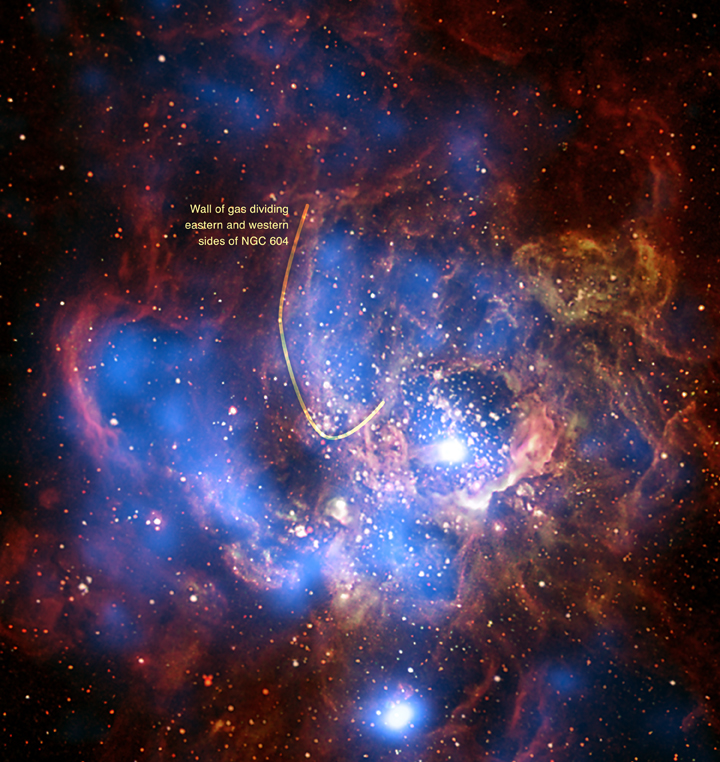
Some 3 million light-years distant in nearby spiral
galaxy M33,
giant stellar nursery
NGC 604 is
about 1,300 light-years across,
or nearly 100 times the size of the
Orion Nebula.
In fact, among the star forming regions within the Local Group of
galaxies, NGC 604 is second in size only to 30 Doradus,
also known as
the Tarantula Nebula in the
Large Magellanic Cloud.
This space-age
color composite of X-ray data (in blue hues)
from the Chandra Observatory, and
Hubble optical data
shows that NGC 604's cavernous bubbles and cavities are filled with a
hot, tenuous,
X-ray
emitting gas.
Intriguingly, NGC 604 itself is divided by
a wall of relatively cool gas.
On the western (right) side of the nebula,
measurements
indicate that material is likely
heated to X-ray temperatures by the energetic winds
from a cluster of about 200 young, massive stars.
On the eastern side the X-ray filled cavities seem to be older,
suggesting
supernova explosions from the end of
massive star evolution contribute to their formation.
 APOD: 2008 December 27 - Crab Pulsar Wind Nebula
Explanation:
The Crab Pulsar, a city-sized, magnetized
neutron star spinning 30 times a second,
lies at the center of
this
remarkable image from
the orbiting Chandra Observatory.
The deep x-ray image gives the first
clear view of
the convoluted boundaries of the Crab's pulsar wind nebula.
Like a
cosmic
dynamo the pulsar powers the x-ray
emission.
The pulsar's energy accelerates
charged particles, producing eerie, glowing x-ray jets directed
away from the poles and an intense wind in the equatorial direction.
Intriguing edges are created as the charged
particles stream away, eventually losing energy as they interact
with the pulsar's strong magnetic field.
With more mass than the Sun and the density of an
atomic nucleus,
the spinning pulsar itself is the collapsed core of a
massive star.
The stellar core collapse resulted in a supernova explosion that
was witnessed in
the year
1054.
This Chandra image spans just under 9 light-years at the Crab's
estimated distance of 6,000 light-years.
 APOD: 2008 August 11 - Black Hole Candidate Cygnus X-1
Explanation:
Is that a black hole?
Quite possibly.
The Cygnus X-1
binary star system contains one of the best candidates for a
black hole.
The system was discovered because it is one of the brightest
X-ray
sources on the sky, shining so bright it was detected by the
earliest rockets
carrying cameras capable of seeing the previously unknown
X-ray sky.
The star's very name indicates that it is the single brightest X-ray source in the
constellation
of the Swan Cygnus.
Data indicate that a
compact object
there contains about nine times the mass of the Sun and changes its
brightness continually on several time scales, at least down to milliseconds.
Such behavior is expected for a
black hole,
and difficult to explain with other models.
Pictured above is an artistic impression of the
Cygnus X-1 system.
On the left is the bright blue
supergiant star
designated HDE 226868, which is estimated as having about 30 times the mass of our Sun.
Cygnus X-1 is depicted on the right, connected to its
supergiant companion by a stream of gas, and surrounded by an impressive
accretion disk.
The bright star in the
Cygnus X-1 system is visible with a small telescope.
Strangely, the
Cygnus X-1 black hole candidate
appears to have formed without a bright
supernova explosion.
 APOD: 2008 August 4 - X-Rays from the Cat's Eye Nebula
Explanation:
Haunting patterns within planetary nebula
NGC 6543
readily suggest its popular moniker -- the
Cat's Eye nebula.
Starting in 1995, stunning false-color optical images
from the Hubble
Space Telescope detailed the swirls of this
glowing nebula, known to
be the gaseous shroud expelled from a dying
sun-like
star about 3,000 light-years from Earth.
This composite picture
combines the latest Hubble optical image of the Cat's Eye with new x-ray data from the
orbiting Chandra Observatory and reveals
surprisingly intense x-ray emission indicating the presence
of extremely hot gas.
X-ray emission is shown as blue-purple hues superimposed on the nebula's center.
The nebula's central star itself is clearly immersed in
the multimillion degree, x-ray emitting gas.
Other pockets of x-ray hot gas seem to be bordered by cooler
gas emitting strongly at optical wavelengths, a clear indication
that expanding hot gas is sculpting the
visible Cat's Eye
filaments and structures.
Gazing into the Cat's Eye, astronomers see
the fate of our sun,
destined to enter its own
planetary nebula phase
of evolution ... in about
5 billion
years.
 APOD: 2008 February 13 - Elliptical Galaxy NGC 1132
Explanation:
NGC 1132 is one smooth galaxy -- but how did it form?
As an
elliptical galaxy,
NGC 1132 has little dust and gas, and few stars have formed in it recently.
Although many elliptical galaxies are in clusters of galaxies, NGC 1132
appears as a large, isolated galaxy toward the constellation of
the River (Eridanus).
To probe the history of this intriguing trillion-star ball, astronomers imaged
NGC 1132 in both
visible light with the
Hubble Space Telescope and
X-ray light with the
Chandra X-ray Observatory.
In this composite false-color image, visible light is white,
while the X-ray light is blue and indicates the unusual
presence of very hot gas.
The X-ray light also likely traces out the location of
dark
matter.
One progenitor hypothesis is that NGC 1132 is the result of a series of
galaxy mergers in what once was a small
group of galaxies.
NGC 1132 is over 300 million light years away, so the light we see
from it today left before
dinosaurs
roamed the Earth.
Many
fascinating background galaxies
can be seen far in the distance.
 APOD: 2008 January 10 - Active Galaxy Centaurus A
Explanation:
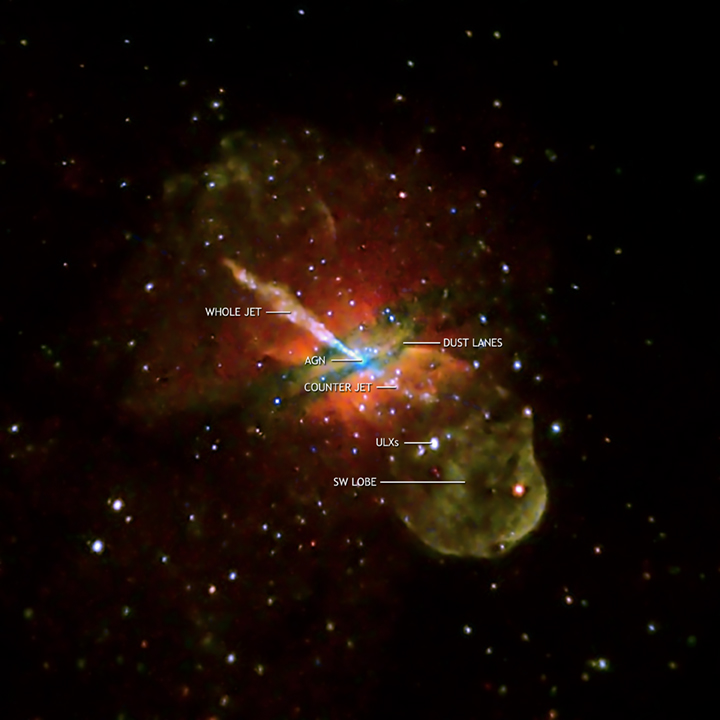
A mere 11 million light-years away,
Centaurus A is a giant elliptical
galaxy - the closest active galaxy to Earth.
This remarkable
composite view of the galaxy
combines
image data
from the x-ray (
Chandra),
optical(ESO), and
radio(VLA)
regimes.
Centaurus A's central region
is a jumble of gas, dust, and stars
in optical light,
but both radio and x-ray telescopes trace a
remarkable jet of
high-energy particles streaming from the galaxy's core.
The cosmic
particle accelerator's
power source is a
black
hole with about 10 million times the mass of the
Sun coincident with the x-ray bright spot at the galaxy's center.
Blasting out from the active galactic nucleus toward the upper left,
the energetic jet extends about 13,000 light-years.
A shorter jet extends from the nucleus in the opposite direction.
Other x-ray bright spots
in
the field are binary star systems with neutron stars or stellar mass
black holes.
Active galaxy Centaurus A is likely the result of a
merger with
a spiral galaxy some 100 million years ago.
 APOD: 2007 October 6 - X-Ray Stars of Orion
Explanation:
The stars of Orion shine brightly
in visible light in planet Earth's night sky.
The
constellation harbors the closest large stellar nursery,
the Great Nebula of Orion,
a mere 1,500 light-years away.
In fact, the apparently bright clump of stars near the center
of this false color Chandra
x-ray telescope picture
are the massive stars of
the Trapezium - the
young star cluster which powers much of the nebula's
visible-light glow.
The stars shown
in blue and orange are young sun-like stars; prodigious sources
of x-rays thought to be produced in hot
stellar coronae and
surface flares in a young star's strong
magnetic field.
Our middle-aged
Sun itself was
probably thousands of times
brighter in x-rays when, like
the
Trapezium stars, it was
only a few million years old.
The
x-ray image
spans about 2.5 light-years
across the central region of the Orion Nebula.
 APOD: 2007 April 11 - The Arms of NGC 4258
Explanation:
Better known as M106, bright
spiral galaxy
NGC 4258 is about 30 thousand light years across and
21 million light years away
toward the northern constellation
Canes Venatici.
The yellow and red hues in
this composite
image show the
galaxy's sweeping
spiral arms
as seen in visible and
infrared light.
But x-ray
and radio data
(blue and purple) reveal two extra
spiral arms -- arms that don't align with the more familiar tracers
of stars, gas, and dust.
In fact,
an analysis of
the x-ray
and radio data suggests
that the anamolous arms are composed of material
heated by shock waves.
Detected at radio wavelengths,
powerful jets originating in the
galaxy's core likely drive the shocks into the disk
of NGC 4258.
 APOD: 2007 February 24- X-rays and the Eagle Nebula
Explanation:
The premier Chandra X-ray Observatory
images of M16,
the Eagle Nebula, show many bright x-ray sources
in the region.
Most of the
x-ray
sources are energetic young stars.
They are seen here as colored spots superimposed on the Hubble's
well-known optical view of M16's light-year long
Pillars of Creation.
For example, a blue source
near
the tip of the large pillar at
the upper left is estimated to be an embedded young star
4 or 5 times as massive
as the Sun.
Still, most of the x-ray sources are not coincident
with the pillars themselves, indicating that embedded stars are
not common in the dusty structures.
The mostly empty pillars are thought to be an
indication that
star formation actually peaked millions of years ago
within
the Eagle
Nebula.
 APOD: 2007 January 16 - Keplers Supernova Remnant in X Rays
Explanation:
What caused this mess?
Some type of star exploded to create the unusually shaped nebula known as
Kepler's supernova remnant,
but which type?
Light from the stellar explosion that
created this energized cosmic cloud was first seen on planet
Earth in October 1604, a mere
four hundred years
ago.
The supernova produced a bright
new star
in early 17th century skies within the constellation
Ophiuchus.
It was studied by astronomer
Johannes Kepler
and his contemporaries, with out the benefit of a telescope, as they
searched for an explanation of the heavenly apparition.
Armed with a
modern
understanding of stellar evolution, early 21st century
astronomers continue to explore the expanding debris cloud, but can now use
orbiting space telescopes to survey Kepler's supernova remnant (SNR)
across the spectrum.
Recent X-ray data and
images
of Kepler's supernova remnant taken by the orbiting
Chandra X-ray Observatory has shown relative elemental abundances more typical of a
Type Ia supernova, indicating that the progenitor was a
white dwarf star that exploded
when it accreted too much material and went over
Chandrasekhar's limit.
About 13,000 light years away, Kepler's supernova
represents the most recent stellar explosion seen to
occur within
our Milky Way galaxy.
 APOD: 2006 August 10 - Galactic Center Star Clusters
Explanation:
If you had
x-ray
vision, the central regions
of our Galaxy would not be hidden from
view by cosmic dust clouds.
Instead,
the Milky Way
toward Sagittarius might look something
like this.
Pleasing to look at, the gorgeous false-color representation of
x-ray data
from the Chandra Observatory shows
high energies in blue, medium in green,
and low energy x-rays in red.
The
mosaic spans about 130 light-years at the 26,000 light-year
distance of the Galactic Center.
It reveals massive, x-ray emitting star clusters
in a crowded environment.
In particular,
the Galactic Center cluster and the enormous
black hole
Sagittarius A* are within the bright region near the
bottom.
Two other star clusters, the Arches,
and the Quintuplet
lie near the top.
Cluster interactions with dense molecular clouds in the region
may produce some of the diffuse emission detected in
the Chandra
x-ray view.
 APOD: 2006 July 22 - Mira: The Wonderful Star
Explanation:
To seventeenth century astronomers,
Omicron
Ceti or
Mira was
known as a wonderful star - a star whose brightness could change
dramatically in the course of about 11 months.
Modern astronomers now recognize an entire class of long period
Mira-type variables as cool,
pulsating, red giant stars, 700 or so times the diameter of the Sun.
Only 420 light-years away,
red
giant Mira (Mira A, right) itself
co-orbits with a companion star, a small white dwarf (Mira B).
Mira B is surrounded by a disk of material drawn from the pulsating
giant and in such a double star system, the white dwarf star's
hot accretion disk
is expected to produce
some x-rays.
But this sharp,
false-color image from the Chandra Observatory also
captures the cool giant star strongly
flaring at
x-ray energies, clearly
separated from the x-ray emission of its companion's accretion disk.
Placing your cursor over the Chandra x-ray image of Mira will reveal
an artist's vision of this still wonderful
interacting binary star system.
 APOD: 2006 April 12 - Binary Black Hole in 3C 75
Explanation:
The two bright sources at the center of
this
composite x-ray (blue)/
radio
(pink) image are co-orbiting supermassive black holes powering
the giant radio source
3C 75.
Surrounded by multimillion degree x-ray emitting gas, and
blasting out jets of relativistic particles the
supermassive black holes
are separated by 25,000 light-years.
At the cores of
two merging galaxies in the
Abell 400
galaxy cluster they are some 300 million light-years away.
Astronomers
conclude that these two supermassive
black
holes are bound together by gravity in a binary system
in part because
the jets' consistent swept back appearance is most likely due to their
common motion as they speed through the hot cluster gas
at 1200 kilometers per second.
Such spectacular cosmic mergers are thought to be common in crowded
galaxy cluster environments
in the distant universe.
In their final stages the mergers are expected to be intense
sources of gravitational waves.
 APOD: 2005 December 8 - X-Rays from the Perseus Cluster Core
Explanation:
The Perseus Cluster of thousands of galaxies,
250 million light-years distant, is
one of
the most massive objects
in
the Universe and the brightest galaxy cluster in the
x-ray sky.
At its core lies the giant
cannibal galaxy Perseus A
(NGC
1275), accreting matter as
gas and galaxies fall into it.
This deep
Chandra Observatory x-ray image spans about 300,000 light-years
across the galaxy cluster core.
It shows
remarkable details
of x-ray emission from the monster galaxy and
surrounding hot (30-70 million degrees C) cluster gas.
The bright central source is the supermassive
black
hole at the core of Perseus A itself.
Low density regions are seen as dark bubbles or voids,
believed to be generated by cyclic outbursts of activity
from the central black hole.
The activity creates pressure waves -
sound waves on a cosmic scale-
that ripple through the x-ray hot gas.
Dramatically, the blue-green wisps just above centre in the
false-color view are likely x-ray shadows of
the remains of a small galaxy falling into the burgeoning
Perseus A.
 APOD: 2005 October 25 - Supernova Remnant N132D in Optical and X Rays
Explanation:
Thousands of years after a star exploded, its expanding remnant
still glows brightly across the spectrum.
Such is the case with
N132D, a
supernova remnant located in the neighboring
Large Magellanic Cloud (LMC) galaxy.
The expanding shell from this explosion now spans 80
light-years
and has swept up about 600 Suns worth of mass.
N132D was imaged recently in optical light and in great detail with the
Hubble Space Telescope.
The Hubble image was then combined with a position coincident detailed image in
X-ray light taken by the
Chandra X-ray Observatory.
The combination,
shown above
in representative colors, shows a nearly spherical expanding
shockwave
highlighted by pink emission from
hydrogen
gas and purple emission from
oxygen gas.
A dense field of unrelated stars also from the
LMC populates the image.
Studying the image gives an opportunity to study material
once hidden deep inside a star.
N132D spans about 150 light years and lies about 160,000
light years away toward the
constellation of
Dorado.
 APOD: 2005 September 2 - X Ray Portrait of Trumpler 14
Explanation:
A wonder of planet Earth's southern sky, star cluster
Trumpler
14 lies about nine thousand light-years away in the
Carina
complex -- a rich star forming region at the
edge of a giant molecular cloud.
This false-color x-ray
portrait
of Trumpler 14 from
the orbiting Chandra Observatory spans over 40 light-years and
reveals
stunning details of a cluster with one of the highest
concentrations of massive stars in the Galaxy.
Profoundly affecting their environment,
the hot cluster stars are themselves a mere one million years old.
Energetic winds from the stars have
cleared out a cavity in
the dense cloud, filling it with shock heated,
x-ray
emitting gas.
Still to come, the next few million years will see these stellar
prodigies rapidly exhaust their nuclear fuel and explode in violent
supernovae, flooding their cosmic neighborhood with
gas enriched in heavy elements.
 APOD: 2005 July 21 - X-Ray Stars of 47 Tuc
Explanation:
Visible light images
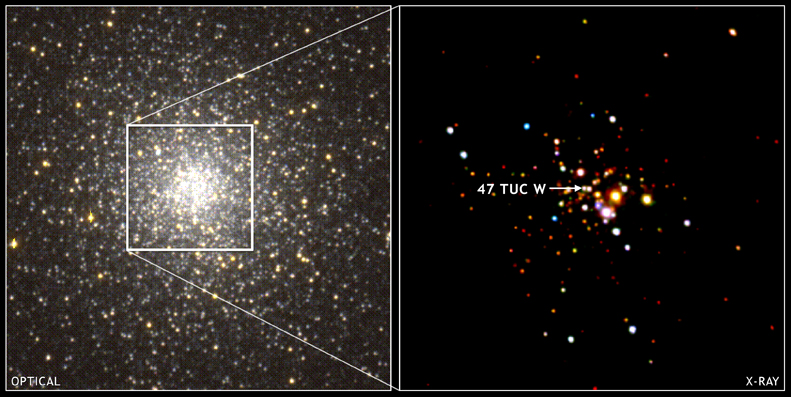
show the central region of globular
cluster 47
Tucanae is closely packed, with stars
less than a tenth of a light-year apart.
This Chandra false-color
x-ray view
of central 47 Tuc also shows the
cluster is a popular neighborhood for
x-ray stars,
many of which are "normal" stars
co-orbiting with extremely dense
neutron stars
-- stars with the mass of the Sun but
the diameter of Manhattan Island.
One of the most remarkable of these exotic
binary systems is
cataloged as 47 Tuc W, a bright source
near
the center of this image.
The system consists of a low mass star and a
a neutron star that spins once every 2.35
milliseconds.
Such neutron stars are known to radio astronomers
as millisecond pulsars, believed to be driven to such
rapid rotation by material falling from the normal star onto
its dense companion.
In fact, x-ray observations of the 47 Tuc W system
link this
spin-up mechanism observed to operate in other x-ray binary
stars with fast rotating millisecond
pulsars.
 APOD: 2005 May 19 - X Ray Stars in the Orion Nebula
Explanation:
When our
middle-aged Sun
was just a few
million years old it was
thousands of times brighter
in
x-rays.
In fact, it was likely similar to some of the stars found
in this false-color x-ray composite of the Orion Nebula region
from the Chandra Observatory.
The image is
centered
on bright stars of the nebula's
Trapezium star cluster, and while
analyzing the
Chandra data
astronomers have now found examples of young,
sun-like stars producing intense
x-ray flares.
It sounds dangerous, but the situation may actually
favor the formation of
hospitable
planetary systems like our own.
Energetic flares can produce turbulence in the
planet-forming disks
surrounding the stars -
preventing rocky earth-like planets from spiraling uncomfortably
close to and even
falling into
their active, young parent stars.
About 1,500 light-years away, the
Orion Nebula is the closest
large stellar nursery.
At that distance, this Chandra image spans about 10 light-years.
 APOD: 2005 May 5 - Mira: The Wonderful Star
Explanation:
To seventeenth century astronomers,
Omicron
Ceti or
Mira was
known as a wonderful star - a star whose brightness could change
dramatically in the course of about 11 months.
Modern astronomers now recognize an entire class of long period
Mira-type variables as cool,
pulsating, red giant stars, 700 or so times the diameter of the Sun.
Only 420 light-years away,
red
giant Mira (Mira A, right) itself
co-orbits with a companion star, a small white dwarf (Mira B).
Mira B is surrounded by a disk of material drawn from the pulsating
giant and in such a double star system, the white dwarf star's
hot accretion disk
is expected to produce
some x-rays.
But this sharp,
false-color image from the Chandra Observatory also
captures the cool giant star strongly
flaring at
x-ray energies, clearly
separated from the x-ray emission of its companion's accretion disk.
Placing your cursor over the Chandra x-ray image of Mira will reveal
an artist's vision of this still wonderful
interacting binary star system.
 APOD: 2005 April 2 - Cyg X-1: Can Black Holes Form in the Dark?
Explanation:
The formation of a
black hole from the collapsing
core of a massive star is thought to be heralded by a spectacular
supernova explosion.
Such an extremely energetic collapse is also a
leading explanation
for the mysterious cosmic gamma-ray bursts.
But researchers now suggest that the Milky Way's most
famous black hole,
Cygnus X-1, was born
when a massive star collapsed --
without
any supernova explosion at all.
Their dynamical evidence is summarized in this
color image of a gorgeous
region in Cygnus,
showing Cyg X-1 and a cluster of massive stars
(yellow circles) known as Cygnus OB3.
Arrows compare the measured direction and speed of Cyg X-1
and the average direction and speed of the massive stars
of Cyg OB3.
The similar motions indicate that
Cyg X-1's progenitor star was itself a cluster member
and that its path was not altered at all when it
became a black hole.
In contrast, if Cyg X-1 were born in a violent supernova
it would have likely received a
fierce
kick, changing its course.
If not a supernova, could
the formation of the Cyg X-1 black
hole have produced a
dark gamma-ray burst in
the
Milky Way?
 APOD: 2005 March 30 - ULXs in M74
Explanation:
In visual appearance, M74 is a
nearly perfect face-on spiral
galaxy, about 30 million light-years away toward the
constellation Pisces.
The red blotches seen in
this
composite view are ultraluminous
x-ray sources (ULXs) mapped by the
Chandra X-ray Observatory.
The ULXs are so called because they actually do radiate 10 to
1,000 times more x-ray power than "ordinary"
x-ray binary stars,
which harbor a neutron star or
stellar mass
black hole.
In fact,
watching
these ULXs change their
x-ray brightness over periods of 2 hours or so, astronomers
conclude that ULXs could well be
intermediate mass black holes --
black holes with
masses 10,000 times or so greater than the Sun, but still much less
than the million solar mass black holes which
lurk in the centers
of large spiral galaxies.
How did these intermediate mass black holes get there?
One intriguing suggestion is that they are left over from
the cores of much smaller galaxies that are
merging with
spiral galaxy M74.
 APOD: 2005 March 26 - Composite Crab
Explanation:
The Crab Pulsar, a city-sized, magnetized
neutron star
spinning 30 times a second,
lies at the center of this composite image of the inner region of
the well-known Crab
Nebula.
The spectacular picture combines optical data (red) from the
Hubble Space Telescope
and x-ray images (blue) from the
Chandra
Observatory, also used in the popular
Crab
Pulsar movies.
Like a
cosmic
dynamo the pulsar powers the x-ray
and optical emission from the nebula, accelerating
charged particles and producing the eerie, glowing x-ray jets.
Ring-like structures are x-ray emitting regions where
the high energy particles slam into the nebular material.
The innermost ring is about a light-year across.
With more mass than
the
Sun and the density of an
atomic nucleus,
the spinning pulsar is the collapsed core of a massive star
that exploded, while the nebula is the
expanding remnant of the star's outer layers.
The supernova explosion was witnessed in
the year 1054.
 APOD: 2005 January 8 - X-Ray Mystery in RCW 38
Explanation:
A mere 6,000 light-years distant and sailing through the constellation
Vela,
star cluster RCW 38
is full of powerful stars.
It's no surprise that these stars,
only a million years young with hot outer atmospheres,
appear as
point-like x-ray sources dotting
this
x-ray image from the orbiting
Chandra
Observatory.
But the diffuse cloud of x-rays surrounding them is a bit
mysterious.
The image is color coded by x-ray energy, with high energies
in blue, medium in green, and low energy x-rays in red.
Just a few light-years across, the cloud
which pervades the cluster has colors suggesting
the x-rays
are produced by high energy electrons
moving
through magnetic fields.
Yet a source of energetic electrons, such as shockwaves
from exploding stars (supernova remnants),
or rotating neutron stars
(pulsars),
is not apparent in the Chandra data.
Whatever their origins, the energetic particles could leave an imprint on
planetary systems forming in young star cluster RCW 38, just
as nearby energetic
events seem to have affected the chemistry and
isotopes found in our own solar system.
 APOD: 2004 November 6 - X-Rays from the Galactic Core
Explanation:
Using the orbiting
Chandra
X-ray Observatory, astronomers have taken
this long look at the core of our
Milky Way galaxy, some 26,000 light-years away.
The spectacular false-color view spans about 130 light-years.
It reveals an energetic region
rich in x-ray sources and high-lighted by the
central source, Sagittarius A*, known
to be a supermassive black hole
with 3 million times the
mass of
the Sun.
Given its tremendous mass, Sagittarius A* is amazingly faint in x-rays
in comparison to central black holes observed in
distant galaxies,
even during its frequent x-ray flares.
This suggests that this supermassive black hole has been
starved
by a lack of infalling material.
In fact, the sharp Chandra image shows clouds of multi-million
degree gas dozens of light-years across flanking
(upper right and lower left) the
central
region -- evidence that violent events have
cleared much material from
the vicinity of the black hole.
 APOD: 2004 November 5 - Supernova Remnant Imaged in Gamma Rays
Explanation:
Gamma rays are the most energetic
form of light.
With up to a billion times the energy of ordinary "medical"
x-rays,
they easily penetrate telescope lenses and mirrors, making it
very difficult to create
gamma-ray images of cosmic sources.
Still, an array of large telescopes
designed to detect gamma-ray
induced atmospheric flashes - the HESS
(High Energy
Stereoscopic System)
experiment - has produced this historic, resolved image of a
supernova remnant at extreme
gamma-ray energies.
Astronomers note that the
premier
gamma-ray view of the expanding
stellar debris cloud is clearly similar to x-ray images of the remnant
and convincingly supports the idea
that these sites of powerful
shock waves are also sources of cosmic
rays within our galaxy.
The gamma-ray intensity is color-coded in the picture, shown with
dark contour lines that trace levels of x-ray emission
from the object.
At an estimated distance of 3,000 light-years, the supernova
remnant measures about 50 light-years across and
lies near the galactic plane.
 APOD: 2004 September 8 - Molecular Torus Surrounds Black Hole
Explanation:
Why do some black hole surroundings appear brighter than others?
In the centers of
active galaxies, supermassive
black holes at least
thousands of times the mass of our
Sun dominate.
Many, called
Seyfert Type I, are very bright in visible light.
Others, called Seyfert Type II, are rather dim.
The difference might be caused by some
black holes accreting
much more matter than others.
Alternatively, the black holes in the center of
Seyfert
Type II galaxies might be obscured by a surrounding
torus.
To help choose between these competing hypotheses,
the nearby Seyfert II galaxy
NGC 4388 has been observed in
X-ray light recently by many recent Earth-orbiting
X-ray observatories, including
CGRO,
SIGMA,
BeppoSAX,
INTEGRAL,
Chandra, and
XMM-Newton.
Recent data
from INTEGRAL and XMM-Newton have
found that the X-ray flux in some X-ray colors varies rapidly,
while flux in other X-ray colors is quite steady.
The constant flux and apparent absorption of very
specific X-ray colors by cool
iron together
give evidence that the central black hole in NGC 4388 is seen through a
thick torus composed of
molecular gas and dust.
 APOD: 2004 May 22 - X-Rays From Tycho's Supernova Remnant
Explanation:
In 1572,
Danish
astronomer
Tycho Brahe
recorded the sudden appearance of
a bright new star in the constellation Cassiopeia.
The
new star faded from view over a period of months and is
believed to have been a supernova, one of the last stellar explosions
seen in our Milky Way galaxy.
Now known
as Tycho's Supernova Remnant, the expanding debris cloud is
shown in this detailed
false-color x-ray image
from the orbiting Chandra Observatory.
Represented in blue, the highest energy x-rays come from shocked regions
along the outer edges of the supernova remnant, corresponding to gas at
temperatures of 20 million degrees Celsius.
X-rays
from cooler gas (only 10 million degrees or so!) dominate the
remnant's interior.
Unlike some
other supernova remnants,
no hot central
point source
can be found, supporting the theory
that the origin of this stellar explosion
was a runaway nuclear detonation that ultimately
destroyed a white dwarf star.
At a distance of about 7,500 light-years,
Tycho's Supernova Remnant
appears to be nearly 20 light-years across.
This x-ray picture's field of view slightly cuts off the
bottom of the generally spherical cloud.
 APOD: 2004 April 29 - Titan's X-Ray
Explanation:
This June's rare and much heralded
transit of Venus will
feature our currently brilliant evening
star in silhouette,
as the inner planet glides across the face of the Sun.
But on January 5, 2003 an even rarer transit took place.
Titan, large moon
of ringed gas giant Saturn, crossed
in front of the Crab
Nebula, a supernova remnant some 7,000
light-years away.
During Titan's transit,
the orbiting Chandra Observatory's
x-ray detectors recorded the shadowing of cosmic x-rays generated
by the Crab's amazing pulsar
nebula, pictured above, in a situation analogous to a
medical
x-ray.
The resulting image (inset at left) probes the extent of
Titan's
atmosphere.
So, how rare was Titan's transit of the Crab?
While Saturn itself passes within a few degrees of the Crab
Nebula every 30 years, the next similar transit is reportedly
due in 2267.
And since the stellar explosion which gave birth to the Crab was
seen in 1054, the 2003 Titan transit may have been
the first to occur ... ever.
 APOD: 2004 March 12 - X-Ray Saturn
Explanation:
Above, the ringed planet
Saturn
shines in x-rays.
Otherwise beyond the range of human vision, the eerie
x-ray view was created by overlaying a computer
generated
outline of the gas giant's disk and ring system on a false-color
picture of smoothed,
reconstructed
x-ray data
from the orbiting Chandra Observatory.
The data represent the first clear detection
of Saturn's disk
at x-ray energies and held some surprises for
researchers.
For starters, the x-rays seem concentrated near the planet's
equator rather than the poles, in marked contrast to
observations of Jupiter, the only
other gas giant seen at such high energies.
And while Saturn's high energy emission is found to be consistent
with the reflection of x-rays
from the Sun, the intensity of the
reflected x-rays was also found to be unusually strong.
Outside the planet's disk, only a faint suggestion of x-rays from
Saturn's magnificent
ring system
is visible at the left.
 APOD: 2004 February 3 - X-Rays From Antennae Galaxies
Explanation:
A bevy of
black holes and
neutron stars
shine as bright, point-like
sources against bubbles of
million degree gas in this
false-color
x-ray image from the
orbiting Chandra Observatory.
The striking picture spans about 80 thousand light-years across the
central regions of two
galaxies, NGC 4038 and NGC 4039, locked in a titanic collision
some 60 million light-years away in the
constellation Corvus.
In visible light images, long, luminous,
tendril-like structures emanating
from the wreckage lend the pair their
popular moniker, the Antennae Galaxies.
Galactic collisions are now thought to be
fairly common, but when
they happen individual stars rarely collide.
Instead gas and dust clouds merge and compress, triggering furious
bursts of massive star formation with
thousands of resulting supernovae.
The exploding stars litter the scene with bubbles of shocked gas
enriched
in heavy elements, and collapsed stellar cores.
Transfixed by this cosmic accident
astronomers watch and are beginning
to appreciate the
collision-driven evolution
of galaxies, not unlike our own.
 APOD: 2004 January 30 - X-Ray Rings Expand from a Gamma Ray Burst
Explanation:
Why do x-ray
rings appear to emanate from a gamma-ray burst?
The surprising answer has little to do with the explosion
itself but rather with light reflected off sheets of
dust-laden gas in our own
Milky Way Galaxy.
GRB 031203
was a tremendous explosion -- a
gamma-ray burst that occurred far across the universe
with radiation just arriving in our Solar System last December 3.
Since GRBs can also emit copious amounts of x-rays,
a bright
flash of x-rays likely arrived simultaneously with the
gamma-radiation.
In this case,
the x-rays also bounced off
two slabs of cosmic dust nearly 3500
light-years distant and created the
unusual reflections.
The longer path from the GRB, to the dust slab, to the
XMM-Newton telescope caused the x-ray
light echoes to arrive well after the GRB.
 APOD: 2003 November 28 - The Most Distant X-Ray Jet
Explanation:
A false-color
x-ray
image inset at upper left reveals emission
from a cosmic jet of high-energy particles, 100,000 light-years
in length, emerging
from
quasar GB1508+5714.
An estimated 12 billion (12,000,000,000) light-years away,
this appears to be the most distant energetic jet in the
known Universe.
Astrophysical jets of many sizes seem to be produced in a range of
environments where significant accretion, or infalling matter is
thought to arrange itself
in a disk, from contracting
star-forming
clouds to supermassive black holes in active
galactic nuclei.
Here, as depicted in the illustration, the accretion disk
is thought to surround a
supermassive black hole, accelerating
particles to near the
speed of light in two jets at right
angles to the disk itself.
In the case of
this quasar,
the jet tilted towards us is visible in
x-rays as the particles collide with low energy photons from the
cosmic
background radiation.
The collisions boost the photons to higher x-ray energies and
scatter some of them in our direction.
 APOD: 2003 October 16 - NGC 6888: X-Rays in the Wind
Explanation:
NGC 6888, also known as
the Crescent Nebula, is
a cosmic bubble of interstellar gas about 25 light-years across.
Created by
winds from the bright, massive star seen near the center
of this composite image, the
shocked filaments of gas glowing at optical
wavelengths are represented in green and yellowish hues.
X-ray
image data from a portion of the nebula viewed by
the Chandra Observatory is overlaid in blue.
Such isolated
stellar wind
bubbles are not usually seen to
produce
energetic x-rays, which require
heating gas to a million degrees celsius.
Still, NGC 6888 seems to have accomplished this
as slow moving winds from the central star's initial transition
to a red supergiant
were overtaken and rammed by faster
winds driven by the intense radiation from the star's
exposed inner layers.
Burning fuel
at a prodigious rate and near the end
of its stellar life, NGC 6888's central star
should ultimately go out with a bang, creating a supernova
explosion in 100,000 years or so.
NGC 6888 is about 5,000 light-years close, toward the constellation
Cygnus.
 APOD: 2003 October 4 - X-Ray Moon
Explanation:
This x-ray image of the Moon
was made by the orbiting
ROSAT
(Röntgensatellit) Observatory in 1990.
In this digital picture, pixel brightness corresponds to x-ray intensity.
Consider the image in three parts:
the bright hemisphere of the x-ray moon,
the darker half of the moon,
and the x-ray sky background.
The bright lunar hemisphere shines
in x-rays because it scatters
x-rays emitted by the sun.
The background sky has an x-ray
glow in part due to
the myriad of distant, powerful active galaxies, unresolved
in the ROSAT picture but recently detected in Chandra Observatory
x-ray images.
But why isn't the dark half of the moon completely dark?
New
Chandra results also suggest that a few x-rays only seem
to come from the shadowed
lunar hemisphere.
Instead, they
originate in Earth's geocorona or
extended
atmosphere which surrounds the orbiting x-ray observatories.
 APOD: 2003 September 12 - A Note on the Perseus Cluster
Explanation:
A truly enormous collection of thousands of galaxies, the
Perseus Cluster - like other
large galaxy clusters - is
filled with hot, x-ray emitting gas.
The x-ray hot gas
(not the individual galaxies) appears
in the left panel above, a false color
image
from the Chandra Observatory.
The bright central source flanked by two
dark cavities is
the cluster's supermassive black hole.
At right, the panel shows the
x-ray image
data specially processed
to enhance contrasts and reveals a strikingly regular
pattern of pressure waves
rippling through
the hot gas.
In other words,
sound
waves, likely generated by bursts of
activity from the black hole, are ringing through the
Perseus Galaxy Cluster.
Astronomers infer that these previously unknown sound waves are a
source of energy which keeps the cluster gas so hot.
So what note is the Perseus Cluster playing?
Estimates of the distance between the wave peaks and sound speed
in the cluster gas suggests
the cosmic note is about 57 octaves below B-flat above middle C.
 APOD: 2003 September 4 - Composite Crab
Explanation:
The Crab Pulsar, a city-sized, magnetized
neutron star
spinning 30 times a second,
lies at the center of this composite image of the inner region of
the well-known Crab
Nebula.
The spectacular picture combines optical data (red) from the
Hubble Space Telescope
and x-ray images (blue) from the
Chandra
Observatory, also used in the popular
Crab
Pulsar movies.
Like a
cosmic
dynamo the pulsar powers the x-ray
and optical emission from the nebula, accelerating
charged particles and producing the eerie, glowing x-ray jets.
Ring-like structures are x-ray emitting regions where
the high energy particles slam into the nebular material.
The innermost ring is about a light-year across.
With more mass than
the
Sun and the density of an
atomic nucleus,
the spinning pulsar is the collapsed core of a massive star
that exploded, while the nebula is the
expanding remnant of the star's outer layers.
The supernova explosion was witnessed in
the year 1054.
 APOD: 2003 August 21 - X-Rays from M17
Explanation:
About 5,000
light-years
away, toward the constellation Sagittarius
and the center of our galaxy,
lies the bright star forming region
cataloged as M17.
In visible light, M17's bowed and hollowed-out appearance has resulted in
many popular names
like the Horseshoe, Swan, Omega, and Lobster
nebula.
But what has
sculpted this glowing gas cloud?
This
Chandra
Observatory image of x-rays from M17 provides a clue.
Many massive young stars are responsible for the pink
central region of the false-color
x-ray picture, their colliding
stellar winds producing the
multimillion
degree gas cloud
which extends ten or so light-years to the left.
When compared
with visible light images,
this x-ray hot cloud is partly surrounded by the nebula's cooler gas.
In fact, having carved out a central cavity
the hot gas seems to be flowing out of the horseshoe
shape like champagne from an uncorked bottle ...
suggesting yet another name for star forming
region M17.
 APOD: 2003 August 12 - X-rays from Stephan's Quintet
Explanation:
Stephan's
Quintet is a picturesque but clearly troubled
grouping of galaxies about 300 million light-years away
toward the high-flying constellation
Pegasus.
Spanning over 200,000 light-years at that distance,
this
composite false-color image
illustrates the powerful nature of this
multiple
galaxy collision,
showing x-ray data from the
Chandra
Observatory in blue superposed on optical data in yellow.
The x-rays
from the central blue cloud running vertically
through the image are produced by
gas heated to millions of degrees by an energetic
shock on a cosmic scale.
The shock was likely the result of the interstellar gas
in the large spiral galaxy, seen immediately to the right
of the cloud,
colliding with the quintet's tenuous intergalactic gas
as this galaxy plunged through group's central regions.
In fact, over billions of years, repeated passages of the
group galaxies through the hot intergalactic
gas should progressively strip them of their own star
forming material.
In this view, the large spiral galaxy just seen peeking
above the bottom edge is an unrelated foreground galaxy
a mere 35 million light-years distant.
 APOD: 2003 July 12 - X-Ray Milky Way
Explanation:
If you had x-ray vision,
the center regions
of our Galaxy would not be hidden from
view by the immense cosmic dust clouds
opaque to visible light.
Instead,
the Milky Way
toward Sagittarius might look something
like this stunning mosaic
of images from the orbiting
Chandra Observatory.
Pleasing to look at, the gorgeous false-color
representation of
the x-ray data shows
high energy x-rays in blue, medium energies in green,
and low energies in red.
Hundreds of white dwarf stars,
neutron stars, and black holes immersed in a
fog of multimillion-degree gas are included in the
x-ray vista.
Within the white patch at the image center lies
the Galaxy's central supermassive black hole.
Chandra's sharp
x-ray vision will likely lead to a new
appreciation of our Milky Way's most active neighborhood
and has already indicated that the hot gas itself may
have a temperature of a mere 10 million degrees Celsius
instead of 100 million degrees as previously thought.
The full mosaic is composed of 30 separate images and covers
a 900 by 400 light-year swath
at
the galactic center.
 APOD: 2003 July 11 - NGC 1068 and the X-Ray Flashlight
Explanation:
At night,
tilting a flashlight up under your chin hides the
glowing bulb from the direct view of your friends.
Light from the bulb still reflects from your face though, and can
give you a startling appearance.
Spiral
Galaxy NGC 1068
may be playing a similar trick on a
cosmic scale,
hiding a central powerful source of x-rays -- likely a
supermassive black hole -- from direct view.
X-rays are
still scattered into our line-of-sight
though, by a dense torus of material surrounding the black hole.
The scenario is
supported by x-ray data from the
Chandra Observatory combined with a Hubble Space
Telescope optical image in
this
false-color composite picture.
Optical data in red shows spiral structure across NGC 1068's
inner 7 thousand light-years with the x-ray data overlaid in blue
and green.
A hot wind of gas streaming from the galaxy's core
is seen as the broad swath of x-ray emission while material
lit up
by the hidden black hole source is within the central
cloud of more intense x-rays.
Also well known
as M77, NGC 1068 lies a mere 50 million
light-years away toward the constellation Cetus.
 APOD: 2003 July 5 - Centaurus A: X-Rays from an Active Galaxy
Explanation:
Its core hidden
from optical view by a thick lane of dust, the giant elliptical
galaxy
Centaurus A was among the first objects
observed by the orbiting Chandra X-ray Observatory.
Astronomers were not disappointed, as Centaurus A's
appearance in x-rays makes its classification as an
active galaxy easy to appreciate.
Perhaps the most striking feature of
this
Chandra false-color x-ray view
is the jet, 30,000 light-years long.
Blasting toward the upper left corner of the picture,
the jet
seems to arise from the galaxy's bright central x-ray source --
suspected of harboring a black hole with a million or so times
the mass of the Sun.
Centaurus A
is also seen to be teeming with other
individual x-ray sources and a pervasive, diffuse
x-ray glow.
Most of these individual sources are likely to be neutron stars
or solar mass black holes accreting material from their less
exotic binary companion stars.
The diffuse high-energy glow
represents gas throughout the galaxy
heated to temperatures of millions
of degrees C.
At 11 million light-years distant in the constellation
Centaurus,
Centaurus A (NGC 5128) is the closest
active galaxy.
 APOD: 2003 June 12 - Cyg X-1: Can Black Holes Form in the Dark?
Explanation:
The formation of a
black hole from the collapsing
core of a massive star is thought to be heralded by a spectacular
supernova explosion.
Such an extremely energetic collapse is also a
leading explanation
for the mysterious cosmic gamma-ray bursts.
But researchers now suggest that the Milky Way's most
famous black hole,
Cygnus X-1, was born when a massive
star collapsed --
without
any supernova explosion at all.
Their dynamical evidence is summarized in this
color image of a gorgeous
region in Cygnus,
showing Cyg X-1 and a cluster of massive stars
(yellow circles) known as Cygnus OB3.
Arrows compare the measured direction and speed of Cyg X-1
and the average direction and speed of the massive stars
of Cyg OB3.
The similar motions indicate that
Cyg X-1's progenitor star was itself a cluster member
and that its path was not altered at all when it
became a black hole.
In contrast, if Cyg X-1 were born in a violent supernova
it would have likely received a
fierce
kick, changing its course.
If not a supernova, could
the formation
of the Cyg X-1 black
hole have produced a dark
gamma-ray burst in
the
Milky Way?
 APOD: 2003 May 1 - The Energetic Jet from Centaurus A
Explanation:
The center of well-studied active galaxy
Centaurus A
is hidden from the view of optical
telescopes by a cosmic jumble of stars, gas, and dust.
But both radio and
x-ray
telescopes can trace the
remarkable jet
of high-energy particles streaming from the galaxy's core.
With Cen A's central region at the lower right,
this composite false-color image shows the
radio emission in red and x-rays in blue over
the inner 4,000 light-years of the jet.
One of the most detailed images of its kind,
the
picture shows how the x-ray
and radio emitting sites are related along the
jet, providing
a road map to understanding the energetic stream.
Extracting
its energy from a supermassive black hole at the
galaxy's center, the jet is confined to a relatively narrow angle
and seems to produce most of its x-rays (bluer colors) at the upper left,
farther from the core, where the jet begins to collide with
Centaurus A's
denser gas.
 APOD: 2003 February 14 - The Heart in NGC 346
Explanation:
Yes, it's Valentine's Day (!) and
looking toward star cluster
NGC 346
in our neighboring galaxy
the Small
Magellanic Cloud, astronomers have noted
this heart-shaped cloud of hot, x-ray emitting gas
in the cluster's central region.
The false-color Chandra Observatory
x-ray image
also shows a strong
x-ray source just above the heart-shaped cloud which corresponds
to HD 5980, a remarkable, massive binary star system that lies within
the cluster.
HD 5980
has been known to undergo dramatic brightness variations,
in 1994 briefly outshining all other stars in the
Small Magellanic Cloud, and has been likened to
the luminous, eruptive variable star
Eta Carinae in our own Milky Way galaxy.
At about 100 light-years across,
NGC 346's
heart-shaped cloud is probably the result of an ancient
supernova explosion.
Alternatively it may
have been produced during past eruptions from the HD 5980 system, analogous
to the nebula associated with
Eta Carinae.
 APOD: 2003 February 6 - X-Rays from M83
Explanation:
Bright and beautiful spiral galaxy
M83 lies a mere
twelve million light-years from Earth, toward the
headstrong constellation
Hydra.
Sweeping spiral arms, prominent in visible light images,
lend this galaxy its popular moniker --
the Southern Pinwheel.
In fact, the spiral arms are still apparent in this
Chandra Observatory false-color
x-ray image of M83,
traced by diffuse, hot,
x-ray emitting gas.
But more striking in the
x-ray
image is the galaxy's bright central
region.
The central emission likely represents even hotter gas
created by a sudden burst
of massive star formation.
Point-like neutron star and black hole x-ray
sources,
final stages in the life cycles of massive stars,
also show a
concentration near
the center of M83 and offer
further evidence for a burst of star formation
at this galaxy's core.
Light from this burst of star formation
would have first reached Earth some 20 million years ago.
 APOD: 2003 January 8 - X-Rays from the Galactic Core
Explanation:
Using the orbiting
Chandra
X-ray Observatory, astronomers have taken
this long look at the core of our
Milky Way galaxy, some 26,000 light-years away.
The spectacular false-color view spans about 130 light-years.
It reveals an energetic region
rich in x-ray sources and
high-lighted by the
central source, Sagittarius A*, known
to be a supermassive black hole
with 3 million times the
mass of
the Sun.
Given its tremendous mass, Sagittarius A* is amazingly faint in x-rays
in comparison to central black holes observed in
distant galaxies,
even during its frequent x-ray flares.
This suggests that this supermassive black hole has been
starved
by a lack of infalling material.
In fact, the sharp Chandra image shows clouds of multi-million
degree gas dozens of light-years across flanking
(upper right and lower left) the
central
region -- evidence that violent events have
cleared much material from
the vicinity of the black hole.
 APOD: 2002 December 27 - X Ray Mystery in RCW 38
Explanation:
A mere 6,000 light-years distant and sailing through the constellation
Vela,
star cluster RCW 38
is full of powerful stars.
It's no surprise that these stars,
only a million years young with hot outer atmospheres,
appear as
point-like x-ray sources dotting
this
x-ray image from the orbiting
Chandra
Observatory.
But the diffuse cloud of x-rays surrounding them is a bit
mysterious.
The image is color coded by x-ray energy, with high energies
in blue, medium in green, and low energy x-rays in red.
Just a few light-years across, the cloud
which pervades the cluster has colors suggesting
the x-rays
are produced by high energy electrons
moving
through magnetic fields.
Yet a source of energetic electrons, such as shockwaves
from exploding stars (supernova remnants),
or rotating neutron stars
(pulsars), is not apparent in the Chandra data.
Whatever their origins, the energetic particles could leave an imprint on
planetary systems forming in young star cluster RCW 38, just
as nearby energetic
events seem to have affected the chemistry and
isotopes found in our own solar system.
 APOD: 2002 November 28 - The Supermassive Black Holes of NGC 6240
Explanation:
The
Hubble optical image on the left shows
NGC 6240 in
the throes of a
titanic galaxy - galaxy collision 400 million light-years away.
As the cosmic catastrophe plays out, the merging galaxies spew forth
distorted tidal tails
of stars, gas, and dust and undergo
frantic bursts of star formation.
Using the orbiting
Chandra
Observatory's x-ray vision to peer within
the bright central regions of NGC 6240 astronomers
believe they have uncovered,
for
the first time, not one but
two enormous orbiting black holes, by
detecting the characteristic x-ray radiation from the interstellar debris
swirling toward them.
In the false-color close-up view at right,
the x-ray data clearly show
the black hole
sources (shaded blue) separated by about 3,000 light-years.
Einstein's theory of gravity predicts that such a pair of black holes
must spiral closer together, and
ultimately coalesce into a single,
even more massive black hole
after
several hundred million
years.
In the final moments the merging supermassive black holes will
produce an extremely powerful burst of
gravitational radiation.
 APOD: 2002 October 26 - Dark Matter, X-rays, and NGC 720
Explanation:
Elliptical galaxy NGC 720 is enveloped in a
cosmic cloud of x-ray emitting gas.
Seen in
this
false color image from the
Chandra
X-ray Observatory,
the extreme temperature of the gas - about 7 million degrees Celsius -
makes it impossible to confine the cloud to the vicinity of NGC 720 based
on the gravity of this galaxy's visible stars alone.
In fact, the x-ray cloud is taken as solid evidence for the
presence
of dark matter surrounding NGC 720 -- unseen material which has
gravitational influence that can keep the x-ray hot gas cloud
from escaping.
Chandra's remarkable vision clearly distinguishes the bright
point-like x-ray
sources from the diffuse cloud.
Astronomers can then use
the detailed shape
of the cloud to infer
the distribution of dark matter in NGC 720 and even test theories
about the fundamental nature of dark matter.
According to modern understanding, the mysterious
dark matter, whatever
it is, is by far the most common
form of matter in the Universe.
Galaxy NGC 720 lies about 80 million light-years distant
toward the constellation Cetus.
 APOD: 2002 October 12 - Chandra Deep Field
Explanation:
Officially the
Chandra
Deep Field - South, this picture represents the deepest ever
x-ray image of the Universe.
One million seconds of accumulated exposure time with the orbiting
Chandra X-ray Observatory went in to its making.
Concentrating on a single, otherwise unremarkable patch
of sky in the constellation
Fornax,
this x-ray image corresponds to the
visible light Hubble Deep Field - South
released in 1998.
Chandra's view, color coded with low energies in red, medium in green,
and high-energy x-rays in blue, shows many faint sources of relatively
high-energy x-rays.
These are likely active galaxies feeding supermassive central
black holes
and large clusters of galaxies
at distances of up to 12 billion light-years.
The stunning picture supports
astronomers' ideas
of a youthful
universe in which massive black holes
were much more dominant than at present.
 APOD: 2002 October 8 - The X-Ray Jets of XTE J1550
Explanation:
The motion of ultra-fast
jets shooting out from a candidate
black hole star system have now been documented
by observations from the orbiting
Chandra X-ray Observatory.
In 1998, X-ray source
XTE J1550-564 underwent a tremendous outburst.
Jets of material sent streaming into space at
near light-speed impacted existing gas heating it so much
it glowed in
X-ray light.
The panels on the left of the
above image show in X-rays that the
hot spots have moved out by more than three
light years in the time since the explosion,
with the left jet recently fading below detectability.
The drawing of the right depicts the
binary star system
that likely produced the X-ray jets,
with a normal red star on the left dumping matter into an
accretion disk around the
black hole on the right.
The jets are thought to be emitted along the
spin axis of the
black hole.
 APOD: 2002 October 5 - X-Ray Cygnus A
Explanation:
Amazingly detailed,
this
false-color x-ray image is centered on the galaxy Cygnus A.
Recorded by the orbiting
Chandra Observatory, Cygnus A is
seen here as a
spectacular high energy x-ray source.
But it is actually more
famous at the low energy end of
the electromagnetic spectrum as one of
the brightest celestial radio sources.
Merely 700 million light-years distant,
Cygnus A is
the closest powerful radio galaxy and the false-color
radio image (inset right)
shows remarkable similarity to Chandra's x-ray view.
Central in both pictures, the center of
Cygnus A shines brightly while emission
extends 300,000 light-years to either side along the same axis.
Near light speed jets of atomic particles
produced by a massive central
black hole are believed to cause
the emission.
In fact, the x-ray image reveals "hot spots" suggestive
of the locations where the particle jets are stopped in
surrounding cooler, denser gas.
The x-ray image also shows that the jets have
cleared out a huge cavity in the surrounding gas.
Bright swaths of emission within the cavity likely indicate
x-ray hot material ... swirling toward the
central black hole.
 APOD: 2002 September 28 - X-Ray Rainbows
Explanation:
A drop of water
or prism of
glass can spread out visible sunlight into
a
rainbow of colors.
In order of increasing energy, the well known spectrum of colors in
a rainbow
runs red, orange, yellow, green, blue, indigo, violet.
X-ray
light too can be spread out into
a spectrum
ordered by energy ... but not by drops of water or glass.
Instead, the orbiting
Chandra
X-ray Observatory
uses a set of 540 finely ruled, gold gratings to spread out the
x-rays, recording the results with digital detectors.
The resulting x-ray spectrum reveals much about the compositions,
temperatures, and motions within
cosmic x-ray sources.
This false color
Chandra image shows
the x-ray spectrum of a
star system in Ursa Major cataloged
as XTE J1118+480 and thought to consist of a sun-like star orbiting a
black hole.
Unlike the familiar appearance of a
prism's visible light rainbow,
the energies here are ordered
along radial lines with the highest energy x-rays near the center
and lowest energies near the upper left and lower right edges of the image.
The central spiky region itself is created by x-rays from the
source which are not spread out by the array of gratings.
 APOD: 2002 September 14 - X-Ray Moon
Explanation:
This x-ray image of the Moon
was made by the orbiting
ROSAT
(Röntgensatellit) Observatory in 1990.
In this digital picture, pixel brightness corresponds to x-ray intensity.
Consider the image in three parts:
the bright hemisphere of the x-ray moon,
the darker half of the moon,
and the x-ray sky background.
The bright lunar hemisphere shines
in x-rays because it scatters
x-rays emitted by the sun.
The background sky has an x-ray
glow in part due to
the myriad of distant, powerful active galaxies, unresolved
in the ROSAT picture but recently detected in Chandra Observatory
x-ray images.
But why isn't the dark half of the moon completely dark?
It's true that the dark lunar face is in
shadow and so is shielded
from direct solar x-rays.
Still, the few x-ray photons which seem to come from the moon's
dark half are currently thought to be caused by energetic particles in
the
solar wind bombarding the lunar surface.
 APOD: 2002 September 12 - X-Rays From Tycho's Supernova Remnant
Explanation:
In 1572,
Danish
astronomer
Tycho Brahe
recorded the sudden appearance of
a bright new star in the constellation Cassiopeia.
The
new star faded from view over a period of months and is
believed to have been a supernova, one of the last
stellar explosions seen
in our Milky Way galaxy.
Now known
as Tycho's Supernova Remnant, the expanding debris cloud is
shown in this detailed
false-color x-ray image
from the orbiting Chandra Observatory.
Represented in blue, the highest energy x-rays come from shocked regions
along the outer edges of the supernova remnant, corresponding to gas at
temperatures of 20 million degrees Celsius.
X-rays
from cooler gas (only 10 million degrees or so!) dominate the
remnant's interior.
Unlike some
other supernova remnants,
no hot central
point source
can be found, supporting the theory
that the origin of this
stellar explosion
was a runaway nuclear detonation that ultimately
destroyed a white dwarf star.
At a distance of about 7,500 light-years,
Tycho's Supernova Remnant
appears to be nearly 20 light-years across.
This x-ray picture's field of view slightly cuts off the
bottom of the generally spherical cloud.
 APOD: 2002 July 11 - M51: X Rays from the Whirlpool
Explanation:
Fresh from yesterday's episode,
a popular pair of interacting galaxies
known as the
Whirlpool debut here beyond
the realm of visible
light -- imaged at high energies by the orbiting Chandra X-ray
Observatory.
Still turning in a remarkable performance, over 80 glittering
x-ray stars are present in
the
Chandra image data from the region.
The number of luminous x-ray
sources, likely neutron star and black hole
binary
systems within the confines of M51, is unusually high
for normal spiral or elliptical galaxies and suggests this cosmic
whirlpool has experienced
intense
bursts of massive star formation.
The bright cores of both galaxies, NGC 5194 and NGC 5195
(right and left respectively), also exhibit high-energy
activity in this false-color x-ray picture showing a diffuse
glow from multi-million degree gas.
An
expanded view of the region near the core of NGC 5194
reveals x-rays
from a supernova remnant, the debris from
a spectacular stellar explosion,
first detected by
earthbound astronomers in 1994.
 APOD: 2002 June 17 - NGC 4697: X-Rays from an Elliptical Galaxy
Explanation:
The many bright, point-like sources in
this
Chandra Observatory x-ray image lie within NGC 4697, an
elliptical galaxy some 40 million
light-years away towards Virgo.
Like other normal
elliptical
galaxies, NGC 4697 is a spherical
ensemble of mainly older, fainter, low mass stars, with
little star forming gas and dust compared to spiral galaxies.
But the luminous x-ray
sources in the Chandra image indicate that
NGC 4697 had a wilder youth.
Powering the x-ray sources are neutron stars
and black holes in
binary
star systems, where x-rays are generated as matter from
a more ordinary companion star falls in to these bizarre,
compact objects.
Since neutron
stars and
black holes
are the endpoints in the lives of
massive stars, NGC 4697 must have had many bright, massive stars
in its past.
An exceptionally large number of NGC 4697's x-ray binaries are
found in the galaxy's globular star clusters, suggesting that
dense star clusters
are a good place for neutron stars and
black holes to capture a companion.
Stellar winds and
supernovae explosions of massive stars
could also have produced the hot gas responsible
for this galaxy's diffuse x-ray glow.
 APOD: 2002 May 23 - N132D and the Color of X-Rays
Explanation:
Supernova remnant N132D shows off complex structures in
this
sharp, color x-ray image.
Still, overall this
cosmic debris from a massive
star's explosive death has a strikingly simple horseshoe shape.
While N132D
lies 180,000 light-years distant in the
Large Magellanic Cloud,
the expanding remnant
appears here about 80 light-years across.
Light from the
supernova blast which created it would have reached
planet Earth about 3,000 years ago.
Observed by the orbiting
Chandra
Observatory, N132D still glows in
x-rays, its shocked gas heated
to millions of degrees
Celsius.
Since x-rays are invisible,
the Chandra x-ray image data are represented
in this picture by
assigning visible
colors to
x-rays with
different energies.
Low energy x-rays are shown as red, medium energy as green, and
high energy as blue colors.
These color choices make a pleasing picture and they also
show the x-rays in the same energy order as
visible light photons, which range
from low to high energies as red, green, and blue.
 APOD: 2002 April 5 - Gamma Ray Burst Afterglow: Supernova Connection
Explanation:
What causes the mysterious
gamma-ray bursts?
Indicated in this
Hubble Space Telescope exposure of an otherwise
unremarkable field in the constellation
Crater, is the dwindling
optical afterglow of a gamma-ray burst first
detected
by the Beppo-SAX satellite on 2001 December 11.
The burst's host galaxy,
billions of light-years distant, is the
faint smudge extending above and to the left of the afterglow position.
After rapidly catching the
fading
x-ray light from the burst with
the orbiting XMM-Newton
observatory, astronomers are
now reporting
the telltale signatures of
elements
magnesium, silicon,
sulphur, argon, and calcium - material most likely found in an
expanding debris
cloud produced by the explosion of a massive star.
The exciting result
is evidence that the gamma-ray burst itself
is linked to a very energetic supernova
explosion
which may have
preceded the powerful
flash of gamma-rays by up to a few days.
 APOD: 2002 March 28 - Centaurus Galaxy Cluster in X-Rays
Explanation:
The Centaurus
Cluster is a swarm of hundreds of galaxies a
mere 170 million light-years away.
Like other immense
galaxy clusters, the Centaurus Cluster
is filled with gas at temperatures of 10 million degrees or more,
making the cluster a luminous source of
cosmic x-rays.
While individual galaxies are not seen here,
this
false-color x-ray image from the
Chandra
Observatory does reveal striking details of the
central region's hot cluster gas,
including a large twisted plume about 70,000 light-years long.
Colors represent temperatures indicated by the x-ray data with
red, yellow, green, and blue shades ranging in order from cool to hot.
The plume of gas alone is estimated to contain material equivalent
to about one billion times the mass of the Sun.
It may be a wake of gas condensing and
cooling along the path of
the massive, dominant
central galaxy moving through the cluster.
 APOD: 2002 March 1 - Jupiter's Great X Ray Spot
Explanation:
The Solar System's largest planet,
gas
giant Jupiter, is famous
for its swirling
Great Red Spot.
In the right hand panel above, the familiar giant planet with
storm system and
cloud bands is shown in an
optical image from the passing
Cassini spacecraft.
In the left hand panel, a false-color image from the
orbiting
Chandra
Observatory presents a corresponding x-ray view of Jupiter.
The Chandra image
shows clearly, for the first time, x-ray spots and
auroral x-ray emission
from the poles.
The x-ray spot dominating the emission from Jupiter's
north pole (top)
is perhaps as surprising for astronomers today as the Great Red Spot
once
was.
Confounding previous theories,
the x-ray spot is too far north to be
associated with heavy electrically charged particles
from
the vicinity of volcanic moon Io.
Chandra data also show that the spot's
x-ray
emission mysteriously pulsates over a period of about 45 minutes.
 APOD: 2002 February 8 - PKS 1127-145: Quasar View
Explanation:
The quasar known as
PKS 1127-145 lies
ten billion
light-years from our fair planet.
A Hubble Space Telescope
view in the left panel shows this quasar
along with other galaxies as they appear in optical light.
The
quasar itself is the brightest object in the lower right corner.
In the right panel is a
Chandra Observatory x-ray picture, exactly
corresponding to the Hubble field.
While the more ordinary galaxies are
not seen in the Chandra image,
a striking jet, nearly a million light-years long, emerges
from the quasar to dominate the x-ray view.
Bright in both optical and x-ray light, the quasar is thought to
harbor a supermassive black hole
which powers the jet and makes
PKS 1127-145
visible across the
spectrum -- a beacon from the
distant
cosmos.
 APOD: 2002 January 10 - X-Ray Milky Way
Explanation:
If you had x-ray vision,
the center regions
of our Galaxy would not be hidden from
view by immense cosmic dust clouds
opaque to visible light.
Instead,
the Milky Way
toward Sagittarius might look something
like this stunning mosaic
of images from the orbiting
Chandra Observatory.
Pleasing to look at, the gorgeous false-color
representation of
the x-ray data shows
high energy x-rays in blue, medium energies in green,
and low energies in red.
Hundreds of white dwarf stars,
neutron stars, and black holes immersed in a
fog of multimillion-degree gas are included in the
x-ray vista.
Within the white patch at the image center lies
the Galaxy's central supermassive black hole.
Chandra's sharp
x-ray vision will likely lead to a new
appreciation of our Milky Way's most active neighborhood
and has already indicated that the hot gas itself may
have a temperature of a mere 10 million degrees Celsius
instead of 100 million degrees as previously thought.
The full mosaic is composed of 30 separate images and covers
a 900 by 400 light-year swath
at
the galactic center.
 APOD: 2001 December 11 - Venusian Half Shell
Explanation:
Venus,
second planet from the Sun, appears above imaged for
the first time ever in x-rays (left) by the
orbiting Chandra Observatory.
Chandra's smoothed, false-color, x-ray
view is compared to
an optical image (right) from a small earthbound telescope.
Both show Venus illuminated by the Sun from the right, with
only half the sunward hemisphere visible, but at least one
striking difference is apparent.
While the optical image in
reflected sunlight is filled and
bright at the center, Venus in x-rays is bright around the edge.
Venus' x-rays are produced
by
fluorescence rather than reflection.
About 120 kilometers or so above the surface,
incoming solar x-rays
excite atoms in the Venusian atmosphere
to unstable energy levels.
As the atoms
rapidly decay back to their stable ground states they emit
a "fluorescence" x-ray, creating a glowing x-ray
half-shell above the sunlit hemisphere.
More x-ray emitting
material can be seen looking at the edge
of the shell, so the edge appears brighter in the x-ray image.
 APOD: 2001 October 24 - The Matter of Galaxy Clusters
Explanation:
Situated over 2,000,000,000 (two billion)
light-years from Earth, galaxies in cluster Abell 2390 (top) and
MS2137.3-2353 (bottom)
are seen in the right hand panels above,
false-color images from the
Hubble
Space Telescope.
Corresponding panels on the left reveal each cluster's
x-ray
appearance in images from the Chandra X-ray Observatory.
While the Hubble images record the cluster's star-filled galaxies,
the x-ray images show no galaxies at all ... only
multi-million degree hot intracluster gas
which glows in high energy x-rays.
But there lies a profound mystery.
The total mass in the galaxies on the right, plus the
mass of the hot gas on the left, falls far short of providing enough gravity
to confine the hot gas within
the galaxy clusters.
In fact,
the best accounting to date
can only find 13 per cent (!)
of the total matter necessary.
Gravitational lens
arcs visible in the deep Hubble images
also indicate these clusters have much more mass than directly identifiable
in the Chandra and Hubble data.
Astronomers conclude that most of the cluster matter is
dark matter,
invisible even to the combined far-seeing eyes of these orbiting
astrophysical observatories.
What is the
nature of this cosmic dark matter?
 APOD: 2001 October 19 - X-Ray Stars and Winds in the Rosette Nebula
Explanation:
This mosaic of x-ray images
cuts a swath across the photogenic
Rosette Nebula, a stellar nursery 5,000 light-years from Earth
in the constellation Monoceros,
the
Unicorn.
Constructed from data recorded by the orbiting
Chandra X-ray Observatory,
the mosaic spans less than 100 light-years and is color
coded to show low energies in red and high energy x-rays in blue.
At the upper right is the young star cluster
NGC 2244, central to
the Rosette Nebula itself.
The hot outer layers of the massive stars are seen to be copious
sources of x-rays, but a diffuse x-ray glow
also pervades this cluster of newborn stars.
Since these stars are so young (less than few million years old!) the diffuse
x-ray emission is thought to be powered by energetic,
colliding
stellar winds rather
than remnants of supernovae explosions,
a final act in the
life cycle
of a massive star.
Moving away from the center, south and east across the nebula
(upper right to lower left),
the hot, blustery environment gives way to
dense molecular gas, absorbing low energy x-rays
while revealing the penetrating high energy x-rays from embedded stars.
 APOD: 2001 September 20 - X Ray Stars in M15
Explanation:
Side by side, two
x-ray stars greeted astronomers in
this false-color Chandra Observatory
x-ray image of a
region near the core of globular star
cluster M15.
The greeting was a pleasant surprise, as all previous x-ray
images of the cluster showed only one such source where
Chandra's
sharper x-ray vision now reveals two.
These x-ray sources are modeled as
neutron star
binary systems.
Each is a city-sized neutron star in close orbit with
a normal stellar companion.
X-rays are generated
as matter from the normal star
falls onto
the compact neutron star.
This break through explains
why observations of the
previously recognized lone neutron star binary system in M15
were difficult to reconcile with any single model.
It also suggests that other globular star clusters which
roam the halo
of our Milky Way galaxy and
seem to contain
only one such neutron star x-ray source may in fact
contain more.
An optical Hubble Space Telescope image of the dense
M15 cluster is inset at the upper right.
 APOD: 2001 September 13 - X-Rays and the Circinus Pulsar
Explanation:
A bizarre
stellar
corpse 19,000 light-years from Earth,
pulsar
PSR B1509-58
beckons from the small southern constellation
of Circinus.
Like its cousin at the heart of the Crab nebula,
the Circinus pulsar is a rapidly spinning, magnetized
neutron star.
Seen in this false-color
Chandra Observatory
image, the environment
surrounding this cosmic powerhouse glows in high energy x-rays.
The Circinus
pulsar itself, thought to generate more than
7 quadrillion
volts (7 followed by 15 zeros), lies within the knot of bright
emission near the center of the picture.
Stretching toward the bottom left,
x-ray
emission traces a
jet of particles almost 20 light-years long
that seems to arise from the pulsar's south pole,
while the arc of bright emission
above the central knot is likely a shockwave produced by particles
driven from the pulsar's equator.
Near the top of the picture, lower energy x-ray emission shown in green
is from gas shock-heated to millions of degrees Celsius.
The shocked gas was produced by debris
blasted out from
the stellar explosion that
created the Circinus pulsar.
 APOD: 2001 August 16 - Centaurus A: X-Rays from an Active Galaxy
Explanation:
Its core hidden
from optical view by a thick lane of dust, the giant elliptical
galaxy Centaurus A was among the first objects
observed by the orbiting Chandra X-ray Observatory.
Astronomers were not disappointed, as Centaurus A's
appearance in x-rays makes its classification as an
active galaxy easy to appreciate.
Perhaps the most striking feature of
this
Chandra false-color x-ray view
is the jet, 30,000 light-years long.
Blasting toward the upper left corner of the picture,
the jet
seems to arise from the galaxy's bright central x-ray source --
suspected of harboring a black hole with a million or so times
the mass of the Sun.
Centaurus A
is also seen to be teeming with other
individual x-ray sources and a pervasive, diffuse
x-ray glow.
Most of these individual sources are likely to be neutron stars
or solar mass black holes accreting material from their less
exotic binary companion stars.
The diffuse high-energy glow
represents gas throughout the galaxy
heated to temperatures of millions
of degrees C.
At 11 million light-years distant in the constellation
Centaurus,
Centaurus A (NGC 5128) is the closest
active galaxy.
 APOD: 2001 August 14 - X-Rays from the Galactic Plane
Explanation:
In February 2000, the orbiting
Chandra X-ray Observatory spent 27 hours
staring into the plane
of our Milky Way galaxy.
Its target was a spot in the small
constellation
Scutum, within the Milky Way's
zone of avoidance where galactic
gas and dust clouds block visible light, making a poor
window for optical telescopes.
However the penetrating x-ray observations looked through
the obscurations revealing the Milky Way and the Universe beyond.
The x-ray view is
reconstructed above in false color.
Distant active galaxies
emitting high energy x-rays appear as blue dots,
while reddish dots are sources of lower energy x-rays,
likely stars within the
Milky Way itself.
Intriguing is the
diffuse blue glow of high energy x-rays,
distinct from the individual sources in the picture.
Astronomers have
long debated whether our galactic plane's apparently
extended x-ray emission
was due to discrete sources or diffuse hot gas.
As these results
suggest diffuse interstellar
gas with a temperature of tens of millions of degrees Celsius
is indeed the answer, other questions arise.
What heats the gas to these incredible temperatures?
Why does this energetic gas linger in the galactic plane?
 APOD: 2001 July 25 - Hot Gas Halo Detected Around Galaxy NGC 4631
Explanation:
Is our Milky Way Galaxy
surrounded by a halo of hot gas?
A step toward solving this long-standing mystery
was taken recently with
Chandra X-ray observations of nearby galaxy
NGC 4631.
In the
above composite picture, newly resolved diffuse
X-ray emission is shown in blue, superposed on an
HST image
showing massive stars in red.
Since NGC 4631 is similar to the
Milky Way, this
observation indicates that our own Galaxy
is indeed surrounded by a halo of hot X-ray emitting gas,
although we are too close to clearly differentiate it from
more nearby extended X-ray sources.
The
clusters of massive stars
probably heat the halo gas.
Exactly how this gas gets ejected into a
halo is a topic of
continuing research.
 APOD: 2001 June 7 - NGC 253: X-Ray Zoom
Explanation:
Astronomers now report
that Chandra X-ray Observatory
observations of galaxies known to be
frantically forming stars
show that these galaxies also
contain luminous x-ray sources -- thought to be
intermediate mass
black holes and immense clouds of superheated gas.
Take the lovely
island universe NGC 253 for example.
At distance of a mere 8 million light-years, NGC 253's prodigious
starforming activity has been well studied
using high-resolution optical images like the
one seen here at lower left.
Zooming in on this energetic galaxy's central region,
Chandra's
x-ray detectors reveal
hidden details indicated in the inset at right.
In the false-color image,
x-ray hot gas clouds glow near the core
and at least four very powerful x-ray sources
lie within 3,000 light-years of the center of the galaxy.
Much more luminous than
black hole binary star systems in our own
galaxy, these extreme x-ray sources may be gravitating toward
NGC 253's center.
As a result,
NGC 253 and other similar starforming galaxies
could ultimately develop a single, central, supermassive black hole,
transforming their cores into quasars.
 APOD: 2001 May 24 - X-Ray Stars of 47 Tucanae
Explanation:
A deep optical image (left)
of 47 Tucanae shows an ancient
globular star cluster so dense and crowded that individual stars
can not be distinguished in its closely packed core.
An
x-ray image of its central regions (inset right) from the
Chandra
Observatory reveals a wealth of x-ray stars hidden there.
Color-coded by energy, low energies are red, medium are green,
and high energy cosmic
x-ray sources are blue, while
whitish sources are bright across the x-ray energy bands.
The x-ray stars here are double stars or "compact"
binary star systems.
They are so called because one of the pair of stellar companions is
a normal star and the other a compact object --
a white dwarf,
neutron star,
or possibly a black hole.
Chandra's
x-ray vision detects the presence of
an unexpectedly large number of these exotic star systems
within 47 Tucanae, but it also indicates the apparent
absence of a large central black hole.
The finding suggests that compact binary star systems of
47 Tucanae
may be ejected from the cluster before coalescing
to form a large black hole at its core.
 APOD: 2001 May 16 - The Center of the Circinus Galaxy in X-Rays
Explanation:
Are black holes the cause of X-rays that pour out
from the center of the
Circinus galaxy?
A new high-resolution image from the orbiting
Chandra X-ray Observatory has resolved the
inner regions of this nearby galaxy into
several smaller sources.
The image is shown above in representative-color.
Extended
X-ray emission from the center appears to
match optical light and appears consistent
with a model where hot gas is escaping from a
supermassive black hole at
Circinus' center.
At least one of the other sources varies
its X-ray brightness as expected from a
binary star system,
indicating that the system is small yet massive,
and giving credence to a model where a
black hole
is surrounded by doughnut-shaped ring.
The region shown spans about 5000
light-years across.
 APOD: 2001 May 11 - X-Ray Rainbows
Explanation:
A drop of water
or prism of
glass can spread out visible sunlight into
a
rainbow of colors.
In order of increasing energy, the well known spectrum of colors in
a rainbow
runs red, orange, yellow, green, blue, indigo, violet.
X-ray
light too can be spread out into
a spectrum
ordered by energy ... but not by drops of water or glass.
Instead, the orbiting
Chandra
X-ray Observatory
uses a set of 540 finely ruled, gold gratings to spread out the
x-rays, recording the results with digital detectors.
The resulting x-ray spectrum reveals much about the compositions,
temperatures, and motions within
cosmic x-ray sources.
This false color
Chandra image shows
the x-ray spectrum of a
star system in Ursa Major cataloged
as XTE J1118+480 and thought to consist of a sun-like star orbiting a
black hole.
Unlike the familiar appearance of a
prism's visible light rainbow,
the energies here are ordered
along radial lines with the highest energy x-rays near the center
and lowest energies near the upper left and lower right edges of the image.
The central spiky region itself is created by x-rays from the
source which are not spread out by the array of gratings.
 APOD: 2001 April 13 - GRB010222: Gamma Ray Burst, X Ray Afterglow
Explanation:
A
fading afterglow from one of the most powerful explosions
in the universe is centered in this
false
color image from the spacebased
Chandra X-ray Observatory.
The cosmic explosion, an enormously bright
gamma-ray
burst (GRB), originated in a galaxy billions
of light-years away and was detected by the
BeppoSAX
satellite on February 22.
GRB010222
was visible for only a few seconds at
gamma-ray energies, but its afterglow
was
followed for days by x-ray, optical, infrared and radio instruments.
These Chandra observations of the GRB's
x-ray glow hours after
the initial explosion suggest an expanding fireball of material
moving at near light speed has hit a wall of relatively dense gas.
While the true nature of gamma-ray bursters remains unknown,
the mounting evidence from
GRB afterglows does indicate that
the cosmic blasts may be hypernovae -- the
death explosions of very massive, short-lived stars
embedded in active star forming regions.
As the hypernova
blasts sweep up dense clouds of material in the
crowded star forming regions they may also trigger more
star formation.
 APOD: 2001 March 28 - Chandra Deep Field
Explanation:
Officially the
Chandra
Deep Field - South, this picture represents the deepest ever
x-ray image of the Universe.
One million seconds of accumulated exposure time with the orbiting
Chandra X-ray Observatory went in to its making.
Concentrating on a single, otherwise unremarkable patch
of sky in the constellation
Fornax,
this x-ray image corresponds to the
visible light Hubble Deep Field - South
released in 1998.
Chandra's view, color coded with low energies in red, medium in green,
and high-energy x-rays in blue, shows many faint sources of relatively
high-energy x-rays.
These are likely active galaxies feeding supermassive central
black holes
and large clusters of galaxies
at distances of up to 12 billion light-years.
The stunning picture supports
astronomers' ideas
of a youthful
universe
in which massive black holes were much more dominant
than at present.
 APOD: 2001 March 9 - X-rays From HCG 62
Explanation:
Scanning the skies for galaxies Canadian astronomer
Paul Hickson and colleagues identified some 100 compact
groups
of galaxies, now appropriately called
Hickson Compact Groups (HCGs).
With only a few member galaxies per group, HCGs are much smaller
than the immense
clusters of galaxies
which lurk in the cosmos,
but like the large galaxy clusters, some HCGs seem to be filled with
hot,
x-ray emitting gas.
In fact, groups of galaxies like HCGs may
be the building blocks of the large clusters.
This false-color x-ray image from the orbiting
Chandra
Observatory reveals x-ray emission from the gas in
one
such group, HCG 62, in startling detail.
In the image, black and green colors
represent low intensities while red and purple hues indicate
high x-ray intensities.
Striking features of the
x-ray image are the low brightness blobs
at the upper left and lower right
which symmetrically flank the intense central x-ray region.
HCG 62 lies in Virgo,
and near the group's center resides elliptical
galaxy
NGC 4761.
At optical wavelengths,
some HCGs
make for
rewarding viewing,
even with modest sized telescopes.
 APOD: 2001 February 22 - 3C294: Distant X Ray Galaxy Cluster
Explanation:
Large
clusters of galaxies
are the most massive objects in the universe.
Astronomers now realize that a hallmark of these cosmic behemoths
are gas clouds with temperatures of tens of millions of
degrees that
pervade the clusters and radiate
strongly in x-rays.
This
Chandra Observatory image
centered on a
radio galaxy cataloged as
3C294 indeed reveals the telltale
hot x-ray gas in an hourglass shaped
region surrounding the dominant galaxy and
shows the presence of a massive galaxy cluster in the
distant universe.
Here the picture is color-coded by x-ray energy, red for low, green
for medium, and blue for high energy x-rays.
The cluster associated with 3C294
is 10 billion light-years away making it the
most distant x-ray galaxy cluster
ever detected.
Objects at that extreme distance existed when the universe was
young, a mere 20 percent of its present age.
Impressively, this observation demonstrates that even at those early
times massive
clusters of galaxies were already present.
 APOD: 2001 January 24 - NGC 3603: X-Rays From A Starburst Cluster
Explanation:
A mere 20,000 light-years from
the Sun lies the
NGC 3603 star cluster,
a resident of the nearby
Carina
spiral arm
of our Milky
Way galaxy.
Seen here in this recent false-color
x-ray image from the Chandra Observatory,
NGC 3603
is well known to astronomers
as a young cluster in a large
galactic star-forming region.
The image colors were chosen to show the relative x-ray brightness
of the many individual sources present, where
green are faint and red to purple hues are bright sources of x-rays.
The stars in the cluster were formed in a single "burst" of star
formation only one or two million years ago,
so the x-rays are believed to come from the massive young
stars themselves or from their energetic stellar winds.
Since other common galactic
sources
of x-rays such as
supernova remnants and neutron stars
represent final stages in the life of a massive
star, they are unlikely to be present in such a young cluster.
Nearby NGC 3603 is thought to be a convenient
example of the star clusters that populate
distant starburst galaxies.
 APOD: 2001 January 19 - Black Holes Are Black
Explanation:
Q: Why are
black holes black?
A: Because they have an
event horizon.
The event horizon is that one-way boundary predicted by
general
relativity beyond which nothing, not even light, can return.
X-ray
astronomers using the space-based Chandra Observatory now
believe they have direct evidence for event horizons - therefore
black holes - in binary star systems which can be
detected in x-ray light.
These binaries, sometimes called x-ray novae, are
known to consist of relatively normal stars dumping
material on to massive, compact companions.
As illustrated,
the material swirls toward the companion in an
accretion disk which itself glows in x-rays.
If the compact companion is a neutron star
(right), the material ultimately smashes into the solid surface
and glows even more brightly in high energy x-rays.
But if it is indeed a
black hole with a defining event
horizon, then the x-ray hot material approaches the speed of
light as it swirls past the surface of no
return and is lost from view.
Recent
work describes observations of two classes of
x-ray binaries,
one class 100 times fainter than the other.
The results imply the presence of an event horizon in the
fainter class which causes the extreme difference in x-ray
brightness.
 APOD: 2001 January 11 - X-rays From The Cat's Eye
Explanation:
Haunting patterns within planetary nebula
NGC 6543
readily suggest its popular moniker -- the Cat's Eye nebula.
In 1995, a stunning false-color optical image
from the Hubble
Space Telescope detailed the swirls of this
glowing nebula, known to
be the gaseous shroud expelled from a dying
sun-like
star about 3,000 light-years from Earth.
This composite picture combines the famous Hubble image
with new x-ray data from the
orbiting
Chandra Observatory and reveals
surprisingly intense x-ray emission indicating the presence
of extremely hot gas.
X-ray emission is shown as blue-purple hues superimposed on red and
green optical emission.
The nebula's central star itself is clearly immersed in
the multimillion degree, x-ray emitting gas.
Other pockets of x-ray hot gas seem to be bordered by cooler
gas emitting strongly at optical wavelengths, a clear indication
that expanding hot gas is sculpting the
visible Cat's Eye
filaments and structures.
Gazing into the Cat's Eye, astronomers see
the fate of our sun,
destined to enter its own
planetary nebula phase
of evolution ... in about
5 billion
years.
 APOD: 2000 December 15 - IC443's Neutron Star
Explanation:
Using
x-ray data from the orbiting
Chandra Observatory
along with radio data from the
Very Large Array,
a team of researchers has
discovered evidence for
a new example of one of the most bizarre objects known to
modern astrophysics -- a
neutron star.
Embedded within
supernova remnant IC443,
the suspected neutron star
appears as the reddish source at the lower right
in this false-color x-ray image.
Perhaps 20 kilometers across but with more mass than the Sun,
this ultracompact object is the collapsed core of a massive
star.
The core collapsed when the star, located a reassuring
5,000 light-years away
in the constellation
Gemini, exploded long ago.
How long ago?
Judging from the characteristic
bow wave shape of the
x-ray nebula
the researchers have estimated the speed of the neutron
star as it plows away from the explosion site.
Comparing the speed to the measured distance traveled from
the center of IC443,
the team,
three high school students and a teacher from the
North Carolina School for Science and Mathematics,
calculated that the light from the supernova
explosion arrived at Earth about 30,000 years ago.
 APOD: 2000 December 8 - Abell 1795: A Galaxy Cluster s Cooling Flow
Explanation:
Throughout the Universe, galaxies
tend to swarm in groups
ranging from just a handful of members to casts of thousands.
Astronomers have realized since the early 1970s that
the larger swarms, immense
clusters of galaxies millions of
light-years across, are immersed
within tenuous clouds of hot gas which glow strongly in x-rays.
These clouds may have been heated by their collapse
in the early Universe, but in many
galaxy clusters,
the gas appears to be cooling.
This Chandra Observatory
x-ray image reveals a striking
cooling flow
in the central regions of the
galaxy
cluster
cataloged
as Abell 1795.
Brighter pixels in the false-color image represent higher x-ray
intensities.
The bright filament down the center indicates gas condensing and
cooling -- rapidly
loosing energy by radiating x-rays.
At the very top of the filament is a
large, x-ray bright galaxy.
As it moved through the
cluster gas cloud, the massive galaxy's gravitational
influence seems to have created this cosmic wake of denser,
cooling gas.
Continuing to cool, the cluster gas will ultimately
provide raw material to form future generations of stars.
 APOD: 2000 December 2 - SN 1006: Pieces of the Cosmic Ray Puzzle
Explanation:
Research
balloon flights
conducted in 1912 by Austrian physicist Victor Hess
revealed that the Earth was constantly bombarded by high energy
radiation from space - which
came to be called "Cosmic Rays".
What are Cosmic Rays and where do they come from?
They are now known to be mostly subatomic particles - predominantly
protons and electrons -
but their origin is a long standing mystery.
After almost a century of study,
this cosmic puzzle may have been at least partially solved by
X-ray images
and spectra from the
ASCA satellite observatory.
Pieced together to show the region around a star observed to go
supernova in 1006 AD, the overlapping X-ray snapshots above
(seen in false color) reveal the bright rims of
the exploded star's still expanding
blast wave.
These ASCA observations showed for the
first time that the energy spectrum of the bright regions is like that
produced by extremely high energy electrons
streaming through a magnetic field at nearly the speed of light.
If (as expected) high energy protons are associated with
these energetic electrons
then supernova remnants like SN 1006 are sources of Hess'
puzzling Cosmic Rays.
 APOD: 2000 November 10 - X-Ray Cygnus A
Explanation:
Amazingly detailed,
this
false-color x-ray image is centered on the galaxy Cygnus A.
Recorded by the orbiting
Chandra Observatory, Cygnus A is
seen here as a
spectacular high energy x-ray source.
But it is actually more
famous at the low energy end of
the electromagnetic spectrum as one of
the brightest celestial radio sources.
Merely 700 million light-years distant,
Cygnus A is
the closest powerful radio galaxy and the false-color
radio image (inset right)
shows remarkable similarity to Chandra's x-ray view.
Central in both pictures, the center of
Cygnus A shines brightly while emission
extends 300,000 light-years to either side along the same axis.
Near light speed jets of atomic particles
produced by a massive central
black hole are believed to cause
the emission.
In fact, the x-ray image reveals "hot spots" suggestive
of the locations where the particle jets are stopped in
surrounding cooler, denser gas.
The x-ray image also shows that the jets have
cleared out a huge cavity in the surrounding gas.
Bright swaths of emission within the cavity likely indicate
x-ray hot material ... swirling toward the
central black hole.
 APOD: 2000 November 9 - The Cosmic X-Ray Background
Explanation:
Early on,
x-ray satellites revealed a surprising
cosmic background glow
of x-rays and astronomers have struggled
to understand its origin.
Now, peering through
a hole in the obscuring gas and dust of
our own Milky Way Galaxy, the powerful orbiting
XMM-Newton telescope
has recorded this deep image of
the x-ray sky, resolving some of the
mysterious background
into many faint individual sources.
The tantalizing image
is color-coded, with red representing
relatively low energy x-rays, photons with 500 or so times the
energy of visible light.
Green and blue colors correspond to increasingly energetic
x-rays with up to about 10,000 times visible light energies.
Notably, the faint sources tend to be green and blue,
showing x-ray characteristics of huge amounts of material
falling into massive black holes in very distant galaxies.
Do massive black holes reside in the
hearts of all large galaxies?
The XMM-Newton
results add
to the growing consensus that they
do and that, from across the
universe,
x-rays produced as matter
feeds these black holes
account for
the cosmic x-ray background.
 APOD: 2000 October 31 - The Perseus Cluster s X Ray Skull
Explanation:
This haunting image from the orbiting
Chandra Observatory
reveals the Perseus Cluster of Galaxies
in x-rays,
photons with a thousand or more times the energy of visible light.
Three hundred twenty million light-years distant, the
Perseus Cluster
contains thousands of galaxies, but none of them are
seen here.
Instead of mere galaxies, a fifty million degree cloud of
intracluster gas, itself more
massive than all the cluster's galaxies
combined, dominates the x-ray view.
From this angle, voids and bright knots in the
x-ray hot gas cloud lend it a very
suggestive appearance.
Like eyes in a skull, two dark bubbles flank a bright central source
of x-ray emission.
A third elongated bubble (at about 5 o'clock) forms a toothless mouth.
The bright x-ray source is likely a supermassive black hole at the
cluster center with the bubbles blown by explosions of
energetic particles ejected from the black hole and expanding into
the immense gas cloud.
Fittingly, the dark spot forming the skull's "nose" is an
x-ray shadow ... the shadow of a large galaxy inexorably falling into
the cluster center.
Over a hundred thousand light-years across, the Perseus Cluster's
x-ray skull is a bit larger than skulls you
may see tonight.
Have a safe and happy Halloween!
 APOD: 2000 October 6 - X-Rays From Sirius B
Explanation:
In visible light
Sirius A
(Alpha Canis Majoris) is the
brightest
star in the night sky, a closely watched celestial beacon throughout
recorded
history.
Part of a
binary star system only 8 light-years away,
it was known in modern times to have a small
companion star,
Sirius B.
Sirius B is much dimmer and
appears so close to the brilliant Sirius A
that it was not
actually
sighted until 1862,
during Alvan Clark's testing
of a large, well made optical
refracting telescope.
For orbiting x-ray telescopes, the
Sirius situation is exactly
reversed, though.
A smaller but hotter Sirius B appears as the overwhelmingly
intense x-ray source in this Chandra Observatory
x-ray
image (lines radiating from Sirius B are image artifacts).
The fainter source seen at the position of Sirius A
may be largely due to ultraviolet light from the star leaking
into the x-ray detector.
With a surface temperature of 25,000
kelvins,
the mass of the Sun, and a radius just less than Earth's, Sirius B
is the closest known
white dwarf star.
Can you guess what makes
Sirius B like
Neptune,
the Sun's most distant gas giant planet?
While still unseen, the presence of both celestial
bodies was detected based on their gravitational
influence alone ... making them early examples of
dark
matter.
 APOD: 2000 September 16 - X-Ray Earth
Explanation:
Above is a picture of the
Earth in x-rays,
taken in March of 1996 from the orbiting
Polar satellite.
Most of the planet is dark with superposed continent and coordinate grids,
while the bright x-ray emission near the north pole
is shown in red.
Why does the Earth have an x-ray glow?
Actually, the Earth itself does not,
but the aurora high in
the Earth's atmosphere do glow with x-rays
detectable by space-based instruments.
Gusts of
energetic ions
from the Sun can distort the
Earth's magnetosphere
allowing high energy electrons spiraling along magnetic field
lines to slam into the upper atmosphere above the
magnetic poles.
This activity causes
shimmering visible aurora
along with x-ray, ultraviolet, and
radio emission.
The x-rays are not dangerous to life on Earth because
they are absorbed by the dense, lower atmosphere.
 APOD: 2000 September 9 - X Ray Moon and X Ray Star
Explanation:
An
x-ray star winks out behind the Moon
in these before (left) and after
views of a
lunar occultation of the galactic x-ray source
designated GX5-1.
The false color images were made using data from the
ROSAT
(ROentgen SATellite), orbiting observatory.
They show high energy x-rays in yellow (mostly from
GX5-1), and lower energy x-rays in red (the
Moon reflecting x-rays from the Sun).
GX5-1 is a
binary system consisting of a
neutron star and a companion star in
mutual orbit about the system's center of mass.
The gas in the companion star's outer envelope falls
toward the neutron star
and accumulates in a disk around it.
This disk material swirls deeper in to
the neutron star's gravitational well, and is finally dumped onto
its surface - in the process creating tremendous
temperatures and generating the high energy x-rays.
 APOD: 2000 September 2 - X Ray Moon
Explanation:
This x-ray image of the Moon
was made by the orbiting
ROSAT
(Röntgensatellit) Observatory in 1990.
In this digital picture, pixel brightness corresponds to x-ray intensity.
Consider the image in three parts:
the bright hemisphere of the x-ray moon,
the darker half of the moon,
and the x-ray sky background.
The bright lunar hemisphere shines
in x-rays because it reflects
x-rays emitted by the sun ... just as it shines
at night by reflecting visible sunlight.
The background sky has an x-ray
glow in part due to
the myriad of distant, powerful active galaxies, unresolved
in the ROSAT picture but recently detected in Chandra Observatory
x-ray images.
But why isn't the dark half of the moon completely dark?
It's true that the dark lunar face is in
shadow and so is not
reflecting solar x-rays.
Still, the few x-ray photons which seem to come from the moon's
dark half are currently thought to be caused by energetic particles in
the
solar wind bombarding the lunar surface.
 APOD: 2000 August 19 - ROSAT Explores The X-Ray Sky
Explanation:
Launched in 1990, the orbiting
ROSAT observatory explored the Universe by
viewing the entire
sky in x-rays -- photons with about
1,000 times more energy than visible light.
This
ROSAT survey produced the sharpest, most sensitive
image of the x-ray sky to date.
The all-sky image is shown with the plane of
our Milky Way Galaxy running
horizontally through the center.
Both x-ray brightness and relative energy
are represented with red, green, and blue colors indicating three
x-ray energy ranges (from lowest to highest).
Bright x-ray spots near the galactic plane are within our own Milky Way.
The brightest region (right of center) is toward the
Vela Pulsar and the Puppis
supernova remnant.
Bright sources beyond our Galaxy are also apparent, notably the
Virgo cluster
of galaxies (near top right) and
the
Large Magellanic Cloud (LMC).
The LMC is easy to find here as
several of the black stripes (blank areas caused by missing data) seem
to converge on its position (lower right).
Over large areas of the sky a general diffuse
background of x-rays dominates.
Hot gas in our own Galaxy provides
much of this background and gives rise to the grand
looping structures
visible in the direction of the galactic center (image center).
Unresolved extragalactic sources also add to this background, particularly
above and below the plane.
Despite the x-ray sky's exotic appearance,
a very familiar feature is visible -
the gas and dust clouds which line the plane of our galaxy
absorb x-rays as well
as optical light and produce the dark bands running
through the galactic center.
 APOD: 2000 August 18 - X-Rays From Antennae Galaxies
Explanation:
A bevy of
black
holes and
neutron stars
shine as bright, point-like
sources against bubbles of
million degree gas in this
false-color x-ray image from the
orbiting Chandra Observatory.
The striking picture shows the central regions of two
galaxies, NGC 4038 and NGC 4039, locked in a titanic collision
some 60 million light-years distant in the
constellation Corvus.
In visible
light images, long, luminous, tendril-like structures emanating
from the wreckage lend the pair their
popular moniker, the Antennae Galaxies.
Galactic collisions are now thought to be fairly common, but when
they happen individual stars rarely collide.
Instead gas and dust clouds merge and compress, triggering furious
bursts of massive
star
formation with thousands of resulting supernovae.
The exploding stars litter the scene with
bubbles
of shocked hot gas and
collapsed stellar cores.
Transfixed by this cosmic accident
astronomers watch and are beginning
to
appreciate the collision-driven evolution
of galaxies, not unlike
our own.
 APOD: 2000 August 1 - X-Rays from Comet LINEAR
Explanation:
Why do comets emit X-rays?
First discovered
during the passing of
Comet Hyakutake in 1996,
the reason a cold
comet
would produce hot
X-rays has since remained a mystery.
On July 14, however, the orbiting
Chandra X-ray Observatory was able to
provide an image of passing
Comet LINEAR,
shown above, in enough detail to unravel the mystery.
The key to the
solution turns out to be the unusual
wind of fast ions emitted by our
Sun.
These
ions apparently collide with gas recently emitted by the
comet and cause some ions to
acquire a new
electron.
An
electron
that starts in a high-energy state will emit an
X-ray as it falls in closer to the ion
nucleus.
As other comets move into the inner Solar System, this discovery should allow
future study of the continually evolving gas cloud that surrounds
comets as well as the composition of the
solar wind.
 APOD: 2000 July 13 - LP 944-20: A Failed Star Flares
Explanation:
The tiny spot circled on the right actually represents a big
astronomical discovery -- the first detected
flare from a failed star.
Failed stars, termed
brown dwarfs in astronomers'
parlance,
are too low in mass to ignite nuclear hydrogen burning in their cores,
yet still shine feebly as the energy from
their gravitational collapse is converted to heat and light.
In fact, the
dim brown dwarf cataloged as LP944-20 is
estimated to have only
6 percent the mass of the Sun (60 times the mass of Jupiter) and
one-tenth the Sun's diameter.
A mere 16 light-years distant in the southern constellation Fornax
it is well studied,
but this failed star recently
startled astronomers
by producing a
flare visible at
x-ray energies.
The above
Chandra X-ray Observatory
images of the LP944-20 star field were
recorded in December 1999.
Showing nothing (left) for the first
nine hours, the brown dwarf generated a significant x-ray flare during the
final hours of the observation.
How did a failed star produced such a
high-energy flare?
Magnetic fields twisted and broken by turbulent motions near the surface
of the brown dwarf may be the culprit.
Difficult to detect
because they are otherwise faint, brown dwarf stars
are believed to be common throughout the galaxy.
 APOD: 2000 July 2 - Gamma Ray Burst: A Milestone Explosion
Explanation:
Gamma-Ray Bursts (GRBs)
were discovered by accident.
Thirty three years ago today, satellites
first recorded a GRB.
The data plotted here show that
the count rate of the satellite gamma-ray instrument
abruptly jumped indicating a sudden
flash of gamma-rays.
The Vela
satellites
that detected this and other GRBs were
developed to test technology to monitor
nuclear
test ban treaties.
With on board sensors they
watched for brief
x-ray and
gamma-ray flashes, the telltale signatures of
nuclear explosions.
As intended, the Velas
found flashes of gamma-rays - but not
from nuclear detonations near Earth.
Instead, the flashes were determined to come from deep space!
Dubbed "cosmic gamma-ray bursts"
they are now known to be the most powerful explosions
originating in distant galaxies.
What could power a gamma-ray burst?
 APOD: 2000 June 15 - X-Rays From The Perseus Cluster Core
Explanation:
The Perseus Cluster
of thousands of galaxies, 320 million
light-years distant, is
one of
the most massive objects
in
the Universe.
At its core lies the giant cannibal galaxy
Perseus A
(NGC 1275), accreting matter as
gas and galaxies fall into it.
Representing low, medium, and high energy
x-rays as red, green,
and blue colours respectively,
this Chandra X-ray Observatory image
shows remarkable details of x-ray emission from this monster galaxy and
surrounding hot (30-70 million degrees C)
cluster gas.
The bright central source is the supermassive
black
hole at the core of Perseus A itself.
Dark circular voids just above and below the galaxy center,
each about half the size of our own
Milky Way Galaxy,
are believed to be magnetic bubbles of
energetic particles
blown by the accreting black hole.
Settling
toward
Perseus A, the cluster's x-ray hot gas piles up
forming bright regions around the bubble rims.
Dramatically, the long greenish wisp just above the galaxy's centre
is likely the x-ray shadow produced by
a small galaxy falling into the burgeoning
Perseus A.
 APOD: 2000 June 9 - Vela Pulsar: Neutron Star-Ring-Jet
Explanation:
This
stunning image from the orbiting
Chandra X-ray
Observatory is centered on the Vela pulsar -- the collapsed
stellar core within
the Vela supernova remnant
some 800 light-years distant.
The Vela pulsar is a
neutron star.
More massive than the Sun, it has the density of an atomic nucleus.
About 12 miles in diameter it
spins 10 times a second as it hurtles through the
supernova debris cloud.
The pulsar's electric and magnetic fields accelerate
particles to nearly the speed of light, powering the compact
x-ray emission nebula revealed
in the Chandra picture.
The cosmic crossbow shape is over 0.2 light-years across,
composed of an arrow-like jet emanating from the polar region of
the
neutron star and bow-like inner and outer arcs believed
to be the edges of tilted rings of x-ray
emitting high energy particles.
Impressively, the swept back compact nebula indicates the
neutron star is moving up and to the right in this
picture, exactly along the direction of the x-ray jet.
The Vela pulsar (and
associated
supernova remnant) was created by a massive
star which exploded over 10,000 years ago.
Its awesome x-ray rings and jet are reminiscent of another
well-known pulsar powered system,
the Crab Nebula.
 APOD: 2000 June 8 - Active Regions, CMEs, and X Class Flares
Explanation:
Space Weather forcasters
are predicting major storm conditions
over the next few days as the
active Sun
has
produced at least three strong flares and a
large coronal mass ejection (CME) since
Tuesday, June 6th.
This recent
false color
X-ray image of the Sun
shows the
active region generating the explosive events, here
the Sun's most intense source
of X-rays, as the dominant bright area
just above center.
X-ray hot plasma suspended in looping magnetic fields arcs
above this region, cataloged as AR9026.
AR9026 appears as a large group of
sunspots in visible light images.
The three intense flares were all X-class events, the
most severe class of solar flares based on X-ray flux
measurements by
the earth-orbiting
GOES
satellites.
Energetic particles from the CME, associated
with the second X-class flare, were
directed toward
planet Earth and could produce
geomagnetic storms
as early as today.
Possible effects range from increased
auroral displays to
disruptions of satellite and communications systems and
electrical power grids.
But wait ... there's more!
In the coming days AR9026, carried slowly across the Sun
(from left to right) by
solar rotation, is likely to produce
even more solar flares.
 APOD: 2000 June 1 - X-Ray Wind From NGC 3783
Explanation:
A black
hole is supposed to inexorably attract matter.
But the intense radiation generated as material swirls and plunges into
its high gravity field also heats up surrounding gas and drives it away.
In fact, measurements made using
this recent Chandra Observatory X-ray
spectrum of active galaxy
NGC 3783
reveal a wind of highly ionized
atoms blowing away from the galaxy's suspected
central
black hole at a million miles per hour.
Displayed in false color, the bright central spot is the
X-ray image of NGC 3783 while the
lines radiating away represent
an X-ray
spectrum of this source
produced by Chandra's
High
Energy Transmission Grating (HETG).
An X-ray spectrum is the analog to
the rainbow spread of colors in a visible light spectrum.
It represents a detailed, spread out image of X-ray colors or
energies arising from the source.
Ionized atoms of iron, magnesium, oxygen, nitrogen and other
elements produce
patterns of absorption at known X-ray energies.
These patterns have been identified in
the spectrum of NGC 3783 at slightly shifted energies
and the measured shifts indicate the hot wind's velocity.
 APOD: 2000 May 12 - X-Ray Ring Around SN1987A
Explanation:
This
false-color image from the
Chandra X-ray Observatory
reveals a one light-year diameter ring of hot, ten million degree plasma.
It is one of the most detailed
X-ray images of the
expanding blast wave from
supernova 1987A
(SN1987A).
At visible wavelengths
SN1987A
is famous for its evolving rings, and
superposed on this image are white contour lines which outline the
innermost optical ring as seen by the
Hubble Space Telescope.
The composite picture clearly shows that the X-ray emitting shocked
material lies just inside the optical ring.
In fact,
the X-ray
emission seems to peak (whitest color) close to
where the optical emission peaks (closely spaced contours), a persuasive
demonstration that the optical light
is produced as the blast wave plows into surrounding material.
What will
SN1987A look like in the future?
According to a popular model,
in coming years the expanding supernova blast wave should
hit and light up even more material while
the violent impacts send reverse
shocks back towards
the site of the explosion and light up the ejected stellar debris.
In any event, astronomers will watch eagerly from a ringside seat as a
new supernova remnant emerges.
 APOD: 2000 April 21 - M82: Starburst in X-rays
Explanation:
Star formation occurs at a faster pace
in M82
-- a galaxy with about 10 times the rate of massive star birth (and
death) compared to our Milky Way.
Winds from massive stars and blasts from supernova explosions
have created the expanding
cloud of million degree gas filling the above
Chandra X-ray Observatory image of this
remarkable
starburst galaxy.
The false color image even resolves bright spots which are likely
shocked supernova remnants and
X-ray bright
binary stars.
Also observed
as a radio
galaxy and a bright celestial infrared source,
M82's
aspect in optical pictures has led to its popular
moniker, the Cigar Galaxy.
M82's burst of star formation was likely triggered a mere
100 million years ago in the latest of a
series of bouts
with another large galaxy, M81.
 APOD: 2000 April 14 - Supernova Remnant E0102 72 from Radio to X-Ray
Explanation:
Not all stars form a big Q after they explode.
The shape of
supernova remnant
E0102-72, however,
is giving astronomers a clue about how
tremendous explosions disperse
elements
and interact with surrounded gas.
The
above image is a composite of three
different photographs in three different
types of light.
Radio waves, shown in red, trace high-energy
electrons spiraling around
magnetic field lines in the
shock wave expanding out from the detonated star.
Optical light, shown in green, traces clumps of
relatively cool gas that includes oxygen.
X-rays, shown in blue, show relatively
hot gas that has been heated to millions of
degrees.
This gas has been heated by an inward moving
shock wave that has rebounded from a collision
with existing or slower moving gas.
This big Q currently measures 40
light-years across and was found
in our neighboring
SMC galaxy.
Perhaps we would know even more if we could
buy a vowel.
 APOD: 2000 February 11 - XMM-Newton First Light: X-Rays From The LMC
Explanation:
Recently the European Space Agency released this and other
spectacular "first light" pictures from its new
orbiting x-ray observatory, christened
XMM-Newton.
A churning region of star birth and death
in our small neighboring galaxy, the
Large Magellanic Cloud (LMC),
this field was one of several
chosen to test out XMM-Newton's
x-ray imaging capabilities.
The picture is a false-colour one in which low energy x-rays
are translated to red, medium energy to green, and high energy
to blue.
Image colours therefore
represent the relative million degree
temperatures of the x-ray emitting regions, red being the coolest
and blue the hottest.
Remains of the star that exploded as
Supernova 1987a appear here
as the white x-ray source at the lower right, while another
supernova remnant,
cataloged as N157D is the brightest
source at the upper left.
The bluish arc (near center) also appears to be a
supernova remnant whose
expanding debris cloud is interacting with
the LMC's local interstellar gas.
 APOD: 2000 February 4 - X-Ray Stars Of Orion
Explanation:
The stars of Orion shine brightly
in northern winter skies where
the constellation
harbors the closest large stellar nursery,
the Great Nebula of Orion, a mere 1500 light-years away.
In fact, the apparently bright clump of stars near the center
of this Chandra
X-ray telescope picture of a portion of
the nebula are the massive stars of
the Trapezium - the
young star cluster which powers much of the nebula's
visible-light glow.
But the sheer number of other stars seen in
this X-ray image, which
spans about 10 light-years, has surprised and delighted astronomers
and
this picture was recently touted
as the richest field of X-ray sources ever recorded
in a single observation.
The picture does dramatically illustrate that
young stars are prodigious sources
of X-rays,
thought to be produced in hot
stellar coronas and
surface flares in a young star's strong magnetic field.
Our middle-aged Sun
itself was probably thousands of times
brighter in X-rays when, like
the Trapezium stars, it was
only a few million years old.
The dark lines through the image are instrumental artifacts.
 APOD: 2000 January 21 - X For Andromeda
Explanation:
A big beautiful spiral galaxy 2 million light-years away,
Andromeda (M31)
has long been touted as an analog to the Milky Way,
a distant mirror of our own galaxy.
The popular 1960s British sci-fi series,
A For Andromeda,
even postulated that it was home to another technological civilization
that communicated
with us.
Using the newly unleashed observing power of the orbiting
Chandra X-ray telescope,
astronomers have now imaged the
center of our near-twin
island universe, finding evidence
for an object so bizarre it would have impressed many
60s science fiction writers (and readers).
Like the Milky Way,
Andromeda's galactic center appears to
harbor an X-ray source characteristic of
a black hole of a million or more solar masses.
Seen above,
the false-color X-ray picture shows a number of
X-ray sources, likely
X-ray binary stars, within
Andromeda's central region as yellowish dots.
The blue source located right at the galaxy's center is coincident
with the position of the suspected massive black hole.
While
the X-rays are produced as material falls into the
black hole and heats up, estimates from the X-ray data show Andromeda's
central source to be surprisingly cool - only a million
degrees or so compared to the tens of millions of degrees
indicated for Andromeda's X-ray binaries.
 APOD: 2000 January 20 - X-Rays From The Galactic Center
Explanation:
Exploring quasars
and active galaxies in the distant
universe, astronomers have come to believe that
most galaxies have massive black holes at their centers.
Swirling stars and a strong, variable
radio source offer convincing evidence that even our own Milky Way
galaxy's center harbors such a
bizarre object,
a mere 30,000 light-years away.
Still, it has long been realized that if a massive black hole
lurks there
it should produce X-rays
- which have not previously been identified.
Now, though relatively faint,
the missing X-ray source may have been found.
Taking advantage of the sensitive Chandra Observatory
astronomers have recorded this false-color
X-ray image of the Galactic Center.
Embedded in a diffuse cloud of
X-ray hot gas,
the white dot at the center corresponds to an X-ray
source at exactly the position of the strong radio source
and suspected black hole.
Other individual X-ray sources are also present in
the picture which spans about 10 light-years at the distance
of the galactic center.
With radio and X-ray emission generated by infalling material,
the Milky Way's central black hole is thought to have a mass of
over 2 million suns.
 APOD: 2000 January 14 - Chandra Resolves the Hard X Ray Background
Explanation:
It is everywhere but nobody knew why.
In every direction at all times, the
sky glows in
X-rays.
The
X-ray background phenomenon was discovered over 35 years ago,
soon after the first
X-ray satellites were launched,
and has since gone unexplained.
Yesterday
results were released using data from the recently launched
Chandra X-Ray Observatory
that appears to have resolved much of this mystery.
The above photograph shows that about 80 percent of the apparently diffuse
hard X-ray background
can be resolved into very many very faint sources.
The new question is now what are these sources?
Early speculation, much of which
predates these observations, holds that many of these sources are the
active centers of
distant galaxies,
probably involving
massive black holes.
Still other sources may be of origins currently unknown.
 APOD: December 21, 1999 - XMM Launched
Explanation:
X-ray astronomy entered a golden age
earlier this month with the successful launch of the
X-ray Multi-Mirror
(XMM) satellite.
XMM's three huge telescope barrels each hold
58 concentric cylindrical mirrors,
together totaling a surface area rivaling a
tennis court.
Each mirror has been
gold plated to less than one-millimeter thickness to
reflect normally penetrating
X-rays.
ESA's XMM joins
NASA's Chandra X-ray Observatory
as leading observatories in X-ray astronomy.
The
XMM satellite also carries a small optical and
ultraviolet telescope.
XMM's unusually elliptical orbit around the Earth peaks nearly one-third
of the way to the Moon.
XMM's observing program during its planned two-year
mission includes monitoring the hot surroundings of
black holes,
the fiery regions surrounding the
centers of galaxies,
the mysterious
X-ray background
light that appears to come from all directions, and the
hot gas that glows between galaxies and stars.
 APOD: December 17, 1999 - Hot Gas In Hydra A
Explanation:
The Hydra A galaxy cluster is really big.
In fact, such
clusters of galaxies
are the largest gravitationally
bound objects in the Universe.
But
individual galaxies are too cool to be recorded
in this false-color
Chandra Observatory X-ray image which
shows only the 40 million degree gas
that permeates the Hydra A cluster.
Astronomers have discovered that such
X-ray hot gas clouds,
millions of light-years across, are common
in galaxy clusters.
They
expected the gas
to be cooling and smoothly flowing into the clusters' central regions
to form new galaxies and stars.
Instead, the Chandra image shows
details around the X-ray bright cluster core
which suggest that magnetic fields and explosive
events disturb the flow, deflecting the gas
into loops and long structures and possibly inhibiting the
formation of more cluster galaxies and stars.
 APOD: December 9, 1999 - X-ray Hot Supernova Remnant in the SMC
Explanation:
The Q-shaped cloud seen in
this false-color X-ray image
from the orbiting Chandra Observatory is big ... about
40 light-years across.
It's hot too, as its
X-ray glow is produced by multi-million
degree gas.
Cataloged as E0102-72, this cosmic Q is likely a
several thousand year old
supernova remnant, the
result of the death explosion of a massive star.
A supernova can dramatically affect its galactic
environment, triggering star formation
and enriching
the local interstellar medium with newly
synthesized elements.
This supernova remnant is
located about 210,000 light-years away in our neighboring galaxy, the
Small Magellanic Cloud (SMC), so the detailed Chandra
X-ray image
is impressive - particularly as it reveals
what appear to be strange spoke-like
structures radiating from the remnant's center.
 APOD: November 25, 1999 - 3C 295: X-rays From A Giant Galaxy
Explanation:
Did this galaxy eat too much?
Five billion light-years away,
the giant elliptical galaxy 3C295
is a prodigious source of
energy at radio wavelengths.
Bright knots of
X-ray emission are also seen at the center of
this false-color Chandra Observatory image of the region.
The X-ray and radio emission are believed to be the result of
an explosive event triggered when too much material flowed
into a supermassive
black hole at the heart of the giant galaxy.
Additionally, the
Chandra
picture beautifully reveals an extensive
cloud of 50 million degree gas surrounding
3C295.
Embedded in the cloud is a
cluster of about 100 galaxies,
too cool to be seen in the X-ray picture.
About two million light-years across, the
X-ray hot cloud
itself contains enough material to create another
1,000 galaxies or so making the cluster and cloud among
the most massive objects in the Universe.
However, X-ray data indicate that there is
still not enough observed mass to hold the cloud and cluster together
gravitationally,
suggesting the presence of large amounts of
dark matter.
 APOD: November 6, 1999 - X ray Transit of Mercury
Explanation:
This sequence of
false color X-ray images captures a rare event -
the passage or
transit of planet Mercury in front of the Sun.
Mercury's small disk is
silhouetted against the bright background of X-rays from the hot
Solar Corona.
It appears just to the right of center in the
top frame and moves farther right as the sequence progresses toward
the bottom.
The dark notch is
a coronal hole near
the Solar South Pole, while
a flaring coronal bright point can be seen to the left of the notch
in the top frames.
The frames were recorded on November 6, 1993 by the
Soft X-ray Telescope
on board
the orbiting Yohkoh satellite.
Transits of Mercury (and Venus) were historically used to discover
the geometry of the solar system and to
map planet Earth itself.
The next transit of Mercury will occur on November 15.
 APOD: October 28, 1999 - X Ray Jet From Centaurus A
Explanation:
Spanning over 25,000 light-years, comparable to the distance from
the Sun to the center of our own Milky Way galaxy, a
cosmic jet seen in X-rays blasts from
the center of Centaurus A.
Only 10 million light-years away,
Centaurus A is a giant
elliptical galaxy - the closest
active galaxy to Earth.
This composite image illustrates
the jumble of gas, dust, and stars visible
in an optical picture
of Cen A superposed on
a new image recorded by the orbiting
Chandra X-ray Observatory.
The X-ray data is shown in red.
Present theories hold that the X-ray bright jet
is caused by electrons driven to extremely high energies
over enormous distances.
The jet's
power source is likely to be a black hole with about 10 million
times the mass of the Sun
coincident with the X-ray bright spot at the galaxy's center.
Amazingly, while
some material in the vicinity of the black hole
falls in, some material is blasted outward in energetic jets.
Details of this
cosmic power
generator can be explored with the
Chandra X-ray data.
 APOD: October 11, 1999 - Eta Carinae in X Rays
Explanation:
Eta Carinae is the one of the most luminous star systems in
our Galaxy,
radiating millions of times more power than
our Sun.
Eta Carinae is also
one of the strangest star systems known,
brightening and fading greatly since the early 1800s.
Recently, the
Chandra Observatory observed
Eta Carinae in
X-ray light, adding even more
unanticipated pieces to this enigmatic puzzle.
Pictured above, a horseshoe-shaped outer ring about two
light-years across has been
discovered surrounding a hot core
measuring three light-months across.
One thing appears likely: these structures were caused by
collisions involving matter expelled from the center at supersonic speeds.
Speculation continues that
Eta Carinae will be seen to undergo a
supernova explosion sometime in the next thousand years.
 APOD: September 29, 1999 - The Crab Nebula in X Rays
Explanation:
Why does the Crab Nebula
still glow? In the year 1054 A.D. a
supernova
was observed that left a nebula that even today
glows brightly in every color possible, across the entire electromagnetic spectrum.
At the nebula's center is an ultra-dense
neutron star
that rotates 30 times a second.
The power liberated as this
neutron star slows its rotation matches
the power radiated by the
Crab Nebula.
The above picture by the recently launched
Chandra X-Ray Observatory
shows new details of the nebula's center in X-ray light, yielding important clues to how the
neutron star powers the nebula.
Visible are rings of
high-energy particles that are being flung outward near
light-speed from the center, and powerful
jets emerging from the poles.
Astrophysicists continue to study and learn from this
unusual engine
which continually transfers 30 million times more power than
lightning
at nearly perfect
efficiency.
 APOD: September 13, 1999 - Supernova Remnant N132D in X Rays
Explanation:
Thousands of years after a star explodes,
an expanding remnant may still glow brightly.
Such is the case with
N132D, a
supernova remnant
located in the neighboring
Large Magellanic Cloud galaxy.
The expanding shell
from this explosion now spans 80
light-years and has swept up about 600 Suns worth of mass.
The bright regions surrounding the lower right of this
X-ray image result from a collision with an even more massive
molecular cloud.
Towards the upper left, the
supernova remnant expands more rapidly into
less dense region of space.
This image is one of the first ever taken with the
High Resolution Camera onboard the orbiting
Chandra X-ray Observatory,
and records details being analyzed for the first time.
 APOD: August 28, 1999 - X-Ray Pleiades
Explanation:
The Pleiades star cluster is one of the
jewels of the northern sky.
To the unaided eye it appears as
an alluring group of stars in
the constellation Taurus,
while telescopic views reveal cluster stars
surrounded by delicate blue wisps of
dust-reflected starlight.
To the X-ray telescopes
on board the orbiting
ROSAT observatory,
the cluster also presents an impressive,
but slightly altered, appearance.
This false color image was produced from ROSAT observations
by translating different
X-ray energy bands to visual colors - the lowest energies are shown
in red, medium in green, and highest energies in blue.
(The green boxes mark the position of the
seven brightest visual stars.)
The Pleiades stars seen in X-rays have extremely hot, tenuous
outer atmospheres called coronas and
the range of colors corresponds to different
coronal temperatures.
 APOD: August 27, 1999 - Chandras First Light: Cassiopeia A
Explanation:
Cosmic wreckage from the detonation of a massive star is the
subject of
this official first image from NASA's
Chandra X-ray Observatory.
The supernova remnant, known as
Cassiopeia A, was produced when
a star exploded around 300 years ago in
this northern sky constellation.
It is revealed here in unprecedented
detail in the
light of X-rays - photons with thousands of times the energy
of visible light.
Shock waves expanding at 10 million miles-per-hour
are seen to have heated this 10 light-year diameter
bubble of stellar debris
to X-ray emitting temperatures of 50 million
kelvins.
The tantalizing bright speck near the bubble's center could
well be the dense, hot remnant of the stellar core collapsed to form a
newborn neutron star.
With this and other
first light images, the Chandra
Observatory is still undergoing check out operations in preparation
for its much anticipated exploration of the X-ray sky.
Chandra was launched
aboard the space shuttle Columbia in July.
 APOD: July 31, 1999 - X Ray Triple Jet
Explanation:
Recorded on July 7, 1998,
this animation using
X-ray
images
of the Sun shows
an amazing event - three nearly simultaneous jets connected with
solar active regions.
The two frames were taken several hours apart by the
Soft X-ray Telescope on board
the orbiting Yohkoh observatory.
They have a "negative" color scheme,
the darker colors representing more intense X-rays from
the corona and
active regions on the solar
surface.
The pictures clearly show two curving jets of X-ray hot plasma
appearing above the solar equator and one below.
A sharp vertical
stripe near the jet above center is a digital blemish
while the overall shift of the image is due to
solar rotation.
As the Sun is now approaching
the active part of its 11 year cycle, numerous
single jets have been seen.
But the appearance of these three widely separated jets
at once is considered an unlikely coincidence and has
fueled current speculations about their origins.
 APOD: July 27, 1999 - Chandra X Ray Telescope
Explanation:
Wrapped in protective blankets and mounted atop an
Inertial Upper Stage (IUS) rocket,
the Chandra X-ray Telescope is
seen in this wide-angle view
before launch snuggled into the
space shuttle Columbia's payload bay.
Columbia's crew released
the telescope, named in honor of the late Nobel Laureate
Subrahmanyan Chandrasekhar,
into orbit on Friday, July 23rd,
where it is now undergoing check out and
activation of its scientific instruments.
To help realize its enormous potential for
exploration of the distant Universe at
X-ray energies, controllers
will perform a series
of firings in the coming days
which will eventually
boost the 10,000 pound telescope into a highly ecentric orbit.
In fact, the final working orbit for Chandra
will range from a close point of about 6,200 miles out
to 87,000 miles or one third of
the distance to the Moon.
The elongated orbit will carry Chandra's
sensitive
X-ray detectors beyond interference caused
by the Earth's
radiation belts allowing Chandra to make about 55 hours
of continuous observations per orbit.
The shuttle Colombia, commanded by
Eileen Collins is
scheduled to land this evening at
11:20 pm EDT at Kennedy Space Center.
 APOD: March 7, 1999 - Tychos Supernova Remnant in X ray
Explanation:
How often do stars explode? By looking at external galaxies,
astronomers can guess that these events,
known as a supernovae, should occur about once every
30 years in a typical spiral galaxy
like our MilkyWay.
However, the obscuring gas and dust in the disk of our galaxy
probably prevents us from seeing many galactic supernovae -- making
observations of these events in our own galaxy relatively rare.
In fact, in 1572, the revered
Danish astronomer, Tycho Brahe,
witnessed one of the last to be seen.
The remnant of this explosion is still visible today as the
shockwave it generated continues to expand into
the gas and dust between the stars.Above is an image of the X-rays emitted by this
shockwave made by a telescope onboard the
ROSAT spacecraft.
The nebula is known as Tycho's Supernova Remnant.
 APOD: December 21, 1998 - Solstice Sun In Soft X-rays
Explanation:
The solstice occurs today at 8:56 PM Eastern Standard Time.
At the solstice
the sun reaches its most southerly
position in the sky
and winter begins for the Northern Hemisphere while summer starts
South of the Equator.
This false-color
image of the sun was made about 48 hours before the
solstice in the
light of soft (lower energy) X-rays by a telescope on board the
space-based
Yohkho solar observatory.
The normally bright, visible solar surface or photosphere appears
dark in X-ray light while
active regions in the solar corona
which lie above the photosphere are particularly X-ray bright.
Solar photospheric temperatures are about 6,000 degrees C. but
the X-ray bright coronal regions have temperatures of millions of degrees.
Why is the sun's corona so hot?
 APOD: July 29, 1998 - The High Energy Heart Of The Milky Way
Explanation:
These high resolution false color pictures of the Galactic center
region in high energy
X-ray and gamma-ray light result from a very long
exposure of roughly 3,000 hours performed from 1990 to 1997 by the
French SIGMA telescope onboard the
Russian GRANAT spacecraft.
Each image covers a 14x14 degree field which includes most of the
central bulge of
our Milky Way Galaxy.
The X-ray picture (left) reveals a cluster of sources
releasing enormous amounts of energy.
They are probably
binary star systems where matter accretes
onto a collapsed object, either
a neutron star or
a black hole.
But
according to recent theories, only those
binary systems with black holes
can radiate above X-ray energies -- in the gamma-ray regime.
In that case, the SIGMA sources also shining in the gamma-ray picture
(right) betray the presence of accreting
stellar black holes!
Surprisingly, no high energy source seems to coincide exactly
with the Galactic center itself,
located near the brightest source at the bottom of both
pictures.
This indicates that
the large black hole
thought
to be lurking there
is unexpectedly quiet at these energies.
 APOD: July 23, 1998 - X Ray Pulsar
Explanation:
This dramatic artist's vision shows a
city-sized
neutron star
centered in a disk of hot plasma drawn from
its enfeebled red companion star.
Ravenously
accreting material from the disk,
the neutron star spins faster and faster
emitting powerful particle beams and pulses
of X-rays as it rotates 400 times a second.
Could such a bizarre and inhospitable star system really exist in
our Universe?
Based on data from the orbiting
Rossi X-Ray Timing Explorer (RXTE)
satellite, research teams have
recently announced a discovery which fits
this exotic scenario well - a "millisecond" X-ray pulsar.
The newly detected celestial X-ray beacon
has the unassuming catalog
designation of SAX J1808.4-3658 and is located a comforting
12,000 light years away in the
constellation Sagittarius.
Its X-ray pulses offer evidence of rapid,
accretion powered rotation
and provide a much sought after
connection between
known types of radio and X-ray
pulsars and the
evolution
and ultimate demise of
binary star systems.
 APOD: July 16, 1998 - X Ray Triple Jet
Explanation:
Recorded on July 7,
this animation using
X-ray
images
of the Sun shows
an amazing event - three nearly simultaneous jets connected with
solar active regions.
The two frames were taken several hours apart by the
Soft X-ray Telescope on board
the orbiting Yohkoh observatory.
They have a "negative" color scheme,
the darker colors representing more intense X-rays from
the corona and
active regions on the solar
surface.
The pictures clearly show two curving jets of X-ray hot plasma
appearing above the solar equator and one below.
A sharp vertical
stripe near the jet above center is a digital blemish
while the overall shift of the image is due to
solar rotation.
As the Sun is now approaching
the active part of its 11 year cycle, similar
single jets are seen every week or so.
But the appearance of these three widely separated jets
at once is considered an unlikely coincidence and is
fueling current speculations about their origins.
 APOD: July 2, 1998 - X-ray Transit of Mercury
Explanation:
This sequence of
false color X-ray images captures a rare event -
the passage or
transit of planet Mercury in front of the Sun.
Mercury's small disk is
silhouetted against the bright background of X-rays from the hot
Solar Corona.
It appears just to the right of center in the
top frame and moves farther right as the sequence progresses toward
the bottom.
The dark notch is
a coronal hole near
the Solar South Pole, while
a flaring coronal bright point can be seen to the left of the notch
in the top frames.
The frames were recorded on November 6, 1993 by the
Soft X-ray Telescope
on board
the orbiting Yohkoh satellite.
Transits of Mercury (and Venus) were historically used to discover
the geometry of the solar system and to
map planet Earth itself.
 APOD: May 28, 1998 - Afterglow
Explanation:
This sequence of three false color X-ray pictures
from the
Italian/Dutch BeppoSAX satellite
follows the fading glow from
a gamma-ray burster.
This burster triggered orbiting gamma-ray observatories
on December 14, 1997
and within 6.5 hours the sensitive
X-ray cameras onboard BeppoSAX had been turned to
record the first image (left) of the afterglow.
Each image covers a field about the size of the full moon with the
position of the afterglow indicated by the white circle.
The first two pictures were taken 6 hours apart, while the final
picture was made 2 days after the gamma-ray burst.
Initiated by an unknown but immensely powerful explosive event,
gamma-ray bursts
are thought to be caused by blast waves
of particles moving at nearly the speed of light.
The expanding cosmic fireball produces seconds-long bursts of
gamma-rays and then as it slows and sweeps up surrounding material,
generates an afterglow visible for many days at X-ray, optical,
and radio energies.
Evidence indicates that this burst
originated at a distance
of 12 billion light-years requiring a fantastic and extreme energy source.
What could power a gamma-ray burst?
 APOD: April 25, 1998 - Supernova Remnant and Neutron Star
Explanation:
A massive star ends life as a supernova, blasting
its outer layers back to interstellar space.
The spectacular death explosion is
initiated by the collapse of what has become an impossibly dense
stellar core.
However, this core is not necessarily destroyed. Instead, it may be
transformed into an exotic object with the density of an
atomic nucleus but more total mass
than the sun -
a neutron star.
A neutron star is hard to detect directly because it is
small (roughly 10 miles in diameter)
and therefore dim, but newly formed in this violent crucible
it is intensely hot,
glowing in X-rays.
These
X-ray images from the orbiting ROSAT observatory may offer a premier
view of such a recently formed neutron stars' X-ray glow.
Pictured is the supernova
remnant Puppis A, one of the brightest
sources in the X-ray sky,
with shocked gas clouds still expanding and
radiating X-rays. In the inset close-up view,
a faint pinpoint source of X-rays is visible which is most likely
the young neutron star,
kicked out by the asymmetric explosion and
moving away from the site of the original supernova at about 600 miles
per second.
 APOD: April 20, 1998 - Name This Satellite
Explanation:
Can you name this satellite? In December, NASA's third
Great Observatory is planned for launch.
The two NASA Great Observatories currently in orbit are the
Hubble Space Telescope and the
Compton Gamma-Ray Observatory, both now
named for
famous
scientists.
But after whom should the
Advanced
X-ray Astrophysics Facility (AXAF)
be named? If your submitted suggestion conforms with
contest rules
and is chosen, you will have named the
most powerful X-ray satellite ever built, and may even
win a prize.
AXAF
is the size of a bus, has
strange mirrors polished to
atomic smoothness, and will produce
X-ray
images five times clearer of objects twice as faint as
any previous X-ray satellite.
This should allow
AXAF
the ability to see X-rays emitted near small
black holes, from distant
active galaxies, and
inside huge
clusters of galaxies.
Astronomers now hope for an uneventful launch, routine operations,
and spectacular discoveries.
 APOD: April 5, 1998 - X-Ray Pleiades
Explanation:
The Pleiades star cluster is one of the
jewels of the northern sky.
To the unaided eye it appears as
a lovely and tantalizing grouping of stars in
the constellation of Taurus,
while telescopic views reveal cluster stars
surrounded by delicate blue wisps of dust-reflected starlight.
To the X-ray telescopes
on board the orbiting
ROSAT observatory,
the cluster also presents an impressive,
but slightly altered, appearance.
This false color image was produced from ROSAT observations
by translating different
X-ray energy bands to visual colors - the lowest energies are shown
in red, medium in green, and highest energies in blue.
(The green boxes mark the position of the
seven brightest visual stars.)
The Pleiades stars seen in X-rays have extremely hot, tenuous
outer atmospheres called coronas and
the range of colors corresponds to different
coronal temperatures.
 APOD: July 2, 1997 - Gamma-Ray Burst: A Milestone Explosion
Explanation:
Gamma-Ray Bursts (GRBs)
were discovered by accident.
In fact,
GRBs always seem to be
where scientists least expect them.
Thirty years ago today, satellites
first recorded a GRB.
The burst data plotted in this
histogram show that
the count rate of the gamma-ray instrument
abruptly jumped indicating a sudden flash of gamma-rays.
The Vela satellites
that detected this and other GRBs were
developed to test technology to monitor
nuclear test ban treaties.
With on board sensors they watched for brief
X-ray and gamma-ray
flashes, the telltale signs of
nuclear explosions from the vicinity of
the Earth.
As intended, the Velas
found flashes of gamma-rays - but not
from nuclear detonations near Earth.
Instead, the flashes came from deep space!
Dubbed
"cosmic gamma-ray bursts"
their origin was then unknown and is still
controversial.
However, the gamma-ray surprises were not over.
Exploring the high-energy sky
nearly 25 years later, the orbiting Compton Observatory's
Burst and Transient Source Experiment (BATSE), intentionally
designed to detect cosmic gamma-ray bursts,
was searching for clues to the GRB mystery.
But the second burst BATSE recorded
did not come from deep space. It came from near the Earth!
Don't worry,
these terrestrial GRBs are not nuclear bombs exploding.
They are
a new phenomenon now thought to be related to a
recently discovered type of
high altitude lightning.
Exploring new horizons continues to yield
unexpected results.
 APOD: May 2, 1997 - X-Rays From IC 443
Explanation:
The life-cycles of stars help drive the ecology of our Galaxy,
churning, processing, and redistributing matter.
Massive stars reach a spectacular evolutionary endpoint -
supernovae explosions which blast off
their outer layers, violently merging stellar material with the
gas and dust of the Milky Way.
The supernova remnant IC 443 is typical of the aftermath. Seen in
this false color
X-ray image are the shocked,
expanding shells of gas from a star which
exploded thousands of years ago.
Known to be interacting with
galactic molecular clouds, the expanding
supernova remnant was also recently discovered to have regions of
intense higher energy X-ray emission (coded blue in this map)
near the molecular cloud boundaries.
This X-ray emission may indicate that electrons are
being accelerated within the remnant, gaining in energy as they surf back
and forth across the expanding shock wave.
If so, IC 443 could also be one source of
our Galaxy's puzzling high energy cosmic-rays.
 APOD: April 18, 1997 - Solar Storm Causes X-Ray Aurora
Explanation:
On April 7, the
SOHO spacecraft spotted
a Solar Storm ejecting a
cloud of energetic particles toward planet Earth.
The plasma cloud's center
missed Earth, but high energy particles swept up by
Earth's magnetosphere
still created a geomagnetic storm!
Residents of northerly lattitudes were treated to the spectacle of
brilliant aurora
as curtains of green and white light danced across the sky.
In this image from April 11,
the Polar Ionospheric X-ray Imaging Experiment
(PIXIE)
onboard NASA's orbiting POLAR spacecraft records the strongest
X-ray aurora seen in more than a year of operation.
The false color image overlaying a map of North America
reveals X-rays generated in the upper atmosphere
by showers of high energy electrons.
 APOD: March 19, 1997 - Gamma-Ray Burster
Explanation:
What and where are the Gamma-Ray Bursters?
Since their
discovery
in the early 1970s, nobody has been able to
explain the cause of
mysterious flashes of
gamma rays
that come from seemingly random directions on the sky.
Worse yet, it is even unclear whether these
high energy explosions originate
in our own Galaxy or in distant galaxies across the Universe.
Until late last month, these bursters were known only by their
gamma-ray flashes - no counterpart had been seen at any other wavelength.
But on February 28, an Italian/Dutch satellite known as
BeppoSAX
detected what may well be
X-rays from a burster,
eight hours after the
gamma-ray flash.
The discovery image is shown above. Still hours later, using
the position provided by this X-ray image,
ground-based telescopes recovered an even better located
variable optical source which also seems to be related to the burster.
Dramatically, this optical transient has faded now.
In its place lies a steady source that appears to be
a dim, distant galaxy.
Did this Gamma-Ray Burst originate in the distant galaxy?
If so, it answers one facet of one of modern
astronomy's greatest controversies.
If not, this would not be the first
fortuitous coincidence to mislead astronomers.
Future satellite and ground-based observations will tell.
 APOD: March 18, 1997 - X-Ray Pleiades
Explanation:
The Pleiades star cluster is one of the
jewels of the
northern sky.
To the unaided eye it appears as
a lovely and tantalizing grouping of stars in
the constellation of Taurus,
while telescopic views reveal cluster stars
surrounded by delicate blue wisps of dust-reflected starlight.
To the X-ray telescopes
onboard the orbiting
ROSAT observatory,
the cluster also presents an impressive -
but slightly altered - appearance.
This color image was produced from ROSAT observations
by translating different
X-ray energy bands to visual colors - the lowest energies are shown
in red, medium in green, and highest energies in blue.
(The green boxes mark the position of the
seven brightest visual stars.)
The Pleiades stars seen in X-rays have extremely hot, tenuous
outer atmospheres called coronas and
the range of colors corresponds to different
coronal temperatures.
 APOD: December 30, 1996 - X-Ray Earth
Explanation: The Earth glows in many kinds of light, including
the energetic X-ray band.
Actually, the Earth itself does
not glow - only aurora produced high
in the Earth's atmosphere.
Above is the first picture of the Earth in X-rays,
taken in March with the orbiting Polar satellite.
Bright X-ray emission
is shown in red. Energetic ions from the Sun
cause aurora
and energize electrons
in the Earth's magnetosphere.
These electrons move along the Earth's magnetic field
and eventually strike the Earth's ionosphere,
causing the X-ray emission. These X-rays are not dangerous because
they are absorbed by lower parts of the Earth's atmosphere.
 APOD: November 14, 1996 - Supernova Remnant and Neutron Star
Explanation:
A massive star ends life as a supernova, blasting
its outer layers back to interstellar space.
The spectacular death explosion is
initiated by the collapse of what has become an impossibly dense
stellar core.
However, this core is not necessarily destroyed. Instead, it may be
transformed into an exotic object with the density of an
atomic nucleus but more total mass
than the sun -
a neutron star.
Directly viewing a neutron star is difficult because it is
small (roughly 10 miles in diameter)
and therefore dim, but newly formed in this violent crucible
it is intensely hot,
glowing in X-rays.
Images from the ROSAT X-ray observatory above may offer a premier
view of such a recently formed neutron stars' X-ray glow.
Pictured is the supernova
remnant Puppis A, one of the brightest
sources in the X-ray sky,
with shocked gas clouds still expanding and
radiating X-rays. In the inset close-up view,
a faint pinpoint source of X-rays is visible which is most likely
the young neutron star,
kicked out by the asymmetric explosion and
moving away from the site of the original supernova at about 600 miles
per second.
 APOD: October 16, 1996 - SN 1006: Pieces of the Cosmic Ray Puzzle
Explanation:
Research balloon flights conducted in 1912 by Austrian physicist Victor Hess
revealed that the Earth was constantly bombarded by high energy
radiation from space - which
came to be called "Cosmic Rays".
What are Cosmic Rays and where do they come from?
They are now known to be mostly subatomic particles - predominantly
protons and electrons -
but their origin is a long standing mystery.
After almost a century of study,
this cosmic puzzle may have been at least partially solved by new
X-ray images and spectra from the
ASCA satellite observatory.
Pieced together to show the region around a star observed to go
supernova in 1006 AD, the overlapping X-ray snapshots above
(seen in false color) reveal the bright rims of
the exploded star's still expanding blast wave.
These ASCA observations show for the
first time that the energy spectrum of the bright regions is like that
produced by extremely high energy electrons
streaming through a magnetic field at nearly the speed of light.
If (as expected) high energy protons are associated with
these energetic electrons
then supernova remnants like SN 1006 are sources of Hess'
puzzling Cosmic Rays.
 APOD: October 8, 1996 - ROSAT Explores The X-Ray Sky
Explanation:
Launched in 1990, the orbiting
ROSAT observatory explored the Universe by
viewing the entire
sky in x-rays - photons with about 1,000 times
more energy than visible light.
This ROSAT survey produced the sharpest, most sensitive
image of the x-ray sky to date.
The all-sky image is shown with
the plane of our Milky Way Galaxy running
horizontally through the center. Both x-ray brightness and relative energy
are represented with red, green, and blue colors indicating three
x-ray energy ranges (from lowest to highest).
Bright x-ray spots near the galactic plane are within our own Milky Way.
The brightest region (right of center) is toward the Vela Pulsar and the
Puppis supernova remnant.
Bright sources beyond our Galaxy are also
apparent, notably the Virgo cluster of galaxies
(near top right) and
the Large Magellanic Cloud (LMC).
The LMC is easy to find here as
several of the black stripes (blank areas caused by missing data) seem
to converge on its position (lower right).
Over large areas of the sky a general diffuse background of
x-rays dominates. Hot gas in our own Galaxy provides
much of this background and gives rise to the grand looping structures
visible in the direction of the galactic center (image center).
Unresolved extragalactic sources also add to this background, particularly
above and below the plane.
Despite the x-ray sky's exotic appearance,
a very familiar feature is visible -
the gas and dust clouds which line the plane of our galaxy
absorb x-rays as well
as optical light and produce
the dark bands running through the
galactic center.
 APOD: September 29, 1996 - The X-Ray Moon
Explanation:
This X-Ray image of the Moon was made by
the orbiting Roentgen Observatory Satellite
(ROSAT) in 1990. It shows three distinct regions:
a bright X-ray sky, a bright part of the Moon, and a relatively dark part
of the Moon. The bright X-ray sky is due to the diffuse cosmic
X-ray background.
The bright lunar crescent shines because it reflects X-rays emitted by
the Sun. The dark lunar face is in shadow
and so stands stands out from the relatively bright background -
but, surprisingly it is not completely dark!
Where do those X-rays from?
They are currently thought to result from energetic particles from
the solar wind
bombarding the lunar surface.
 APOD: June 23, 1996 - Tycho's Supernova Remnant in X-ray
Explanation:
How often do stars explode? By looking at external galaxies,
astronomers can guess that these events,
known as a supernovae, should occur about once every
30 years in a typical spiral galaxy
like our MilkyWay.
However, the obscuring gas and dust in the disk of our galaxy
probably prevents us from seeing many galactic supernovae -- making
observations of these events in our own galaxy relatively rare.
In fact, in 1572, the revered
Danish astronomer, Tycho Brahe,
witnessed one of the last to be seen.
The remnant of this explosion is still visible today as the
shockwave it generated continues to expand into
the gas and dust between the stars.
Above is an image of the X-rays emitted by this
shockwave made by a telescope onboard the
ROSAT spacecraft.
The nebula is known as Tycho's Supernova Remnant.
 APOD: June 12, 1996 - Vela Supernova Remnant in X-ray
Explanation:
What happens when a
star explodes? A huge fireball of hot
gas shoots out
in all directions. When this gas slams into the existing
interstellar medium,
it heats up so much it glows in
X-rays. The
above
picture by the
ROSAT satellite has captured some of these X-rays and shown -- for the
first time -- the
Vela supernova
explosion was roughly spherical.
Non-uniformity of the interstellar medium causes Vela's appearance to be
irregular. The size of this X-ray emitting spherical shell is immense -
230 light years across, covering over 100 times the sky-area of the full
Moon. The
supernova
that created this nebula occurred about 1500 light
years away and about 11,000 years ago. Coincidently, a completely different
supernova shell can also be seen in X-rays in this picture! It is visible
as the bright patch near the upper right. This
Puppis supernova remnant nebula is actually about four times farther
than the Vela nebula.
 APOD: May 29, 1996 - The COMPTEL Gamma-Ray Sky
Explanation:
This premier gamma-ray view of the sky was produced by
the COMPTEL instrument
onboard NASA's orbiting
Compton Gamma Ray Observatory.
The entire sky is seen projected on a coordinate system
centered on our Milky Way Galaxy with the
plane of the Galaxy
running across the middle of the picture.
Gamma-ray intensity is represented by a false color map -
low (blue) to high (white).
COMPTEL's sensitivity to gamma-rays which have
over 1 million times the energy of visible light photons
reveals the locations of some of the Galaxy's most exotic objects.
The brightest source, the Crab pulsar,
is located near the plane of the Galaxy on the far right.
Moving along the plane from the Crab, more than halfway toward
the galactic center, another bright gamma-ray source,
the Vela pulsar, appears.
The galactic center itself, along with the
famous black hole candidate Cygnus X-1 (near the plane, halfway from the
center to the left edge) are also seen as bright sources.
Both above and below the plane, spots of gamma-ray emission due to
distant active galaxies are also visible.
 APOD: April 19, 1996 - The Virgo Cluster: Hot Plasma and Dark Matter
Explanation:
This ROSAT image of the
Virgo cluster of galaxies reveals a
hot X-ray emitting plasma or gas with a
temperature of 10-100 million degrees pervading
the cluster. False colors have been used to represent
the intensity of X-ray emission.
The large area of X-ray emission, just below and left of center,
is about 1 million light-years across.
The giant elliptical galaxy M87,
the biggest member
of the cluster, is centered in that area while
other cluster members
are scattered around it.
By adding up the amount of
X-ray emitting gas astronomers
have found that its total mass is
up to 5 times the total mass of the cluster galaxies themselves -
yet all this
matter still does not produce nearly enough gravity to keep
the cluster from flying apart! Where is the unseen mass?
Because galaxy clusters are the
largest structures in the Universe, this
mysterious Dark Matter must dominate the cosmos
but its nature is still an
open question.
 APOD: April 11, 1996 - Unexpected X-rays from Comet Hyakutake
Explanation:
The first X-rays ever detected from a
comet were discovered from
Comet Hyakutake with the
ROSAT
satellite on March 27th.
The
discovery is particularly surprising because there was little previous
indication that comets emit any significant X-radiation. As the
comet passed the Earth in
late March, repeated observations with ROSAT also showed that the X-ray
brightness changed over just a few hours. The crescent shape of the X-ray
emission is also enigmatic. One possible explanation is that X-rays
emitted from the Sun are absorbed by water in the comet's coma causing
fluorescence. Another possible explanation involves interaction with the
solar
wind - fast moving particles streaming away from the
Sun.
 APOD: February 27, 1996 - X-ray Moon and X-ray Star
Explanation:
An X-ray star winks out behind the Moon in these before and after
views of a
lunar occultation of the
galactic X-ray source designated GX5-1.
The false color images were made using data from the
ROSAT
orbiting observatory and show high energy X-rays in yellow (mostly from
GX5-1), and lower energy X-rays in red (the Moon reflecting
X-rays from the Sun). GX5-1 is a
binary system consisting of a
neutron star and a companion star in
mutual orbit about the system's center of mass.
The gas in the companion star's outer envelope falls toward the neutron star
and accumulates in a disk around it.
This disk material swirls deeper in to
the neutron star's gravitational well, and is finally dumped onto
its surface - in the process creating tremendous
temperatures and generating the high energy X-rays.
 APOD: February 20, 1996 - ASCA X-Ray Observatory
Explanation:
Today marks the third anniversary of the launch of the Advanced Satellite
for Cosmology and Astrophysics (ASCA; renamed from Astro D when launched).
ASCA, seen here superposed on galaxy
M31, is a Japanese satellite for
which NASA has provided some scientific equipment.
ASCA
carries four large-area X-ray telescopes. At the focus of two of the
telescopes is a Gas Imaging Spectrometer
(GIS),
while a Solid-state Imaging Spectrometer
(SIS)
is at the focus of the other two. ASCA has provided recent evidence that
high
energy cosmic rays are formed in the expanding gas from a supernova.
During ASCA's three years of operation, it has also yielded valuable data
on quasars,
supernova remnants,
dwarf novae,
pulsars,
clusters of galaxies, and the mysterious
X-ray background
radiation that appears to come from all directions.
 APOD: January 3, 1996 - The X-ray Timing Explorer
Explanation:
Launched
Saturday on a Delta rocket, the
X-ray
Timing Explorer (XTE) will watch the sky for rapid changes in
X-rays.
XTE carries
three separate X-ray telescopes. The
Proportional
Counter Array (PCA) and the
High Energy
X-ray Timing Experiment (HEXTE) will provide the best
timing information in the widest X-ray energy range yet available. They
will observe stellar systems that contain
black holes,
neutron stars, and
white dwarfs as well as study the
X-ray properties of the
centers of active
galaxies.
XTE's
All Sky
Monitor (ASM) will scan the sky every 90 minutes
to find new X-ray transients and track the variability of old ones. XTE has
a planned life time of two years.
 APOD: January 2, 1996 - The X-Ray Sky
Explanation:
What if you could see
X-rays?
If you could, the
night sky would be a strange and unfamiliar place.
X-rays are about 1,000 times more energetic
than visible light photons and are produced in violent and high
temperature astrophysical environments. Instead of the familiar
steady stars, the sky would seem to be filled with
exotic binary star systems
composed of white dwarfs,
neutron stars, and
black holes, along with
flare stars, X-ray bursters,
pulsars,
supernova remnants and
active galaxies.
This X-ray image of the entire sky was constructed with
Skyview,
using data from the first
High Energy Astronomy Observatory (HEAO 1),
and plotted in a coordinate system centered on the galactic center
with the north galactic pole at the top.
Sources near the galactic center are seen to dominate in this
false color map which shows regions of highest X-ray intensity in yellow.
Astronomers' ability to observe the sky at X-ray energies
will be greatly enhanced by the recently launched
X-ray Timing Explorer (XTE) satellite.
 APOD: December 31, 1995 - The X-ray Sources of M31
Explanation:
Just like our own Milky Way Galaxy, the nearest
major galaxy
M31 has many
star systems spewing high energy
radiation. High energy
X-radiation is visible to
certain satellites in
Earth orbit such as
ROSAT - which took the above
picture. The X-ray sources in M31 occur in
globular clusters, the
spiral arms, and near the
galaxy's center. Probably most of these sources are
accretion disk binary star systems.
M31 has more X-ray sources near its center than our Galaxy, and the reason
for this is currently unknown.
 APOD: December 3, 1995 - An X-ray Hot Supernova in M81
Explanation:
In 1993, a star in the galaxy
M81 exploded.
Above is a picture of the hot material ejected by this
supernova explosion.
The picture was taken in
X-rays with the
Advanced
Satellite for Cosmology and Astrophysics
(ASCA).
Since M81 is a relatively nearby galaxy, it can be
examined in close detail by observatories on or near the
Earth. Since the
Earth's atmosphere protects the surface from
interstellar X-radiation, the
above
photo was taken from space. Studying
the nature and distribution of the X-rays has allowed astronomers to
determine the composition and temperature of the expanding supernova gas.
 APOD: October 4, 1995 - The Sun Spews X-rays
Explanation:
Our
Sun is really very hot. The Sun's outer
atmosphere is so hot that it emits much light in the
X-ray band, which was unexpected.
X-rays are usually emitted from objects having a temperature in the
millions of degrees, not the mere thousands of degrees of the Sun's
surface. The above X-ray picture shows the
Sun one particularly active day
in August of 1992. Evident are hot spots on the solar surface, showing that
areas above the
Sun's
surface really do reach millions of degrees. But
possibly more puzzling is the broader X-ray glow visible surrounding the
Sun.
This glow is now attributed to the Sun's X-ray
corona,
the origin of which is currently a subject of much discussion and debate. The
Sun
is one of the most photographed objects, with frequently updated pictures
available
over the WWW. In fact, an X-ray picture from Yohkoh taken earlier today
is usually
available
over the WWW. Compare it to the above picture!
 APOD: August 31, 1995 - X-Raying the Moon
Explanation:
Above is a picture of the Moon taken in
X-rays
by the Roentgen Observatory Satellite
ROSAT in 1990. This famous picture shows three distinct regions:
a bright X-ray sky, a bright part of the Moon, and a relatively dark part
of the Moon. The bright X-ray region is exemplary of the mysterious X-ray
background that is seen everywhere on the sky. The bright lunar crescent
shines because it reflects X-rays emitted by the
Sun. The dark lunar face
is surprising because it is not completely dark, and its slight emission is
thought to result from energetic particles from the
solar wind striking the
Moon.