|
Astronomy Picture of the Day |
| |
Astronomy Picture of the Day |
 APOD: 2024 December 3 – Ice Clouds over a Red Planet
Explanation:
If you could stand on Mars -- what might you see?
You might look out over a
vast orange landscape covered with rocks under a dusty orange sky,
with a blue-tinted
Sun over the horizon,
and odd-shaped water clouds hovering high overhead.
This was just
the view captured last March by NASA's rolling explorer,
Perseverance.
The orange coloring is caused by
rusted iron in the Martian dirt,
some of which is small enough to be
swept up by winds into the atmosphere.
The blue tint near the rising Sun is caused by
blue light being preferentially scattered out from the
Sun by the floating dust.
The light-colored clouds on the right are likely composed of
water-ice and appear high in the
Martian atmosphere.
The shapes of some of these clouds are
unusual for Earth and remain a topic of research.
 APOD: 2019 August 21 - The Orion You Can Almost See
Explanation:
Do you recognize this constellation?
Although it is one of the
most recognizable star groupings on the sky,
this is a
more full Orion than you can see --
an Orion only revealed with long exposure digital
camera imaging and
post-processing.
Here the cool
red giant
Betelgeuse
takes on a strong orange tint as the brightest star at the lower left.
Orion's hot blue stars are numerous, with
supergiant
Rigel balancing Betelgeuse on the upper right, and
Bellatrix at the upper left.
Lined up in
Orion's belt are three stars
all about 1,500
light-years away, born from the constellation's well-studied
interstellar clouds.
To the right of Orion's belt is a bright but fuzzy patch that might also
look familiar -- the stellar nursery known as
Orion's Nebula.
Finally, just barely visible to the
unaided eye but quite striking here is
Barnard's Loop -- a huge gaseous emission nebula surrounding Orion's Belt and Nebula discovered over 100 years ago by the pioneering Orion photographer
E. E. Barnard.
 APOD: 2019 May 17 - RS Puppis
Explanation:
Pulsating
RS Puppis,
the brightest star
in the image center,
is some ten times
more massive than our Sun and on average 15,000 times more luminous.
In fact, RS Pup is a Cepheid
variable star,
a class of stars whose
brightness
is used to estimate distances to nearby galaxies
as one of the first steps in establishing the
cosmic
distance scale.
As RS Pup
pulsates over a period of about 40 days,
its regular changes in brightness are also
seen along its
surrounding nebula delayed in time,
effectively a light
echo.
Using measurements of the time delay and
angular size of the nebula, the known
speed of light allows astronomers to geometrically
determine the distance to
RS Pup to be
6,500 light-years, with a remarkably small error of
plus or minus 90
light-years.
An impressive achievement for stellar astronomy, the
echo-measured
distance also more accurately establishes the true brightness of
RS Pup,
and by extension other Cepheid stars, improving the knowledge
of distances to galaxies beyond the Milky Way.
 APOD: 2019 March 29 - M104: The Sombrero Galaxy
Explanation:
The striking spiral galaxy
M104 is famous
for its nearly edge-on
profile featuring a broad ring of obscuring dust lanes.
Seen in silhouette against an extensive central bulge of stars,
the swath of cosmic dust lends a
broad brimmed hat-like appearance to the galaxy suggesting
a more popular moniker, The Sombrero Galaxy.
Hubble Space Telescope data have been used to
create
this sharp
view of the
well-known galaxy.
The processing results in a natural color appearance
and preserves details often lost in overwhelming glare of M104's
bright central bulge when viewed with smaller ground-based
telescopes.
Also known as NGC 4594, the Sombrero galaxy can be seen
across the spectrum and
is host to a central
supermassive black hole.
About 50,000 light-years across and 28 million light-years away,
M104 is one of the
largest galaxies at the southern edge of the
Virgo Galaxy Cluster.
 APOD: 2019 March 19 - Abell 370: Galaxy Cluster Gravitational Lens
Explanation:
What are those strange arcs?
While imaging the cluster of galaxies Abell 370,
astronomers noticed an unusual arc.
The arc wasn't understood right away --
not until better images showed that the arc was
a previously unseen type of
astrophysical artifact of a
gravitational lens,
where the lens was the center of an entire
cluster of galaxies.
Today, we know that this
arc,
the brightest arc in the cluster, actually consists of
two distorted images of a fairly normal galaxy that
happens to lie far in the distance.
Abell 370's
gravity caused the background galaxies' light -- and others -- to
spread out and come to the observer along
multiple paths, not unlike a distant light appears through the stem of a
wine glass.
Almost all of the yellow images
featured here are galaxies in the Abell 370 cluster.
An astute eye can pick up many
strange arcs and
distorted arclets, however,
that are actually
gravitationally lensed
images of
distant normal galaxies.
Studying Abell 370
and its images gives astronomers a unique window into the distribution of normal and
dark
matter in
galaxy clusters and the universe.
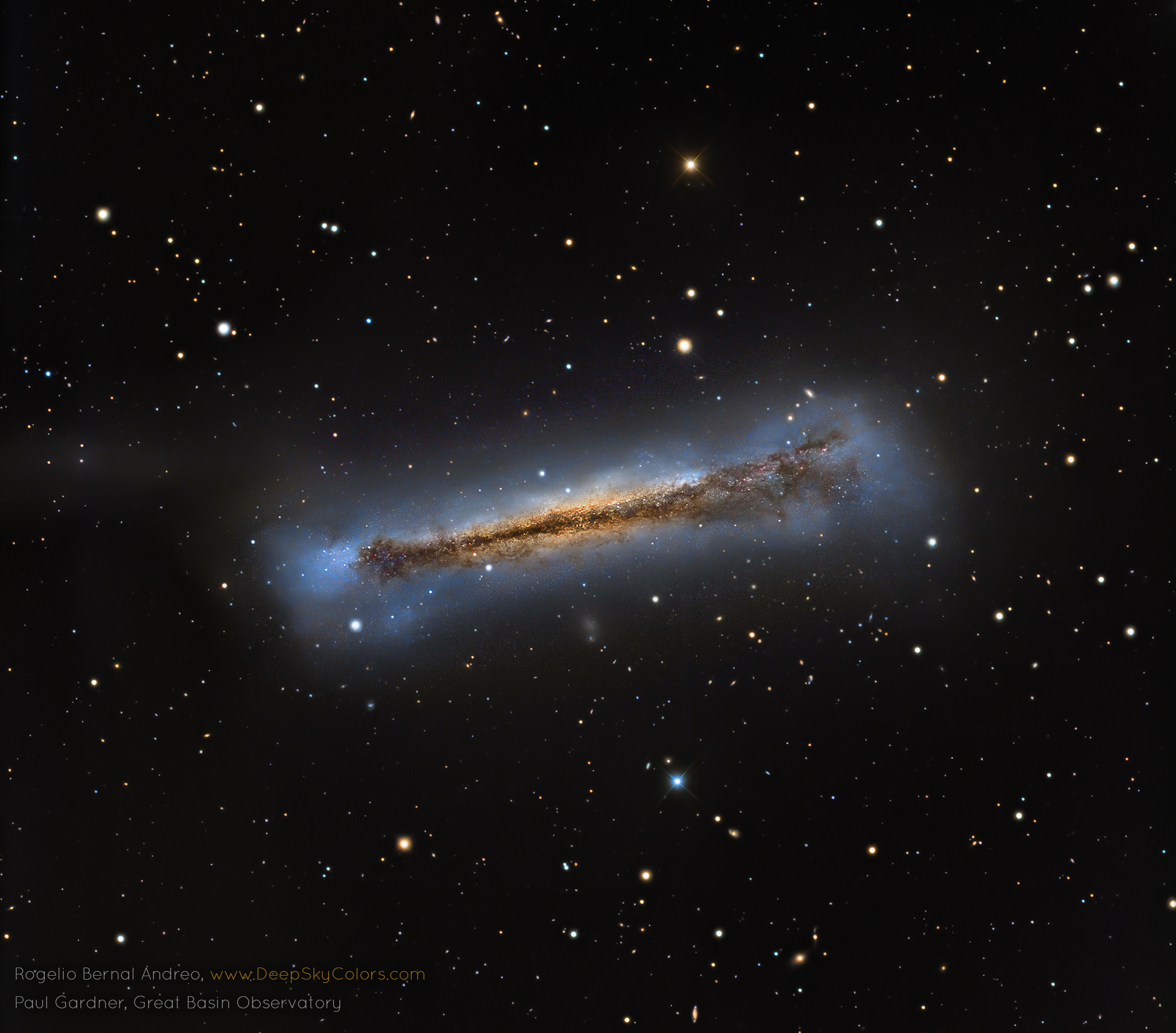
 APOD: 2018 September 5 - NGC 3628: Sideways Spiral Galaxy
Explanation:
What do spiral galaxies look like sideways?
Featured is a sharp telescopic view of a magnificent edge-on spiral
galaxy NGC
3628, a puffy
galactic disk divided by dark dust lanes.
Of course, this
deep galactic portrait puts some astronomers
in mind of its popular moniker,
The Hamburger Galaxy.
The tantalizing island
universe
is about 100,000 light-years across and 35 million
light-years away in the northern springtime
constellation Leo.
NGC 3628
shares its neighborhood in the
local
Universe with two other large spirals
M65 and
M66 in a grouping
otherwise known as the Leo Triplet.
Gravitational
interactions with
its cosmic neighbors are likely responsible for the extended flare and
warp of this spiral's disk.
 APOD: 2018 July 2 - From the Galactic Plane through Antares
Explanation:
Behold one of the most photogenic regions of the night sky, captured impressively.
Featured, the band of our
Milky Way Galaxy runs diagonally along the far left, while the
colorful Rho Ophiuchus
region including the bright orange star
Antares is visible just right of center,
and the nebula
Sharpless 1
(Sh2-1) appears on the far right.
Visible in front of the
Milk Way band are several famous nebulas including the
Eagle Nebula (M16), the
Trifid Nebula (M20), and the
Lagoon Nebula (M8).
Other notable nebulas include the
Pipe and
Blue Horsehead.
In general,
red emanates from nebulas glowing in the light of exited
hydrogen gas, while blue marks
interstellar dust preferentially
reflecting the light of bright young stars.
Thick dust appears otherwise dark brown.
Large balls of stars visible include the globular clusters
M4,
M9,
M19,
M28, and
M80,
each marked on the
annotated companion image.
This extremely wide field -- about 50 degrees across -- spans the constellations of
Sagittarius is on the lower left,
Serpens on the upper left,
Ophiuchus
across the middle, and
Scorpius on the right.
It took over 100 hours of sky imaging, combined with
meticulous planning and digital processing, to create this image.
 APOD: 2018 June 14 - Six Planets from Yosemite
Explanation:
The five naked-eye planets, Mercury, Venus, Mars, Jupiter and Saturn,
have been seen since ancient times to wander the night skies of planet Earth.
So it could be remarkable that on this night,
standing at the side of a clear, calm lake, six planets
can be seen with the unaided eye.
Have a
look.
Very bright and easy to spot for skygazers, yellowish Mars
is left of a pale Milky Way.
Saturn is immersed in the glow of the Milky Way's diffuse starlight.
Jupiter is very near the horizon on the right, shining beyond the
trees against the glow of distant city lights.
Last weekend, while admiring this night time view across beautiful,
high-altitude Lake Tenaya in Yosemite National Park, a
thoughtful
and reflective observer could probably
see three planets more.
 APOD: 2018 January 18 - Blue Comet in the Hyades
Explanation:
Stars of the Hyades
cluster are scattered through this mosaic
spanning over 5 degrees on the sky toward the constellation Taurus.
Presently cruising through the Solar System, the
remarkably blue comet
C/2016 R2 PanSTARRS is placed in
the wide field of view using image data from January 12.
With the apex of the V-shape in the Hyades cluster
positioned near the top center,
bright
Aldebaran, alpha star of Taurus,
anchors the frame at the lower right.
A cool red giant, Aldebaran is seen in orange hues in the
colorful starfield.
While the stars of the Hyades are gathered 151 light-years away,
Aldebaran lies only 65 light-years distant and so is separate
from the cluster stars.
On
January 12, C/2016 R2 was over 17 light-minutes from planet
Earth and nearly 24 light-minutes from the Sun.
Its blue tinted tail largely due to
CO+ gas
fluorescing in sunlight, the
head
or coma
of the comet appears with a slightly greenish hue,
likely emission from diatomic carbon.
 APOD: 2017 December 9 - Stardust in Aries
Explanation:
This composition in
stardust
covers over 8 degrees on the northern sky.
The mosaicked field of view is west of the familiar Pleiades star cluster,
toward the zodiacal
constellation
Aries and the plane of our
Milky Way Galaxy.
At right in the deep skyscape is bluish Epsilon Arietis,
a star visible to the naked-eye and about 330 light-years away.
Reflecting starlight in the region,
dusty nebulae
LBN762, LBN753, and LBN743 sprawl
left to right
across the field, but are likely some 1,000 light-years away.
At that estimated distance, the cosmic canvas is over 140 light-years across.
Near the edge of a large
molecular
cloud, their dark interiors can hide newly
formed stars and young stellar objects
or protostars from prying optical telescopes.
Collapsing due to
self-gravity, the
protostars
form around dense cores embedded in the molecular cloud.
 APOD: 2017 September 8 - The Great Gig in the Sky
Explanation:
There were
no crowds on the beach
at Phillips Lake, Oregon on August 21.
But a few had come there to stand, for a moment, in the
dark shadow of the Moon.
From the beach, this unscripted mosaic photo records their much anticipated
solar eclipse.
In two vertical panels it catches
the last few seconds of totality and the first instant of 3rd contact,
just as the eclipse ends and sunlight faintly returns.
Across the US those gathered
along the path of totality also took pictures
and shared their moment.
And like those at Phillips Lake they may
treasure the experience more
than any planned or unplanned photograph of the total eclipse of the Sun.
 APOD: 2017 June 24 - Markarian's Chain to Messier 64
Explanation:
Top to bottom,
this colorful and broad telescopic mosaic links
Markarian's Chain
of galaxies across the core of the Virgo Cluster to
dusty spiral galaxy Messier 64.
Galaxies are scattered through the field of view that spans some 20 full
moons across a gorgeous night sky.
The cosmic frame is also filled with foreground stars from
constellations Virgo and the well-groomed Coma Berenices, and
faint, dusty nebulae drifting above the plane of the Milky Way.
Look carefully for
Markarian's eyes.
The famous pair of interacting galaxies is near the top, not far
from M87,
the Virgo cluster's giant elliptical galaxy.
At the bottom, you can stare down
Messier 64, also known as the
Black Eye Galaxy.
The Virgo Cluster is the closest large galaxy cluster to our own
local
galaxy group.
Virgo
Cluster galaxies are about 50 million light-years distant,
but M64 lies a mere 17 million light-years away.
 APOD: 2017 June 8 - Firefall by Moonlight
Explanation:
On certain dates in February, an elusive firefall
can be spotted at sunset in
Yosemite
National Park, when the weather cooperates
and the direction to the setting Sun is just right.
Often photographed from vantage points below, at the right moment the
park's seasonal Horsetail Fall is isolated in the shadows of the
steep walls of El Capitan.
Then, still illuminated with rays of sunlight reflected by the angled
rockface directly behind the flow, the waterfall
briefly takes on a dramatic, fiery appearance.
The Horsetail firefall is more rarely photographed at moonset under a
starry night sky,
though.
Even more elusive by moonlight, the firefall effect can also be seen
when skies are clear and a bright Moon sets at the right direction
along the western horizon.
Skies were clear and stars were shining for this
well-planned photograph of the
Horsetail firefall lit by a gibbous Moon setting in the
early morning hours of May 9.
 APOD: 2017 June 4 - Orion: Belt, Flame, and Horsehead
Explanation:
What surrounds the famous belt stars of Orion?
A deep exposure shows everything from dark nebula to star clusters,
all embedded in an extended
patch of
gaseous wisps in the greater
Orion
Molecular
Cloud
Complex.
The brightest three stars,
appearing diagonally on the left of the featured image are indeed the
famous three stars that make up the
belt of Orion.
Just below Alnitak, the lowest of the
three belt stars, is the
Flame Nebula, glowing with
excited hydrogen gas and immersed in filaments of dark brown dust.
Just to the right of
Alnitak lies the
Horsehead Nebula, a
dark indentation of
dense dust that has perhaps the most recognized nebular shapes on the sky.
The dark molecular cloud, roughly 1,500
light years distant, is cataloged as Barnard 33 and is seen primarily because it is backlit by the nearby massive star
Sigma Orionis.
The Horsehead Nebula will slowly shift its
apparent shape over the next few million years and will eventually be destroyed by the
high-energy starlight.
 APOD: 2017 May 16 - Gemini Stars Pollux and Castor
Explanation:
Who are the twins of Gemini?
It terms of astronomical objects, the
famous constellation is dominated by two bright stars:
Pollux (left) and
Castor (right).
Pictured,
the two stars stand out because they are so bright,
so close together
both in angle and brightness, but so different in color.
Pollux, at 33 light years distant, is an evolved red giant star twice as massive as our Sun.
Castor, at 51 light years distant, is a blue main sequence
star about 2.7 times more massive that our Sun.
Castor is known to have at least two
stellar companions, while Pollux is now known to be circled by at least one
massive planet.
In terms of ancient
Babylonian,
Greek, and
Roman mythology, Castor and Pollux
represent twin brothers.
Currently, the Earth's orbit is causing the Sun to appear to shift in front of the constellation of Gemini, with the result that, for much of humanity,
Castor and Pollux
will remain visible toward the west at sunset for only a few more weeks.
 APOD: 2017 March 3 - Sivan 2 to M31
Explanation:
From within the boundaries of the constellation Cassiopeia (left) to
Andromeda (right),
this telescopic
mosaic spans over 10 degrees in planet Earth's skies.
The celestial scene is constructed of panels
that are part of a high-resolution astronomical
survey of the Milky Way in
hydrogen-alpha light.
Processing the monochromatic image data has brought out the
region's faintest structures, relatively
unexplored
filaments of hydrogen gas
near the plane of our Milky Way Galaxy.
Large but faint and also relatively unknown nebula
Sivan 2 is at the
upper left in the field.
The nearby Andromeda Galaxy, M31, is at center right,
while the faint, pervasive hydrogen nebulosities stretch towards
M31 across the foreground in the wide field of view.
The broad survey image demonstrates the intriguing
faint hydrogen clouds
recently imaged by astronomer
Rogelio Bernal Andreo really are within the Milky Way,
along the line-of-sight
to the Andromeda Galaxy.
 APOD: 2017 January 4 - Clouds of Andromeda
Explanation:
The beautiful Andromeda Galaxy is often imaged by
planet Earth-based astronomers.
Also known as M31, the nearest large spiral galaxy is a familiar sight
with dark dust lanes, bright yellowish core, and
spiral arms traced by
blue starlight.
A mosaic of well-exposed broad and narrow-band image data, this
colorful,
premier portrait of our
neighboring island universe
offers strikingly unfamiliar
features though, faint reddish clouds of glowing
ionized hydrogen gas in the same wide field of view.
Still, the ionized hydrogen clouds likely
lie in the foreground of the scene, well within our Milky Way Galaxy.
They could be associated with the pervasive, dusty
interstellar cirrus
clouds scattered hundreds of light-years above our own galactic plane.
If they were located at the 2.5 million light-year distance of the
Andromeda Galaxy they would be enormous,
since the Andromeda Galaxy itself is 200,000 or so light-years across.
 APOD: 2016 December 15 - Seagull to Sirius
Explanation:
This broad, beautiful mosaic spans almost 20 degrees across
planet Earth's sky.
The nebula-rich
region lies near the edge of the Orion-Eridanus
superbubble, filled with looping, expanding shells of gas and dust embedded
in molecular clouds near the plane of the Milky Way Galaxy.
Recognizable at the left is the expansive
Seagull Nebula,
composed of emission nebula NGC 2327, seen as the seagull's head,
with the more
diffuse IC 2177 as the wings and body.
Some 3,800 light-years away, the wings of the Seagull Nebula
spread about 240 light-years, still within our
local spiral arm.
The bluish light of
Sirius,
alpha star of Canis Major and
brightest star in the night, easily dominates the scene at right
but shines from a distance of only 8.6 light-years.
Study the big picture and you should
also be rewarded with star cluster
Messier 41,
also known as NGC 2287, not to
mention the mighty Thor's Helmet.
 APOD: 2016 December 4 - Official Star Names for Orion
Explanation:
Familiar stars in Orion and constellations across the sky now have official names.
Over the past year, the
International Astronomical Union, the
only
body officially tasked with naming stars,
approved names already in common use for
227 of the brightest stars, including the most famous stars on the sky
Sirius,
Polaris, and
Betelgeuse.
Pictured, the
constellation of Orion is shown with several of these
now-official star names superposed.
Spanning about 30 degrees,
this breath-taking vista
stretches across the well-known constellation from
head to toe (left to right) and beyond.
The common names for all three stars in Orion's belt
are also now official.
At 1,500 light years away, the Great Orion
Nebula is the closest large star forming region, here visible
just right and below center.
Also visible are famous nebulae including the
Horsehead Nebula and the
Witch Head Nebula.
Of course, the Orion Nebula and bright stars are
easy to see with the
unaided eye, but dust clouds and emission from the extensive interstellar
gas in this nebula-rich complex,
are too faint and much harder to record.
In the
featured mosaic of broadband telescopic images, additional image
data acquired with a narrow
hydrogen alpha filter was used to
bring out the pervasive tendrils of energized
atomic hydrogen gas like in the arc of the giant
Barnard's Loop.
 APOD: 2016 November 10 - Great Rift Near the Center of the Milky Way
Explanation:
Over 100 telescopic image
panels in this stunning vertical mosaic span
about 50 degrees
across
the night sky.
They follow part of the
Great Rift, the
dark river
of dust and molecular gas that stretches
along the plane of our Milky Way Galaxy.
Start at top center and you can follow the
galactic
equator down through brighter stars in constellations Aquila,
Serpens Cauda, and Scutum.
At the bottom is Sagittarius near the center of the Milky Way.
Along the way you'll encounter many obscuring
dark
nebulae hundreds of light-years distant flanked by bands of
Milky Way starlight, and the telltale reddish glow of starforming regions.
Notable Messier objects
include The Eagle (M16) and Omega (M17)
nebulae, the Sagittarius Star Cloud (M24), the beautiful Trifid (M20)
and the deep Lagoon (M8).
 APOD: 2016 April 28 - A Dust Angel Nebula
Explanation:
The combined light of
stars along the Milky Way
are reflected by these cosmic dust clouds that soar
some 300 light-years or so above the plane of our galaxy.
Dubbed the
Angel
Nebula, the faint apparition is part of an expansive complex
of dim and relatively
unexplored,
diffuse molecular clouds.
Commonly found at high galactic latitudes, the dusty galactic cirrus
can be traced over large regions toward the North and South Galactic poles.
Along with the refection of starlight, studies indicate
the dust clouds produce a faint
reddish
luminescence, as interstellar
dust grains convert invisible ultraviolet radiation to visible red light.
Also capturing nearby Milky Way stars and an array of
distant background galaxies, the deep, wide-field 3x5 degree
image spans about 10 Full Moons
across planet Earth's sky
toward the constellation Ursa Major.
 APOD: 2016 March 18 - The W in Cassiopeia
Explanation:
A familiar, zigzag, W pattern in northern
constellation Cassiopeia
is traced by five bright stars in this colorful and broad mosaic.
Stretching about 15 degrees across rich starfields,
the celestial scene
includes
dark clouds,
bright nebulae, and
star clusters along the Milky Way.
In yellow-orange hues Cassiopeia's
alpha star
Shedar is a standout though.
The yellowish giant star is cooler than the Sun, over 40 times the
solar diameter, and so luminous it shines brightly in
Earth's night from 230 light-years away.
A massive, rapidly rotating star at the center of the W, bright
Gamma Cas
is about 550 light-years distant.
Bluish Gamma Cas is much hotter than the Sun.
Its intense, invisible ultraviolet radiation ionizes hydrogen atoms in
nearby interstellar clouds to produce
visible red H-alpha emission as the atoms recombine with electrons.
Of course, night skygazers
in the Alpha Centauri star system
would also see the recognizable outline traced by
Cassiopeia's bright stars.
But from their
perspective a mere 4.3 light-years away they would see
our Sun as a sixth bright star in Cassiopeia, extending the zigzag
pattern just beyond the left edge of this frame.
 APOD: 2015 August 4 - Virgo Cluster Galaxies
Explanation:
Well over a thousand galaxies are known members of
the Virgo Cluster,
the closest large cluster of galaxies to our own
local group.
In fact, the galaxy cluster is difficult
to
appreciate all at once because
it covers such a large area on the sky.
This careful wide-field
mosaic of telescopic images
clearly records the central region of the Virgo Cluster through faint
foreground dust
clouds lingering above the plane of our own Milky Way galaxy.
The cluster's dominant giant elliptical
galaxy M87, is just below and to the left of the frame center.
To the right of M87 is a string of galaxies known as
Markarian's Chain.
A closer examination of the image will
reveal many Virgo cluster member
galaxies as small fuzzy patches.
Sliding your cursor over the image will label the larger galaxies
using NGC catalog designations.
Galaxies are also shown with
Messier
catalog numbers, including
M84, M86,
and prominent colorful spirals
M88,
M90, and
M91.
On average, Virgo Cluster galaxies are measured to be
about 48 million light-years away.
The Virgo
Cluster distance has been used to give an important
determination of the Hubble Constant and
the scale of the Universe.
 APOD: 2015 June 27 - Stars of a Summer Triangle
Explanation:
Rising at the start of a northern summer's night, these
three bright stars form the familiar asterism known as
the Summer Triangle.
Altair, Deneb, and Vega
are the alpha stars of their respective constellations, Aquila, Cygnus,
and Lyra, nestled near the Milky Way.
Close in apparent brightness the three do look similar in these
telescopic portraits,
but all have
their own
stellar stories.
Their similar appearance hides the fact that
the Summer Triangle stars actually span a large range in
intrinsic luminosity and distance.
A main sequence
dwarf star, Altair is some 10 times brighter
than the Sun and 17 light-years away, while
Vega, also a hydrogen-fusing dwarf, is around 30 times brighter than
the Sun and lies 25 light-years away.
Supergiant Deneb, at about 54,000 times the solar luminosity,
lies some 1,400 light-years distant.
Of course, with a whitish blue hue,
the stars of the Summer Triangle are all hotter than
the Sun.
 APOD: 2015 June 2 - Polaris and Comet Lovejoy
Explanation:
One of these two bright sky objects is moving.
On the right is the famous star Polaris.
Although only the 45th
brightest star in the sky,
Polaris is famous for appearing stationary.
Once you find it, it will
always appear
in the same direction --
all night and all day -- for the rest of your life.
This is because the northern spin pole of the Earth -- called the
North Celestial Pole -- points near
Polaris.
On the left, about ten million times closer, is
Comet Lovejoy,
which noticeably changes its sky position by the hour.
The featured image was taken last week.
Officially designated
C/2014 Q2 (Lovejoy),
this disintegrating snowball is on a visit from the outer
Solar System
and will only appear near the
North Star for a few more weeks.
That should be
long enough, however, for northerners with binoculars or a small telescope
to see the greenish coma of this fleeting newcomer, perhaps with the help of a
good star map.
 APOD: 2015 April 24 - Blue Tears and the Milky Way
Explanation:
Lapping at rocks
along the shore of the Island of Nangan, Taiwan,
planet Earth,
waves are infused with a subtle blue light in this
sea and night skyscape.
Composed of a series of long exposures made on April 16
the image captures the faint glow from
Noctiluca scintillans.
Also known as sea sparkles or blue tears,
the marine plankton's bioluminescence is stimulated by wave motion.
City lights along the coast of mainland China shine
beneath low clouds in the west but stars and the
faint Milky Way
still fill the night above.
Over the horizon the galaxy's central bulge and dark rifts
seem to echo the rocks
and luminous waves.
 APOD: 2015 April 9 - A Golden Gate Eclipse
Explanation:
Shadows play on the water and in the sky
in this panoramic view of the April 4 total lunar eclipse
over San Francisco's Golden Gate Bridge.
Just within planet Earth's shadow
the Full Moon's disk is still easy to spot at its brief total phase.
The urban night skyscape was composed
to cover the wide range of brightness visible to the eye.
The shortest total lunar eclipse of the century, this eclipse
was also the third in a string of four consecutive
total lunar eclipses,
a series known as a tetrad.
Coming in nearly six month intervals, the previous two were last
April 15 and
October 8.
The next and final eclipse in the tetrad will be on September 28.
This 2014-2015 tetrad is one of 8
total
lunar eclipse tetrads in the 21st century.
 APOD: 2015 March 16 - The Clouds of Orion the Hunter
Explanation:
Cradled in cosmic dust and glowing hydrogen,
stellar
nurseries in Orion the
Hunter
lie at
the edge of giant molecular clouds some 1,500 light-years away.
Spanning about 30 degrees,
this breath-taking vista
stretches across the well-known constellation from
head to toe (left to right) and beyond.
At 1,500 light years away, the Great Orion
Nebula is the closest large star forming region, here visible
just right and below center.
To its left are the
Horsehead Nebula,
M78, and
Orion's belt stars.
Sliding your cursor over the picture will also find
red giant Betelgeuse at the hunter's shoulder,
bright blue Rigel at his foot,
the Witch Head Nebula above -- and illuminated by -- Rigel,
and the glowing Lambda Orionis
(Meissa) nebula on the left, near Orion's head.
Of course, the Orion Nebula and bright stars are
easy to see with the
unaided eye, but dust clouds and emission from the extensive interstellar
gas in this nebula-rich complex,
are too faint and much harder to record.
In this mosaic of broadband telescopic images, additional image
data acquired with a narrow
hydrogen alpha filter was used to
bring out the pervasive tendrils of energized
atomic hydrogen gas like in the arc of the giant
Barnard's Loop.
 APOD: 2015 January 17 - Comet Lovejoy's Tail
Explanation:
Sweeping north
in planet Earth's sky, Comet Lovejoy's greenish coma
and blue tinted ion tail stretched across this
field of stars in
the constellation Taurus on January 13.
The inset at the upper left shows the 1/2 degree angular size of
the full moon for scale.
So Lovejoy's coma appears only a little smaller (but much fainter)
than a full moon on the sky, and its tail is visible
for over 4 degrees across the frame.
That corresponds to over 5 million kilometers
at the comet's estimated distance of 75 million kilometers
from Earth.
Blown by the solar wind, the comet's tenuous, structured
ion tail streams
away from the Sun, growing as
this Comet Lovejoy
heads toward perihelion, its closest approach to the Sun, on January 30.
While diatomic carbon
(C2) gas fluorescing in sunlight
produces the coma's green color, the fainter bluish tail is tinted by
emission from ionized carbon monoxide (CO+).
 APOD: 2014 September 6 - Moonbow Beach
Explanation:
Like a rainbow at night,
a beautiful moonbow shines above the western horizon in this
deserted beach scene from Molokai Island,
Hawaii,
USA, planet Earth.
Captured last June 17 in early morning hours, the lights along
the horizon are from Honolulu and cities on the island of Oahu
some 30 miles away.
So where was the Moon?
A rainbow is
produced by sunlight internally reflected in
rain drops from the direction
opposite the Sun
back toward the observer.
As the light passes from air to water and back to air again, longer
wavelengths are refracted (bent) less than shorter ones
resulting in the separation of colors.
And so the moonbow is produced as raindrops reflect moonlight
from the direction opposite the Moon.
That puts the Moon directly behind the photographer,
still low and rising over the eastern horizon,
a few days past
its full phase.
 APOD: 2014 July 27 - Rho Ophiuchi Wide Field
Explanation:
The clouds surrounding the star system Rho Ophiuchi compose one of the closest star forming regions.
Rho Ophiuchi itself is a
binary star system visible in the
light-colored region on the image right.
The star system, located only 400
light years away, is distinguished by its
colorful surroundings,
which include a red
emission nebula and numerous
light and dark brown dust lanes.
Near the upper right of the Rho Ophiuchi
molecular cloud system is the yellow star
Antares, while a distant but coincidently-superposed
globular cluster of stars,
M4, is visible between Antares and the red
emission nebula.
Near the image bottom lies IC 4592, the
Blue Horsehead nebula.
The blue glow that surrounds the Blue Horsehead's eye -- and other stars around the image -- is a reflection nebula composed of fine dust.
On the
above image left is a geometrically angled reflection nebula
cataloged as
Sharpless 1.
Here, the bright star near the dust vortex creates the light of surrounding
reflection nebula.
Although most of
these features are visible through a small telescope pointed toward the constellations of
Ophiuchus,
Scorpius, and
Sagittarius, the only way to see the intricate details of the dust swirls, as featured above, is to use a
long exposure camera.
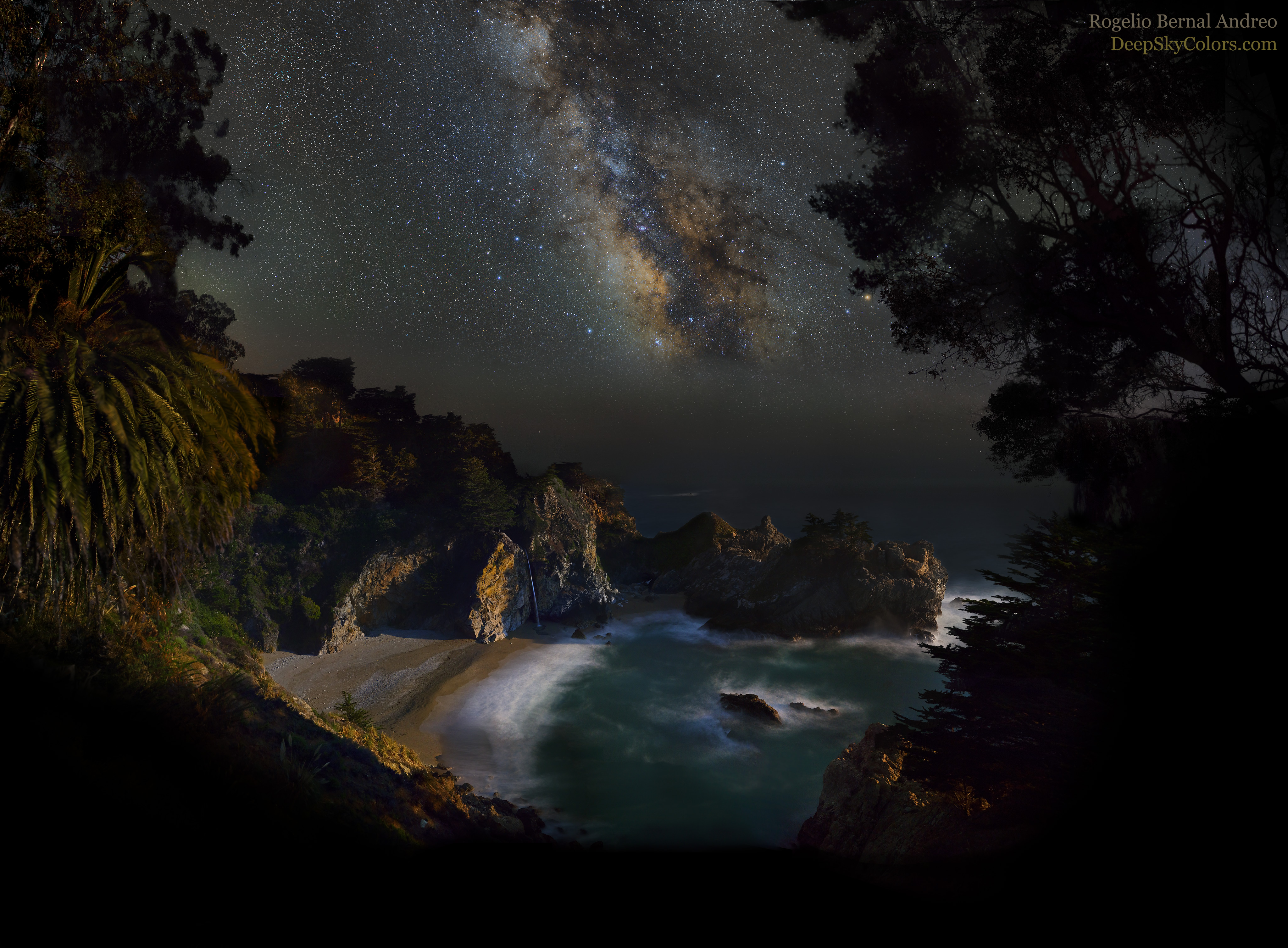
 APOD: 2014 June 29 - Galaxy Cove Vista Revisited
Explanation:
To see a vista like this takes patience, hiking, and a camera.
Patience was needed in searching out just the right place and waiting for just the right time.
A short hike was needed to reach this
rugged perch above a secluded cove in
Julia Pfeiffer Burns State Park in
California,
USA.
And a camera was needed for the long exposure required to bring out the
faint light from stars and nebulae in the background
Milky Way galaxy.
Moonlight
illuminated the hidden beach and inlet behind nearby trees in the
above composite image taken last month.
Usually obscured
McWay Falls is
visible just below the image center,
while the
Pacific Ocean is in view to its right.
The above image is a high-resolution sequel to a similar image that
appeared last year.
 APOD: 2014 May 2 - That Night over Half Dome
Explanation:
Captured one night
last May this eight frame mosaic starts
on the left, down Northside Drive through
Yosemite National Park.
It ends thousands of light-years away though, as the arc of
the Milky Way tracks toward the
center of our galaxy on the right,
far beyond the park's rugged skyline.
That night was still moonless when the storm clouds retreated, so the
rocky faces
of the surrounding mountains are lit by campfires and
artificial lights.
Yosemite
Falls is at the left.
The granite
face of Half Dome juts above the far
horizon, near the center of the view.
The remarkable flash above it is a bright meteor.
Part of the annual Eta Aquarid meteor shower the colorful
streak is moving up, its trail pointing directly
back to the shower's radiant,
low in Aquarius.
This
year's Eta Aquarids should peak in the moonless
early morning hours of May 6 as the Earth sweeps through dust
from the tail of Comet Halley.
 APOD: 2014 February 13 - Downtown Auriga
Explanation:
Rich in star clusters and nebulae, the ancient
constellation
of Auriga, the Charioteer,
rides high in northern winter night skies.
Spanning nearly 24 full moons (12 degrees) on the sky,
this
deep telescopic mosaic view recorded in January
shows off some of Auriga's most popular sights for cosmic tourists.
The crowded field sweeps along the plane of our
Milky Way galaxy in the
direction opposite
the galactic center.
Need
directions?
Near the bottom of the frame, at the Charioteer's boundary with Taurus
the Bull, the bright bluish
star Elnath
is known as both Beta Tauri and Gamma Aurigae.
On the far left and almost 3000 light-years away, the busy,
looping filaments of supernova remnant
Simeis 147 cover about 150 light-years.
Look toward the right to find emission nebula
IC 410,
significantly more distant, some 12,000 light-years away.
Star forming IC 410 is famous for
its embedded young star cluster, NGC 1893,
and tadpole-shaped clouds of dust and gas.
The Flaming Star Nebula, IC 405,
is just a little farther along.
Its red, convoluted clouds
of glowing hydrogen gas are energized by hot O-type star AE Aurigae.
Two of our galaxy's open star clusters, Charles Messier's
M36
and M38 line up in the
starfield above,
familiar to many binocular-equipped skygazers.
 APOD: 2013 December 12 - Alnitak, Alnilam, Mintaka
Explanation:
Alnitak,
Alnilam,
and
Mintaka,
are the bright bluish stars
from east to west (lower right to upper left) along the diagonal in
this gorgeous cosmic vista.
Otherwise known as the
Belt of Orion, these
three blue supergiant stars are hotter and much more
massive than the Sun.
They lie about 1,500 light-years away, born
of Orion's well-studied interstellar clouds.
In fact, clouds of gas and dust adrift in this region have
intriguing and some surprisingly familiar shapes, including the
dark Horsehead Nebula
and Flame Nebula near
Alnitak at the lower right.
The famous Orion Nebula
itself is off the right edge of this colorful star field.
The well-framed, wide-field telescopic image
spans about 4 degrees on the sky.
 APOD: 2013 November 22 - From California to the Pleiades
Explanation:
An astronomical trip from the California Nebula to the Pleiades
star cluster would cover just over 12 degrees across planet Earth's night sky.
That's equivalent to the
angular extent of 25 Full Moons,
as your telescope sweeps past the borders of the
constellations Perseus and Taurus.
This wide and deep mosaic image
of the region explores the
cosmic landscape's dusty nebulae and colors
otherwise too faint
for your eye to see.
On the left, cataloged as NGC 1499, the
California Nebula does
have a familiar shape, though its coastline is actually over
60 light-years long and lies about 1,500 light-years
away.
The nebula's pronounced reddish glow is from hydrogen atoms ionized
by luminous blue star Xi Persei seen just to its right.
At the far right, the famous
Pleiades star cluster is some
400 light-years distant and around 15 light-years across.
Its spectacular blue color is due to the reflection of starlight
by interstellar dust.
In between are hot stars of the Perseus OB2
association and
dusty, dark nebulae along the edge of the nearby, massive
Perseus
molecular cloud.
 APOD: 2013 September 26 - M31 versus M33
Explanation:
Separated by about 14 degrees
(28 Full Moons) in planet Earth's sky,
spiral galaxies M31, left, and M33 are both large members of
the Local Group,
along with our own Milky Way galaxy.
This wide-angle,
telescopic mosaic captures colorful details of spiral structure
in both, while the massive neighboring galaxies seem to be balanced
either side of bright Mirach, beta star in the
constellation Andromeda.
But M31, the Andromeda Galaxy,
is really 2.5 million light-years distant and
M33, the Triangulum Galaxy, is also about
3 million light years away.
Mirach, just 200 light-years from the Sun,
lies well within the Milky Way, along with the
dim
clouds of dust drifting through the frame only a few hundred
light-years above the galactic plane.
Although they look far apart,
M31 and M33 are locked in a mutual gravitational embrace.
Radio astronomers have
found indications of
a bridge of neutral hydrogen gas that could connect the two,
evidence of a closer encounter in the past.
Based on measurements, gravitational
simulations currently
predict that the Milky Way, M31, and M33
will all undergo mutual close encounters and potentially
mergers, billions of years
in the future.
 APOD: 2013 August 2 - Tropic of Cancer
Explanation:
This intriguing monument can be found in Taiwan between the
cities of Hualian and Taitong.
Split into two sides, it straddles a special circle of latitude on
planet Earth, near 23.5 degrees north, known as the
Tropic of Cancer.
Points along the Tropic of Cancer
are the northernmost locations where the Sun can pass directly
overhead, an event that occurs once a year
during the northern hemisphere's
summer solstice.
The latitude that defines the Tropic of Cancer corresponds to
the tilt
of planet Earth's rotation axis with respect to its orbital
plane.
The name refers to the zodiacal
constellation Cancer the Crab.
Historically
the Sun's position was within Cancer
during the northern summer solstice, but because of the precession
of Earth's axis, that
solstice Sun is currently within
the boundaries of Taurus.
In this
starry night scene
the otherwise all white structure is colored
by city lights, with
its orange side just south of the Tropic of Cancer and
the white side just north.
Of course, there is a southern hemisphere counterpart of the Tropic of
Cancer.
It's called the
Tropic of
Capricorn.
 APOD: 2013 May 7 - Galaxy Cove Vista
Explanation:
To see a vista like this takes patience, hiking, and a camera.
Patience was needed in searching out just the right place and waiting for just the right time.
A short hike was needed to reach this
rugged perch above a secluded cove in
Julia Pfeiffer Burns State Park in
California,
USA.
And a camera was needed for the long exposure required to bring out the
faint light from stars and nebulae in the background
Milky Way galaxy.
Moonlight and a brief artificial flash
illuminated the hidden beach and inlet behind nearby trees in the
above composite image taken about two weeks ago.
Usually obscured
McWay Falls
is visible just below the image center, while the
Pacific Ocean is in view to its right.
 APOD: 2012 November 30 - Clouds in Cygnus
Explanation:
Cosmic clouds of gas and dust
drift across this magnificent
mosaic covering a 12x12 degree field within the
high flying constellation Cygnus.
The collaborative skyscape, a combination of broad and narrow
band image data presented in the
Hubble palette, is anchored by
bright, hot, supergiant
star Deneb,
below center near the left edge.
Alpha star of Cygnus, Deneb, is the top of the Northern Cross asterism
and is seen here next to the dark void known as the Northern Coal Sack.
Below Deneb are the recognizable
North America and Pelican nebulae
(NGC 7000 and IC 5070).
Another supergiant star, Sadr (Gamma Cygni)
is near the center of the field
just above the bright wings of the Butterfly Nebula.
A line continuing up and right will encounter
the more compact Crescent Nebula and finally
the Tulip Nebula near the
top of the frame.
Most of these complex nebulosities are located
about 2,000 light-years away.
Along with the Sun, they lie in the
Orion
spiral arm of our Milky Way galaxy.
 APOD: 2012 November 01 - Rigel and the Witch Head Nebula
Explanation:
Double,
double toil and trouble;
Fire burn, and cauldron bubble -- maybe
Macbeth should have consulted the Witch Head Nebula.
The suggestively shaped
reflection nebula
is associated with the
bright
star Rigel in the constellation Orion.
More formally known as
IC 2118,
the Witch Head Nebula spans about 50 light-years and
is composed of interstellar dust grains
reflecting Rigel's
starlight.
In this cosmic portrait,
the blue color of the Witch Head Nebula and of the dust surrounding
Rigel
is caused not only by
Rigel's intense
blue starlight but because the
dust grains scatter blue light more efficiently than red.
The same
physical process causes
Earth's daytime sky to appear blue, although the scatterers in
Earth's atmosphere are molecules of
nitrogen and oxygen.
Rigel, the Witch Head Nebula,
and gas and dust that surrounds them lie about 800 light-years away.
 APOD: 2012 October 9 - Simeis 147: Supernova Remnant
Explanation:
It's easy to get lost following the intricate filaments in this
detailed mosaic image of faint
supernova remnant Simeis 147 (S147).
Also cataloged as Sh2-240,
it covers nearly 3 degrees or 6 full moons on the sky.
That's about 150 light-years at
the stellar debris cloud's estimated distance of 3,000 light-years.
Anchoring the frame at the right, bright star
Elnath
(Beta Tauri) is seen towards the boundary of the
constellations
Taurus
and Auriga, almost exactly opposite the galactic center
in planet Earth's sky.
This sharp composite includes image data taken through
a narrow-band filter to highlight emission from hydrogen atoms
tracing the shocked, glowing gas.
The supernova remnant has an estimated age of about 40,000
years, meaning light from the massive stellar explosion first
reached Earth 40,000 years ago.
But the expanding remnant is not the only
aftermath.
The cosmic catastrophe
also left behind
a spinning neutron star or pulsar,
all that remains of the original star's core.
 APOD: 2012 February 12 - Orion in Gas, Dust, and Stars
Explanation:
The constellation of Orion holds much more than three stars in a row.
A deep exposure shows everything from dark nebula to star clusters,
all embedded in an extended
patch of
gaseous wisps in the greater
Orion
Molecular
Cloud
Complex.
The brightest three stars
on the far left are indeed the
famous three stars that make up the
belt of Orion.
Just below Alnitak, the lowest of the
three belt stars, is the
Flame Nebula, glowing with
excited hydrogen gas and immersed in filaments of dark brown dust.
Below the frame center and just to the right of
Alnitak lies the
Horsehead Nebula, a
dark indentation of
dense dust that has perhaps the most recognized nebular shapes on the sky.
On the upper right lies
M42, the
Orion Nebula,
an energetic caldron of tumultuous gas,
visible to the unaided eye,
that is giving birth to a
new open cluster of stars.
Immediately to the left of
M42
is a prominent bluish reflection nebula sometimes called the
Running Man that houses many bright
blue stars.
The above image, a digitally stitched composite taken over several nights, covers an area with objects that are roughly 1,500
light years away and spans about 75 light years.
 APOD: 2011 November 17 - Pleiades to Hyades
Explanation:
This cosmic vista
stretches almost 20 degrees across the
gentle
constellation Taurus.
It begins at the Pleiades and ends at the Hyades, two of the best known
star clusters in planet Earth's sky.
At left, the
lovely Pleiades star cluster is about 400
light-years away.
In a familiar celestial scene, the cluster stars shine through
dusty clouds that scatter blue starlight.
At right, the V-shaped Hyades cluster looks more spread out compared
to the compact Pleiades and lies much closer,
150
light-years distant.
Of course, the
Hyades cluster
stars seem anchored by
bright
Aldebaran, a red giant star with a yellowish appearance.
But Aldebaran actually lies only 65 light-years away, by chance
along the line of sight to the Hyades cluster.
Faint dust clouds
found near the edge of the
Taurus Molecular Cloud
are also evident throughout the remarkable 12 panel mosaic.
The wide field of view includes the youthful star
T Tauri and Hind's
variable nebula about four degrees left of Aldebaran on the sky.
 APOD: 2011 October 21 - Clouds of Perseus
Explanation:
Cosmic clouds of gas and dust drift across this magnificent
panorama, spanning some 17 degrees near the
southern boundary
of the heroic constellation
Perseus.
The collaborative skyscape begins
with bluish stars of Perseus at the left,
but the eye is drawn to the striking,
red NGC 1499.
Also known as the California Nebula, its
characteristic glow of atomic
hydrogen gas is powered by ultraviolet light from
luminous blue star Xi Persei immediately to the nebula's
right.
Farther along, intriguing young star cluster
IC 348 and
neighboring Flying Ghost Nebula are right of center.
Connected by dark and dusty tendrils on the outskirts of a giant
molecular cloud, another active star
forming region, NGC 1333,
lies near the upper right edge of the wide field of view.
Shining faintly, dust clouds
strewn throughout the scene
are hovering hundreds of light-years above the galactic
plane and reflect starlight from the
Milky Way.
 APOD: 2011 September 9 - Comet Garradd and the Coat Hanger
Explanation:
Sweeping through planet Earth's night sky, last weekend
Comet Garradd
(C/2009 P1)
visited this lovely star field
along the Milky Way in the constellation Vulpecula.
Suggestively oriented, the colorful skyscape features stars in
the asterism known as
the Coat Hanger with the comet's tail
pointing toward the southeast.
Also known as Al Sufi's Cluster, the
Coat Hanger
itself is likely just a chance alignment and
not a cluster of related stars.
But compact open star cluster NGC 6802 does grace
the field of view just right of the Coat Hanger, near the edge of the
frame.
Below naked eye visibility but approaching 7th magnitude
in brightness,
Comet Garradd has been a good
target
for binoculars and small telescopes.
Still, bright moonlit skies this week will make the comet harder to spot.
 APOD: 2011 June 24 - The Big Dipper
Explanation:
The best known asterism in northern skies, The Big Dipper is
easy to recognize, though some might see The Plough.
Either way, the star names and the familiar outlines will appear in this
thoughtfully composed 24 frame mosaic
when you slide your cursor over the image.
Dubhe,
alpha star of the dipper's parent constellation Ursa Major is at
the upper right.
Together with beta star
Merak
below, the two form
a line pointing the
way to
Polaris and
the North Celestial Pole off the top edge of the field.
Notable too
in skygazing lore Mizar,
second star from the left in the dipper's handle,
forms a vision-testing
visual double star with apparently close Alcor.
Also identified in the famous star field are
Messier catalog objects.
Download the
higher resolution image
to hunt for exquisite views
of some of Messier's distant spiral galaxies and a more
local owl.
 APOD: 2011 May 14 - The Little Dipper
Explanation:
At 2nd magnitude,
Polaris is far from the brightest star in the night sky.
But it is the brightest star at the left of
this well-composed, starry mosaic
spanning about 23 degrees across the
northern sky asterism
dubbed the Little Dipper.
Polaris is famous as the North Pole Star, a friend to
navigators and
astrophotographers alike,
but it's not located exactly at the
North Celestial Pole (NCP) either.
It's
presently
offset from the NCP by 0.7 degrees.
Sliding your cursor over the picture will locate Polaris and
the NCP as well as other stars of the Little Dipper.
The stars are shown with their proper names preceded by their
greek alphabet designations within the ancient
constellation Ursa
Minor, the Little Bear.
Dust clouds
suspended above the plane of our
Milky Way Galaxy are also faintly visible throughout the
wide field of view.
 APOD: 2011 April 22 - Virgo Cluster Galaxies
Explanation:
Well over a thousand galaxies are known members of
the Virgo
Cluster,
the closest large cluster of galaxies to our own
local group.
In fact, the galaxy cluster is difficult
to
appreciate all at once because
it covers such a large area on the sky.
Spanning about 5x3 degrees, this careful
mosaic of telescopic images
clearly records the central
region of the Virgo Cluster through faint
foreground dust
clouds lingering above the plane of our own Milky Way galaxy.
The cluster's dominant giant elliptical
galaxy M87, is just below center in the frame.
Above M87 is the famous interacting galaxy pair NGC 4438,
also known as The Eyes.
A closer examination of the image will
reveal many Virgo cluster member galaxies as small fuzzy patches.
Sliding your cursor over the image will label the larger galaxies
using NGC catalog designations.
Galaxies are also shown with
Messier
catalog numbers, including
M84, M86,
and prominent colorful spirals
M88,
M90, and M91.
On average, Virgo Cluster galaxies are measured to be
about 48 million light-years away.
The Virgo
Cluster distance has been used to give an important
determination of the Hubble Constant and
the scale of the Universe.
(Editor's Note: Labels courtesy of
Astrometry.net.)
 APOD: 2010 December 25 - Decorating the Sky
Explanation:
Bright stars, clouds of dust and glowing nebulae
decorate
this cosmic scene, a skyscape just north of
Orion's belt.
Close to the plane of our
Milky Way Galaxy,
the wide field view spans about 5.5 degrees.
Striking
bluish M78,
a reflection nebula, is at the left.
M78's tint is due to dust preferentially reflecting the
blue light of hot, young stars.
In colorful contrast, the red sash of glowing hydrogen gas
sweeping through the center is part of the region's faint but
extensive emission nebula
known as Barnard's Loop.
At right, a dark dust cloud forms a prominent silhouette
cataloged as LDN 1622.
While M78 and the complex Barnard's Loop are some 1,500 light-years
away, LDN 1622 is likely to be much closer, only about 500
light-years distant from our fair planet Earth.
 APOD: 2010 October 23 - Orion: Head to Toe
Explanation:
Cradled in cosmic dust and glowing hydrogen,
stellar
nurseries in Orion the
Hunter
lie at
the edge of a giant molecular cloud some 1,500 light-years away.
Spanning nearly 25 degrees, this breath-taking vista
stretches across the well-known constellation
from head to toe
(left to right).
The Great Orion
Nebula, the closest large star forming region, is right of center.
To its left are the
Horsehead Nebula,
M78, and
Orion's belt stars.
Sliding your cursor over the picture will also find
red giant Betelgeuse at the hunter's shoulder,
bright blue Rigel
at his foot, and the glowing Lambda Orionis
(Meissa) nebula at the far left, near Orion's head.
Of course, the Orion Nebula and bright stars are
easy to see with the
unaided eye, but dust clouds and emission from the extensive interstellar
gas in this nebula-rich complex,
are too faint and much harder to record.
In this mosaic of broadband telescopic images, additional image
data acquired with a narrow
hydrogen alpha filter was used to
bring out the pervasive tendrils of energized
atomic hydrogen gas and the arc of the giant
Barnard's Loop.
 APOD: 2010 October 14 - Clusters, Hartley, and the Heart
Explanation:
An alluring Comet Hartley 2
cruised through
planet Earth's night sky on October 8,
passing within about a Full Moon's
width of the famous double star cluster in Perseus.
The much anticipated
celestial photo-op
was recorded here
in a 3 frame mosaic with greenish comet and the
clusters h and Chi Persei
placed at the left.
The well-chosen, wide field of view spans about 7 degrees.
It extends across the constellation boundary into Cassiopeia,
all the way to the Heart Nebula (IC 1805)
at the far right.
To capture the cosmic moment, a relatively short 5 minute exposure
was used to freeze the moving comet in place, but
a longer exposure with a narrow-band filter was included in the
central and right hand frames.
The narrow-band exposure brings out the fainter
reddish glow
of the nebula's atomic hydrogen gas, in contrast
to the cometary coma's
kryptonite green.
In the past few days,
comet watchers have reported that Hartley 2
has become just visible to the unaided eye for experienced observers
from dark, clear sites.
On October 20, the
comet will
make its closest approach to Earth,
passing within about 17 million kilometers.
On November 4, a
NASA spacecraft will fly by the
comet's small nucleus
estimated to be only 1.5 kilometers in diameter.
 APOD: 2010 September 9 - Cepheus: Trunk to Bubble
Explanation:
Star clusters, glowing nebulae
and dark dust clouds
abound
in Cepheus, royal constellation of
the northern hemisphere.
You can follow them in amazing detail across this broad
skyscape,
a mosaic of telescopic images spanning about 17 degrees.
Beginning at the lower left, the large emission nebula
is cataloged as IC 1396.
Hundreds of light-years across and about 3,000 light-years distant,
it contains a dark, winding, tendril-shaped feature popularly known
as the Elephant's Trunk.
Near the top middle, the bright nebula with an embedded star cluster
is NGC 7380.
At the upper right lies NGC 7635
(the Bubble Nebula) and
star cluster M52.
Put your cursor over the picture to see a labeled version
of the field.
Many of the objects highlighted have a designation from the
second version of the
Sharpless
catalog (Sh2) and the
Barnard catalog (B) of dark nebulae.
Associated with star formation, the sites are telltale markers along
the region's complex of giant
molecular clouds.
 APOD: 2010 July 19 - Dark River Wide Field
Explanation:
A Dark River of dust seems to run from our Galactic Center,
then pool into a
starfield containing photogenic sky wonders.
Scrolling right will reveal many of these objects including (can you find?) the bright orange star
Antares, a
blue(-eyed) horsehead nebula, the white
globular star cluster M4,
the bright blue star system Rho Ophiuchi,
the dark brown Pipe nebula,
the red Lagoon nebula,
the red and blue Trifid nebula,
the red Cat's Paw Nebula,
and the multicolored but still important
center of our Galaxy.
This wide view
captures in exquisite detail about 50 degrees of the
nighttime sky,
100 times the size of the full Moon, covering constellations from
the Archer
(Sagittarius) through
the Snake Holder
(Ophiuchus), to
the Scorpion
(Scorpius).
The Dark River itself can be identified as the brown dust lane connected to
Antares,
and spans about 100 light years.
Since the Dark River
dust lane lies only about 500 light years away, it only appears as a bridge to the much more distant Galactic Center, that actually lies about 25,000 light years farther away.
 APOD: 2010 May 24 - Rho Ophiuchi Wide Field
Explanation:
The clouds surrounding the star system Rho Ophiuchi compose one of the closest star forming regions.
Rho Ophiuchi itself is a
binary star system visible in the
light-colored region on the image right.
The star system, located only 400
light years away, is distinguished by its
colorful surroundings,
which include a red
emission nebula and numerous
light and dark brown dust lanes.
Near the upper right of the Rho Ophiuchi
molecular cloud system is the yellow star
Antares, while a distant but coincidently-superposed
globular cluster of stars,
M4, is visible between Antares and the red
emission nebula.
Near the image bottom lies IC 4592, the
Blue Horsehead nebula.
The blue glow that surrounds the Blue Horsehead's eye -- and other stars around the image -- is a reflection nebula composed of fine dust.
On the
above image left is a geometrically angled reflection nebula
cataloged as
Sharpless 1.
Here, the bright star near the dust vortex creates the light of surrounding
reflection nebula.
Although most of
these features are visible through a small telescope pointed toward the constellations of
Ophiuchus,
Scorpius, and
Sagittarius, the only way to see the intricate details of the dust swirls, as featured above, is to use a
long exposure camera.
 APOD: 2010 March 19 - The Seagull and The Duck
Explanation:
Seen as a seagull and a duck, these nebulae are
not the only
cosmic clouds to
evoke images of flight.
But both are winging their way across this broad
celestial landscape, spanning almost 7 degrees across
planet Earth's night sky
toward the constellation
Canis Major.
The expansive Seagull
(upper left) is itself composed
of two major cataloged
emission nebulae.
Brighter NGC 2327 forms the head with the more diffuse
IC 2177 as the wings and body.
Impressively, the Seagull's
wingspan would correspond to about 250 light-years at
an estimated distance of 3,800 light-years.
At the lower right, the Duck appears much more compact and
would span only about 50 light-years given its
15,000 light-year distance estimate.
Blown by energetic winds from an extremely massive,
hot star near its center, the Duck nebula is cataloged
as NGC 2359.
Of course, the Duck's thick body and winged appendages
also lend it a more dramatic popular moniker --
Thor's Helmet.
 APOD: 2010 February 14 - Field of Rosette
Explanation:
What surrounds the florid Rosette nebula?
To better picture this area of the sky, the
famous flowery
emission nebula
on the far right has been captured recently in a deep and
dramatic wide field image that features several other sky highlights.
Designated NGC 2237, the center of the
Rosette nebula is populated by the bright blue stars of
open cluster NGC 2244, whose
winds
and energetic light are evacuating the nebula's center.
Below the famous flower, a symbol of
Valentine's Day, is a
column of dust and gas that appears like a rose's stem but extends hundreds of light years.
Across the
above image, the bright blue star just left and below the center is called
S Monocerotis.
The star is part of the open cluster
of stars labelled NGC 2264 and known as the
Snowflake cluster.
To the right of S Mon is a dark pointy featured called the
Cone nebula, a nebula likely shaped by winds flowing out a massive star obscured by dust.
To the left of S Mon is the
Fox Fur nebula, a tumultuous region created by the rapidly evolving Snowflake cluster.
The Rosette region, at about 5,000
light years distant, is about twice as far away as the region surrounding S Mon.
The entire field
can be seen with a small telescope toward the
constellation of the
Unicorn
(Monoceros).
 APOD: 2009 December 29 - Rigel and the Witch Head Nebula
Explanation:
Double, double toil and trouble;
Fire burn, and cauldron bubble -- maybe
Macbeth should have consulted the Witch Head Nebula.
This suggestively shaped
reflection nebula
on the lower left is associated with the
bright star Rigel, to its right, in the
constellation Orion.
More formally known as
IC 2118,
the Witch Head Nebula glows primarily by light reflected from Rigel.
Fine dust
in the nebula reflects the light.
Pictured above, the blue color of the
Witch Head Nebula and of the dust surrounding
Rigel
is caused not only by
Rigel's blue color but because the
dust grains reflect blue light more efficiently than red.
The same
physical process causes
Earth's daytime sky to appear blue, although the scatterers in
Earth's atmosphere are molecules of
nitrogen and
oxygen.
Rigel, the Witch Head Nebula,
and gas and dust that surrounds them lie about 800 light-years away.
 APOD: 2009 November 3 - Seven Sisters Versus California
Explanation:
On the upper right, dressed in blue, is the
Pleiades.
Also known as the
Seven
Sisters and
M45,
the Pleiades
is one of the brightest and
most easily visible
open clusters
on the sky.
The Pleiades
contains over 3,000 stars, is about 400 light years away, and only 13 light
years across.
Surrounding the stars is a spectacular blue
reflection nebula made of fine
dust.
A
common legend is that one of the brighter stars
faded since the cluster was named.
On the lower left, shining in red, is the
California Nebula.
Named for its shape, the
California
Nebula is much dimmer and hence harder to see
than the Pleiades.
Also known as NGC 1499, this mass of red glowing
hydrogen gas is about 1,500 light years away.
Although about 25 full moons could fit
between them, the above wide angle, deep field image composite has captured
them
both.
 APOD: 2009 October 14 - Pleiades and Stardust
Explanation:
Have you ever seen the Pleiades star cluster?
Perhaps the most famous star cluster on the sky, the
Pleiades
can be seen without binoculars from even the depths of a
light-polluted city.
Also known as the Seven Sisters and
M45,
the Pleiades is one of the
brightest and closest open clusters.
Hurtling through a cosmic dust cloud a mere 400 light-years away,
the Pleiades
or Seven Sisters
star cluster is well-known for its striking blue
reflection nebulae.
This remarkable wide-field (3 degree)
image of the region
shows the famous
star cluster near the center, while
highlighting lesser known dusty
reflection nebulas
nearby, across an area that would
span
over 20
light-years.
In this case, the sister stars and
cosmic dust clouds
are not related, they just happen to be passing through
the same region of space.
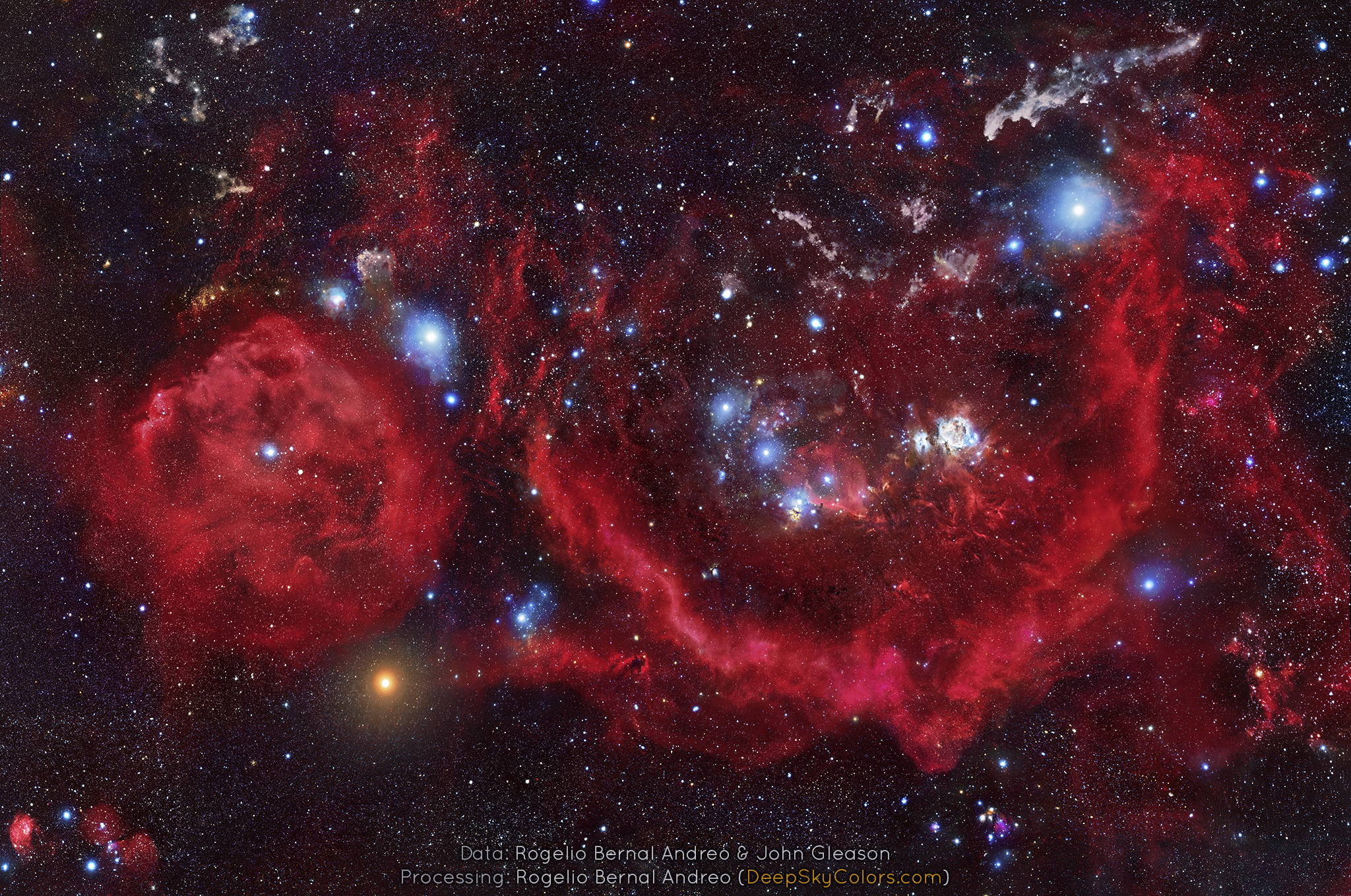
 APOD: 2009 September 29 - Orion in Gas, Dust, and Stars
Explanation:
The constellation of Orion holds much more than three stars in a row.
A deep exposure shows everything from dark nebula to star clusters,
all imbedded in an extended
patch of
gaseous wisps in the greater
Orion
Molecular
Cloud
Complex.
The brightest three stars
on the far left are indeed the
famous three stars that make up the
belt of Orion.
Just below Alnitak, the lowest of the
three belt stars, is the
Flame Nebula, glowing with
excited hydrogen gas and immersed in filaments of dark brown dust.
Below the frame center and just to the right of
Alnitak lies the
Horsehead Nebula, a
dark indentation of
dense dust that has perhaps the most recognized nebular shapes on the sky.
On the upper right lies
M42, the
Orion Nebula,
an energetic caldron of tumultuous gas,
visible to the unaided eye,
that is giving birth to a
new open cluster of stars.
Immediately to the left of
M42
is a prominent bluish reflection nebula sometimes called the
Running Man that houses many bright blue stars.
The
above image, a digitally stitched composite taken over several nights, covers an area with objects that are roughly 1,500
light years away and spans about 75 light years.
 APOD: 2009 May 21 - IC 4592: A Blue Horsehead
Explanation:
This complex of beautiful, dusty reflection nebulae lies
in the constellation
Scorpius
along the plane of our Milky Way Galaxy.
Its overall outline suggests a horsehead in profile,
though it covers a much larger region than the better known
Horsehead Nebula of Orion.
The
star near the eye of the horse and the center of the 5 degree wide
field, is embedded in
blue reflection nebula IC 4592
over 400 light-years away.
At that distance, the view spans nearly 40 light-years.
The horse's gaze seems fixed on Beta Scorpii, also
named
Graffias, the bright star at the lower left.
Toward the top right, near the horse's ear, is another striking bluish
reflection nebula, IC 4601.
The characteristic blue hue of reflection nebulae is caused
by the tendency of interstellar dust to more strongly
scatter blue starlight.
 APOD: 2009 March 12 - Thor's Helmet (NGC 2359) and Planetary Nebula
Explanation:
At the right, Thor's Helmet (NGC 2359) seems to gaze across
a lovely star field.
The broad skyscape
itself covers about 1.5 degrees or 3 full moons
toward the constellation Canis Major.
A close look at the lower left corner of the image
might identify
the object of the cosmic stare as a
faint, round nebula.
Heroically sized even for a Norse god,
Thor's
Helmet is about 30 light-years across.
The helmet is actually more like an interstellar bubble, blown as
a fast wind from the bright, massive star
near the bubble's center sweeps through a surrounding molecular cloud.
Known as a
Wolf-Rayet star,
the central star is an extremely hot giant
thought to be in a brief, pre-
supernova stage of evolution.
In contrast, the faint, round nebula is a
planetary nebula,
the gaseous shroud of a dying lower mass star.
The distance to Thor's Helmet is estimated to be about 15,000
light-years.