|
Astronomy Picture of the Day |
| |
Astronomy Picture of the Day |
 APOD: 2022 November 7 - A Total Lunar Eclipse Over Tajikistan
Explanation:
If the full Moon suddenly faded, what would you see?
The answer was recorded in a dramatic time lapse
video
taken during the total lunar
eclipse in 2011
from
Tajikistan.
During a
total lunar eclipse, the Earth moves between the Moon and the Sun,
causing the moon to fade dramatically.
The Moon never gets completely dark,
though, since the Earth's atmosphere
refracts some light.
As the featured video begins, the scene may appear to be daytime and sunlit, but actually it is a nighttime and lit by the glow of the full Moon.
As the
Moon
becomes eclipsed and fades, background stars become
visible and here can be seen reflected in a lake.
Most spectacularly, the
sky surrounding the eclipsed moon
suddenly appears to be
full of stars
and highlighted by the busy plane of our
Milky Way Galaxy.
The sequence repeats with a closer view,
and the final image shows the placement of the eclipsed Moon near the
Eagle,
Swan,
Trifid, and
Lagoon nebulas.
Nearly two hours after the eclipse started, the moon emerged from the Earth's shadow and its bright full
glare again dominated the sky.
Later today or tomorrow, depending on your location relative to the
International Date Line, a new
total lunar eclipse will take place --
with totality being primarily visible over northeastern
Asia and northwestern
North America.
 APOD: 2020 July 29 - The Giants of Summer
Explanation:
As Comet NEOWISE
sweeps through northern summer skies,
Jupiter and Saturn are shining brightly,
near opposition.
With
Jupiter
opposite the Sun on July 14 and
Saturn
on July 21, the giant planets are still near their closest to planet Earth
in 2020.
Sharing the constellation Sagittarius they are up all night,
and offer their best and brightest views at the telescope.
Both captured on July 22 from a balcony in Paris these two sharp
telescopic images
don't disappoint, showing off what the giant planets are famous for,
Saturn's bright rings and Jupiter's Great Red Spot.
These giants of the Solar System are worth following during 2020.
On December 21, skygazers can watch the once-in-20-year
great conjunction of Jupiter and Saturn.
 APOD: 2018 July 10 - Noctilucent Clouds over Paris Fireworks
Explanation:
It's northern noctilucent cloud season -- perhaps a time to celebrate!
Composed of small ice crystals forming only during specific conditions in the upper atmosphere,
noctilucent clouds may become visible at sunset during late summer when illuminated by sunlight from below.
Noctilucent clouds are the
highest clouds known
and now established to be polar mesospheric clouds observed from the ground.
Although observed with NASA's
AIM satellite since 2007, much about
noctilucent clouds remains unknown and so a
topic of active research.
The featured time-lapse video shows expansive and rippled
noctilucent clouds wafting over
Paris,
France,
during a post-sunset fireworks celebration on
Bastille Day in 2009 July.
This year,
several locations
are already reporting especially
vivid displays of noctilucent clouds.
 APOD: 2018 January 28 - A Total Lunar Eclipse Over Tajikistan
Explanation:
If the full Moon suddenly faded, what would you see?
The answer during the total lunar
eclipse in 2011 was recorded in a dramatic time lapse
video from
Tajikistan.
During a
total lunar eclipse, the Earth moves between the Moon and the Sun,
causing the moon to fade dramatically.
The Moon never gets completely dark,
though, since the Earth's atmosphere
refracts some light.
As the featured video begins, the scene may appear to be daytime and sunlit, but actually it is a nighttime and lit by the glow of the full Moon.
As the
Moon becomes eclipsed and fades, the wind dies down and background stars can be seen reflected in foreground lake.
Most spectacularly, the
sky surrounding the eclipsed moon
suddenly appears to be
full of stars and highlighted by the busy plane of our
Milky Way Galaxy.
The sequence repeats with a closer view, and the final image shows the placement of the eclipsed Moon near the
Eagle,
Swan,
Trifid, and
Lagoon nebulas.
Nearly two hours after the eclipse started, the moon emerges from the Earth's shadow and its bright full
glare again dominates the sky.
This Wednesday another
total lunar eclipse will take place --
but this one will be during a
rare
Super Blue Blood Moon.
 APOD: 2014 October 5 - A Total Lunar Eclipse Over Tajikistan
Explanation:
If the full Moon suddenly faded, what would you see?
The answer during the total lunar
eclipse of 2011 June was recorded in a dramatic time lapse
video from
Tajikistan.
During a
total lunar eclipse, the Earth moves between the Moon and the Sun, causing the moon to fade dramatically.
The Moon never gets completely dark, though, since the Earth's atmosphere
refracts some light.
As the above video begins, the scene may appear to be daytime and sunlit, but actually it is a nighttime and lit by the glow of the full Moon.
As the moon becomes eclipsed and fades, the wind dies down and background stars can be seen reflected in foreground lake.
Most spectacularly, the
sky surrounding the eclipsed moon
suddenly appears to be
full of stars and highlighted by the busy plane of our
Milky Way Galaxy.
The sequence repeats with a closer view, and the final image shows the placement of the eclipsed Moon near the
Eagle,
Swan,
Trifid, and
Lagoon nebulas.
Nearly two hours after the eclipse started, the moon emerged from the Earth's shadow and its bright full glare again dominated the sky.
The next total lunar eclipse will occur
this Wednesday.
 APOD: 2013 March 16 - PanSTARRS from France
Explanation:
Still looking for that comet?
Comet PanSTARRS (C/2011 L4) naked-eye appearance in the northern hemisphere
is described by
successful
comet spotters
as a dim star with a faint tail.
If you want to catch it the next few days could be your best bet.
Start
looking low and almost due west about 45 minutes after sunset.
Of course, clear skies and a pair of binoculars should help a lot.
Sky photographer Jean-Luc Dauvergne found suitable weather and
western horizon for this comet and crescent Moon portrait
after a road trip on March 13.
Seeing PanSTARRS for the first time, he recorded
the beautiful twilight scene with a telephoto lens
near historical
Alesia in France.
 APOD: 2011 October 22 - Jupiter Near Opposition
Explanation:
On
October 29 (UT), Jupiter,
the
solar system's largest planet, will be at opposition,
opposite the Sun in planet Earth's sky,
shining brightly and rising as the Sun sets.
That
configuration results in Jupiter's almost annual
closest approach to planet Earth, so near opposition
the gas giant offers earthbound telescopes stunning views of its
stormy, banded atmosphere and large
Galilean moons.
This sharp snapshot of Jupiter was captured on October 13 with the
1 meter telescope
at the Pic Du Midi
mountain top observatory in the
French Pyrenees.
North is up in the image that shows off oval shaped vortices
and planet girdling
dark belts
and light zones.
Also seen in remarkable detail, Jupiter's
icy Ganymede,
the solar system's largest moon, is emerging from
behind the planet (top) while
volcanic Io
enters the frame near the lower left edge.
 APOD: 2011 July 11 - A Total Lunar Eclipse Over Tajikistan
Explanation:
If the full Moon suddenly faded, what would you see?
The answer during the total lunar
eclipse last month was recorded in a dramatic time lapse
video from
Tajikistan.
During a
total lunar eclipse, the Earth moves between the Moon and the Sun, causing the moon to fade dramatically.
The Moon never gets completely dark, though, since the Earth's atmosphere
refracts some light.
As the above video begins, the scene may appear to be daytime and sunlit, but actually it is a nighttime and lit by the glow of the full Moon.
As the moon becomes eclipsed and fades, the wind dies down and background stars can be seen reflected in foreground lake.
Most spectacularly, the
sky surrounding the eclipsed moon
suddenly appears to be
full of stars and highlighted by the busy plane of our
Milky Way Galaxy.
The sequence repeats with a closer view, and the final image shows the placement of the eclipsed Moon near the
Eagle,
Swan,
Trifid, and
Lagoon nebulas.
Nearly two hours after the eclipse started, the moon emerges from the Earth's shadow and its bright full glare again dominates the sky.
 APOD: 2011 June 5 - Another Nearby Supernova in the Whirlpool Galaxy
Explanation:
One of the brightest supernovas in recent years has just been recorded in the nearby Whirlpool galaxy (M51).
Surprisingly, a seemingly
similar supernova was recorded in M51 during 2005, following yet another one that occurred in 1994.
Three supernovas in 17 years is a lot for single galaxy, and reasons for the
supernova surge in M51 are being debated.
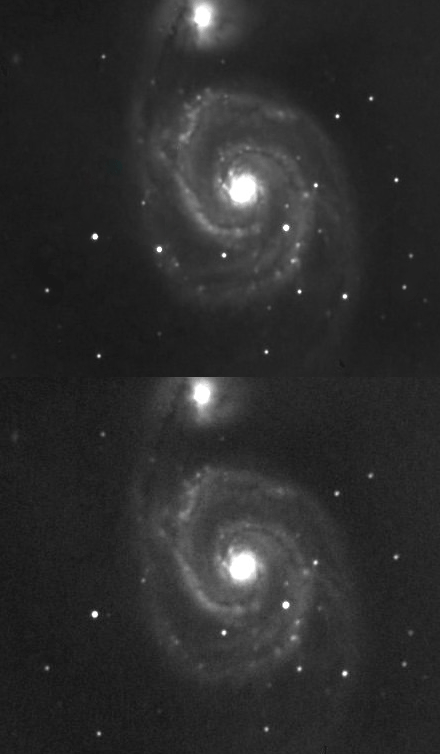
Pictured above are two images of
M51 taken with a small telescope: one taken on May 30 that does not show the supernova, and one taken on June 2 which does.
The June 2 image is one of the first images reported to contain the supernova.
The images are blinked to show the location of the
exploded star.
Although most supernovas follow
classic brightness patterns, the precise brightening and dimming pattern of this or any supernova is hard to predict in advance and can tell astronomers much about what is happening.
Currently, the
M51 supernova, designated
SN 2011dh, is still bright enough to follow with a small telescope.
Therefore, sky enthusiasts are encouraged to image the
Whirlpool galaxy
as often as possible to fill in time gaps left by intermittent observations made by the world's most powerful telescopes.
Views of the developing supernova are being
uploaded here.
 APOD: 2011 January 19 - Saturn Storm
Explanation:
Late last year, a new, remarkably
bright storm erupted in
Saturn's northern hemisphere.
Amateur
astronomers first spotted it in early December, with
the ringed gas giant rising in planet Earth's predawn sky.
Orbiting
Saturn, the Cassini spacecraft was able to
record this close-up of the
complex
disturbance from a distance of 1.8 million
kilometers on December 24th.
Over time, the storm
has evolved, spreading
substantially in longitude,
and now stretches
far around the planet.
Saturn's
thin rings are also seen slicing across
this space-based view,
casting broad shadows on the planet's southern hemisphere.
 APOD: 2010 July 21 - The Crown of the Sun
Explanation:
During a total solar eclipse,
the Sun's
extensive outer atmosphere, or corona, is an inspirational sight.
Subtle shades and shimmering features
that engage
the eye span a brightness range of over
10,000 to 1, making them notoriously difficult
to capture in a single photograph.
But this composite of 7 consecutive digital images
over a range of exposure times comes close to revealing
the crown of the
Sun in all its glory.
The telescopic views were recorded from the Isla de Pascua
(Easter Island) during July 11's
total solar eclipse
and also show solar prominences extending
just beyond the edge of the
eclipsed
sun.
Remarkably, features on the dim, near side of the New Moon can also be
made out, illuminated by sunlight reflected from a
Full Earth.
 APOD: 2010 February 5 - Dust Storm on Mars
Explanation:
It's spring for the northern hemisphere of Mars and
spring on Mars usually means
dust storms.
So the dramatic brown swath of dust (top) marking the otherwise
white north polar cap in this picture of the
Red Planet is not really
surprising.
Taking advantage of the good views
of Mars currently possible
near opposition and its closest approach to planet Earth in 2010,
this sharp image shows
the evolving dust storm extending from the large dark region known as
Mare Acidalium below the polar cap.
It was recorded on February 2nd with the 1 meter telescope at
Pic Du Midi, a
mountain top
observatory in the French Pyrenees.
 APOD: 2009 March 4 - Saturn in View
Explanation:
Very good telescopic
views of Saturn can be expected in the coming days
as the ringed planet
nears opposition on March 8th, its closest
approach to Earth in 2009.
Of course, opposition means opposite the Sun in planet
Earth's sky -
an arrangement that occurs almost yearly for Saturn.
But while Saturn itself grows larger in telescopic images,
Saturn's rings seem to be vanishing as
their tilt to our line-of-sight
decreases.
In fact, the rings will be nearly invisible, edge-on from
our perspective, by September 4.
Recorded on February 28, this sharp image was made with the 1 meter
telescope at
Pic Du Midi, a
mountain top
observatory in the French Pyrenees.
The rings are seen to be tilted nearly edge-on, but
remarkable details are visible in the gas giant's cloud bands.
The icy moon Tethys appears just beyond
the rings at the lower left.
 APOD: 2007 December 6 - Mars in View
Explanation:
Very good telescopic
views of Mars can be expected in the coming
weeks as the
Red
Planet nears opposition on December 24th.
Of course, opposition means opposite
the Sun in planet Earth's sky -
an
arrangement that occurs every 26 months for Mars.
Because
of
Mars' more elliptical orbit, the actual
date of closest approach to Earth will be December 18,
when Mars will be within about 88 million kilometers of
our fair planet.
Situated in the constellation Gemini and rising after evening twilight,
the bright, ruddy disk of Mars will reach nearly 16
arcseconds in diameter
(about 1/100th the diameter of the Full Moon).
In this already exceptional image taken on November 18, north is down
and surface markings around the sprawling, dark, albedo feature
Syrtis Major
are remarkably clear.
The image was recorded with a video camera and filters on a 1 meter
telescope at
Pic Du
Midi, a mountain top observatory in the
French Pyrenees.
NASA launched
the Phoenix
lander to Mars in August, scheduled to arrive in May 2008.
 APOD: 2006 January 27 - A New Storm on Saturn
Explanation:
Presently at opposition
in planet Earth's sky,
Saturn is well placed
for telescopic
observations.
On Wednesday two amateur astronomers took full advantage of
the situation from Melun, near Paris, France.
With a 12 inch diameter telescope and
web cam they recorded
this sharp image of the
ringed gas giant
and made an
exciting discovery --
a new storm on Saturn.
The storm appears as the white spot visible here in
Saturn's southern hemisphere (south is toward the top in
the picture).
In particular, the storm seems to correspond with an outburst
of radio noise detected by the Cassini spacecraft.
The phenomenon is likely similar to the
Dragon Storm recorded by
Cassini's instruments
early last year.
That storm is thought to be analogous to a terrestrial
thunderstorm,
with radio noise produced in high-voltage
lightning discharges.