Astronomy Picture of the Day
Discover the cosmos! Each day a different image or photograph of our fascinating universe is featured, along with a brief explanation written by a professional astronomer.
2026 July 5
Discover the cosmos! Each day a different image or photograph of our fascinating universe is featured, along with a brief explanation written by a professional astronomer.
2026 July 5
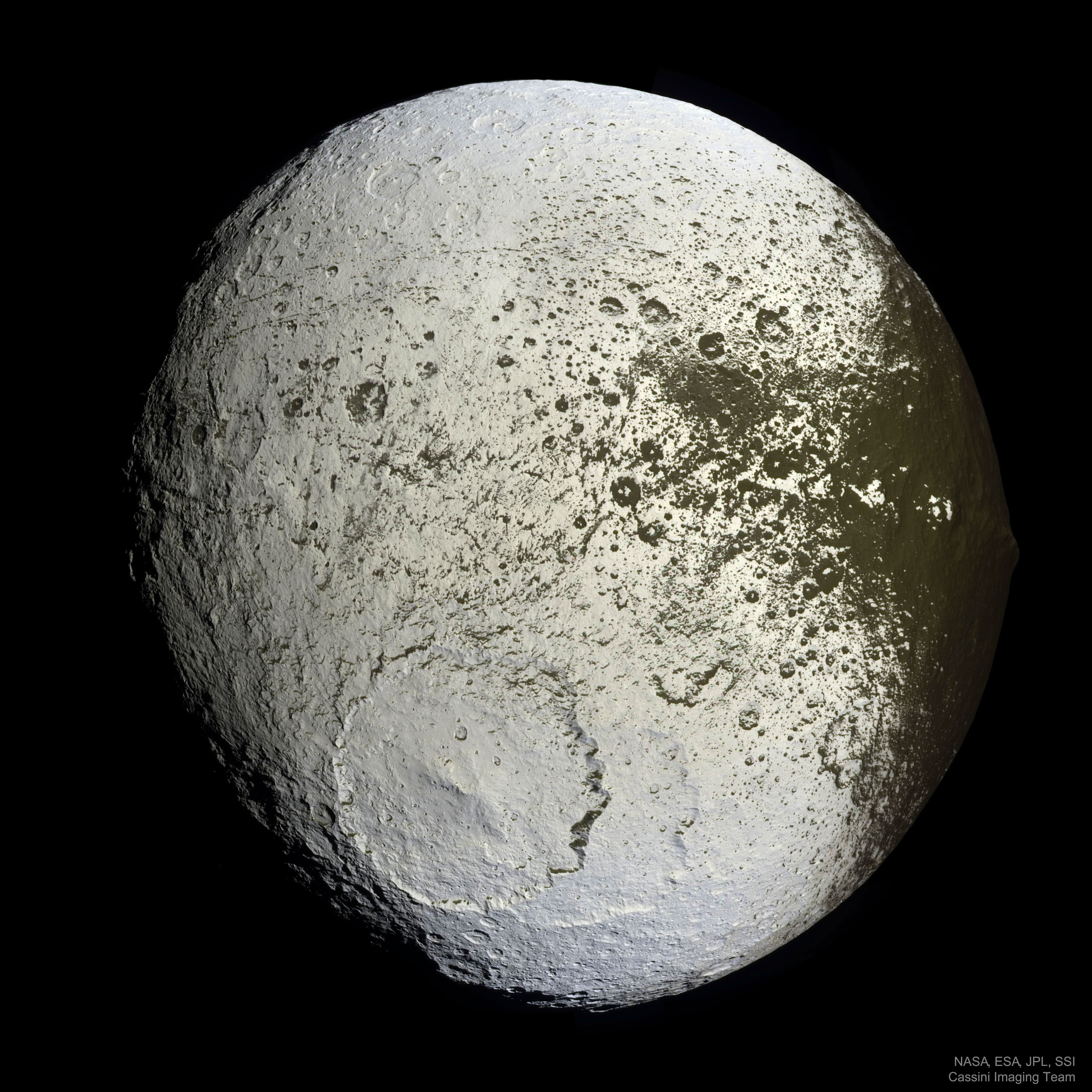
Explanation: What has happened to Saturn's moon Iapetus? Vast sections of this strange world are dark as coal, while others are as bright as snow. To help better understand this unusually tinted moon, NASA directed in 2007 the robotic Cassini spacecraft then orbiting Saturn to swoop within 2,000 kilometers. Pictured here, from about 75,000 kilometers out, is the hemisphere of Iapetus that is always trailing. A large impact crater seen in the south spans 500 kilometers and appears superposed on an older crater of similar size. The dark material is seen increasingly coating the easternmost part of Iapetus, darkening craters and highlands alike. A leading hypothesis is that the dark material is mostly a form of carbon-rich soil leftover when relatively warm but dirty ice sublimates. An initial coating of this dark material may have been effectively painted on by the accretion of meteor-liberated debris from other moons.
Authors & editors:
Robert Nemiroff
(MTU) &
Jerry Bonnell (UMCP)
NASA Official: Amber Straughn
Specific rights apply.
NASA Web Privacy,
Accessibility,
Notices;
A service of:
ASD at
NASA /
GSFC,
NASA Science Activation
& Michigan Tech. U.