Astronomy Picture of the Day
Discover the cosmos! Each day a different image or photograph of our fascinating universe is featured, along with a brief explanation written by a professional astronomer.
2025 December 23
Discover the cosmos! Each day a different image or photograph of our fascinating universe is featured, along with a brief explanation written by a professional astronomer.
2025 December 23
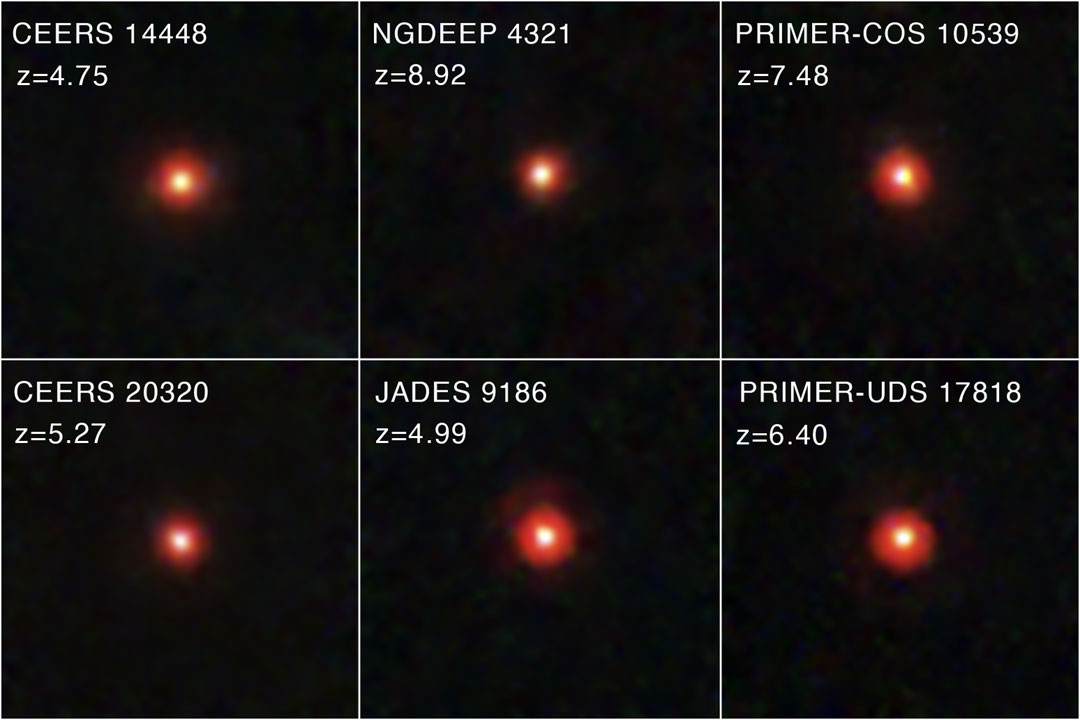
Explanation: What are these little red dots (LRDs)? Nobody knows. Discovered only last year, hundreds of LRDs have now been found by the James Webb Space Telescope in the early universe. Although extremely faint, LRDs are now frequently identified in deep observations made for other purposes. A wide-ranging debate is raging about what LRDs may be and what importance they may have. Possible origin hypotheses include accreting supermassive black holes inside clouds of gas and dust, bursts of star formation in young dust-reddened galaxies, and dark matter powered gas clouds. The highlighted images show six nearly featureless LRDs listed under the JWST program that found them, and z, a distance indicator called cosmological redshift. Additionally, searches are underway in our nearby universe to try to find whatever previous LRDs might have become today.
Authors & editors:
Robert Nemiroff
(MTU) &
Jerry Bonnell (UMCP)
NASA Official: Amber Straughn
Specific rights apply.
NASA Web Privacy,
Accessibility,
Notices;
A service of:
ASD at
NASA /
GSFC,
NASA Science Activation
& Michigan Tech. U.
